

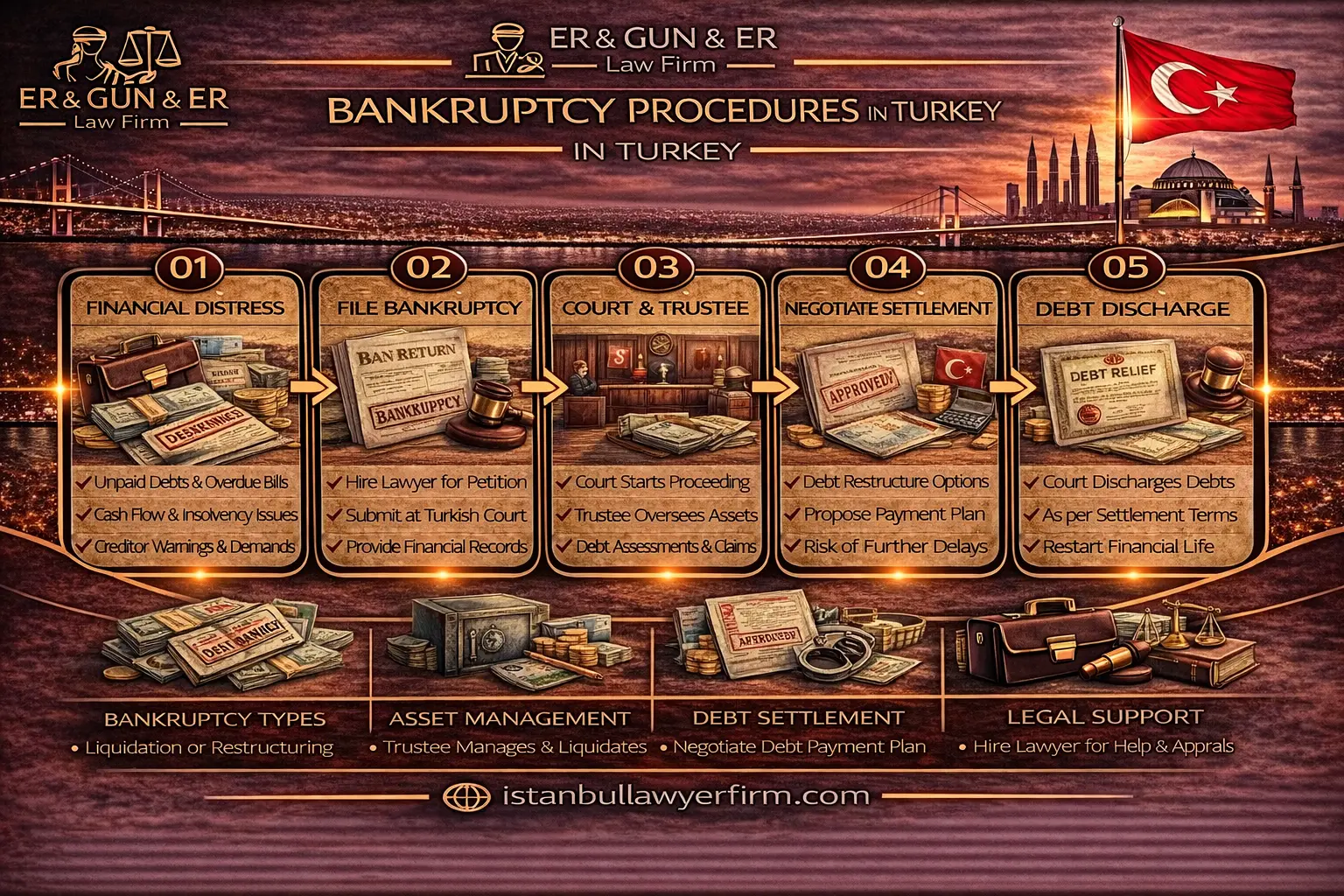
Bankruptcy procedure in Turkey is governed primarily by the Execution and Bankruptcy Law (İcra ve İflas Kanunu, İİK, Law No. 2004), supplemented by the Turkish Commercial Code (Türk Ticaret Kanunu, TTK, Law No. 6102) for commercial matters and the Civil Procedure Law (HMK, Law No. 6100) for procedural questions not specifically addressed in İİK. The framework is not a single procedure but a set of distinct routes with different eligibility requirements, different filing authorities, and different timelines — and route selection materially affects both the debtor's and creditor's strategic position. The three primary routes are: direct bankruptcy (doğrudan iflas) under İİK Articles 177-180, available for enumerated grounds including cessation of payments, without requiring a prior enforcement proceeding; bankruptcy through enforcement (takip yoluyla iflas) under İİK Articles 155-176, where a creditor with an unpaid debt initiates bankruptcy after the enforcement (icra) phase fails; and the concordat procedure (konkordato) under İİK Articles 285-309, which allows a financially distressed but viable debtor to restructure payment obligations under court supervision as an alternative to liquidation. Understanding which route applies, which court has jurisdiction, what documents are required, and what timeline governs each step is the starting point for any effective bankruptcy strategy in Turkey — whether the stakeholder is a creditor seeking recovery or a debtor seeking protection. Practice may vary by authority and year — verify current İİK procedural requirements and commercial court bankruptcy practice directly before relying on any information in this guide.
İİK route selection — direct bankruptcy, enforcement route, and concordat
A lawyer in Turkey advising on İİK route selection must explain that the eligibility for each bankruptcy route depends first on the debtor's legal status — specifically, whether the debtor is a merchant (tacir) subject to the commercial bankruptcy regime under TTK and İİK. The commercial bankruptcy regime applies to commercial companies (including anonim şirket and limited şirketi), individual merchants registered in the trade registry, and entities treated as merchants by operation of law. Non-merchants are subject to the general civil enforcement regime but not to the commercial bankruptcy process. For commercial debtors, the route selection involves a commercial assessment alongside the legal analysis: direct bankruptcy is appropriate where the debtor has stopped payments generally (cessation of payments — ödemelerini genel olarak tatil etmiş olma) or where specific İİK Article 177 grounds are met; enforcement-based bankruptcy is appropriate where a specific creditor with a documented debt wants to initiate collective proceedings after the individual enforcement fails; and concordat is appropriate where the debtor is financially distressed but the business remains viable and the debtor can credibly propose a restructuring plan that is superior to liquidation for creditors. Practice may vary by authority and year — verify current TTK merchant status analysis methodology and İİK route eligibility conditions applicable to the specific debtor type before any route selection decision.
An Istanbul Law Firm advising on the enforcement-based bankruptcy route must explain that the most common creditor-initiated bankruptcy route in Turkish commercial practice is the pathway through prior enforcement proceedings — where a creditor first initiates an enforcement proceeding (icra takibi) against the debtor, the debtor fails to satisfy the debt within the applicable period, and the creditor then petitions the commercial court for bankruptcy. Under İİK's ilamsız takip (enforcement without prior judgment) route, the creditor sends a payment notice (ödeme emri) to the debtor; if the debtor does not object or pay within seven days, the creditor can move to forced execution; if execution fails — the debtor has no attachable assets or assets are insufficient — the creditor can petition for bankruptcy. Under İİK's ilamlı takip (enforcement based on a judgment or equivalent document), the creditor with an existing judgment can more directly enforce; if enforcement fails, bankruptcy can similarly be initiated. The enforcement file — the ödeme emri, the debtor's response (or lack thereof), the execution record, and the insufficiency report — becomes the evidentiary foundation for the bankruptcy petition and must be kept complete and authenticated throughout. Practice may vary — verify current İİK enforcement-to-bankruptcy sequencing requirements and the specific enforcement file documentation that commercial courts require in bankruptcy petition hearings before structuring any creditor-initiated enforcement route strategy.
A law firm in Istanbul advising on direct bankruptcy grounds must explain that İİK Article 177 and related provisions allow direct bankruptcy petition — bypassing the prior enforcement phase — where specific circumstances demonstrate imminent insolvency that cannot wait for the enforcement sequence. The enumerated direct bankruptcy grounds include: the debtor's general cessation of payments (ödemelerini genel olarak tatil etmiş olması), which requires evidence of systemic non-payment across multiple creditors rather than selective non-payment of a specific claim; the debtor's estate being declared insufficient during enforcement to satisfy debts; specific circumstances created by the debtor's conduct (such as fleeing from obligations, hiding assets, or deceiving creditors) that justify immediate collective intervention; and a debtor filing for its own bankruptcy when it becomes aware of imminent insolvency. Each direct bankruptcy ground is fact-intensive and requires documentary evidence rather than general assertions — a creditor alleging cessation of payments must show evidence of systemic payment failures across the debtor's creditor base, not simply the creditor's own unpaid invoice. Practice may vary — verify current commercial court direct bankruptcy application standards and the specific evidence standards required for each İİK Article 177 ground before any direct bankruptcy petition. The debt collection and enforcement framework is analyzed in the resource on debt collection in Turkey: legal process and enforcement options.
Bankruptcy jurisdiction — competent court and venue determination
An English speaking lawyer in Turkey advising on bankruptcy court jurisdiction must explain that the competent court for bankruptcy proceedings under İİK is the commercial court of first instance (asliye ticaret mahkemesi) at the location of the debtor's registered center of business — specifically, the location of the debtor's principal place of commercial operations (ticari işletmenin merkezi) rather than simply the debtor's trade registry registration address where these differ. This distinction matters because Turkish commercial debtors sometimes register their trade registry address at a different location from their actual principal operations — and courts assess actual operational center rather than purely formal registration address in determining jurisdiction. If the debtor operates through multiple branches, the branch that constitutes the principal operations (where management decisions are made, where accounting is maintained, where the majority of commercial activity occurs) determines the competent court. For multi-company groups where bankruptcy is sought against a single entity, the analysis is entity-specific — each entity's principal operations determine its bankruptcy court, and group-level administration is generally not available in Turkish bankruptcy procedure. Practice may vary by authority and year — verify current Turkish commercial court jurisdiction determination methodology for bankruptcy cases and the specific operational evidence that courts currently weight in jurisdictional assessments before any venue selection decision.
A Turkish Law Firm advising on the bankruptcy petition procedure must explain that a bankruptcy petition — whether filed by a creditor or by the debtor — must be filed in writing with the competent commercial court, accompanied by: the filing party's identity and authority documents; the basis for the bankruptcy claim (the enforcement file for enforcement-route petitions, or the documentary evidence for direct-route petitions); a description of the debtor's assets and liabilities to the extent known; and payment of the applicable court fees. The court will first assess formal admissibility — whether the filing party has standing, whether the court is competent, and whether the formal requirements are met — before proceeding to a substantive hearing. If formal requirements are not met, the court may dismiss the petition without prejudice or allow the filing party time to cure deficiencies. For creditor petitions, the court typically notifies the debtor and allows the debtor to respond before a hearing on whether to open bankruptcy. At the hearing, the debtor can contest both the debt's existence and the bankruptcy grounds — and if the debt is seriously disputed in good faith, the court may dismiss the bankruptcy petition without prejudice. Practice may vary — verify current commercial court bankruptcy petition hearing procedure and the specific evidence and argument rights available to debtors at initial bankruptcy petition hearings before planning any response to a bankruptcy petition. The commercial litigation framework is analyzed in the resource on commercial litigation in Turkey: dispute resolution strategy.
A lawyer in Turkey advising on provisional measures during bankruptcy proceedings must explain that once a bankruptcy petition is filed, the commercial court has authority to order provisional protective measures (ihtiyati tedbir) under HMK Articles 389-399 to preserve the debtor's assets while the petition is being assessed — preventing the debtor from disposing of or concealing assets during the period between petition filing and the court's decision on whether to open bankruptcy. These provisional measures can include: sealing of the debtor's premises and inventory; freezing of the debtor's bank accounts; appointment of a temporary trustee (kayyum) to manage the business during proceedings; and prohibitions on the debtor executing specific transactions. The provisional measure application must be supported by evidence of urgency — specifically, that without the measure, the assets that would constitute the bankruptcy estate will be dissipated or concealed before the court can act. The court can order provisional measures ex parte (without prior notice to the debtor) where urgency justifies it. Practice may vary — verify current commercial court provisional measure practice in bankruptcy proceedings and the specific urgency evidence that courts currently require before any provisional measure application during a bankruptcy petition. Practice may vary — check current guidance before acting on any information on this page.
The concordat alternative — restructuring under court supervision
An Istanbul Law Firm advising on the concordat procedure must explain that concordat (konkordato) under İİK Articles 285-309 is Turkey's primary formal restructuring mechanism — a debtor-initiated procedure (and in limited circumstances creditor-initiated) that provides a stay of enforcement proceedings while the debtor proposes and implements a restructuring plan that is approved by the court and a defined majority of creditors. The concordat is available where the debtor is in financial distress (unable to pay due debts or facing imminent inability to do so) but the business retains sufficient viable operations that a restructuring plan produces better creditor outcomes than immediate liquidation. The concordat filing requires a comprehensive information package demonstrating the debtor's current financial position and projections — including audited financial statements, a cash flow projection showing the business's ability to service the proposed concordat terms, a draft concordat plan specifying the proposed payment terms for each creditor class, and the debtor's explanation of why the business is viable under the proposed terms. The filing must be accompanied by a report from an independent concordat commissioner (konkordato komiseri) confirming that the plan appears feasible. Practice may vary by authority and year — verify current İİK concordat application requirements and the specific independent commissioner qualification and reporting standards applicable to concordat filings before any concordat application.
A law firm in Istanbul advising on the concordat stay and creditor approval process must explain that upon filing a concordat application, the court can grant a temporary stay (geçici mühlet) of up to three months — extendable by one additional month — during which enforcement proceedings against the debtor are suspended, giving the debtor breathing space to prepare a complete concordat plan and to engage with creditors. If the court's assessment of the concordat plan is positive, it can extend the stay for a definitive period (kesin mühlet) of up to one year, during which the formal concordat approval process proceeds. The concordat requires approval by a defined supermajority of creditors: under current İİK provisions, the plan is approved if accepted by creditors representing more than half of the total admitted claims and more than half of the total number of admitted creditors — or in the alternative, creditors representing three-quarters of the total admitted claims. Once creditor approval is obtained, the court confirms (tasdik) the concordat, which then becomes binding on all creditors including those who voted against it or did not participate in the vote. Practice may vary — verify current İİK concordat stay duration limits, creditor approval threshold requirements, and court confirmation standards before any concordat plan design and creditor engagement strategy. The company restructuring framework is analyzed in the resource on company liquidation in Turkey: legal process and alternatives.
An English speaking lawyer in Turkey advising on creditors' strategy in concordat proceedings must explain that creditors in a concordat proceeding face a different strategic calculus from creditors in a bankruptcy proceeding — because the concordat produces a restructured claim (paid at the agreed concordat terms over the agreed period) rather than a distribution from liquidated assets, and whether concordat produces a better or worse outcome than bankruptcy depends on the quality of the proposed plan and the viability of the business. Creditors should critically evaluate: the financial projections' credibility (are the cash flow assumptions realistic and supported by verifiable order pipeline data); the management's track record and capability to execute under supervised conditions; the independent commissioner's assessment; the proposed payment percentage relative to expected bankruptcy distribution; and whether the concordat plan addresses the causes of the distress or merely defers obligations that will recur. A creditor with security (secured creditor) should specifically assess whether the concordat plan respects its security rights — secured creditors can negotiate separately about collateral treatment and are typically not bound by a concordat plan that impairs security rights without their specific consent. Practice may vary — verify current İİK secured creditor rights in concordat proceedings and the specific collateral protection provisions applicable to secured creditors in concordat plans before advising on any secured creditor concordat strategy. Practice may vary — check current guidance before acting on any information on this page.
Bankruptcy estate administration — trustees, asset inventory, and claims registration
A Turkish Law Firm advising on bankruptcy estate administration must explain that upon the commercial court's decision to open bankruptcy (iflas kararı), the debtor loses the ability to manage or dispose of its assets, which pass under the control of the bankruptcy estate (iflas masası) administered by the bankruptcy trustees (iflas idaresi) under the supervision of the bankruptcy judge (iflas memuru) appointed by the commercial court. The bankruptcy administration's first tasks are: seizing and inventorying all of the debtor's assets (malların haczi ve envanteri); notifying all known creditors of the bankruptcy opening; publicizing the bankruptcy through official gazette (Türkiye Ticaret Sicil Gazetesi) and other required channels; and opening the claims registration period during which creditors must submit their claims with supporting documentation. The bankruptcy trustees are responsible for preserving the estate's value, liquidating assets for the benefit of creditors, investigating suspect transactions, pursuing clawback claims, and preparing the distribution schedule. The trustees operate under court supervision and must periodically report to the court and the creditors' body (alacaklılar toplantısı) on the administration's progress. Practice may vary by authority and year — verify current Turkish bankruptcy administration appointment procedures and the specific trustee authority and reporting requirements before advising on any estate administration strategy.
An Istanbul Law Firm advising on claims registration in bankruptcy must explain that the claims registration process (alacak bildirimi) is the gateway for creditor participation in the bankruptcy distribution — and only claims that are properly registered, with adequate supporting documentation, within the prescribed registration period can participate in the distribution. The registered period is announced in the bankruptcy opening notice and typically runs for several months, with creditors required to submit their claims to the bankruptcy administration office by the deadline. Each claim submission must include: the legal basis of the claim (contract, court judgment, enforcement file, or other instrument); the principal amount claimed; any interest, penalties, or ancillary items claimed; documentary evidence establishing the claim (contracts, invoices, delivery records, payment histories, judgment copies); and identification of whether the claim is secured (rehinli) and the basis and scope of the security. Late-filed claims may be admitted but with lower priority in distribution, and creditors who miss the registration period entirely risk losing the right to participate in distributions. Foreign creditors should prepare their submissions with certified Turkish translations of all foreign-language documents, as claims documentation in foreign languages alone is routinely rejected or delayed. Practice may vary — verify current bankruptcy administration claims registration deadline calculation and the specific documentation format required for claim submissions before any creditor claims registration in Turkish bankruptcy proceedings.
A lawyer in Turkey advising on the claims verification and ranking process must explain that after the registration period closes, the bankruptcy administration reviews each submitted claim, verifies the documentation, and prepares the sıra cetveli (ranking schedule) — the document that classifies each admitted claim by priority category and determines the order in which creditors will receive distribution from the estate's liquidated assets. The priority ranking under İİK follows a statutory hierarchy: first-priority claims include estate administration expenses and certain employee wage claims; second-priority and subsequent claims include other privileged creditors as defined by statute; followed by secured creditors to the extent of their security's value; and finally ordinary unsecured creditors (adi alacaklılar) who share proportionally in the remaining distributable assets. A creditor who disagrees with the classification or the amount of their claim in the sıra cetveli can file an objection (itiraz) through a formal court proceeding — the sıra cetveline itiraz davası — within the defined deadline. The objection proceeding is a full civil lawsuit at the commercial court, where the burden of proof shifts between the parties depending on whether the claim was admitted in a lower amount or entirely rejected. Practice may vary — verify current İİK sıra cetveli preparation methodology and the specific objection deadline and burden of proof rules applicable to claim ranking challenges before any claims ranking dispute strategy. Practice may vary — check current guidance before acting on any information on this page.
Priority of claims and distribution waterfall
An English speaking lawyer in Turkey advising on bankruptcy priority rules must explain that the distribution waterfall in Turkish bankruptcy is a statutory hierarchy that cannot be contracted around — and understanding where a specific claim falls in the hierarchy is the most important economic variable for any creditor in a bankruptcy proceeding. İİK's priority framework classifies claims across multiple categories: estate administration expenses (iflas masası alacakları) that are incurred after the bankruptcy opening and must be paid in full before any distributions to pre-bankruptcy creditors; first-order privileged claims (birinci sıra alacaklar) including certain employee wage and severance claims from the period before bankruptcy; second-order privileged claims (ikinci sıra alacaklar) including certain other labor claims; claims secured by pledge or mortgage (rehinli alacaklar) paid from the proceeds of the specific pledged or mortgaged asset; and ordinary unsecured claims (adi alacaklar) that share pro rata in the remaining distributable pool after all higher-priority claims are fully satisfied. The practical consequence of this hierarchy in most Turkish bankruptcy proceedings is that unsecured trade creditors receive distributions only after all higher-priority claims and administration expenses are satisfied from the available asset pool — and in many cases, the asset pool is insufficient to fully satisfy even higher-priority claims, leaving unsecured creditors with zero or nominal recovery. Practice may vary by authority and year — verify current İİK priority classification standards and the specific evidence required to establish each priority category before any claim priority argument in Turkish bankruptcy proceedings.
A Turkish Law Firm advising on secured creditor treatment in bankruptcy must explain that secured creditors (rehinli alacaklılar) in Turkish bankruptcy have a legally privileged position — they are entitled to have the specific pledged or mortgaged asset (rehinli mal) sold and to receive payment from the proceeds in priority to all other claims against that asset. However, the secured creditor's priority applies only to the specific collateral — to the extent the sale proceeds of the collateral are insufficient to satisfy the full secured debt (a shortfall — açık), the remaining unsecured portion of the debt falls into the ordinary unsecured creditor pool and shares pro rata with other unsecured claims. A secured creditor should therefore maintain complete documentation of the security — the security agreement, the registration evidence (tapu sicili mortgage annotation, quality pledge registration, or applicable asset-specific registration), the default record, and the current valuation of the collateral — to support both the priority claim and the calculation of any shortfall. A security that is not properly registered, or that was registered after the security became legally effective (creating a timing vulnerability to clawback challenges), or whose scope is unclear, may be challenged by the estate or other creditors with attendant priority risk. Practice may vary — verify current Turkish registration requirements for different security types and the specific registration-to-effectiveness timing standards that determine security vulnerability to İİK clawback challenges before any secured creditor position assessment in bankruptcy.
A lawyer in Turkey advising on employee priority claims in Turkish bankruptcy must explain that Turkish bankruptcy law gives specific priority to a limited category of employee claims — reflecting both the social protection purpose of labor law and the statutory policy that wage earners should not bear the full risk of employer insolvency. Under İİK's priority framework and the Labor Code (İş Kanunu, Law No. 4857), claims for wages earned in the period immediately before bankruptcy, certain severance entitlements, and specific notice pay entitlements may qualify for first or second-order priority. However, the scope of employee priority is defined by statute and is not unlimited — not every employment-related claim qualifies for priority, and claims for items such as performance bonuses, stock options, or other contingent compensation may be treated as ordinary unsecured claims. Employees who have claims against the bankrupt employer should file with the bankruptcy administration with complete supporting documentation — employment contracts, payslips, and termination records — and should verify whether their specific claims qualify for priority under the applicable statutory categories. Practice may vary — verify current İİK employee priority claim categories and the specific Labor Code provisions that interact with the bankruptcy priority framework before any employee claims strategy in Turkish bankruptcy proceedings. Practice may vary — check current guidance before acting on any information on this page.
Clawback actions — avoidance of pre-bankruptcy transactions
An Istanbul Law Firm advising on clawback actions in Turkish bankruptcy must explain that İİK provides specific mechanisms (iptal davaları) for the bankruptcy administration or individual creditors to avoid (undo) pre-bankruptcy transactions that unfairly depleted the estate or favored specific creditors or insiders at the expense of the general creditor body. The primary clawback mechanisms under İİK are: Article 278 (tasarrufun iptali davası) — which allows avoidance of transactions made by an insolvent debtor within defined periods before bankruptcy where the transaction resulted in a transfer of value without adequate consideration (such as gifts or transfers for grossly insufficient consideration); Article 279 — which allows avoidance of security grants for pre-existing debts made within defined periods before bankruptcy where the security was not agreed as part of the original transaction (old-debt security created near insolvency); and Article 280 — which allows avoidance of transactions made with fraudulent intent where the counterparty knew or should have known of the debtor's insolvency and the transaction's prejudicial effect on creditors. The avoidance period (and the applicable knowledge or intent standard) differs between these provisions — making the timing analysis of each challenged transaction critical to determining which provision applies and what the estate must prove. Practice may vary by authority and year — verify current İİK clawback action timing periods and the specific intent and knowledge standards applicable to each avoidance provision before any clawback action assessment.
A law firm in Istanbul advising on clawback defense strategies must explain that a counterparty who received a transfer that is being challenged under İİK's clawback provisions has specific defenses available depending on which avoidance provision applies. For İİK Article 278 transactions (transfers for insufficient consideration), the key defense is demonstrating that adequate consideration was given — through valuation evidence, market comparables, and the contemporaneous commercial rationale for the pricing. For İİK Article 279 transactions (old-debt security grants), the key defense is demonstrating either that the security was not for old debt (it was contemporaneous with the creation of the secured obligation or accompanied new credit) or that the security was given within the normal course of commercial dealings rather than as a preferential act. For İİK Article 280 transactions, the key defense is demonstrating that the counterparty did not know and had no reason to know of the debtor's insolvency or the transaction's prejudicial character — good faith is a complete defense to Article 280 avoidance. In all cases, the counterparty should maintain complete transaction documentation — board approvals, independent valuations, payment records, and the contemporaneous commercial context — to support the defense. Practice may vary — verify current Turkish commercial court clawback defense evidence standards and the specific knowledge and good faith assessment methodology applied in İİK avoidance actions before any clawback defense strategy. The asset seizure and civil measure framework is analyzed in the resource on asset freezing orders in Turkey: civil and commercial provisional measures.
An English speaking lawyer in Turkey advising on clawback action selection strategy must explain that the bankruptcy administration's decision to pursue clawback actions involves a cost-benefit analysis — avoidance actions are litigation matters that consume estate resources, and they should be pursued only where the expected recovery exceeds the litigation cost with a reasonable probability of success. The most productive clawback targets typically include: transfers of significant assets to related parties at below-market values within the applicable avoidance period; security grants for pre-existing large debts created near insolvency without contemporaneous new credit; and payments to insiders or connected parties in the period of distress that deviated from ordinary payment patterns. The clawback action must be filed in the commercial court, names the transaction counterparty as defendant, and typically results in a judgment requiring the counterparty to return the transferred value to the estate (or its cash equivalent if the asset has been further transferred). Where the counterparty is a foreign entity, the clawback must also address enforcement — a Turkish court judgment against a foreign defendant may require foreign recognition proceedings before it can be enforced, extending the recovery timeline. Practice may vary — verify current Turkish commercial court clawback action jurisdiction and the specific foreign defendant service and enforcement procedures applicable before any cross-border clawback action is initiated. Practice may vary — check current guidance before acting on any information on this page.
Director liability in Turkish insolvency
A Turkish Law Firm advising on director liability in insolvency must explain that directors (yönetim kurulu üyeleri for AŞ, müdürler for LTD) of Turkish companies face personal liability exposure in insolvency situations through multiple legal pathways — and the exposure is not limited to cases of outright fraud or dishonesty but extends to failures of governance, document keeping, and decision-making process that fall below the standard of a diligent businessman (basiretli iş adamı). The primary personal liability pathways include: TTK Article 369-375 director liability for breach of fiduciary duties to the company and its shareholders during the distress period; VUK (Tax Procedure Law) Article 10 liability for the company's unpaid tax obligations where the failure to pay resulted from the director's failure to exercise adequate oversight; Law No. 5510 (Social Security Law) Article 88 liability for the company's unpaid SGK premiums where the failure to pay is attributable to management; and in serious cases, potential criminal liability under TCK for specific insolvency-related offenses including fraudulent insolvency (hileli iflas), reckless insolvency (taksiratlı iflas), and failure to maintain required commercial books. Practice may vary by authority and year — verify current Turkish court director liability standards applicable to the specific director conduct under scrutiny and the specific statutory liability provisions applicable to the insolvency fact pattern before any director liability assessment.
An Istanbul Law Firm advising on director liability protection must explain that the most effective director liability protection in insolvency situations is a documented decision-making process — not because documentation eliminates liability, but because it converts the narrative from "the directors acted improperly" to "the directors followed a documented process that a reasonable businessman could have followed in the circumstances." Protective documentation includes: board minutes recording the solvency assessment process and the decision to continue operations or to file for bankruptcy; financial statements and management accounts maintained in accordance with applicable standards; records of creditor negotiations and standstill requests; documentation of any asset disposals (with independent valuations confirming fair value); records of payments to creditors during the distress period (with the commercial rationale for any preferential payments); and records of any legal or financial advice sought and received during the distress period. Directors who maintained these records are significantly better positioned to defend against claims that specific decisions were improper or that the filing was delayed to benefit insiders. Directors who did not maintain these records face the evidentiary burden of reconstructing their decision process from the documentary debris that remains — which is typically an inferior position. Practice may vary — verify current Turkish court director liability defense documentation standards applicable to the specific claim and timing before designing any director liability protection program.
A lawyer in Turkey advising on fraudulent and reckless insolvency criminal exposure must explain that Turkish Penal Code (TCK) Articles 161-163 create criminal liability for two specific categories of director conduct in insolvency: fraudulent insolvency (hileli iflas) — where a director intentionally engages in acts designed to disadvantage creditors, such as concealing assets, creating fictitious debts, or destroying records, to avoid obligations — carries up to 8 years imprisonment; and reckless insolvency (taksiratlı iflas) — where a director's negligent management contributed to the company's insolvency through extravagant spending, improvident transactions, or failure to take reasonable protective measures when insolvency was foreseeable — carries up to 2 years imprisonment. These criminal provisions do not require that the director acted with the intent to harm specific creditors — reckless insolvency is a negligence-based crime. Directors who made large payments to related parties without commercial justification, who sold assets at grossly insufficient prices, or who failed to maintain required commercial books in the period before insolvency face potential exposure under TCK Article 162 even if they did not specifically intend to defraud. Corporate criminal defense coordination must begin immediately if the bankruptcy administration refers the file to the public prosecutor. Practice may vary — verify current Turkish public prosecutor insolvency criminal referral practice and the specific conduct patterns that prosecutors currently treat as TCK Article 162 or 163 violations before any director criminal defense strategy in insolvency. Practice may vary — check current guidance before acting on any information on this page.
Cross-border insolvency — recognition and international coordination
An English speaking lawyer in Turkey advising on cross-border insolvency must explain that Turkey does not have a comprehensive cross-border insolvency statute equivalent to the UNCITRAL Model Law or the EU Insolvency Regulation — and cross-border insolvency coordination in Turkey is therefore primarily managed through general private international law principles (MÖHUK, Law No. 5718) and bilateral treaties rather than through a specific cross-border insolvency recognition framework. For foreign insolvency proceedings involving assets in Turkey: a foreign insolvency proceeding does not automatically bind Turkish creditors, does not automatically stay Turkish enforcement proceedings, and does not automatically authorize the foreign insolvency administrator to take control of Turkey-based assets. A foreign administrator seeking to control Turkish assets or to stay Turkish proceedings must typically initiate separate proceedings in Turkish courts — either recognition proceedings (tenfiz) for foreign judgments already issued, or fresh proceedings applying Turkish insolvency law to the Turkish assets. Practice may vary by authority and year — verify current Turkish court recognition standards for foreign insolvency judgments and the specific MÖHUK provisions applicable to different foreign insolvency orders before any cross-border insolvency strategy involving Turkish assets.
A Turkish Law Firm advising on Turkish bankruptcy proceedings with foreign dimensions must explain that when a Turkish company in bankruptcy has assets or creditors outside Turkey, the bankruptcy administration must specifically plan for the international dimensions — because Turkish bankruptcy court orders do not automatically bind foreign courts or foreign financial institutions. For Turkish companies with foreign bank accounts or foreign subsidiary assets, the Turkish bankruptcy trustees typically need to: identify the assets abroad; assess whether Turkish court orders will be voluntarily honored by the foreign institutions or whether recognition proceedings are required in the foreign jurisdiction; and determine whether the foreign jurisdiction has its own insolvency proceedings that might have priority over the Turkish estate's claims to those assets. Foreign creditors who are owed money by a Turkish bankrupt company can participate in the Turkish bankruptcy proceedings by submitting registered claims — and they have the same rights as Turkish creditors in the claims registration and distribution process. However, their practical ability to enforce the distribution judgment depends on the Turkish estate having realizable assets. Practice may vary — verify current Turkish bankruptcy estate authority over foreign assets and the specific recognition steps required in major foreign jurisdictions for Turkish insolvency orders before any cross-border insolvency coordination strategy.
A lawyer in Turkey advising on MLAT and cross-border asset tracing in insolvency must explain that where the Turkish bankruptcy administration suspects assets have been moved offshore — whether through pre-bankruptcy transfers to foreign affiliates or through hidden accounts in foreign jurisdictions — the tools for tracing and recovering those assets are primarily civil rather than criminal. The civil tool is a clawback action (iptal davası) under İİK Articles 278-280, which can be filed against foreign counterparties — though enforcement of a Turkish judgment against a foreign defendant requires recognition proceedings in the foreign jurisdiction. Where the asset movement also constitutes a criminal offense (fraudulent insolvency), the public prosecutor can request mutual legal assistance (MLAT) from foreign authorities to obtain banking and financial records that trace the movement. For creditors who want to pursue foreign assets independently — rather than waiting for the bankruptcy administration — the enforcement framework requires a Turkish court judgment or other recognized enforcement title and then recognition proceedings in the foreign jurisdiction. A coordinated strategy that integrates the Turkish bankruptcy proceedings with parallel civil and where appropriate criminal investigations in relevant foreign jurisdictions produces the most comprehensive asset recovery outcome. Practice may vary — verify current Turkish MLAT request procedures and the specific bilateral treaty framework applicable to asset tracing requests in the relevant foreign jurisdictions before any cross-border asset recovery coordination. Practice may vary — check current guidance before acting on any information on this page.
How we work in Turkish insolvency mandates
A best lawyer in Turkey managing a Turkish insolvency mandate — whether for a creditor seeking to initiate or participate in bankruptcy proceedings, a debtor evaluating restructuring options, or a third party facing clawback claims — begins with a structured fact mapping exercise: identifying the debtor's legal status (merchant subject to commercial bankruptcy regime); the available routes (enforcement-based, direct, or concordat); the asset profile (what Turkish assets exist, where they are, and whether they are encumbered); the creditor composition (secured, priority, and unsecured creditors and their relative claim sizes); the transaction history (whether any recent transfers or security grants are vulnerable to clawback); and the director's exposure profile (what governance documentation exists and what decisions require defense). This mapping exercise determines the correct strategy — because the same factual scenario may support different optimal routes depending on whether the stakeholder is a creditor with security, an unsecured trade creditor, or the debtor's management team.
ER&GUN&ER advises creditors, debtors, administrators, and third parties across the full spectrum of Turkish insolvency — İİK route selection analysis, enforcement-to-bankruptcy sequencing and file management, direct bankruptcy petition preparation and defense, concordat application preparation and commissioner coordination, commercial court bankruptcy jurisdiction analysis, provisional measure applications in bankruptcy proceedings, bankruptcy administration coordination and cooperation advice, claims registration documentation assembly, sıra cetveli preparation and objection proceedings, secured creditor collateral realization strategy, employee priority claims analysis, İİK Article 278-280 clawback action prosecution and defense, director personal liability assessment and governance documentation advice, TCK fraudulent and reckless insolvency criminal defense, cross-border insolvency recognition and foreign asset recovery coordination, and foreign creditor claim submission. We work in English throughout all international mandates. For the enforcement and debt collection framework — see the resource on debt collection in Turkey. For the civil asset freezing framework — see the resource on asset freezing orders in Turkey. Practice may vary — check current guidance before acting on any information on this page.
Frequently Asked Questions
- What is the legal framework for bankruptcy in Turkey? Turkish bankruptcy is governed primarily by the Execution and Bankruptcy Law (İcra ve İflas Kanunu, İİK, Law No. 2004), the Turkish Commercial Code (TTK, Law No. 6102) for commercial matters, and the Civil Procedure Law (HMK, Law No. 6100) for procedural questions. The framework provides three main routes: direct bankruptcy (doğrudan iflas) under İİK Articles 177-180, enforcement-based bankruptcy (takip yoluyla iflas) under İİK Articles 155-176, and concordat restructuring under İİK Articles 285-309. Practice may vary — verify current İİK provisions applicable to the specific debtor type before any route selection.
- Who can be made subject to bankruptcy in Turkey? The commercial bankruptcy regime applies to merchants (tacirler) — commercial companies, registered individual merchants, and entities treated as merchants by law. Non-merchants are subject to the general civil enforcement regime but not the commercial bankruptcy process. The analysis must be grounded in TTK merchant status provisions and trade registry records. Practice may vary — verify current TTK merchant classification applicable to the specific debtor before any bankruptcy filing.
- What is the difference between enforcement-based bankruptcy and direct bankruptcy? Enforcement-based bankruptcy (takip yoluyla iflas) requires a prior enforcement (icra takibi) phase — the creditor issues a payment notice, the debtor fails to pay or object, enforcement fails to satisfy the debt, and the creditor then petitions for bankruptcy. Direct bankruptcy (doğrudan iflas) bypasses the enforcement phase and is available for specific İİK Article 177 grounds, primarily where the debtor has generally ceased payments across its creditor base, or where the debtor itself files. Practice may vary — verify current İİK enforcement-to-bankruptcy and direct bankruptcy requirements at the relevant commercial court.
- What is concordat and how does it differ from bankruptcy? Concordat (konkordato) under İİK Articles 285-309 is a court-supervised restructuring that allows a financially distressed but viable debtor to propose a restructuring plan — typically involving rescheduled or reduced payments — that is approved by creditor supermajority and court confirmation. Unlike bankruptcy (iflas), concordat does not result in the debtor losing control of its assets or in asset liquidation — the debtor continues to operate under court supervision while implementing the plan. Concordat is appropriate where the business remains viable; bankruptcy is appropriate where it does not. Practice may vary — verify current concordat eligibility and approval standards.
- Which court has jurisdiction over bankruptcy in Turkey? The commercial court of first instance (asliye ticaret mahkemesi) at the location of the debtor's principal place of commercial operations is competent — not simply the trade registry registration address where these differ. Courts assess the actual operational center (where management decisions are made, where accounting is maintained) rather than purely formal registration. Practice may vary — verify current commercial court jurisdiction determination methodology for bankruptcy cases at the relevant location.
- What priority does my claim have in Turkish bankruptcy distribution? Distribution follows a statutory hierarchy: (1) estate administration expenses (paid in full before pre-bankruptcy creditors); (2) first-order privileged claims (certain employee wages and severance); (3) second-order privileged claims (other labor items); (4) secured creditors from their specific collateral proceeds; (5) ordinary unsecured creditors pro rata from remaining assets. Unsecured trade creditors share only in the pool remaining after all higher-priority claims are satisfied — which in many cases leaves little or nothing. Practice may vary — verify current İİK priority classification standards applicable to the specific claim type.
- What is the claims registration process in Turkish bankruptcy? After bankruptcy is opened, the court announces a registration period during which creditors must submit their claims with supporting documentation to the bankruptcy administration. Submissions must identify the legal basis, principal amount, any ancillary items, supporting documents (contracts, invoices, delivery records, judgment copies), and security documentation where applicable. Late-filed claims may receive lower priority. Foreign creditors must provide certified Turkish translations. Practice may vary — verify current bankruptcy administration claims registration deadline and documentation requirements before any submission.
- What is the sıra cetveli and how can I challenge it? The sıra cetveli (ranking schedule) classifies each admitted claim by priority category and amount, determining the distribution sequence. If your claim is rejected, ranked in a lower category than justified, or admitted at a lower amount, you can challenge through a sıra cetveline itiraz davası — a formal civil lawsuit at the commercial court filed within the prescribed deadline after the sıra cetveli is announced. The objection proceeding has specific burden-of-proof rules. Practice may vary — verify current sıra cetveli objection deadline and burden of proof standards applicable to your specific claim situation.
- What are clawback actions and can they affect transactions I received? İİK Articles 278-280 allow the bankruptcy administration or creditors to avoid (undo) certain pre-bankruptcy transactions: Article 278 targets transfers for insufficient consideration; Article 279 targets security grants for old debts made near insolvency; Article 280 targets transactions with fraudulent intent where the counterparty knew of the insolvency. If you received a transfer from the bankrupt within the applicable avoidance period, you may receive a clawback claim. Key defenses include demonstrating adequate consideration, contemporaneous security creation, and good faith (particularly for Article 280). Practice may vary — verify current clawback action timing periods and defense standards.
- What personal liability do directors face in Turkish bankruptcy? Directors face liability through multiple pathways: TTK Articles 369-375 for breach of fiduciary duties; VUK Article 10 for unpaid company taxes; Law No. 5510 Article 88 for unpaid SGK premiums; and potential TCK Articles 161-163 criminal liability for fraudulent insolvency (hileli iflas — up to 8 years) or reckless insolvency (taksiratlı iflas — up to 2 years). Directors who maintained complete governance documentation — board minutes, financial statements, transaction approvals with independent valuations — are significantly better positioned to defend against all these claim categories. Practice may vary — verify current director liability standards applicable to the specific conduct and timing.
- Does Turkish bankruptcy automatically affect foreign assets? No — Turkish bankruptcy court orders do not automatically bind foreign courts, foreign financial institutions, or foreign assets. A foreign administrator seeking to control Turkish assets must initiate separate Turkish proceedings. Similarly, Turkish bankruptcy trustees seeking to recover foreign assets must obtain Turkish court judgments and then pursue recognition proceedings in each relevant foreign jurisdiction. Turkey does not have a comprehensive cross-border insolvency recognition statute equivalent to the UNCITRAL Model Law. Practice may vary — verify current recognition procedures in the specific foreign jurisdiction involved.
- Can foreign creditors participate in Turkish bankruptcy proceedings? Yes — foreign creditors have the same rights as Turkish creditors in the claims registration and distribution process. They must submit registered claims with complete supporting documentation, including certified Turkish translations of all foreign-language documents, authority documents establishing who can sign and receive notices, and any required authentication (apostille or legalization) for foreign official documents. Missing formal requirements commonly cause claim rejection or delay. Practice may vary — verify current Turkish bankruptcy administration requirements for foreign creditor claim submissions.
- How does concordat affect enforcement proceedings against the debtor? Upon granting a temporary stay (geçici mühlet) in concordat proceedings, the court suspends enforcement proceedings against the debtor for the stay's duration. This means individual creditor enforcement actions — attachments, execution proceedings — cannot be initiated or continued during the mühlet. However, secured creditors may have specific rights to enforce their security during mühlet that differ from unsecured creditor stay rights. Practice may vary — verify current İİK concordat stay provisions and the specific secured creditor rights during the temporary stay period before any enforcement-related decision in a concordat proceeding.
- What happens to contracts when bankruptcy is opened in Turkey? Contract treatment in Turkish bankruptcy requires case-by-case analysis — İİK and the underlying civil law provide for different outcomes depending on contract type, performance status, and the parties' positions. The bankruptcy administration generally has the ability to elect whether to adopt or reject executory contracts, with adopted contracts becoming estate obligations and rejected contracts creating ordinary unsecured creditor claims. Contracts with automatic termination-on-insolvency clauses may be enforceable but should be evaluated against İİK and specific sector rules. Practice may vary — verify current Turkish bankruptcy contract treatment analysis for the specific contract type before any contract-related decision in a bankruptcy proceeding.
- Do you advise on both creditor and debtor sides of Turkish bankruptcy? Yes — we advise creditors (securing claims registration, pursuing clawback and priority arguments, coordinating with bankruptcy trustees, and pursuing cross-border recovery), debtors and their management (evaluating routes, preparing concordat applications, governing the distress period to protect director liability exposure, and managing foreign asset coordination), and third parties facing clawback actions (defending against İİK Article 278-280 avoidance claims and negotiating settlement). Each mandate begins with a structured fact mapping exercise determining the optimal strategy for the specific stakeholder's position. We work in English throughout all international mandates.
Author: Mirkan Topcu is an attorney registered with the Istanbul Bar Association (Istanbul 1st Bar), Bar Registration No: 67874. His practice focuses on cross-border and high-stakes matters where evidence discipline, procedural accuracy, and risk control are decisive.
He advises creditors, debtors, administrators, and third parties across İİK Route Selection Analysis, Enforcement-to-Bankruptcy Sequencing, Direct Bankruptcy Petition Preparation, Concordat Application and Creditor Engagement, Commercial Court Bankruptcy Jurisdiction Analysis, Provisional Measures in Bankruptcy, Claims Registration Documentation, Sıra Cetveli Preparation and Objection Proceedings, Secured Creditor Collateral Realization, Employee Priority Claims Analysis, İİK Articles 278-280 Clawback Prosecution and Defense, Director Personal Liability Assessment, TCK Fraudulent/Reckless Insolvency Criminal Defense, Cross-Border Insolvency Recognition, and Foreign Creditor Claim Submission matters where procedural precision and evidence discipline are decisive.
Education: Istanbul University Faculty of Law (2018); Galatasaray University, LL.M. (2022). LinkedIn: Profile. Istanbul Bar Association: Official website.