

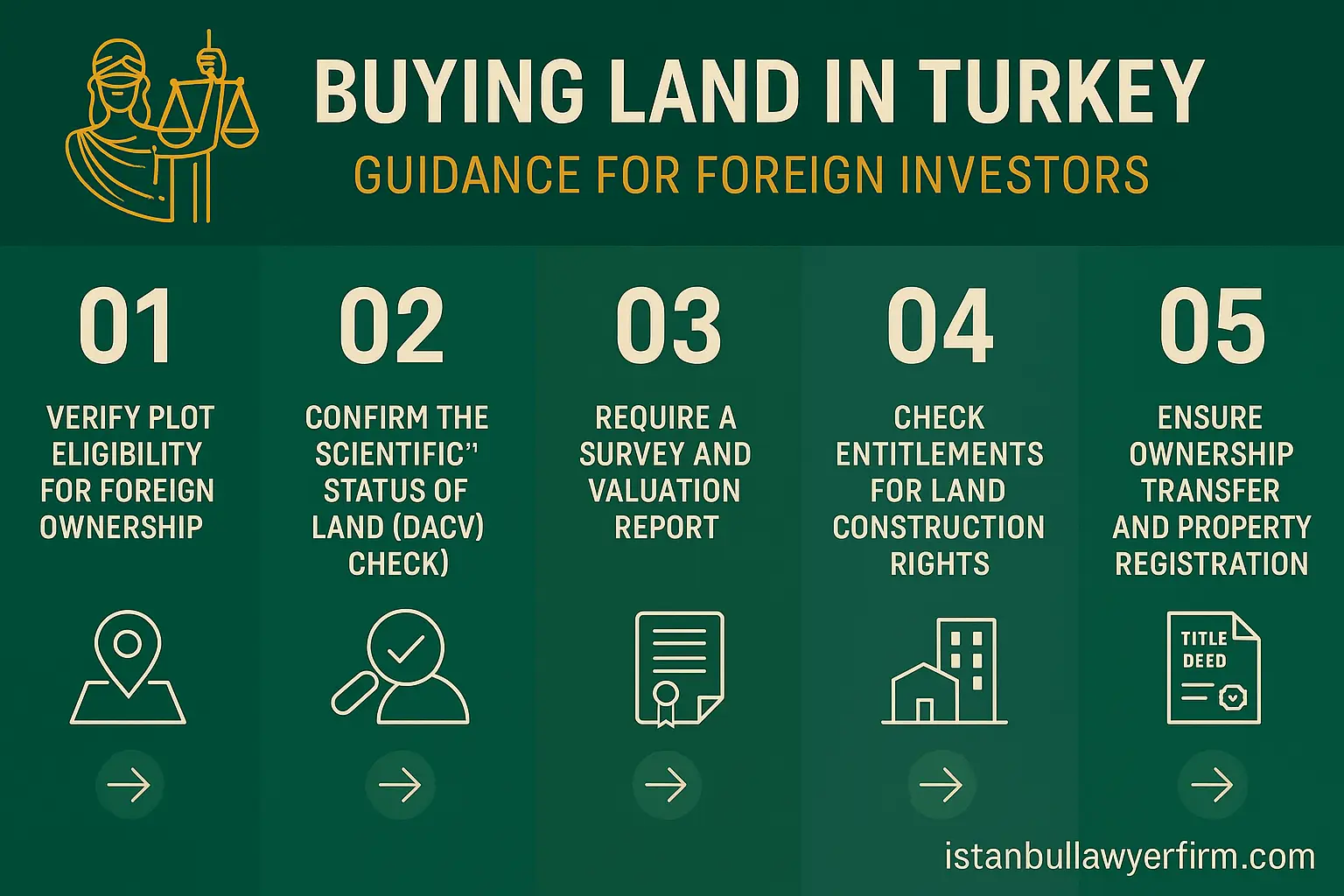
Buying land in Turkey — whether raw construction land (arsa), agricultural land (tarım arazisi), or other unimproved parcels — involves a more complex legal analysis than purchasing a completed residential or commercial building, because the land parcel's permitted use, development potential, and foreign acquisition eligibility depend on multiple concurrent regulatory frameworks that must all be verified before any purchase commitment is made. The foundational eligibility rule is Tapu Kanunu (Land Registry Law, Law No. 2644) Article 35, which establishes that foreign natural persons from eligible countries can acquire Turkish real property subject to a 30-hectare nationwide limit — but this general permission is heavily qualified by: the Agricultural Land Law (Tarım Arazilerinin Korunması ve Kullanılması Hakkında Kanun, Law No. 5403), which restricts foreign natural person acquisition of agricultural land; the Forest Law (Orman Kanunu, Law No. 6831), which establishes state ownership of Turkish forest lands and prohibits private acquisition; the Coastal Law (Kıyı Kanunu, Law No. 3621), which restricts construction within coastal protection zones; the military zone law (Askeri Yasak Bölgeler ve Güvenlik Bölgeleri Kanunu, Law No. 2565), which requires clearance for acquisition near military installations; and the Zoning Law (İmar Kanunu, Law No. 3194), which determines what can actually be built on a parcel. This guide explains each of these frameworks, how they interact, and how foreign investors can navigate them effectively. Practice may vary by authority and year — verify current Tapu Kanunu, Law No. 5403, and İmar Kanunu requirements directly before relying on any information in this guide.
Tapu Kanunu Article 35 — foreign eligibility and the 30-hectare limit
A lawyer in Turkey advising on foreign land acquisition eligibility must explain that Tapu Kanunu Article 35 establishes three primary conditions for foreign natural person land acquisition in Turkey: nationality eligibility (the buyer must be a citizen of a country whose nationals are permitted to acquire Turkish real property under the current list — covering over 180 countries); compliance with the 30-hectare nationwide maximum (a foreign natural person's total Turkish real property holdings, including all land parcels and built properties, cannot exceed 30 hectares); and geographic restriction compliance (the land cannot be in a military zone, security zone, or other restricted area designated under Law No. 2565). The 30-hectare limit is assessed cumulatively across all of Turkey — a foreign national who already owns Turkish property must account for those existing holdings when assessing whether a new acquisition will bring the total above 30 hectares. The Land Registry Office (Tapu Müdürlüğü) checks the foreign buyer's existing registered Turkish property before completing a new transfer. Practice may vary by authority and year — verify current Tapu Kanunu Article 35 eligibility conditions and the specific Land Registry nationality eligibility list applicable to the buyer's nationality before any land acquisition planning.
An Istanbul Law Firm advising on foreign company versus foreign individual land acquisition must explain that the 30-hectare limit and many other foreign acquisition restrictions apply to foreign natural persons — they do not apply in the same way to Turkish companies (including Turkish companies 100% owned by foreign shareholders). A Turkish company (AŞ or Ltd. Şti.) that is wholly owned by foreign shareholders acquires land as a Turkish legal entity, not as a foreign person — and the Tapu Kanunu Article 35 restrictions (nationality eligibility, 30-hectare limit) do not apply to the Turkish company's own acquisitions. This is one of the primary reasons foreign investors establishing development projects in Turkey typically form a Turkish company as the land acquisition vehicle: the Turkish company can acquire larger plots without the 30-hectare constraint, does not require military clearance in the same way as foreign persons, and can hold multiple parcels across Turkey without the cumulative limit applying. However, specific restrictions on agricultural land (under Law No. 5403 discussed below) and forest land (under Orman Kanunu) apply to both foreign persons and Turkish companies with majority foreign ownership in certain circumstances. Practice may vary — verify current Turkish regulatory restrictions on Turkish company land acquisition where the company has significant foreign ownership before any corporate land acquisition structure design.
An English speaking lawyer in Turkey advising on the land acquisition eligibility assessment must explain that determining a foreign investor's eligibility to acquire a specific Turkish land parcel requires analyzing simultaneously: the buyer's nationality eligibility under Tapu Kanunu Article 35; the parcel's land classification (construction land, agricultural land, forest land, coastal zone, or other special classification); the parcel's location relative to military and security zones under Law No. 2565; whether the buyer's existing Turkish property holdings plus the new acquisition would exceed 30 hectares; and whether any sector-specific restrictions apply to the parcel's location (agricultural zone regulations, forestry buffer zones, coastal protection areas). Each of these elements is determined by reference to different government databases — the Land Registry records for classification and ownership, the General Staff's military zone mapping for security clearance, and the relevant Ministry's data for agricultural and environmental classification. A land parcel that passes all of these checks is eligible for foreign acquisition — a parcel that fails any check requires either a different acquisition structure or is not legally acquirable by the specific foreign investor. Practice may vary — verify the current regulatory databases applicable to each eligibility check and the specific inquiry procedures available to confirm each element before any land acquisition commitment. Practice may vary — check current guidance before acting on any information on this page.
Agricultural land restrictions — Law No. 5403 and foreign buyer limitations
A Turkish Law Firm advising on agricultural land restrictions must explain that Law No. 5403 (Toprak Koruma ve Arazi Kullanımı Kanunu — Soil Protection and Land Use Law) imposes specific restrictions on the transfer of Turkish agricultural land that apply beyond the general Tapu Kanunu Article 35 foreign acquisition framework — and these restrictions can prevent foreign natural persons from purchasing agricultural land even where the general Tapu Kanunu Article 35 conditions are otherwise met. The core restriction under Law No. 5403 is that foreign natural persons and foreign companies (companies headquartered or incorporated outside Turkey) cannot acquire agricultural land (tarım arazisi) in Turkey — the transfer of agricultural land to foreign natural persons or foreign legal entities is generally prohibited. This prohibition applies regardless of the buyer's nationality eligibility under Tapu Kanunu Article 35, regardless of the parcel's size, and regardless of whether the buyer intends to continue agricultural use or to develop the land. Practice may vary by authority and year — verify current Law No. 5403 foreign acquisition prohibition standards and any applicable exemptions before any agricultural land acquisition planning by a foreign natural person or foreign company.
An Istanbul Law Firm advising on the agricultural land classification must explain that determining whether a specific Turkish parcel is "agricultural land" under Law No. 5403 requires examining the parcel's official land classification in the cadastral records and the Land Registry — which may differ from the parcel's current physical condition or actual use. Turkish land classification distinguishes between: absolute agricultural land (mutlak tarım arazisi — the highest-quality agricultural land where agricultural use is mandatory and conversion is generally prohibited); specialized product agricultural land (özel ürün tarım arazisi — land suitable for specific valuable crops like fruit, vegetables, or viticulture); marginal agricultural land (marjinal tarım arazisi — lower-quality agricultural land where conversion may be possible under certain conditions); and dry agricultural land (kuru tarım arazisi). Each classification has different regulatory protections and different conversion requirements under Law No. 5403. A parcel classified as absolute or specialized product agricultural land faces the most restrictive conversion limitations, while marginal agricultural land may have greater flexibility for reclassification under the right conditions. Practice may vary — verify current Law No. 5403 agricultural land classification system and the specific conversion possibilities applicable to the parcel's classification level before any agricultural land acquisition consideration.
A lawyer in Turkey advising on agricultural land conversion (imar değişikliği) for development purposes must explain that converting a Turkish agricultural land parcel from agricultural use to a use that permits construction — enabling a foreign investor to develop the land for residential, commercial, or other non-agricultural purposes — requires obtaining a change in the parcel's designation through the relevant administrative process, which is outside the buyer's unilateral control and subject to the discretion of the Ministry of Agriculture and Forestry (Tarım ve Orman Bakanlığı). The conversion process involves: an application to the relevant provincial directorate of the Ministry of Agriculture and Forestry for exemption from the agricultural use obligation (tarım dışı kullanım izni); a field inspection and soil quality assessment; and if the conversion is approved, an amendment to the parcel's classification in the cadastral records. For absolute agricultural land, conversion is extremely restricted and generally only available for specific public interest uses (infrastructure, energy facilities). For marginal agricultural land, conversion may be more feasible but still requires administrative approval that is uncertain and potentially lengthy. Practice may vary — verify current Ministry of Agriculture and Forestry conversion application procedures and the specific conversion approval criteria applicable to the parcel's classification before any development-oriented agricultural land purchase planning. Practice may vary — check current guidance before acting on any information on this page.
Forest land, coastal zones, and other protected area restrictions
An English speaking lawyer in Turkey advising on forest land restrictions must explain that Turkish forest land (orman arazisi) classified under the Forest Law (Orman Kanunu, Law No. 6831) is state property that cannot be transferred to private ownership — whether Turkish or foreign — and land that appears in the cadastral records or Land Registry as orman (forest) cannot be legitimately sold to any private party. The practical risk for land buyers is that the boundary between private land and adjacent state forest is not always physically obvious and is subject to ongoing survey disputes — and a parcel that the seller presents as fully private land may in fact encroach on or overlap with adjacent state forest cadastral parcels in the official records. The General Directorate of Forestry (Orman Genel Müdürlüğü) maintains forest cadastral maps (orman kadastro haritaları) that identify the boundaries of state forest land, and cross-referencing the target parcel's boundaries against the forestry cadastral maps is an essential due diligence step for land purchases in areas adjacent to forest zones. A parcel with a title deed (tapu) that overlaps with state forest cadastral land is at risk of tapu cancellation (tescil iptali) — the courts can invalidate title deeds that were improperly registered over state forest land. Practice may vary by authority and year — verify current Orman Genel Müdürlüğü forest cadastral map access procedures and the specific title cancellation risk assessment methodology applicable to parcels in forest-adjacent areas before any land acquisition in potentially forest-zone areas.
A Turkish Law Firm advising on coastal zone restrictions must explain that the Coastal Law (Kıyı Kanunu, Law No. 3621) establishes a coastal band (kıyı şeridi) extending from the shoreline (defined as the high water mark) inland — and construction within this coastal band is generally prohibited or severely restricted, with the specific restriction zone width varying depending on the coastal designation and the adjacent development context. The standard coastal band protection provisions include: the shoreline itself (kıyı — the area between the low water mark and the high water mark) is state property and cannot be privately owned; the immediate coastal fringe (kıyı kenar çizgisinin karaya doğru 100 metre uzağına kadar olan alan) within 100 meters of the high water mark is generally restricted from private construction; and the "protected coastal area" (sahil şeridi) between 100-200 meters from the shoreline may have restricted development rights depending on the specific designation. For land parcels near the Turkish coastline, the due diligence must include specifically verifying the parcel's position relative to the kıyı kenar çizgisi (shoreline boundary line) established by the relevant coastal authority — because this boundary is not always accurately reflected in the parcel's tapu records. Practice may vary — verify current Kıyı Kanunu coastal zone boundary data from the relevant provincial environmental authority before any coastal land acquisition planning.
An Istanbul Law Firm advising on other protected area restrictions must explain that beyond forest land and coastal zones, Turkish land parcels may be subject to additional regulatory restrictions arising from: heritage protection area designations (Kültürel Miras Koruma Alanları) administered by the Ministry of Culture and Tourism, which impose strict construction restrictions on land within or adjacent to archaeological or cultural heritage sites; natural protection area designations (Doğal Sit Alanları) administered by the Ministry of Environment and Urbanization, which restrict development in areas with exceptional natural significance; first-degree earthquake zone restrictions that affect construction standards (requiring seismic engineering certification for any new construction); and national park and nature reserve designations (Milli Park, Tabiat Parkı, Tabiat Koruma Alanı) that may restrict private ownership or use of land within their boundaries. Each of these designations is maintained in a separate governmental database, and comprehensive land due diligence requires checking the parcel against all relevant protection databases rather than relying solely on the tapu records and imar plan, which may not reflect all designations. Practice may vary — verify current heritage, environmental, and protection area designation databases and the specific construction restriction standards applicable to each designation type before any land acquisition in areas that may have heritage or environmental significance. Practice may vary — check current guidance before acting on any information on this page.
Military zone clearance and security restrictions under Law No. 2565
A lawyer in Turkey advising on military zone clearance must explain that Law No. 2565 (Askeri Yasak Bölgeler ve Güvenlik Bölgeleri Kanunu — Law on Military Prohibited Zones and Security Zones) establishes restricted zones around military installations, defense infrastructure, strategic facilities, and border areas within which property acquisition by foreign nationals is subject to clearance requirements — and the specific clearance procedure must be completed before the Land Registry Office will process a title transfer to a foreign buyer. The military zone classification system under Law No. 2565 designates: Military Prohibited Zone First Degree (Askeri Yasak Bölge Birinci Derece) — within 2,500-3,000 meters of military installations — where civilian construction and entry is generally prohibited; Military Prohibited Zone Second Degree (Askeri Yasak Bölge İkinci Derece) — within an outer buffer zone — where civilian use is permitted with restrictions; Security Zone (Güvenlik Bölgesi) — broader areas around strategic national security facilities. A foreign buyer whose target parcel falls within or adjacent to these zones must complete the military clearance process before the Land Registry Office will schedule the title transfer appointment. Practice may vary by authority and year — verify current Law No. 2565 military zone classification boundaries and the specific clearance application procedure applicable to the parcel's location before any land acquisition in areas potentially subject to military zone designations.
An Istanbul Law Firm advising on the military clearance application procedure must explain that the military clearance (askeri izin) procedure for foreign buyer land acquisitions was significantly simplified by legislative amendments — the clearance is now conducted through an electronic check by the Land Registry Office against the General Staff's digital military zone database rather than requiring a separate physical application by the buyer to the military authorities. In practice, this means that the Land Registry Office automatically checks whether the subject parcel requires military clearance as part of the appointment scheduling process — and if the parcel is not in a restricted zone, the transfer can proceed without any separate military clearance step. However, for parcels that trigger a clearance requirement because they are in or adjacent to a designated restricted zone, the Land Registry Office will not schedule the transfer appointment until clearance confirmation is received from the relevant military authority — and this clearance process can add 4-8 weeks to the transaction timeline in areas with higher clearance requirements. Foreign buyers should factor this potential timing element into their transaction schedule. Practice may vary — verify current Land Registry Office military clearance electronic check procedures and the expected clearance timeline applicable to the specific parcel's location before any transaction timeline planning involving a military clearance area.
An English speaking lawyer in Turkey advising on security zone restrictions near borders must explain that in addition to zones around military installations, Law No. 2565 designates security zones along Turkey's land borders and in certain strategically sensitive geographic areas — and land acquisition in these areas by foreign nationals may be subject to additional restrictions or prohibitions beyond the standard military clearance process. The specific security zone boundaries and the rules applicable to foreign acquisition within them are classified and not publicly mapped in detail — making advance verification through the Land Registry Office and relevant authorities an essential step before pursuing land in areas that might fall within border security zones. Turkey's border areas in the east (near Syria, Iraq, Iran, Georgia, and Armenia), in certain Aegean island approaches, and in other strategically designated areas may have more restrictive foreign acquisition rules than the standard military clearance process. A foreign buyer whose target parcel is in a potentially sensitive geographic area should specifically obtain confirmation from the Land Registry Office about the applicable clearance requirements before committing to the transaction. Practice may vary — verify current Law No. 2565 security zone designations applicable to the specific parcel's location and the specific foreign acquisition restrictions applicable in that zone before any border area or strategically sensitive area land acquisition planning. Practice may vary — check current guidance before acting on any information on this page.
Imar (zoning) classification and development potential of land parcels
A Turkish Law Firm advising on imar plan analysis must explain that the permitted use and development potential of a Turkish land parcel is determined primarily by its classification in the current imar planı (zoning plan) administered by the relevant municipality or, for areas outside municipal boundaries, by the provincial authority — and the imar plan classification is the single most important determinant of a land parcel's investment value and development feasibility. The imar plan designations relevant to land investors include: konut alanı (residential zone — permits residential building construction at defined density levels specified in the plan); ticaret alanı (commercial zone — permits office, retail, and service commercial buildings); sanayi alanı (industrial zone — permits manufacturing and industrial facilities); turizm tesis alanı (tourism facilities zone — permits hotel, resort, and tourism-related development); depolama ve lojistik alanı (storage and logistics zone — permits warehousing and distribution facilities); tarım alanı (agricultural zone — restricts development to agricultural use); and yeşil alan (green space — prohibits private construction). A parcel with no imar plan designation (i.e., a parcel in an area where no municipal zoning plan has been adopted) is called an imarsız parsel and cannot receive a building permit until a parcel-specific development plan (parselasyon planı) and imar plan are adopted for the area. Practice may vary by authority and year — verify current municipality imar plan designations and the specific floor area ratio and height limits applicable to the relevant zone classification before any land acquisition premised on a development expectation.
An Istanbul Law Firm advising on imar plan change possibilities must explain that the practical value of raw land in Turkey is often closely tied to the possibility — but not the certainty — of a favorable imar plan change that would enable higher-density or higher-value development than currently permitted. The imar plan change process involves: filing an application with the relevant municipality or provincial authority proposing specific plan amendments; technical justification through urban planning analysis; public notification and a 30-day public objection period during which neighbors and affected parties can challenge the proposed change; municipal council review and decision; and where applicable, referral to the Ministry of Environment and Urbanization for approval of changes above defined thresholds. The process is subject to the discretion of municipal and provincial authorities — there is no right to a favorable imar plan change, and applications can be rejected without the investor having recourse to a plan amendment as a legal entitlement. Investors who purchase land premised on an expectation of future imar plan improvement (speculative development land) are exposed to the risk that the anticipated plan change may not occur — making the due diligence on the current imar status and realistic assessment of improvement probability critical investment decisions. Practice may vary — verify current imar plan change application procedures and the specific criteria applied by the relevant municipality or provincial authority before any speculative development land investment planning.
A lawyer in Turkey advising on the imarsız parsel (unzoned parcel) risk must explain that a significant category of land available for purchase in Turkey consists of parcels that are registered in the Land Registry with valid title but have no approved imar plan — they are outside any current municipal zoning plan or their area has not been included in an adopted imar plan. These imarsız (unzoned) parcels cannot receive building permits from the municipality until a parcel development plan (parselasyon planı) is approved for the area and the individual parcel receives an imar application. In practice, imarsız parcels in areas where municipalities are actively expanding their imar plan boundaries — urban fringe areas around growing cities — can represent investment opportunities if the plan is adopted during the holding period. However, there is no guaranteed timeline for imar plan adoption, and parcels that have been imarsız for decades may remain so — with the land's investment value consisting primarily of speculative development potential rather than current buildable rights. Foreign investors should be specifically advised that a parcel being registered in the Land Registry does not mean the parcel has been included in an approved imar plan, and the two are entirely separate questions. Practice may vary — verify current municipal imar plan coverage status for the specific parcel's location and the realistic timeline for imar plan adoption in the area before any imarsız parcel acquisition. Practice may vary — check current guidance before acting on any information on this page.
Cadastral due diligence for land parcels — boundary verification and title checks
An English speaking lawyer in Turkey advising on cadastral due diligence must explain that land parcel due diligence in Turkey requires a specific set of cadastral verifications that go beyond the Land Registry title record check — because the Land Registry (tapu sicili) and the Cadastral Map (kadastro paftası) are technically separate registers that are maintained by different departments of the General Directorate of Land Registry and Cadastre, and inconsistencies between them can create significant legal problems for buyers. The cadastral verification should include: obtaining the TKGM (Tapu ve Kadastro Genel Müdürlüğü) cadastral map for the parcel showing its exact surveyed boundaries, adjacent parcel numbers, and any easements or servitudes registered on the cadastral record; cross-referencing the parcel's recorded area in the tapu with the cadastral surveyed area; and verifying that the parcel's physical location on the ground (established through GPS coordinates if needed) matches the cadastral map boundaries. Boundary disputes (sınır anlaşmazlıkları) between adjacent land owners are common in Turkey, particularly in rural areas where historical boundary markers have been lost or disputed, and purchasing a parcel without verifying the physical boundary can lead to expensive litigation after closing. Practice may vary by authority and year — verify current TKGM cadastral map access procedures and the specific boundary verification methodologies available before any land parcel cadastral due diligence.
A Turkish Law Firm advising on the specific risks of shared and fractional ownership parcels must explain that some Turkish land parcels — particularly in rural areas and areas with historical agricultural use — are registered in the Land Registry not as individually owned parcels with a single registered owner, but as parcels with multiple co-owners (hissedarlar) each holding a defined fractional share (hisse) of the total parcel, without physical demarcation of which portion of the parcel each co-owner's share corresponds to. This co-ownership structure (paylı mülkiyet) is common in inherited agricultural land where the original owner's estate was divided equally among multiple heirs who each inherited a fractional share of the undivided parcel. A buyer purchasing a fraction of such a co-owned parcel (buying one co-owner's share) acquires only an undivided fractional interest in the parcel — not a specific defined portion of the land. Practical issues with fractional parcel ownership include: the inability to develop a specific portion of the parcel without the agreement of all co-owners; the pre-emption rights (önalım hakkı) of existing co-owners who have the right to purchase the departing co-owner's share at the same price offered to the external buyer (under TBK Article 732-740); and potential management disputes among co-owners about the parcel's use. Practice may vary — verify current TBK co-owner pre-emption right standards and the specific co-ownership management rules applicable to the parcel's ownership structure before any fractional land parcel acquisition.
An Istanbul Law Firm advising on the tapu cancel risk for land parcels must explain that a specific risk for land (as opposed to built property) purchases in Turkey is the possibility that a parcel's title deed is subject to a tapu cancellation action (tescil iptali davası) — a lawsuit initiated by the Turkish Treasury (Hazine), a municipality, neighboring landowners, or other parties claiming that the parcel's tapu was improperly registered and should be cancelled. Tapu cancellation actions for land parcels most commonly arise from: state forest land encroachment (where the private tapu covers land that should be in the state's orman kadastro); treasury land encroachment (where the private tapu covers land that should be registered in the Treasury's name); improper cadastral registration during the initial cadastral survey (a historical process where surveying errors sometimes resulted in private parcels overlapping with state-owned land); and boundary dispute escalations where an adjacent landowner seeks judicial determination of the boundary. A tapu cancellation annotation (tescil iptali şerhi) registered against the parcel in the Land Registry is a serious red flag that must be identified during due diligence — and a parcel subject to a pending tapu cancellation lawsuit should not be purchased without specific legal analysis of the cancellation claim's merits. Practice may vary — verify current tapu cancellation claim verification procedures available through the Land Registry and court record systems before any land parcel title due diligence. Practice may vary — check current guidance before acting on any information on this page.
Land purchase procedure — official valuation, taxes, and title transfer
A lawyer in Turkey advising on the land purchase procedural requirements must explain that the title transfer procedure for a Turkish land parcel acquisition by a foreign buyer follows the same basic sequence as for residential or commercial property purchase — official valuation (ekspertiz), payment of purchase price through documented banking channels, tax payment at the Land Registry, and title transfer at the Land Registry appointment — but with specific additional steps arising from the land-specific regulations discussed above. For a foreign natural person buyer: the military zone clearance check is conducted by the Land Registry Office; the SPK-licensed official valuation report (ekspertiz raporu) is mandatory and establishes the floor value for fee calculation; the 4% title deed transfer fee (tapu harcı) is calculated on the declared value or the ekspertiz value (whichever is higher); and the sworn interpreter must be present at the title transfer appointment if the buyer does not speak Turkish. For a Turkish company acquisition vehicle, the corporate documentation (trade registry extracts, authorized signatory documents) must be current and authenticated. Practice may vary by authority and year — verify current Land Registry Office appointment procedures and the specific document checklist applicable to foreign buyer land acquisitions at the relevant Land Registry Office before any land transaction closing planning.
An Istanbul Law Firm advising on the KDV (VAT) applicable to land transactions must explain that the Turkish VAT treatment of land sales is different from the VAT treatment of built property sales — raw land (arsa) is generally not subject to KDV where the seller is not a VAT taxpayer and the sale is not a commercial land transaction. However, where the seller is a VAT-registered company or developer selling land as part of a commercial activity, KDV applies at the standard rate. The specific KDV analysis for a land transaction must assess: whether the seller is a VAT taxpayer (all commercial entities are, but individual landowners who are not in the business of selling real estate generally are not); whether the land sale qualifies as a commercial activity (a long-held family agricultural parcel being sold by an individual is typically not a commercial transaction, while a developer's parcel sale as part of a development project is commercial); and whether the land is being sold as part of a larger transaction that includes completed buildings (which have their own KDV rules). For most raw land sales between individuals, KDV does not apply. For commercial land transactions, the 20% standard rate applies. Practice may vary — verify current Turkish KDV treatment applicable to the specific land transaction type and seller status before any land acquisition KDV planning.
An English speaking lawyer in Turkey advising on the purchase agreement for land transactions must explain that a well-drafted land purchase agreement must address several land-specific issues that do not typically arise in built property purchases — specifically, the contractual treatment of the outstanding pre-conditions that must be satisfied before the title transfer can proceed. Key land-specific contractual provisions include: a condition precedent for satisfactory military zone clearance (with a defined timeline and the buyer's right to terminate if clearance is refused); a condition precedent for satisfactory imar plan confirmation (for buyers whose development plans depend on a specific imar designation); representations and warranties from the seller about the land's agricultural classification status (particularly important for land in areas that may be agricultural); a representation that the seller has no knowledge of pending tapu cancellation proceedings; provisions about who bears the risk if the parcel's surveyed area differs from the registered area; and an agreed-upon mechanism for deposit and escrow management while the pre-conditions are being satisfied. The land purchase agreement should be notarized (for legal certainty and to facilitate registration of a pre-sale declaration annotation in the Land Registry) but need not be — a private written agreement is legally binding between the parties under Turkish contract law. Practice may vary — verify current Turkish contract law requirements for land purchase agreements and the specific Land Registry pre-sale annotation registration procedure before any land purchase agreement design. Practice may vary — check current guidance before acting on any information on this page.
Corporate structures for land investment — Turkish company as acquisition vehicle
A Turkish Law Firm advising on corporate land acquisition structures must explain that forming a Turkish company as the land acquisition vehicle provides foreign investors with significant advantages over direct personal acquisition — particularly for larger development projects where the 30-hectare foreign individual limit would be a constraint. The primary advantages of corporate land acquisition include: no 30-hectare limit applicable to the Turkish company's own acquisitions (though the Turkish company's total Turkish land holdings are still subject to regulatory oversight in certain sectors); greater flexibility in future ownership transfer through share transactions rather than property transactions (avoiding repeated title deed transfer fees); easier management of multiple parcels under a single corporate entity; and potential tax advantages for development and investment activities conducted through a corporate structure. The Turkish company's articles of association should include real estate investment, land acquisition, and development in its commercial objects to ensure the company has the authority to acquire and develop land. Practice may vary by authority and year — verify current Turkish corporate land ownership regulations and the specific commercial objects requirements for companies engaging in real estate investment and development before any corporate land acquisition structure design.
An Istanbul Law Firm advising on the Law No. 5403 restrictions for Turkish companies with foreign ownership must explain that while Turkish companies are generally not subject to the Tapu Kanunu Article 35 foreign natural person restrictions, Law No. 5403's agricultural land restrictions apply specifically to Turkish companies where more than 50% of the shares are owned by foreign natural persons or foreign legal entities — creating a potential restriction on Turkish company agricultural land acquisition for foreign-majority-owned entities. This restriction means that a Turkish company established by a foreign investor to circumvent the agricultural land prohibition cannot simply acquire agricultural land through the Turkish company — if the Turkish company is majority foreign-owned, the Law No. 5403 agricultural land restriction may still apply to the company's acquisitions. Foreign investors specifically targeting agricultural land in Turkey should seek specific legal advice on whether their planned corporate structure creates agricultural land acquisition eligibility or whether alternative structures or exemptions are available. Practice may vary — verify current Law No. 5403 corporate entity agricultural land restriction standards and the specific foreign ownership threshold assessment methodology before any agricultural land acquisition through a Turkish corporate vehicle.
A lawyer in Turkey advising on the tax implications of corporate versus personal land holding must explain that the choice between holding Turkish land personally and through a Turkish company has significant Turkish tax implications that must be factored into the investment structure decision. Key tax considerations include: a Turkish company's land holdings are subject to Turkish corporate income tax on any rental income, capital gains on sale, and development profits; depreciation of land itself is generally not available under Turkish corporate income tax rules (land does not depreciate), while buildings on the land can be depreciated; a personal land holder pays capital gains income tax at progressive rates on sales within five years (with the five-year exemption for older holdings), while a corporate holder pays corporate income tax on all sale gains; and for development projects, the corporate entity's development income is corporate income tax subject, while a personal land holder selling developed property may face complex characterization questions between capital gains and business income. The appropriate structure depends on the investment horizon, the development plan, and the investor's overall Turkish tax situation. Practice may vary — verify current Turkish corporate income tax and personal income tax treatment applicable to the specific land holding and development plan before any land investment structure decision. Practice may vary — check current guidance before acting on any information on this page.
How we work in foreign land acquisition mandates
An English speaking lawyer in Turkey at ER&GUN&ER managing a foreign land acquisition mandate explains that our approach to land investment mandates begins with a six-element eligibility and due diligence matrix: (1) buyer eligibility — confirming nationality eligibility under Tapu Kanunu Article 35 and calculating remaining 30-hectare capacity given existing holdings; (2) land classification — determining whether the parcel is construction land, agricultural land, forest land, or other classification and the specific acquisition restrictions applicable to each; (3) imar status — obtaining the imar durumu belgesi and assessing whether the current imar designation supports the buyer's development plans or whether a plan change is required and realistic; (4) special zone assessment — checking military zone, coastal zone, heritage protection, and environmental protection designations; (5) title and cadastral verification — full Land Registry record review, cadastral boundary verification, and tapu cancellation risk assessment; and (6) acquisition structure — determining whether personal or corporate acquisition is optimal given the buyer's objectives, tax situation, and applicable restrictions. Only after this six-element assessment is complete do we advise on whether the acquisition is recommended, what the purchase structure should be, and what the realistic timeline and risk profile are.
ER&GUN&ER advises foreign investors and companies across the complete spectrum of Turkish land acquisition — Tapu Kanunu Article 35 nationality and capacity eligibility assessment; Law No. 5403 agricultural land restriction analysis; Orman Kanunu forest land boundary verification; Kıyı Kanunu coastal zone setback assessment; Law No. 2565 military clearance zone identification; imar plan designation verification (imar durumu belgesi); imarsız parcel development feasibility assessment; imar plan change application support; co-ownership and pre-emption right analysis; cadastral boundary verification; tapu cancellation risk assessment; full Land Registry title due diligence; SPK-licensed official valuation (ekspertiz) coordination; land purchase agreement drafting with land-specific conditions precedent; escrow arrangement structuring; military clearance tracking; tapu harcı and KDV analysis and payment coordination; Turkish company formation as acquisition vehicle; citizenship-by-investment qualification assessment (USD 400,000 threshold); Uygunluk Belgesi application coordination; long-term land holding tax planning; and land resale capital gains tax assessment. We work in English throughout all international mandates. For the residential property purchase framework — see the resource on buying a holiday home in Turkey. For the corporate structure formation — see the resource on foreigners establishing a business in Turkey. Practice may vary — check current guidance before acting on any information on this page.
Frequently Asked Questions
- Can foreign nationals buy land in Turkey? Yes — Tapu Kanunu Article 35 permits foreign natural persons from eligible countries (currently over 180 countries) to purchase Turkish land subject to the 30-hectare nationwide acquisition limit, military zone clearance requirements, and geographic restrictions. Turkish companies (even 100% foreign-owned) acquire land as Turkish entities without the Article 35 foreign person restrictions. Agricultural land acquisition by foreign natural persons is generally prohibited under Law No. 5403. Practice may vary — verify current eligibility conditions.
- What is the 30-hectare limit for foreign land buyers? Under Tapu Kanunu Article 35, a foreign natural person's total Turkish real property holdings — including all land parcels and built properties — cannot exceed 30 hectares nationwide. This limit is assessed cumulatively. A foreign buyer who already owns Turkish property must account for existing holdings. The Land Registry Office checks the buyer's existing registered Turkish properties before completing any new transfer. Companies incorporated in Turkey are not subject to this individual limit.
- Can foreign investors buy agricultural land in Turkey? Generally no — Law No. 5403 prohibits foreign natural persons and foreign legal entities from acquiring Turkish agricultural land. This prohibition applies regardless of the buyer's nationality eligibility under Tapu Kanunu Article 35. Turkish companies with majority foreign ownership may also be subject to this restriction. Agricultural land with development potential typically requires reclassification through an administrative conversion application before it can be developed — a process subject to regulatory discretion. Practice may vary — verify current Law No. 5403 restrictions.
- What is military zone clearance and when is it required? Law No. 2565 restricts land acquisition by foreign nationals near military installations, defense infrastructure, and border areas. The Land Registry Office electronically checks each foreign buyer's proposed acquisition against the General Staff's military zone database. In restricted zones, additional clearance is required before the title transfer is processed — adding 4-8 weeks to the transaction timeline. Most urban and developed areas do not trigger clearance requirements, but rural and border areas may. Practice may vary — verify current clearance requirements for the specific parcel location.
- What is an imar (zoning) plan and why is it important for land? The imar planı (zoning plan) designates each parcel's permitted use — residential, commercial, industrial, tourism, agricultural, or green space. A parcel designated for residential use can receive a building permit for a house; an agricultural-designated parcel cannot. An imarsız parcel (one with no imar designation) cannot receive any building permit until a zoning plan is adopted for the area. The imar designation is the most important determinant of land's development value. Practice may vary — verify current imar designations through the relevant municipality before any land acquisition premised on development expectations.
- What is an imarsız parcel and what are its risks? An imarsız parsel is a land parcel registered in the Land Registry with valid title but not yet included in an approved municipal zoning plan. It cannot receive a building permit until the municipality adopts an imar plan for the area — a process with no guaranteed timeline. Imarsız parcels in expanding urban fringe areas may eventually be zoned, creating development value, but this is speculative. Buyers of imarsız land should understand they are making a speculative investment with no guaranteed development rights. Practice may vary — verify current municipal planning timeline for the specific parcel location.
- What forest land risks should land buyers be aware of? Turkish state forest land (orman arazisi) under the Orman Kanunu cannot be privately owned. Parcels near forests may have boundaries that overlap with state forest cadastral records, creating tapu cancellation risk. Courts can void title deeds registered over state forest land regardless of how the private title was obtained. Due diligence must include cross-referencing the parcel against the Orman Genel Müdürlüğü's forest cadastral maps. Practice may vary — verify current forest cadastral data access procedures before any land acquisition in forest-adjacent areas.
- What coastal zone restrictions apply to land near the Turkish coast? The Kıyı Kanunu (Law No. 3621) prohibits construction within approximately 100 meters of the high water mark. The kıyı (shoreline itself) is state property. The sahil şeridi (100-200 meters from shore) may have restricted development rights. Parcels near the Turkish coast must be verified for compliance with coastal zone boundaries established by the provincial environmental authority. A coastal parcel's construction potential may be significantly less than it appears from physical inspection. Practice may vary — verify current coastal zone boundary data from the relevant authority.
- Can a land purchase qualify for Turkish citizenship by investment? Yes — a land acquisition meeting the USD 400,000 minimum official valuation, maintained without transfer for three years and annotated with the commitment annotation on the title deed, and receiving the Uygunluk Belgesi from the Ministry of Environment and Urbanization, can qualify for the citizenship-by-investment program. The official SPK-licensed valuation (ekspertiz) must confirm the USD 400,000 threshold is met. Practice may vary — verify current citizenship-by-investment eligibility conditions for land acquisitions.
- What official valuation is required for foreign land buyers? Since 2019, foreign natural person buyers must obtain an official property valuation report (ekspertiz raporu) from an SPK-licensed valuation company before the Land Registry title transfer appointment can be scheduled. The report establishes the market value in Turkish Lira and sets the floor for tapu harcı (title deed fee) calculation. It is typically valid for 3 months from the valuation date and is also required for citizenship-by-investment applications. Practice may vary — verify current Land Registry Office valuation requirements.
- What taxes are due when buying Turkish land? The primary tax at transfer is the 4% tapu harcı (title deed fee) calculated on the declared transfer value or the official valuation (ekspertiz), whichever is higher, typically split 2% buyer / 2% seller. KDV (VAT) generally does not apply to land sales between individuals but applies at 20% where the seller is a VAT-registered commercial entity selling land commercially. Annual emlak vergisi (property tax) applies during ownership at rates depending on the land type and municipality. Practice may vary — verify current tax rates applicable to the specific transaction.
- What is the co-owner pre-emption right (önalım hakkı) for fractional land? Under TBK Articles 732-740, when one co-owner of a fractional land parcel sells their share to a third party, the other co-owners have a pre-emption right (önalım hakkı) to purchase the departing co-owner's share at the same price offered to the external buyer. This right must be exercised within 3 months of notification (or 3 months from learning of the sale for unregistered rights). Buyers acquiring fractional interests in Turkish land must account for this risk that existing co-owners may exercise their pre-emption right before or after the sale is completed. Practice may vary — verify current önalım hakkı standards.
- What is a tapu cancellation (tescil iptali) action and what causes it? A tapu cancellation action is a lawsuit seeking to void a private land title deed — most commonly brought by the Turkish Treasury, forestry administration, or neighboring landowners claiming the private tapu was improperly registered over state land (treasury, forest, or other public land). Courts can cancel private title deeds that were registered over state land regardless of how the title was acquired. Tapu cancellation risk is highest for rural land parcels near forests, public land, and areas with historical cadastral survey disputes. A tapu cancellation annotation (şerh) in the Land Registry is a major red flag requiring specific legal analysis before purchase. Practice may vary — verify current tapu cancellation risk assessment methodology.
- Can I use a power of attorney to buy land in Turkey remotely? Yes — a foreign buyer can execute a notarized power of attorney (vekaletname) authorizing a Turkish representative to complete the land acquisition at the Land Registry Office on their behalf. The POA must be apostilled (for Hague Convention countries) or consularly legalized (for non-Convention countries) and accompanied by a certified Turkish translation. The scope must specifically authorize all required Land Registry actions. Remote buyers should prepare the POA well in advance of the planned transfer date. Practice may vary — verify current Land Registry POA requirements.
- Why is a Turkish company sometimes preferable for land investment? A Turkish company (AŞ or Ltd.) as the land acquisition vehicle eliminates the Tapu Kanunu Article 35 30-hectare foreign individual limit, facilitates future ownership transfer through share transactions rather than property transfers, enables multiple parcel management under a single entity, and provides a clear corporate structure for development financing. Turkish companies with majority foreign ownership may still face Law No. 5403 agricultural land restrictions. The tax treatment differs from personal holding (corporate income tax vs. individual capital gains tax). We assess the optimal structure for each client's specific investment profile and objectives.
Author: Mirkan Topcu is an attorney registered with the Istanbul Bar Association (Istanbul 1st Bar), Bar Registration No: 67874. His practice focuses on cross-border and high-stakes matters where evidence discipline, procedural accuracy, and risk control are decisive.
He advises foreign investors and companies across Tapu Kanunu Article 35 Eligibility and 30-Hectare Capacity Assessment, Law No. 5403 Agricultural Land Restriction Analysis, Orman Kanunu Forest Land Boundary Verification, Kıyı Kanunu Coastal Zone Assessment, Law No. 2565 Military Clearance Zone Identification, İmar Plan Designation Verification, Imarsız Parcel Development Feasibility Assessment, İmar Plan Change Application Support, Co-Ownership and Pre-Emption Right Analysis, Cadastral Boundary Verification, Tapu Cancellation Risk Assessment, Full Land Registry Title Due Diligence, SPK Official Valuation Coordination, Land Purchase Agreement Drafting with Land-Specific Conditions Precedent, Military Clearance Tracking, Turkish Company Formation as Acquisition Vehicle, Citizenship-by-Investment Qualification Assessment, Uygunluk Belgesi Coordination, Long-Term Land Holding Tax Planning, and Land Resale Capital Gains Tax Assessment matters where regulatory eligibility analysis and land-specific due diligence are decisive.
Education: Istanbul University Faculty of Law (2018); Galatasaray University, LL.M. (2022). LinkedIn: Profile. Istanbul Bar Association: Official website.