

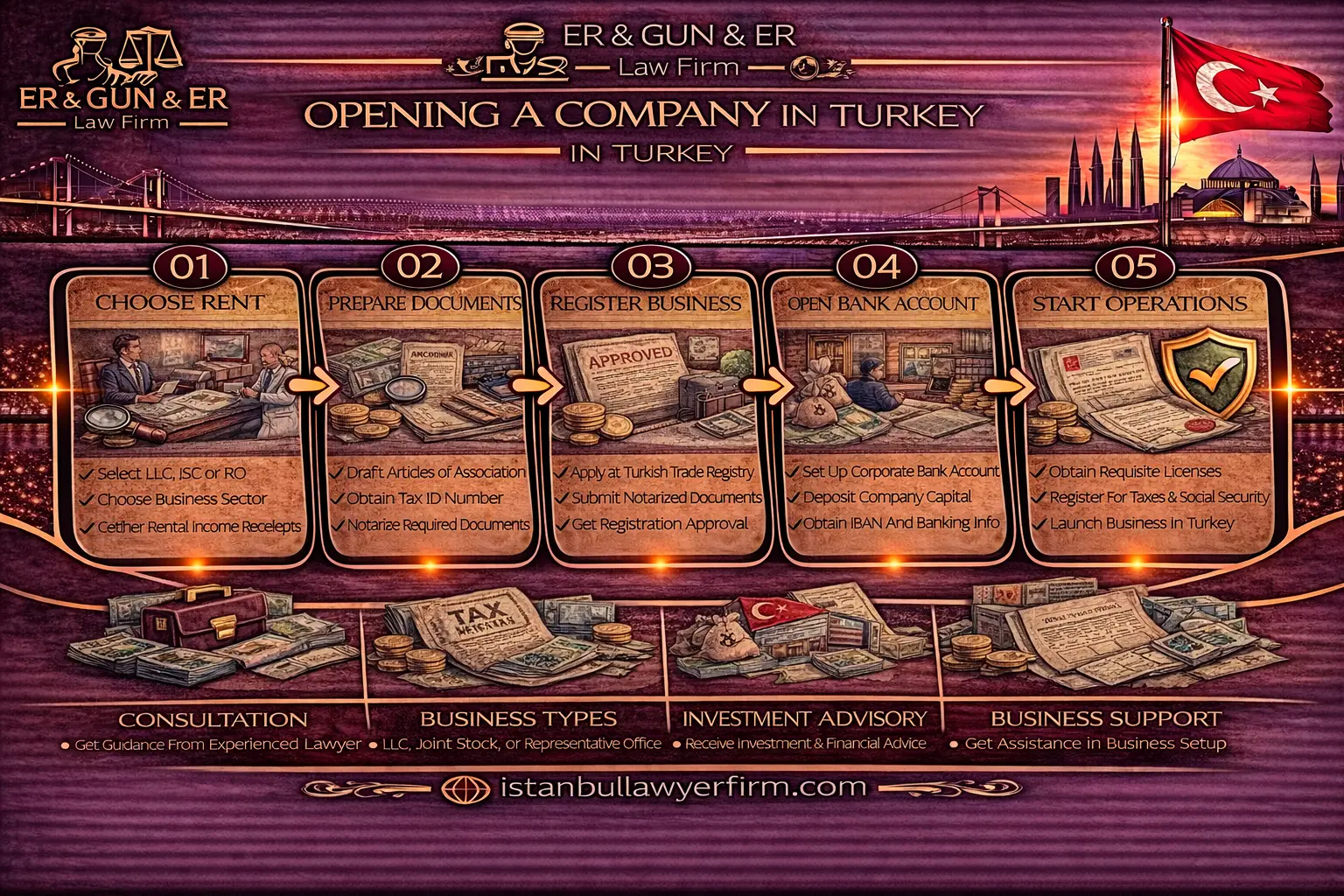
The phrase opening a company in Turkey is usually searched by founders who want a lawful, bankable operating vehicle rather than a paper entity. In practice, the work is a Turkish company registration process that combines corporate law, registry mechanics, tax onboarding, banking compliance, and employment setup. The legal step is selecting the correct entity type and drafting articles that reflect your real business model without triggering unnecessary licensing requirements. The procedural step is completing the Trade Registry workflow cleanly so the company is registered, its signatories are documented, and its address is accepted. The compliance step is registering with the tax administration and maintaining bookkeeping from day one, because informal operations create later audit and banking problems. The banking step is opening accounts and passing source-of-funds and shareholder due diligence, which can be a bottleneck for foreign founders. The employment step is setting up SGK and payroll processes before hiring, because non-compliance creates fines and litigation exposure. Founders often lose time because they treat incorporation as a single filing, while the system treats it as a sequence of dependent approvals and verifiable documents. Working with a lawyer in Turkey helps when you need to align registry documents, tax registrations, and bank expectations into one coherent pack. The sections below explain the workflow in practical terms, focusing on evidence and process rather than on fixed numbers or promised timelines.
Company formation overview
company formation Turkey starts with a simple question: do you need a vehicle for investment holding, for trading, for services, or for regulated activity. Your answer determines which documents are required and which authorities will later ask questions. A well-run formation file is designed to be read by three audiences: the Trade Registry officer, the tax office, and the bank compliance team. Each audience expects a different proof set, but contradictions between them are the main cause of delays. Founders should therefore build one master data set of names, passport numbers, addresses, and corporate purpose wording. Even small spelling drift between passports, notarized signatures, and registry forms can force re-signing and re-translation. The corporate steps usually include choosing a name, reserving it where applicable, drafting articles, and preparing founder resolutions. The procedural steps include filing through the Trade Registry system, obtaining a registration number, and publishing required notices. The operational steps include getting a signature circular, opening a tax file, and arranging bookkeeping and invoicing capability. The bank step is not automatic and may require separate compliance interviews and beneficial owner disclosure. If your shareholders are abroad, document legalization and translation can become the pacing item. practice may vary by authority and year — check current guidance. For a baseline orientation, you can compare your plan to the workflow described in this formation guide and then tailor the document pack to your sector. A good formation strategy also anticipates the first year, including contracts, payroll readiness, and tax filings. When these downstream needs are planned early, the incorporation step becomes predictable rather than stressful. For the full procedural framework, see our pillar guide on establishing a company in Turkey.
Many founders focus on registration day, but the more important question is how to start a business in Turkey without creating compliance debt in the first quarter. Banks and counterparties want to see that the company has a real address, real signatories, and a defensible business purpose. Tax offices want to see that invoices are issued through proper systems and that bookkeeping is not retroactively reconstructed. Employees want to see that payroll, insurance, and work safety duties are taken seriously from the first hiring. Suppliers want to see that the company can sign and pay, which depends on bank onboarding and internal authority design. If you plan to import or export, you may need additional registrations beyond the company registration itself. If you plan to serve regulated clients, you may need sector approvals before you can invoice. These requirements are often not visible in the articles, but they become visible in audit and bank reviews. A clean approach is to treat incorporation as an onboarding program with defined milestones and document owners. That program should include a compliance binder that stores registry documents, tax registrations, and signature authorities. It should also include a change log that records later changes to address, managers, and shareholding. corporate compliance Turkey company discipline matters because one missed notification can block banking or trigger penalties. practice may vary by authority and year — check current guidance. A founder who keeps this binder current can answer bank and tax questions quickly without improvisation. This is the difference between a company that is merely registered and a company that is operationally credible.
The legal perspective treats the company as a set of rights and obligations created at the moment the registry records are completed. The operational perspective treats the company as a compliance object that must remain consistent across systems. If you change a manager, you should consider how that affects bank signatory rules and tax communications. If you change the address, you should consider how that affects inspections and invoice validity. If you change shareholding, you should consider beneficial owner declarations and bank KYC updates. These are not theoretical, because practical delays often occur when systems show conflicting data. A disciplined Trade Registry company setup Turkey file includes a single source of truth for names, IDs, and authorities. It also includes a corporate file map so any officer can find the articles, signature circular, and registry gazette quickly. If you are a foreign founder, the file map must also include apostilles, translations, and passport copies in consistent form. A founding team should also decide early who can bind the company and what limits exist for major commitments. That authority design reduces internal disputes and reduces external counterparty risk. If you want the workflow to be frictionless, treat the first month as a controlled closing period rather than as improvisation. Working with a Turkish Law Firm can help you keep documents consistent across the registry, the tax office, and bank onboarding. practice may vary by authority and year — check current guidance. When the file is structured this way, the company becomes easier to manage, finance, and audit.
Choosing entity type
Entity selection is the first strategic decision because it determines governance, reporting, and investor options. Founders usually choose between an LLC-style structure and a joint stock structure, but the right choice depends on capital plan and liability profile. If your plan is a small founder team with limited external investors, an LLC may be operationally simpler. If your plan includes venture funding, employee option plans, or multiple share classes, a joint stock structure may be more flexible. The phrase limited liability company Turkey setup is often used for founder-friendly structures, but the details are still shaped by the articles and practice. A realistic selection process begins by listing your expected shareholders, expected cash flows, and expected contract counterparties. Then it tests which entity type can deliver clean authority rules for bank onboarding and contract signing. It also tests which entity type can handle future share transfers without administrative friction. It also tests what record-keeping and audit expectations you will face during the first year. If you are unsure, start with a neutral overview of company forms and then narrow to your facts. A useful starting point is this guide to company types, which helps you map governance differences before drafting articles. The decision should also consider whether you will need regulated licenses, because some regulators prefer one form over another. practice may vary by authority and year — check current guidance. Entity selection is not only legal, because it affects taxation posture, bookkeeping workflow, and employment setup. When selection is done early, all later drafting becomes easier because the legal structure matches the business reality.
A joint stock structure usually provides stronger mechanisms for future investment rounds and governance layering. The phrase joint stock company Turkey setup appears in investor conversations because it can support share class structuring and clearer transfer mechanics. However, it also tends to require more formal corporate housekeeping and more disciplined minute-taking. A founder should therefore ask whether the team can maintain corporate records with consistent quality. If the founder team will run operations informally, the form may not match the reality and disputes can arise later. If you anticipate frequent board decisions, you need a board workflow that produces written resolutions and preserves approvals. If you anticipate entering large contracts, you need signature authority rules that counterparties can verify quickly. If you anticipate foreign investors, you need a translation and apostille workflow that does not block share subscription steps. If you anticipate employee incentive plans, you need a corporate governance approach that can document grants and vesting decisions. If you anticipate an exit sale, you need a form that can support due diligence and share transfer closing mechanics. A practical comparison between the two main forms is explained in this structure comparison and it is useful before you commit to one set of articles. Entity type also affects how banks interpret beneficial ownership and who must attend onboarding. Entity type also affects how auditors and tax inspectors read your internal controls. practice may vary by authority and year — check current guidance. Choosing the form is therefore a governance decision, not a paperwork decision, because form determines how disputes will be judged later.
Entity selection should also be tested against your counterparties’ expectations and your own risk tolerance. Some counterparties prefer dealing with entities that have clear board approvals and easily verifiable signatories. Some counterparties care more about tax registration clarity and invoice systems than about share structure. If your business model depends on complex commercial contracts, your entity should support clear authority and dispute resolution pathways. This is where commercial contracts Turkey company planning becomes part of entity selection rather than a later drafting task. A prudent founder also considers whether the entity can be managed remotely by foreign shareholders without constant travel. If remote management is expected, you need a governance system that produces written approvals and retains them securely. You also need a representative system for notary steps and banking steps when founders cannot be physically present. If you plan to change entity type later, understand that conversion steps can be procedural and may require additional filings and consents. Therefore, it is often cheaper to choose correctly at the start than to restructure after operations begin. When founders are unsure, working with a law firm in Istanbul can help because the team can test the planned structure against registry practice, bank expectations, and contract workflows. The goal is to reduce friction at the Trade Registry stage and at the bank stage, not to optimize for theory. practice may vary by authority and year — check current guidance. A good structure is one that your accountant, your bank, and your counterparties can understand without constant explanation. If the structure is coherent, future due diligence becomes easier because corporate actions and approvals are documented consistently.
Foreign shareholder basics
Foreign participation adds a second layer of documentation because identity and authority must be proven across borders. A foreign shareholder company Turkey file should start with clean passport copies, consistent name spelling, and clear signature authority evidence. If the shareholder is an individual, you must plan how signatures will be notarized and whether apostille or consular legalization is needed. If the shareholder is a corporate entity, you must plan how to evidence corporate existence, signatory authority, and beneficial ownership. Banks and registries will ask who ultimately controls the entity, and the answer must be consistent across all forms. If the shareholder is from a jurisdiction that issues documents in another language, certified translations become a gating item. If the shareholder is not physically in Turkey, representation and power of attorney logistics become a practical bottleneck. If the shareholder expects to be a director or manager, residency and work authorization questions may arise later. The safest approach is to build a foreign shareholder pack that includes identity, address, and authority documents in one controlled folder. That folder should also include a translation glossary so names and addresses are not transliterated differently in different documents. For foreign investors, the corporate law context is explained in this foreign investor guide and it helps align expectations before registry filing. Foreign founders should also anticipate that banks may request source-of-funds and source-of-wealth explanations. practice may vary by authority and year — check current guidance. If you plan early, these cross-border steps become predictable and can be sequenced with the registry filing. If you plan late, the same steps can delay the entire launch because bank and registry steps are dependent on identity proof.
Foreign founders often assume that corporate ownership automatically gives a right to work in Turkey, but that is a separate legal track. The phrase work permit for foreign founders Turkey should be treated as an immigration and labor compliance question, not as a registry question. A founder can own shares without working day to day, but if the founder will sign contracts, manage staff, or represent the company, work authorization may be required. Corporate structures should therefore define management roles carefully so the company does not unintentionally place founders in unlawful work posture. If a foreign founder will be appointed as manager, the company should plan the authorization route before operational activity begins. Founders should also plan entry and residence status so they can attend bank onboarding and notary steps without visa problems. If a founder is abroad, consider appointing a local signatory for early steps until the founder’s status is regularized. That signatory design should be documented in the articles and in internal resolutions to avoid later authority challenges. Foreign founders should also consider personal tax residency implications if they spend substantial time in Turkey. Those personal tax issues are separate from corporate tax registration and should be managed in parallel. If the company will hire foreign employees, separate work permit planning must be done for those employees as well. Companies that ignore work authorization often discover the issue during bank KYC, tax inspections, or labor disputes. practice may vary by authority and year — check current guidance. The safest approach is to build a compliance calendar that covers immigration, payroll, and corporate filings from the first month. When these tracks are coordinated early, the company can operate without sudden stops caused by immigration compliance issues.
Foreign shareholder structures are often tested most strictly during banking onboarding rather than at registry filing. A bank account for company Turkey is not simply a form, because banks must satisfy internal KYC and AML controls. Banks typically ask for beneficial owner declarations, corporate charts, and proof of address for key individuals. Banks also ask for business model explanation and expected transaction profile to understand risk. If the company will receive foreign transfers, banks may ask for source documentation and contract references. If the company will handle cash-intensive business, banks may ask additional questions about controls and reporting. If the shareholder is from a high-risk jurisdiction, banks may require additional verification steps. These steps are not always predictable because each bank has its own compliance appetite. practice may vary by authority and year — check current guidance. To reduce friction, prepare a banking pack that mirrors the registry pack but also includes business plan notes and key contracts. Keep all documents in consistent name spelling and consistent address format to avoid rejection for technical reasons. If the founders are not fluent in Turkish, using an English speaking lawyer in Turkey can help because banking interviews and written requests must be answered precisely without mistranslation. The defense against delays is not persuasion, but completeness and consistency. A clean banking pack also helps later in tax audits because it shows that funds entered the company through transparent channels. When foreign shareholders treat banking as part of formation rather than as an afterthought, operations start with fewer interruptions.
Articles and corporate purpose
Articles of association are the legal DNA of the company because they define purpose, management, and authority. They are also the document banks and counterparties read to understand who can bind the company. Articles should be drafted to reflect the real business model rather than a generic list of activities. Generic purpose clauses can create licensing confusion when the company later applies for sector approvals. Overly narrow purpose clauses can also create authority problems when the company signs contracts outside the clause. The solution is to draft purpose language that is accurate, scalable, and consistent with planned revenue streams. This drafting is not only legal, because it affects tax classification and bank risk profiling. The phrase corporate lawyer Turkey company formation matters here because purpose drafting must align with registry expectations and later compliance controls. Articles should also define management structure, such as manager powers, board powers, and approval thresholds for major acts. Where multiple shareholders exist, articles should define transfer rules and deadlock management to prevent future disputes. Where foreign shareholders exist, articles should define representation rules to reduce repeated travel for signatures. Where investors are expected, articles should be compatible with later investor rights agreements and share subscription workflows. Working with an Istanbul Law Firm can help because the team can test draft wording against registry acceptance practice and banking onboarding expectations. practice may vary by authority and year — check current guidance. A well-drafted article set reduces later friction because it anticipates the full lifecycle of corporate operations.
Corporate purpose drafting should be coordinated with tax onboarding so the company’s activity description matches its actual invoices. Banks often ask for a purpose summary that matches the articles, so inconsistency creates compliance flags. Tax offices also use the activity description to understand what records and invoices should exist. Therefore, tax registration for new company Turkey is not a separate universe and should be aligned with articles from the first draft. If the company will trade internationally, the articles should not suggest activities that require licenses you do not hold. If the company will provide professional services, the articles should match the service scope to avoid later claim that the company operated outside its purpose. If the company will run e-commerce, the articles should anticipate consumer-facing obligations and data compliance duties. If the company will hold investments, the articles should clarify whether it is an operating company or a holding vehicle. Articles should also define whether the company can open branches and appoint representatives, because expansion often requires these authorities. If the founder wants to delegate signing, articles and internal resolutions must align so delegation is defensible. If the founder wants to restrict spending, articles can reference internal approval thresholds, but the firm must ensure they are practicable. This is where counsel adds value by making governance rules enforceable internally without blocking daily operations. A best lawyer in Turkey approach is to draft articles with a future audit in mind, meaning every authority rule can be proven by minutes and signatures. practice may vary by authority and year — check current guidance. When articles and tax onboarding are aligned, the company’s compliance story is coherent and easier to defend later.
Corporate purpose is not only a sentence in the articles, because it becomes the narrative used in contracts, invoices, and compliance checks. If the narrative shifts mid-year, the company should update internal resolutions and ensure filings reflect the change where required. If the narrative is inconsistent, the company can face delays in banking, difficulties in contract negotiations, and confusion in tax inspections. A disciplined company keeps a governance file that includes articles, signature rules, and a minutes book for key decisions. That governance file should also include shareholder resolutions that approve major commitments and capital contributions. If multiple shareholders exist, the articles should be complemented by internal shareholder agreements that address deadlock and transfer. Those agreements should be consistent with the articles, because conflicting rules create enforceability disputes. If foreign shareholders exist, the governance file should also include translations and apostilled signature authorities in a consistent format. If the company will be audited or will seek funding, governance discipline becomes a due diligence asset. If the company will seek bank credit, banks often ask to see governance proof that signing authority is real and current. This is why drafting is not a one-time event, but the start of a record-keeping system. Working with Turkish lawyers who treat governance as an evidence file can reduce future disputes because decisions are traceable. practice may vary by authority and year — check current guidance. When corporate purpose and governance are consistent, counterparties can rely on the company’s authority without demanding extra comfort. That consistency reduces transaction friction and supports long-term compliance stability.
Trade Registry filing steps
The Trade Registry step is the legal birth event of the company and it is where the Turkish company registration process becomes public record. A disciplined file starts by confirming the exact trade name spelling and the activity description that will appear on registry outputs. You should align the activity description with your real operations, because banks and tax offices often compare the description to invoices later. The registry application typically relies on structured electronic data entry and uploaded document sets that must match one another. Founders should verify that every identity field uses one consistent spelling across passports, notarized signatures, and application forms. If any founder is a foreign national, translations and legalization should be completed before submission so that the registry officer sees a complete pack. If a corporate shareholder is involved, the authority chain should be evidenced with corporate documents that show who can sign on behalf of the shareholder. Where the file uses a representative, the power of attorney scope should be checked so it covers registry submission and signing steps. The registry will usually require that the articles are finalized in the accepted format and that signatory details are declared consistently. If the articles include multiple managers or directors, confirm the representation method so counterparties understand whether signatures are joint or sole. If the company will be used for cross-border payments, set the purpose wording so it does not conflict with later banking compliance interviews. For founders who want a predictable workflow, Trade Registry company setup Turkey is best treated as a closing checklist with a document index. The index should list what was uploaded, what was notarized, and what original documents exist for later bank onboarding. If the registry requests corrections, respond with corrected documents and keep the change history to avoid later disputes about the effective version. If you file with inconsistent data, you can lose days to re-signing, re-translation, and re-approval loops. A coordinated Istanbul Law Firm workflow often reduces these loops by checking consistency before submission.
When opening a company in Turkey, the registry file should be built around a single source of truth folder that contains the latest approved drafts. The articles should be paired with founder identification sets and any authority evidence for corporate shareholders. If founders will sign remotely, confirm which signature formalities are accepted and plan the logistics early. A common delay occurs when the address evidence is missing or inconsistent with the declared district and building details. An address lease or office use evidence should be aligned with the company name so the registry does not question whether the address belongs to the entity. If the entity type requires a board or manager appointment record, ensure that the appointment language matches the representation rules in the articles. If multiple founders are involved, confirm that each founder’s contribution commitment is documented consistently across the articles and any side documents. The registry stage is also where you should prepare the corporate books and minute templates you will use after registration. If the file will later be audited, the quality of early minutes can matter because they show whether the company was managed formally from day one. company formation Turkey becomes smoother when every uploaded document has a mirrored original in your compliance binder. That binder should store notarized signatures, identity copies, and any apostilled documents so the bank pack can be assembled quickly. If the registry requires a change, record the requested change in writing and update the binder so outdated versions are not re-used by mistake. If the founders plan to appoint a professional manager, confirm whether the manager’s identity documents are needed at filing or only after registration. If a founder will be a signatory, ensure the signatory’s passport and signature specimens are ready for the notary stage that follows. If the file is complex, a Turkish Law Firm can coordinate the registry pack so that each authority document is translated once and used consistently. “practice may vary by authority and year — check current guidance.”
After the registry records are completed, you should immediately collect the official registry outputs that counterparties will request. Those outputs typically include proof of registration, proof of management, and proof of representation authority. Store them in both digital and hard-copy form, because banks and tax offices often ask for stamped versions. The next task is verifying that the company’s internal file reflects the exact registry wording, including address and activity description. If you later change address or management, you should plan to update both the registry record and the bank KYC record to keep systems aligned. Many founders discover that their bank interview asks questions that are answered by registry documents, so you should prepare those documents as a single pack. If your company will sign long-term contracts, ensure that signature authority is clear so contract counterparties can verify who can bind the company. If the company will issue invoices quickly, coordinate with your accountant so tax registration is sequenced without gaps. corporate compliance Turkey company should be treated as a lifecycle discipline that begins with accurate registry information and continues with timely updates. If you have foreign shareholders, ensure that beneficial ownership documentation is consistent with the registry outputs so the bank does not request rework. If the company is part of a group, keep a group chart and update it when shareholding changes, because banks often ask for it at onboarding and at reviews. If the registry publishes notices, preserve the notice proof as part of the corporate record so you can show third parties that the company exists and is active. If a dispute later arises with a shareholder, clean registry outputs often reduce conflict because governance facts are verifiable. If you want proactive governance design, corporate lawyer Turkey company formation support can help align articles, internal minutes, and signature authority into one system. A careful team of Turkish lawyers will also test whether the registry wording creates unintended licensing triggers and will advise revisions if needed. “practice may vary by authority and year — check current guidance.”
Signature circular and notary
The signature circular is the practical document that shows who can bind the company and how. Banks, suppliers, and public offices often ask for it before they accept any instruction from the company. Because it is an authority document, it should match the registry output exactly in names, titles, and representation method. If the company has multiple signatories, the circular should show whether they sign alone or jointly for different transaction categories. If internal authority limits exist, they should be documented in a way that third parties can verify without guessing. A common risk is issuing broad signature power and then discovering later that internal approvals were ignored. To prevent that, founders should align internal minutes and signature authority so major commitments are approved before signing. This alignment matters most when negotiating commercial contracts Turkey company because counterparties test whether the signer had authority. Notary steps are usually involved in producing signature specimens and the circular, so the signatory must be available with identity documents. If a signatory is foreign, translation of identity and power documents may be required before the notary will proceed. If the company uses a manager structure, ensure the manager appointment wording is consistent across the registry, minutes, and circular. If you change a signatory, treat the change as an immediate compliance update and not as an internal HR action. Update the bank signatory rules at the same time, because outdated signatory lists create operational freeze during payments. For founders who need coordinated signatory design, a law firm in Istanbul can align registry wording, notary documents, and contract signing workflows. The goal is a circular that is readable, consistent, and defensible in any later dispute about authority. “practice may vary by authority and year — check current guidance.”
Notary practice is where foreign shareholder structures often face friction because authority must be proven in the notary’s accepted format. If the signatory is not physically present, representation may rely on a power of attorney that is drafted with notary use in mind. That power document should clearly authorize signature specimen issuance and company representation acts. If the power is issued abroad, legalization and certified translation should be completed before presentation. If the shareholder is a foreign corporate entity, corporate authority evidence should show who can sign for the entity and how the entity decided to invest. The authority evidence should be consistent with the foreign shareholder company Turkey structure declared in the registry pack. If the documents contain different transliterations of the same name, the notary may refuse or may create mismatched records that later block banking. A disciplined approach is to lock one spelling standard and apply it across passports, translations, and registry forms. If the signatory uses multiple passports, choose one and keep the identity chain consistent across all documents. If the signatory must appear briefly in Turkey, schedule notary steps efficiently so time is not lost on rework. If remote management is required, test whether the notary and registry will accept the planned document route before you sign the investment agreement. Trade Registry company setup Turkey can be delayed if the notary stage creates a new spelling that does not match the registry application. If that happens, correction steps may require re-signing, re-translation, and re-filing. An English speaking lawyer in Turkey can reduce these mismatches by controlling translations and by pre-checking notary templates against registry practice. The most reliable defense against notary friction is not persuasion but consistency, completeness, and version control. “practice may vary by authority and year — check current guidance.”
Once the signature circular is issued, treat it as a controlled corporate artifact with strict version tracking. Store the original and certified copies in the corporate binder and in the secure digital vault. Provide counterparties only the latest version and record when you shared it so later disputes about authority are provable. If the company changes managers, directors, or representation method, update the circular immediately and do not wait for the annual cycle. Banks can freeze transactions if their signatory file is outdated, which can disrupt payroll and supplier payments. This is why corporate compliance Turkey company includes a routine signatory review whenever there is a governance change. If the company issues internal delegation letters, keep them separate from the public signatory circular to avoid confusing third parties. If a signatory is limited in authority, reflect that limitation in internal approvals rather than relying on verbal instructions. If electronic signatures are used for contracts, ensure that the authority to use them is documented and aligned with internal minutes. If you operate in regulated sectors, confirm whether regulators require specific signatory disclosures beyond the circular. If you have multiple shareholders, ensure that shareholder approvals are recorded before expanding signatory powers. If a dispute arises, authority documents become central evidence, so inconsistencies between minutes and circular can harm credibility. If you anticipate future investment, keep signatory authority clean and scalable so due diligence can be answered quickly. If you need urgent corrections, a lawyer in Turkey can coordinate notary corrections, registry notifications, and bank updates as one task list. Authority hygiene is therefore not administrative paperwork, because it directly affects operations and enforceability. “practice may vary by authority and year — check current guidance.”
Tax registration essentials
Tax onboarding is where the company becomes a reporting subject and where informal founders often create their first compliance debt. tax registration for new company Turkey usually begins after the registry record is issued and the company has a verifiable address. The tax file should reflect the same activity description used in the articles so that invoices and declarations match the official profile. A common friction point is the address verification step, so keep the lease and address proof ready and consistent. Appointing a qualified accountant early matters because accounting and bookkeeping Turkey company starts from day one, not from the first sale. Even if the company has no revenue yet, bookkeeping should record founding transactions, capital movements, and early expenses accurately. If the company will issue invoices immediately, confirm which invoice systems are required and do not improvise invoices outside the compliant channel. If founders pay expenses personally, document reimbursements properly so later audits do not treat them as hidden income or unrecorded financing. If the company will receive foreign transfers, align tax documentation with banking explanations so the story is coherent. If the company will export services, keep contracts and payment proofs so revenue characterization is defensible. If the company will import goods, ensure that customs documentation matches invoice records and bank transfers. If the company uses multiple locations, clarify which location is the registered office and how other sites are documented. If the company changes address, update tax records promptly because mismatched addresses can trigger questions during inspection. If the company hires staff, coordinate payroll tax withholding and SGK steps with the accountant so reporting is synchronized. For founders who want a conservative and defensible setup, a best lawyer in Turkey will typically insist on a clean onboarding binder that matches tax office expectations. “practice may vary by authority and year — check current guidance.”
After the tax file is opened, the company must maintain a reporting rhythm that matches its activity and transaction volume. Founders should treat tax reporting as a documentation discipline rather than as an accounting formality. If revenue is domestic, invoices and receipts should be recorded in the correct period so later reconciliations do not create artificial discrepancies. If revenue is cross-border, contracts and payment proofs should be stored so characterization questions can be answered without guessing. If the company is financed by shareholder loans, document the loan terms and the bank transfer trail so the financing story is coherent. If the company is financed by capital contributions, ensure that the contribution documentation is consistent with registry records and bank statements. If the company pays service providers abroad, keep invoices and contracts so outbound payments can be reconciled with services received. If the company pays consultants inside Turkey, ensure that service agreements and tax invoices are stored so expense deductibility can be defended. A common operational issue is mixing business and personal spending, so founders should separate cards and accounts early. If personal payments occur, document reimbursement and approval so later audits do not treat them as unrecorded benefits. corporate compliance Turkey company also includes timely response to tax office requests and the ability to produce documents quickly. This speed depends on having an indexed archive, not on memory. If founders want deeper planning on cross-border structure, the international tax planning guide is a useful reference point for questions to ask before transactions begin. If the company expects foreign investors, keep beneficial owner data consistent across tax onboarding and bank onboarding. An Istanbul Law Firm can coordinate legal and accountant workflows so corporate decisions, invoices, and reporting remain consistent in one file. “practice may vary by authority and year — check current guidance.”
Tax disputes are easier to avoid when records are kept in a way that can be produced quickly and consistently. Founders should assume that an audit question may arrive months later when staff have changed and memory has faded. That is why accounting and bookkeeping Turkey company must be organized as an archive with dates, counterparty names, and payment proofs. If the company uses e-invoice or e-ledger tools, preserve system confirmations and exports so you can prove what was issued and when. If the company issues manual documents, preserve originals and scanned copies so later authenticity is not disputed. If the company has related-party transactions, document approvals and pricing rationale so they are defensible in both tax and corporate terms. If the company has foreign transfers, keep correspondence that explains contract purpose so banks and tax offices see one coherent story. If the company is pre-revenue, document why expenses are incurred and how they relate to the planned business activity. If the company changes its business model, update internal resolutions and adjust reporting so the activity profile remains consistent. If the company plans to hire, align payroll and withholding processes with the accountant so the first payroll is compliant. If the company plans to pay dividends later, maintain clean profit and cash flow tracking so distributions can be defended. If the company plans intercompany lending, document loans with written agreements and bank trails to avoid characterization disputes. If a tax office requests documents, respond with indexed bundles rather than scattered emails to reduce misunderstanding. A careful team of Turkish lawyers can help coordinate legal documentation so that corporate minutes and tax records reinforce each other. This coordination reduces rework because the same evidence binder answers both legal and tax questions. “practice may vary by authority and year — check current guidance.”
Bank account opening issues
Bank onboarding is often the slowest step in early operations because banks apply KYC and AML rules before allowing transactions. A bank account for company Turkey requires the bank to verify the company’s registry record, signatories, and beneficial owners. Banks typically request the registry extract, articles, signature circular, and a clear address proof that matches the registry. They also request identity and address proof for individuals who control or manage the company. If there are foreign shareholders, banks often ask for corporate charts and certified authority documents in consistent format. If the business expects international transfers, banks ask for transaction profile explanations and sample contract references. If the company will operate in a high-risk sector, banks may ask for additional compliance explanations and internal controls. If the company is newly formed, banks may want to see initial funding source documents and the reason for the expected account activity. Founders should prepare a bank onboarding pack that mirrors the registry pack and adds business model summaries and expected counterparties. If founders want to explore remote onboarding options, remote bank account opening steps provides a workflow to understand what banks typically request before scheduling meetings. Banks may require in-person interviews even when some steps are remote, so plan founder travel and signatory presence realistically. Avoid providing inconsistent answers across different bank officers because inconsistencies become internal compliance flags. Use one narrative that matches your articles and your tax activity description so your file is coherent. corporate compliance Turkey company is reinforced when bank onboarding documents and tax onboarding documents describe the same business activity. If the bank asks for additional documents, respond with indexed bundles and keep a record of what you submitted and when. “practice may vary by authority and year — check current guidance.”
For foreign founders, bank compliance often focuses on beneficial ownership and the origin of the initial funding. Banks want to see who ultimately controls the company and whether that control structure matches registry documents. They often request corporate charts, shareholder registers, and signatory authority proofs for each corporate layer. If a shareholder is overseas, banks usually expect legalized and translated corporate authority documents that can be verified. If there is a foreign shareholder company Turkey structure with multiple entities, inconsistencies in names or dates can cause the bank to pause onboarding. Banks also review planned incoming transfers and ask for contract references that explain why funds will enter the account. They may ask for invoices, service agreements, or purchase orders that match the stated business purpose. When banks request funding explanations, the concept is usually a source-of-funds narrative supported by bank records rather than by stories. A practical reference for preparing that narrative is source of funds verification guidance, which helps founders understand what documentary trails banks typically accept. If funding comes from shareholders, show the shareholder bank transfer chain and the corporate resolution authorizing the transfer. If funding comes from third parties, show the contract basis and the payment instructions that tie the transfer to a legitimate transaction. If funding is cash-based, expect enhanced questions and consider whether alternative banking structures are needed. Answer bank questions consistently in one written pack rather than improvising different answers in different meetings. A Turkish Law Firm can help keep the bank pack consistent with the registry pack so compliance questions do not restart at each bank. This consistency reduces delays because the bank sees a stable story supported by verifiable documents. “practice may vary by authority and year — check current guidance.”
Once the account is open, maintain it as a compliance asset and not merely as a payment tool. Keep your bank file updated when signatories, address, or shareholding changes, because outdated KYC data can trigger transaction blocks. If you add a new shareholder, provide the bank with updated ownership documents and do not wait for the next annual review. If you change your activity scope, provide the bank with updated contracts and explain the new transaction profile in writing. If you receive foreign transfers, keep contract and invoice references so each incoming payment can be matched to business purpose. If you send outbound payments, keep supplier contracts and approval records so outgoing payments can be defended in audits. If a bank requests additional documentation, treat the request as a structured checklist and respond with indexed attachments. Avoid mixing personal spending with company spending, because commingling creates both tax risk and bank compliance risk. If founders inject funds frequently, document whether each injection is capital or loan and keep bank trails consistent with that classification. If you will run payroll, ensure that payroll payments are clearly labeled and supported by payroll records. If you anticipate an audit, store bank statements in the corporate archive so reconciliation can be done without later retrieval problems. A bank account for company Turkey is therefore an ongoing disclosure relationship that must be managed with consistency. If you expect cross-border counterparties, keep bilingual contract summaries internally so bank questions can be answered accurately. If a transaction is unusual, pre-brief the bank with supporting documents to reduce the risk of a compliance freeze. An Istanbul Law Firm can coordinate bank update submissions with registry updates so the company does not operate with inconsistent records. “practice may vary by authority and year — check current guidance.”
Capital and contributions
Capital planning is not only a registry matter, because it directly affects banking onboarding, credibility with suppliers, and tax reconciliation. Many founders search limited liability company Turkey setup or joint stock company Turkey setup expecting one fixed capital number, but the correct approach is context-based. Capital requirements can differ by entity type and by regulated sector, and published thresholds can change over time. practice may vary by authority and year — check current guidance. The first step is deciding whether founders will fund the company primarily through capital contributions or through shareholder loans. Capital contributions have corporate law meaning and appear on registry and financial statements as equity. Shareholder loans are debt and should be documented with loan terms, repayment expectations, and bank transfer trails. If the founders use mixed funding, document the split clearly to prevent later characterization disputes. Banks often ask whether incoming funds are equity or loan, because that affects beneficial owner narratives and transaction monitoring. Tax offices also look at whether funding is recorded consistently and whether interest or repayment terms exist. If the company is pre-revenue, a documented funding plan can also support the business purpose narrative in bank interviews. If you plan to raise external investment, equity structure often matters more than debt structure, and the articles should be drafted with future issuance in mind. If you plan to remain closely held, simplicity may be more valuable than flexibility. A disciplined approach is to draft a capital memo that lists sources, timing, and documentation for each injection. This memo becomes the master reference for accountant entries, bank questions, and investor due diligence. A law firm in Istanbul can align capital documentation with registry practice so that contributions are recorded in the legally expected form.
Contributions should be treated as a chain of documents rather than as a single payment. The chain usually includes a shareholder decision, a payment instruction, a bank transfer, and an accounting entry. If any link is missing, later audits and bank reviews treat the contribution as suspicious or inconsistent. If a founder pays from a personal account, keep a bank transfer receipt and record in writing whether it is equity or loan. If a founder pays from a corporate shareholder account, keep corporate authority evidence that the shareholder authorized the transfer. If the funds originate from abroad, keep SWIFT messages and underlying contract references where relevant. If the company receives funds before bank onboarding is complete, plan how those funds will be held and documented to avoid unexplained cash. If the company uses cash, expect enhanced compliance questions and consider safer channels. If a founder contributes assets rather than cash, document asset valuation and transfer steps carefully and avoid claiming numbers without verifiable valuation sources. practice may vary by authority and year — check current guidance. If the company plans to issue new shares later, keep a clean cap table that matches registry records and internal minutes. If the company has multiple shareholders, define who approves further funding and whether dilution is allowed, because disputes often start from unexpected injections. If you plan to add foreign shareholders later, prepare for new translation and authority evidence that must match the existing record. Consistency across years matters because banks perform periodic KYC refresh and will compare past contributions to current structure. An English speaking lawyer in Turkey can help keep cross-border contribution documentation consistent across languages and currencies.
Capital strategy also intersects with operational credibility because suppliers and employees often infer stability from paid-in funding. If the company will hire quickly, ensure that funding is sufficient to support payroll and SGK obligations without delays. If the company will import, ensure that funding supports customs and logistics payments and that bank records match import invoices. If the company will sign leases, ensure that funding supports deposits and rent payments and that the company can show source of funds. If the company will engage in regulated activity, confirm whether minimum equity is required and how regulators verify it. practice may vary by authority and year — check current guidance. If the company expects significant foreign inflows, coordinate the funding narrative with bank onboarding documentation and with the source of funds verification guide so that transfers are not blocked. If founders plan to repay shareholder loans quickly, document repayment terms and approval so repayments are not treated as disguised distributions. If founders plan dividends later, ensure profit calculation and cash flow are aligned so distributions are defensible. If the company has related-party transactions, document approvals so auditors can see governance discipline. If founders want to reduce future disputes, they should agree on a funding policy and record it in shareholder minutes. A structured funding policy prevents later claims that one founder “secretly funded” the company to gain leverage. Capital is therefore not only legal, but also governance and dispute prevention. When capital documentation is clean, external due diligence becomes faster because the company can prove where funds came from and why they were classified as they were. This clarity reduces friction in investment negotiations and reduces audit risk.
Address and office compliance
A registered address is not a decorative field; it is a compliance anchor used by the Trade Registry, tax office, and banks. Address and office compliance begins with securing a lawful right to use the premises, typically through a lease or ownership record. The address in the registry file must match the address used in tax registration and bank onboarding, down to district and building number spelling. Inconsistency is a common reason for inspections, delayed onboarding, and returned official notices. If the company uses a virtual office or co-working arrangement, confirm whether the arrangement provides the specific documents required by the registry and tax office. practice may vary by authority and year — check current guidance. If the company uses a home office, confirm whether the building rules and municipal rules allow business registration and what evidence is needed. If the company uses a shared office, confirm whether the lease allows sub-occupancy and whether the landlord consent is documented. If the company changes address, update registry and tax records promptly because outdated address records can create penalties and operational blocks. Banks may also freeze accounts when they cannot verify current address, so address updates must be sent to banks as well. If the company expects foreign clients, a credible address also supports trust because it shows the company has a stable footprint. Address proof should be stored in the corporate binder with signature authority documents because counterparties often request them together. If you plan to sign an office lease, align lease signatory authority with your signature circular to avoid invalid lease signatures. A disciplined Turkish Law Firm can coordinate address documentation so it is accepted by all systems without repeated rework.
Office compliance also includes operational reality such as signage, access, and document retention capacity. Tax offices may conduct address verification visits, and the company should be able to show that it operates from the declared location. Do not assume that you can register an address that is not operational, because inconsistency creates audit risk. practice may vary by authority and year — check current guidance. If the company stores sensitive data, ensure that the office has secure storage and access control because data protection obligations require physical and digital security measures. If the company will host employees, ensure that workplace safety obligations and building compliance are considered early. If the company will meet clients, ensure that the office arrangement supports confidentiality and professional image, because client trust is a business asset. If the company will operate with warehouses or multiple sites, clarify which site is the registered office and how other sites are documented. If the company uses a service provider for mail handling, ensure that mail handling is reliable because missed notices can create procedural defaults. If founders are abroad, ensure that someone physically receives mail and scans it securely, because many corporate obligations are delivered by mail. If the company expects to apply for licenses, ensure that the office meets any sector-specific physical requirements. Office compliance is often a hidden reason for bank onboarding delays, because banks cross-check address against inspections and against registry data. Therefore, treat the office file as part of the bank file, not as an unrelated lease. A coordinated law firm in Istanbul can also design a compliance calendar that includes address verification readiness and update triggers, so you are not reacting under pressure.
Address compliance becomes more complex when foreigners are founders and cannot attend inspections or sign address updates easily. In those cases, appointing a local representative with clear authority can reduce operational risk. That authority should be recorded in internal minutes and be consistent with the signature circular. If the company plans remote management, ensure that board or manager resolutions can be signed and stored in a way that satisfies Turkish corporate record expectations. If the company uses electronic signature tools, confirm whether the tools are accepted for the intended documents and keep verification logs. If the company uses physical books, plan where books are stored and who can access them, because missing books create audit risk. accounting and bookkeeping Turkey company discipline requires that invoices, contracts, and receipts are stored in an organized way, and the registered office is usually the natural storage point. If the office changes, plan the transfer of books and records carefully and document the transfer to prevent later allegations of record loss. If the company will be audited, auditors will often ask where records are stored and who controls access. If the company will apply for financing, banks will ask similar questions and will treat sloppy record storage as a risk indicator. Office compliance is therefore not only legal, but operational governance. If the company is part of a group, align office documentation across the group to prevent conflicting KYC records at banks. If your business model involves online operations, do not assume physical office is irrelevant, because physical address remains the legal anchor for service and inspections. A disciplined approach is to treat address as a compliance object with an owner, a document set, and an update trigger. This approach reduces friction because updates are done proactively rather than after a bank freeze or returned notice.
Accounting and reporting duties
Accounting and reporting duties are the core of ongoing compliance because they determine whether your company can survive audits and bank reviews. accounting and bookkeeping Turkey company begins from day one, even if the company has not generated revenue yet. Founding transactions, capital movements, and early expenses should be recorded accurately to avoid later reconstruction. If founders pay expenses personally, reimbursements should be documented so expense characterization is defensible. If founders inject funds, document whether funds are equity or loan and record them consistently across bank statements and accounting entries. If the company issues invoices, ensure invoices are issued through compliant channels and stored with the underlying contracts. If the company receives foreign transfers, store contracts and payment references so revenue characterization is clear. If the company pays foreign suppliers, store supplier contracts and invoices so outbound transfers are defensible. If the company hires staff, integrate payroll reporting and SGK reporting into the accounting calendar from the first hire. If the company is in a regulated sector, reporting may include sector-specific reports that must be coordinated with general accounting. practice may vary by authority and year — check current guidance. A disciplined reporting calendar reduces risk because deadlines are met and documents are consistent. If you need cross-border tax alignment, consult international tax counsel guide and plan whether double-tax issues exist. A company that keeps clean books is more bankable because banks treat clean books as reduced AML risk.
Reporting discipline should also anticipate investor and counterparty due diligence, because you may need to produce records quickly. Investors will ask for cap table, shareholder minutes, bank statements, major contracts, and tax filings. Counterparties will ask for signature authority, registry extracts, and sometimes tax registration proof. If these items are stored in an indexed archive, you can respond quickly and maintain credibility. If these items are scattered across emails, you lose time and create confusion that can kill deals. If the company uses external accountants, define a clear responsibility split between accountants and legal counsel so no task falls between them. Accountants typically manage books and filings, while counsel manages corporate decisions and contract governance. The two must be synchronized because a corporate decision often has accounting implications and a tax filing often requires corporate support documentation. If the company changes management, ensure that reporting access credentials are transferred securely and that the new managers understand the calendar. If a founder leaves, ensure that reporting access is revoked appropriately to protect data. If the company enters a dispute, clean books also protect you because they make damages analysis and causation analysis more credible. If the company is suspected of informal operations, clean reporting can be a defense tool because it shows consistent compliance behavior. This is why corporate compliance Turkey company is not only about avoiding fines, but about maintaining operational credibility. practice may vary by authority and year — check current guidance. A disciplined archive also supports bank reviews because banks often ask for current financials and tax filings as part of periodic KYC refresh. If your bank asks for these items, respond with indexed documents to avoid transaction blocks.
Founders should also understand that reporting is not only about tax, but about corporate governance and legal defenses. Corporate minutes and board resolutions should be maintained so that major transactions are approved and documented. If the company signs major contracts, store the contract and approval minutes together so authority is traceable. If the company takes loans, store loan contracts and bank disbursement records with board approvals. If the company pays dividends, store profit distribution resolutions and payment records. If the company issues new shares, store capital increase resolutions and subscription documents. If the company plans to sell, maintain a data room that includes clean records and a clear index. If you plan to operate cross-border, maintain documentation that supports transfer pricing and intercompany arrangements, because those issues are commonly tested in audits. Do not treat recordkeeping as a back-office burden, because it is the foundation of legal defensibility. If you face a dispute with a shareholder, clean records show whether the company was governed properly. If you face a dispute with an employee, clean payroll and SGK records show compliance. If you face a dispute with a supplier, clean invoice and delivery records show performance. Therefore, the reporting system should be designed as a legal evidence system, not only as a tax filing system. A lawyer in Turkey can help design the governance part of this system so that minutes and approvals are consistent with the legal structure. A disciplined Turkish Law Firm will also encourage founders to maintain a compliance calendar that includes corporate filings, tax filings, and bank KYC refresh deadlines. “practice may vary by authority and year — check current guidance.” When the system is built early, the company becomes easier to finance, to audit, and to exit.
Employment and SGK setup
Employment compliance starts before hiring because the company becomes an employer the moment it pays or directs work. Your first decision is whether you will hire employees, engage independent contractors, or use outsourced service providers, because each has different documentation expectations. If you hire, create written job descriptions so duties, working hours, and reporting lines are clear. Prepare a standardized employment contract template that reflects the role and does not rely on generic internet forms. Align the contract language with your internal authority rules so the person signing can bind the company. Build an HR file for each employee that includes identity copies, address information, and onboarding acknowledgments. Plan payroll setup with your accountant so salary payments, withholding reporting, and social security reporting are synchronized. In practice the SGK onboarding step is often called SGK registration employer Turkey and it is treated as a formal employer activation rather than a casual notification. Keep a documented start date and workplace address record for each employee so later inspections can verify presence. If the founder will actively manage day-to-day operations, do not assume shareholding alone solves authorization issues, because work permit for foreign founders Turkey is a separate compliance track. Maintain a clear separation between shareholder rights and employment status so the file does not look like disguised employment or disguised dividend. If you will pay benefits, record the benefit policy in writing to prevent later discrimination arguments. If you will use performance bonuses, record the criteria in writing to avoid disputes about entitlement. Maintain payroll payment proof by bank transfer rather than cash so the company can rebut future wage claims. Expect that requirements differ by sector and by year, and treat onboarding as a checklist rather than a one-time email. practice may vary by authority and year — check current guidance.
Foreign founders and foreign managers should plan immigration status in parallel with corporate onboarding to avoid operational gaps. Banks, notaries, and tax offices may require the signatory to be physically present, so travel planning should be realistic. If a foreign founder will be appointed as manager, confirm whether the appointment will trigger additional reporting duties for the company. If the foreign founder will be paid a salary, align payroll entries with the legal status and the job description. If the foreign founder will not be paid, document the management role so the company can explain the relationship during audits. When founders ask for a single universal rule, the safer answer is to review current guidance for the specific profile, because authorities update instructions. A helpful starting point is the internal workflow described in work permit guide and then the file should be tailored to the company’s sector and planned role. Use one consistent spelling for names across passports, powers of attorney, and appointment minutes to prevent later rejection. Keep translations controlled and consistent because small translation drift can change whether a document is accepted. If the company will sponsor other foreign staff, create a separate onboarding pack per person and do not reuse outdated templates. Document the workplace address and the supervisor name for each foreign staff file so inspections can be answered quickly. If the company uses remote work arrangements, document where the work is performed and how supervision occurs. Keep a log of filings and submissions so you can prove that applications were made on time and with complete attachments. If an application is refused, store the refusal notice and build a correction plan based on the stated reason rather than guessing. practice may vary by authority and year — check current guidance.
After onboarding, the employer’s main risk is not registration but ongoing recordkeeping. Store payroll reports, bank transfer receipts, and employee acknowledgments in one indexed archive. Ensure that overtime and leave are recorded consistently because wage disputes often turn on missing records. If employees travel or work at client sites, record assignments so workplace responsibility questions are manageable. If you reimburse expenses, require invoices and written approvals so reimbursements are not treated as hidden wages. If the company provides devices, record device delivery and return to prevent later loss claims. If the company changes its office address, update HR records and internal postings so inspections do not find mismatches. If the company scales quickly, keep hiring approvals and role descriptions current so HR practice does not become informal. Termination risk should be planned early because poorly documented performance issues often become litigation. Use written warnings and performance improvement notes where appropriate and keep them factual and dated. When terminating, document the reason, the notice steps, and the settlement discussions in writing to avoid later contradictions. If the employee leaves without a handover, document asset return and access revocation so data and device risks are controlled. If disputes arise, do not rely on memory, and instead produce the employment file as the proof backbone. If the company carries liability insurance that may cover employment-related claims, notify the insurer in accordance with policy language and keep the notice record. practice may vary by authority and year — check current guidance.
Licenses and regulated sectors
Licensing analysis should be done before registry filing because some activities require approvals that cannot be improvised after registration. Start by mapping your products and services into operational activities rather than marketing labels. Then identify which activities are regulated by sector authorities and which are ordinary commercial activities. Avoid adding broad regulated activity language to the articles if you do not plan to hold the license, because it can complicate banking interviews and tax profiling. If you will operate in finance-adjacent services, health services, education services, or other high-control areas, plan approvals as a separate workstream. Confirm whether the sector authority requires specific corporate form, specific governance rules, or specific location requirements. Confirm whether sector rules require specific qualified personnel and how those personnel must be documented. Confirm whether the authority expects an internal compliance officer or a documented compliance program from day one. Confirm whether the authority requires specific client disclosures and contract formats. Confirm whether the authority requires ongoing reporting beyond normal tax filings. Confirm whether advertising or promotions are restricted and how marketing must be reviewed internally. Confirm whether data handling rules are stricter than general privacy rules and how data retention must be designed. Confirm whether inspections are expected and what inspection records must be maintained at the office. Confirm whether your bank will treat the sector as higher risk and require extra KYC documentation. Confirm whether the business model can start with unregulated activities first while licenses are pursued later, without misleading clients. practice may vary by authority and year — check current guidance.
Licensing work is mostly a document project because authorities and banks do not evaluate intentions, they evaluate files. Build a licensing binder that contains application forms, correspondence, and submission receipts. Keep a matrix that shows which license is required for which service line so sales teams do not sell outside approval scope. Ensure that the corporate purpose language and the licensing scope language match so regulators do not see internal contradictions. If the license requires a physical site, align the site lease, floor plan, and occupancy permissions before you submit. If the license requires qualified personnel, store diplomas, professional registrations, and employment documents in a controlled file. If the license requires internal policies, draft those policies in a way that staff can actually follow, and record training acknowledgments. If the license requires customer complaint procedures, design a complaint intake channel and document how complaints are logged and closed. If the license requires client risk assessment, document who performs assessments and what evidence is stored for audits. If the business uses third-party agents, document agent controls and approval steps to avoid liability for agent misconduct. If the authority requests clarifications, respond with targeted documents rather than long explanations to reduce processing friction. If approvals take longer than expected, keep the company’s activities within the approved scope and document that limitation to protect future defenses. If the business model changes, update the license matrix and consider whether amendment applications are needed. If foreign investors are involved, keep translations consistent so investor due diligence and regulator submissions are aligned. If the bank asks questions about regulated activity, answer using the licensing binder rather than by improvising explanations. practice may vary by authority and year — check current guidance.
Regulated sector risk should also be integrated into contracts and governance so compliance is not separated from operations. If you operate under a license, include compliance representations in supplier and customer contracts where appropriate. If you handle sensitive data, embed data security and retention clauses in service agreements so responsibility is clear. If you outsource parts of operations, include audit rights and incident notification clauses so the company can manage regulatory accountability. If you operate in a sector with frequent inspections, keep inspection logs and corrective action logs so the company can show continuous improvement. If staff make errors, document remediation and training updates without framing them as admissions of regulatory breach. If the company is cross-border, map which services are provided from Turkey and which are provided abroad, and document the separation. If the company is funded by foreign shareholders, maintain a clean record of who controls compliance decisions and how oversight is documented. If the company faces a complaint, treat complaint handling as a compliance incident and create a file that can be shown to regulators if needed. If the company faces a media issue, keep statements factual and avoid claims that cannot be proven. If the company adds new product lines, run a license impact assessment before launching. If the company plans expansion to other cities, verify whether the license is nationwide or site-specific and document the conclusion. If the company changes managers, update regulator contacts where required and keep proof of notifications. If the company wants to reduce long-term risk, design compliance ownership roles and review cycles as part of corporate governance. practice may vary by authority and year — check current guidance. A regulated company that treats licensing as a living system is less likely to face sudden operational freezes.
Contracts and governance
Contracts are the operating layer of the company because they translate your business model into enforceable obligations. A good contract set starts with defining what you sell, what you deliver, and how you prove delivery. Commercial contracts Turkey company drafting should be aligned with your corporate authority rules so the right person signs and approvals are recorded. Keep a contract template library with version control so teams do not use outdated clauses. Include clear payment terms and define invoice triggers to prevent cash flow disputes. Include clear scope definitions to prevent clients from claiming that additional services were included. Include clear acceptance criteria so delivery is not disputed months later. Include clear termination clauses so exits are controllable and not emotional. Include clear confidentiality clauses that reflect the data you actually handle, not generic boilerplate. Include clear dispute resolution clauses that match your risk tolerance and your enforcement reality. Include clear limitation language where lawful and appropriate, but do not rely on it as a substitute for performance. Include a signature block that matches your official signatory names and titles exactly. Store signed originals and signed scans in a controlled archive with a contract register. Tie each contract to the internal approval minute or approval email so authority is provable. Ensure that sales teams do not promise terms that contradict the written contract, and train them on the reason. practice may vary by authority and year — check current guidance.
Governance is the internal system that makes the company auditable and bankable. Maintain a minutes book and record major decisions such as capital injections, loans, large contracts, and manager appointments. Maintain a signatory matrix so staff know who can sign what and when board or shareholder approval is required. Maintain a policy set for approvals, expense reimbursement, and conflict-of-interest disclosures so decisions are traceable. Maintain a related-party transaction policy if founders have multiple entities, because related-party payments often trigger tax and banking questions. Maintain a document retention policy that matches your business risk and ensures that key proofs are kept for disputes. Maintain a customer complaint handling protocol so disputes are identified early and resolved before they become litigation. Maintain a vendor onboarding protocol so you can prove how suppliers were selected and what checks were done. Maintain a banking compliance folder that stores KYC communications and updates so future bank reviews are easy. Maintain a tax compliance folder that stores filings, confirmations, and audit responses in chronological order. Maintain a workplace compliance folder if you have employees, including HR policies and safety records. Maintain a change management discipline so address changes, manager changes, and shareholding changes are updated across all systems. If you plan to raise money, maintain a data room-ready folder structure from the first month so due diligence is not rushed. If you plan to sell, keep IP ownership and contract assignment clauses organized so closing can proceed smoothly. practice may vary by authority and year — check current guidance.
Governance must also be practical, because governance that staff cannot follow becomes a liability. Avoid writing policies that require unrealistic approvals for routine tasks, because staff will bypass them and create undocumented risk. Instead, define clear thresholds and simple workflows that produce written evidence without blocking daily operations. Use standard forms for approvals and keep them in a shared location with restricted editing rights. If the company operates cross-border, ensure that foreign approvals are documented in a way that can be produced in Turkish proceedings if needed. If the company uses digital signing, store signature verification logs and do not rely on screenshots as proof. If the company uses outsourcing, ensure contracts include audit rights and data security obligations so the company remains compliant even when tasks are delegated. If the company handles personal data, ensure that privacy compliance is integrated into contracts and not left as a website policy only. If the company handles client funds, ensure that segregation and approval controls exist to prevent misuse allegations. If the company is insurance-adjacent or provides risk services, ensure that claims and complaint workflows are documented because disputes often focus on documentation gaps. If the company is tech-heavy, ensure that source code ownership and contractor assignments are documented so later investors do not find ownership holes. If the company is founder-led, ensure that founder decisions are still recorded as minutes so later disputes do not treat the company as informal. If the company uses multiple banks, ensure that signatory updates are sent to each bank consistently. If the company uses multiple accountants, ensure that one accounting policy set is used to avoid inconsistent filings. practice may vary by authority and year — check current guidance. Governance discipline is the cheapest form of dispute prevention because it creates an auditable story for every major decision.
Common mistakes and risks
The most common error in opening a company in Turkey is treating the process as a single registration event and ignoring the dependent compliance steps. Founders often finalize the registry filing but postpone tax onboarding, which creates retroactive bookkeeping problems. Founders often open an address on paper but cannot pass address verification visits, which triggers delays and credibility loss. Founders often choose entity type based on hearsay and then discover their governance needs are mismatched to the entity’s formalities. Founders often draft overly broad corporate purpose wording and then face licensing questions they did not plan for. Founders often draft overly narrow purpose wording and then face contract authority questions when the business expands. Founders often mix personal and company transactions, which creates tax risk and bank compliance risk. Founders often inject funds without documenting whether funds are equity or loan, which creates later audit and investor confusion. Founders often neglect version control and end up with inconsistent spellings across registry, bank, and tax forms. Founders often rely on verbal arrangements with accountants and do not keep filing confirmations in a central archive. Founders often delay employment onboarding and then hire staff informally, creating labor dispute exposure. Founders often ignore foreign founder work authorization and later discover the issue during bank interviews or inspections. Founders often sign contracts without internal approval records, which creates shareholder dispute exposure later. Founders often underestimate the cost of cleaning a messy file after operations begin, because re-signing and re-translation becomes routine. practice may vary by authority and year — check current guidance.
Banking risk is a frequent surprise because banks evaluate the company’s story, not only its registry record. A bank account for company Turkey can be blocked later if the bank’s KYC file is not updated after shareholding or signatory changes. Founders often add a shareholder and forget to update the bank, which triggers compliance freezes at the worst time. Founders often receive foreign transfers without storing contract and invoice references, which triggers request-for-proof cycles. Founders often respond to bank questions inconsistently across different officers, which creates internal flags that are hard to reverse. Founders often promise a revenue model in bank interviews that does not match the articles, which creates a credibility problem. Founders often treat source documentation as optional, but banks treat it as mandatory for higher-risk flows. Founders often cannot produce beneficiary owner proofs quickly because corporate charts are not maintained as living documents. Founders often cannot produce address proofs because leases were not kept in certified form. Founders often delegate banking to a junior employee without authority, which slows onboarding and creates misunderstandings. Founders often forget that banks refresh KYC periodically and require updated financials and updated contact details. Founders often ignore that regulated sectors trigger additional bank controls and require stronger internal compliance explanations. Founders often try to solve bank issues by switching banks without fixing the underlying documentation inconsistencies. Founders often create risk by paying wages or suppliers in cash because cash payments reduce proof quality. Founders often fail to align bank file wording with tax file wording, which increases audit friction. practice may vary by authority and year — check current guidance.
Governance and compliance risks often appear later, when the company grows or when a dispute arises. Founders often do not keep minutes for major decisions, which weakens authority defenses in disputes. Founders often do not maintain a clear cap table, which complicates investment and makes disputes personal. Founders often do not document related-party transactions, which triggers tax and banking scrutiny. Founders often do not document IP assignments from contractors, which becomes a due diligence problem in fundraising. Founders often do not document employment performance issues, which creates termination litigation exposure. Founders often do not keep an indexed archive, which turns every audit request into an emergency. Founders often ignore contract acceptance and delivery proofs, which makes revenue disputes harder to defend. Founders often ignore data retention discipline, which creates both privacy risk and evidence gaps in litigation. Founders often implement policies but do not train staff, which makes policies useless as compliance evidence. Founders often rely on one person’s memory rather than on a centralized document vault, which fails when staff turnover occurs. Founders often forget to update registry records promptly when managers change, which creates operational freezes. Founders often sign side agreements with investors that contradict the articles, which creates enforceability conflict. Founders often assume that “we are small” will protect them from inspection, but inspections are driven by triggers, not size. Founders often underestimate that a clean compliance story is a competitive advantage in banking, procurement, and fundraising. practice may vary by authority and year — check current guidance.
Practical roadmap
A practical roadmap starts by defining the business model and then selecting the entity type that matches funding and governance needs. company formation Turkey should be planned as a sequence of dependent milestones rather than as one filing. Start by locking identity spellings, addresses, and shareholder details as a single source of truth. Draft the articles to match the business model and to avoid unnecessary regulated activity wording. Prepare founder resolutions and authority records so signatory design is consistent. Build the Trade Registry pack with translations and legalization completed before filing if foreigners are involved. File the registry application and collect official outputs immediately into the corporate binder. Produce signature circular documents and ensure they match registry outputs exactly. Open the tax file and appoint an accountant to start bookkeeping from day one. Build the banking pack with registry outputs, signatory proofs, and business narrative documents. Schedule bank onboarding and answer KYC questions with a consistent document index. Decide funding classification for each founder injection and document equity versus loan clearly. Secure a registered address and ensure it can pass verification visits and mail delivery. Build contract templates and governance minutes templates so operations do not start informally. practice may vary by authority and year — check current guidance.
The roadmap should also include the first-quarter compliance plan because that is where most founders create hidden debt. Prepare an accounting calendar that lists reporting cycles and required internal approvals for filings. Prepare a bank calendar that lists KYC refresh points and update triggers for address and shareholding changes. Prepare an HR onboarding plan that includes contract templates, payroll setup, and record storage rules before hiring. Prepare a policy set for approvals, reimbursements, and related-party controls so decisions are documented. Prepare a data handling plan if you collect customer data, including retention and access controls. Prepare a contract register that records signed contracts and renewal dates so obligations are not missed. Prepare a cap table file and update it whenever shareholding changes, because investors will ask for it. Prepare a minute book process so capital injections, loans, and major contracts are approved in writing. Prepare a compliance binder that stores registry outputs, tax registrations, and bank correspondence in one place. Prepare a change log that records every update to address, manager, and shareholding with dates. Prepare a dispute readiness folder that stores key contracts, approvals, and delivery proofs so claims can be answered quickly. Prepare a vendor onboarding process so supplier risks are controlled and invoices are defensible. Prepare a cash management plan so payments are traceable and bankable rather than cash-heavy. Prepare a periodic legal review routine so new activities do not drift outside purpose and licensing limits. practice may vary by authority and year — check current guidance.
The roadmap should be treated as a living system that is updated as the company grows. When you add a shareholder, update registry records where required and update the bank KYC file immediately. When you change a manager, update signature circular documents and update the bank signatory file on the same day concept. When you change address, update all systems and keep proof of updates to avoid returned notices and inspection risk. When you add a new service line, run a license impact check and update contracts and disclosures accordingly. When you hire, maintain HR files and payroll proofs so future disputes can be answered with documents. When you sign major contracts, store approvals and contracts together so authority is provable. When you receive foreign funds, store contract and invoice references so the source narrative is coherent. When you pay abroad, store supplier contracts and invoices so outbound payments are defensible. When you face an audit request, respond with indexed bundles rather than scattered emails to protect credibility. When you seek investment, open a controlled data room and provide consistent versions of key documents. When you seek credit, maintain clean financials and governance proofs so lenders trust the record. When you consider exit, maintain a closing binder that shows corporate actions and ownership are clean. When you encounter a dispute, keep communications factual and evidence-led to preserve legal posture. practice may vary by authority and year — check current guidance.
FAQ
Q1: Opening a company is a legal and compliance workflow, not only a registry filing. The sequence usually includes entity selection, Trade Registry registration, tax onboarding, and banking/KYC. practice may vary by authority and year — check current guidance.
Q2: The best entity type depends on governance needs, investor plans, and operational discipline. LLC and joint stock options have different formalities and flexibility. A structured review of your business model should precede drafting.
Q3: Foreign shareholders typically require additional identity and authority documentation, including translations and legalization. Banks often test foreign ownership most strictly during onboarding. Consistent spelling and a single source of truth file reduce delays.
Q4: Articles should reflect your real business purpose and your governance plan. Overly broad purpose wording can create licensing questions, and overly narrow purpose wording can create authority friction. practice may vary by authority and year — check current guidance.
Q5: Tax onboarding should be planned immediately after registration and bookkeeping should start from day one. Retroactive reconstruction creates audit risk and banking risk. Keep invoices, contracts, and bank proofs organized.
Q6: Banking is often the pacing item because KYC and source documentation are reviewed before accounts are fully operational. Prepare a bank pack that mirrors registry outputs and adds business model documents. practice may vary by authority and year — check current guidance.
Q7: Capital and funding should be documented as equity or shareholder loan with clear bank trails and approvals. Mixing classifications creates later disputes and due diligence friction. Avoid stating fixed capital numbers without current verification.
Q8: Address compliance is an operational anchor because tax offices and banks verify address and may conduct checks. Keep address proof consistent across registry, tax, and bank files. Update all systems promptly after any address change.
Q9: Employment compliance requires contract templates, payroll setup, and SGK onboarding before hiring. Maintain HR files and bank transfer proofs to defend against later disputes. practice may vary by authority and year — check current guidance.
Q10: Regulated sectors require separate approval planning and documentation beyond normal company registration. Launch only within your approved scope and maintain a license binder. Coordinate contracts and disclosures with licensing duties.
Q11: Governance discipline reduces risk because minutes, approvals, and signatory rules become evidence in audits and disputes. Keep a compliance binder and a change log as living documents. This improves bankability and investment readiness.
Q12: The safest formation approach is a roadmap with milestones and a controlled document vault that remains consistent across registry, tax, and bank systems. Consistency prevents rework and reduces the chance of operational freezes. practice may vary by authority and year — check current guidance.
Author: Mirkan Topcu is an attorney registered with the Istanbul Bar Association (Istanbul 1st Bar), Bar Registration No: 67874. His practice focuses on cross-border and high-stakes matters where evidence discipline, procedural accuracy, and risk control are decisive.
He advises individuals and companies across Sports Law, Criminal Law, Arbitration and Dispute Resolution, Health Law, Enforcement and Insolvency, Citizenship and Immigration (including Turkish Citizenship by Investment), Commercial and Corporate Law, Commercial Contracts, Real Estate (including acquisitions and rental disputes), and Foreigners Law. He regularly supports corporate clients on governance and contracting, shareholder and management disputes, receivables and enforcement strategy, and risk management in Turkey-facing transactions—often in matters involving foreign shareholders, investors, or cross-border documentation.
Education: Istanbul University Faculty of Law (2018); Galatasaray University, LL.M. (2022). LinkedIn: Profile.