

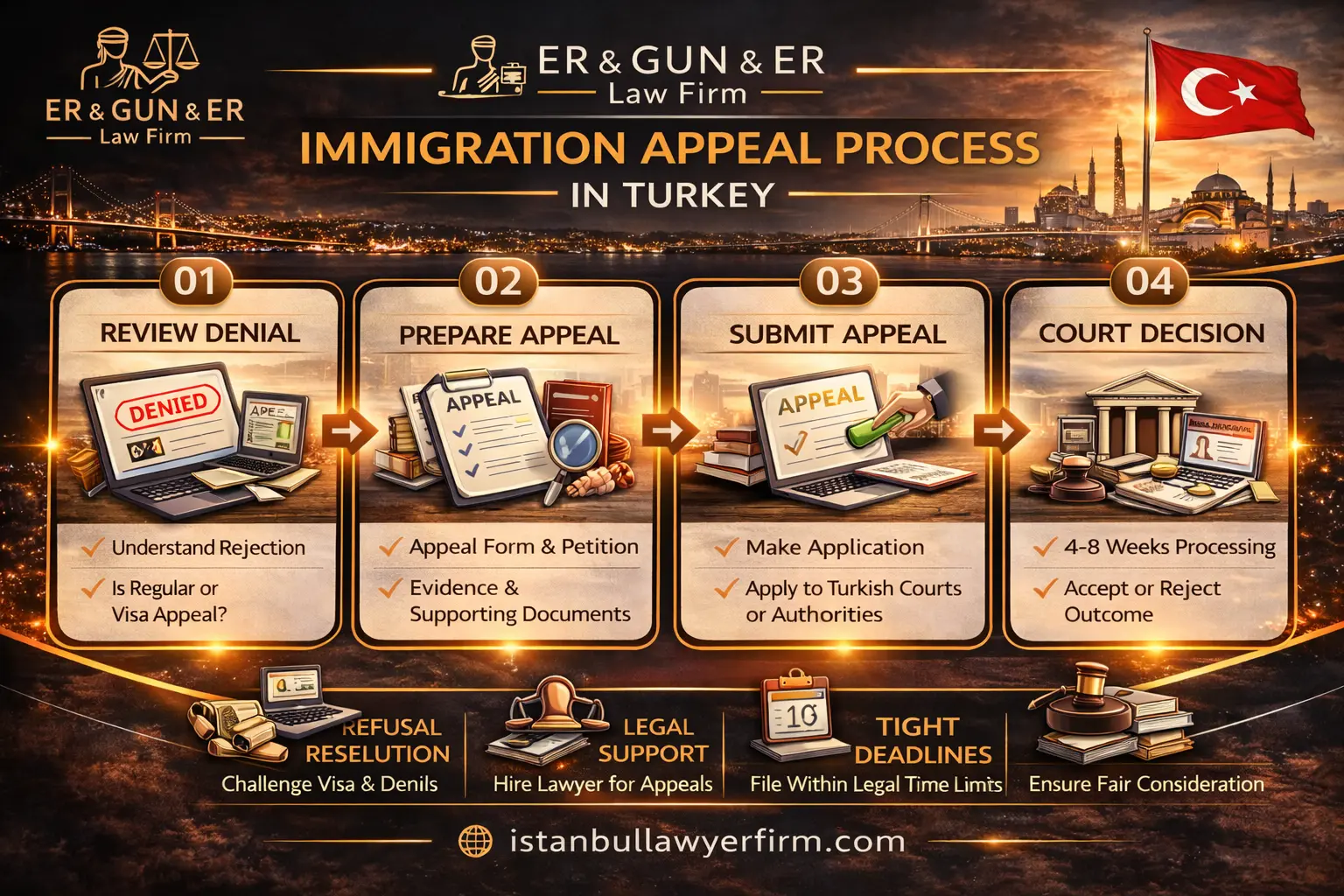
A lawyer in Turkey who advises on immigration law understands that an appeal in Turkish immigration contexts can follow several different procedural pathways whose correct identification is the essential first step—because challenging a decision through the wrong route, or missing the applicable deadline for the correct route, can forfeit remedies that would otherwise be available. An Istanbul Law Firm that advises on the immigration appeal process in Turkey provides the integrated procedural assistance covering every stage: identifying the decision type and the issuing authority; securing the full written decision and the notification record; selecting the correct remedy pathway—whether administrative objection to the issuing authority, administrative court litigation, or both in sequence; building the evidence package that matches the legal theory and factual narrative; managing enforcement risk through interim stay requests where available; and coordinating parallel immigration compliance steps to avoid creating new violations while the challenge is pending. A Turkish Law Firm that handles immigration appeal proceedings understands that the process is document-led and time-sensitive—that courts and administrations evaluate appeals primarily through the consistency and completeness of the written record, and that a coherent, indexed file consistently produces better outcomes than a persuasive oral narrative unanchored to objective exhibits. An English speaking lawyer in Turkey who advises on immigration appeals provides the bilingual guidance that enables foreign nationals to build a procedurally correct appeal file while understanding what the Turkish administrative and judicial systems require at each stage. Practice may vary by authority and year — verify current appeal deadlines, current procedural requirements, and current administrative practice at the specific Provincial Migration Management Directorate and Administrative Court with qualified counsel before initiating any immigration appeal in Turkey, since the specific timelines, procedural steps, and documentation requirements applicable to each decision type may differ between provinces and may have changed from prior guidance in ways that affect the available remedies. Practice may vary by authority and year.
Legal Framework, Decision Types and Selecting the Correct Appeal Route
A lawyer in Turkey who advises on immigration appeals explains that identifying the specific type of decision being challenged is the first and most practically significant step in appeal planning—because the correct procedural route, the applicable deadline, and the evidence expectations differ substantially between decision types. An Istanbul Law Firm that advises on immigration decision analysis helps individuals understand the specific decision types most significant for each situation: residence permit refusal decisions issued by the Provincial Directorate of Migration Management, which are the most common appeal trigger for expatriates; entry ban notations recorded in border control systems following overstay findings or deportation measures, which may be discovered only at a later travel interaction; deportation measures issued under the Law on Foreigners and International Protection No. 6458, which can be accompanied by administrative detention in removal centers and require urgent procedural response; voluntary departure orders that give the individual an administrative framework for departing Turkey; and international protection decisions—rejections of refugee, conditional refugee, or subsidiary protection applications—which have their own distinct procedural requirements and legal framework. Turkish lawyers advising on decision type identification help individuals understand that the remedy route depends on how the decision was classified by the issuing authority—and that acting on an assumption about the correct route without verifying the actual decision classification creates procedural risk. Practice may vary by authority and year.
An Istanbul Law Firm that advises on remedy route selection for immigration appeals explains that the Turkish administrative appeal framework involves two distinct lanes—administrative objection within the administration and administrative litigation before Administrative Courts—whose relationship to each other depends on the specific decision type. Turkish lawyers advising on remedy route selection help individuals understand the specific pathway most appropriate for each situation: some decisions permit or require an administrative objection as a preliminary step before Administrative Court access; some decisions allow direct administrative court filing without a preliminary objection requirement; and in some situations both routes can be pursued in a coordinated sequence where the objection produces a record that strengthens the subsequent litigation. An English speaking lawyer in Turkey who advises on remedy route selection for foreign nationals helps individuals avoid the common error of treating administrative objection as a substitute for court review when court review is legally required—and of filing in court before required administrative steps are completed, since bypassing a required preliminary step can result in the court dismissing the case on procedural grounds without examining the merits. Practice may vary by authority and year — verify which specific route applies to the challenged decision type with qualified counsel before filing.
A Turkish Law Firm that advises on appeal file structure explains that the appeal file should be organized around three distinct records whose coherent management determines the overall quality of the challenge: the decision record, which contains the written decision text, any annexes, and the reference numbers that allow consistent identification across all submissions; the notification record, which contains proof of how and when the decision was served—because appeal deadlines typically run from notification rather than from the decision date; and the evidence record, which contains factual proofs that respond to the specific reasons stated in the challenged decision. An English speaking lawyer in Turkey who manages appeal files for foreign nationals imposes the specific organizational discipline most effective for each file type: indexed exhibit bundles that allow a court or administrative reviewer to locate any exhibit from its reference in the petition; a master chronology that tracks every significant event from before the decision through the final submission; and a single approved narrative memo that prevents inconsistent accounts from appearing across different submissions to different authorities—ensuring that the three-record structure remains coherent even when submissions are filed across multiple weeks and multiple procedural stages. Practice may vary by authority and year.
Administrative Objection Petitions, Internal Review and Record Strategy
A lawyer in Turkey who advises on administrative objection procedures explains that an administrative objection petition is often the first formal response to an immigration decision—and that it should be drafted as an evidence-led request for reconsideration rather than as an emotional complaint, because administrations evaluate objections primarily on the coherence and completeness of the documentary record presented. An Istanbul Law Firm that drafts administrative objection petitions for immigration matters helps individuals structure the petition most effectively for each decision type: identifying the challenged decision by date, reference number, and issuing unit at the outset; stating the requested correction in operational terms—such as reconsideration, record rectification, or withdrawal of the measure—rather than in abstract legal principles; attaching the core exhibits that directly address the decision's stated reasons; and maintaining complete consistency with prior applications and statements unless a documented change event is described with a specific date and supporting proof. Turkish lawyers advising on objection drafting help individuals understand that the petition language should be drafted as if it could be read by an administrative court judge at a later stage—because internal objection responses often become exhibits in subsequent litigation, and language that concedes facts incorrectly or speculates about reasons the administration did not state can damage credibility across both lanes. Practice may vary by authority and year.
An Istanbul Law Firm that advises on objection submission and follow-up explains that the administrative objection process requires disciplined follow-up because silence after submission can be misread as abandonment, and informal phone calls to authority offices rarely produce a reliable paper record that can support later proceedings. Turkish lawyers advising on objection follow-up help individuals implement the specific approach most effective for each case situation: submitting the objection through the official channel and immediately preserving proof of submission with date and receipt reference; maintaining a follow-up log that records all contacts, responses, and system messages in dated order; avoiding the repeated submission of slightly different petitions on the same grounds, which creates inconsistent narratives that can be used to challenge credibility; and assessing promptly whether a negative or ambiguous internal response requires transitioning to Administrative Court—preserving the full objection record for that transition while remaining mindful of court filing deadlines that may be running concurrently. An English speaking lawyer in Turkey who manages administrative objections for foreign nationals coordinates the submission process and the follow-up log in English while managing the Turkish-language interactions with the authority—providing the bilingual interface that ensures no significant response is missed or misunderstood. Practice may vary by authority and year.
A Turkish Law Firm that advises on the strategic relationship between administrative objection and administrative litigation explains that these two lanes must be treated as parts of a single coordinated strategy rather than as independent options—and that decisions made in the objection stage directly affect the strength of any subsequent court case. An English speaking lawyer in Turkey who coordinates immigration objection and litigation strategy helps individuals understand that the strongest position is typically one where the administrative objection presents a clean, documented record that demonstrates the decision's factual or procedural defects—creating an administrative record that the court can rely on rather than having the court examine a case that was never coherently presented to the administration, and that the objection record also serves as the applicant's most detailed opportunity to have the administration correct its own error before incurring the additional time and cost of court proceedings. Practice may vary by authority and year.
Filing to Administrative Court and Building the Litigation File
A lawyer in Turkey who advises on administrative court filings for immigration cases explains that filing to an Administrative Court is the stage where the case becomes record-driven and where procedural form becomes decisive—and that the petition should be structured as a legal theory tied to documents rather than as a narrative of personal hardship. An Istanbul Law Firm that prepares administrative court petitions for immigration matters implements the specific filing approach most effective for each case type: identifying the challenged decision, issuing authority, date, and reference number consistently at the outset; framing the case as an administrative court case immigration Turkey matter whose grounds are based on the legality and procedural regularity of the decision rather than on general dissatisfaction; attaching exhibits in an indexed order that follows the case chronology so each exhibit supports a specific factual statement in the petition; and including a chronology memo written in short factual sentences with exhibit references rather than assumptions—because courts evaluate credibility through the consistency and objectivity of the record rather than the persuasiveness of the narrative. Turkish lawyers advising on administrative court immigration petitions help individuals understand that the petition should address the decision's stated reasons specifically rather than imagined reasons—and that courts read petitions against the administrative file to assess whether the administration's stated reasoning was supported by its own records. Practice may vary by authority and year.
An Istanbul Law Firm that advises on the post-filing management of administrative court cases explains that keeping the record clean after filing is as important as building a strong initial petition—because procedural noise introduced after filing can weaken a strong case by creating inconsistencies that distract from the core legal grounds. Turkish lawyers advising on post-filing case management help individuals implement the specific discipline most effective for each case stage: storing the filed petition and all annexes as the definitive filed version with drafts clearly marked as superseded; preserving court registry references and submission proofs immediately after filing; responding to court clarification requests with short, targeted responses that point to exhibits rather than expanding the narrative; filing document supplements with their own index and submission proof, clearly labeled as supplemental with a statement of which point they support; and coordinating all parallel submissions to other authorities so they do not contradict the litigation narrative. An English speaking lawyer in Turkey who manages administrative court immigration cases provides the bilingual case management that enables foreign nationals to maintain informed oversight of proceedings conducted entirely in Turkish—ensuring that every court notice is received, understood, and responded to within applicable deadlines. Practice may vary by authority and year.
A Turkish Law Firm that advises on court review scope in immigration litigation explains that Turkish Administrative Courts review immigration decisions primarily for legality and administrative reasoning rather than conducting a full re-examination of the administration's discretionary choices—and that understanding this scope significantly affects how the petition should be framed. An English speaking lawyer in Turkey who advises on administrative court strategy for immigration cases helps individuals understand the specific legal grounds most available for each case situation: where the decision contradicts the administration's own records or prior decisions; where the decision relies on incomplete or outdated information that the administration possessed or should have considered; where the notification process was defective in a way that affected the applicant's ability to respond; and where the administration applied its rules inconsistently with documented practice in comparable cases. Practice may vary by authority and year — verify which grounds are available and legally established for the specific decision type before filing.
A Turkish Law Firm that advises on the importance of maintaining a single factual narrative across court proceedings explains that one of the most common ways immigration court cases are weakened is through inconsistent statements in different submissions—where the petition describes one timeline, a supplement describes a slightly different one, and an interim stay request introduces additional facts that were not in the main petition. An English speaking lawyer in Turkey who manages immigration court proceedings for foreign nationals maintains the single narrative memo as an active working document that is consulted before every new submission—ensuring that each new filing adds precision or new documented events without contradicting the established factual record, and that the case arrives at the hearing stage with a coherent, consistent story whose credibility has been reinforced rather than eroded by the submission process. Practice may vary by authority and year.
Evidence, Documentation and Translation Requirements for Appeals
A lawyer in Turkey who advises on evidence strategy for immigration appeals explains that evidence strategy determines whether an immigration dispute remains a legal question or becomes a credibility dispute—and that treating evidence submission as a structured workflow with an index and a chronology produces more reliable outcomes than submitting documents reactively as each issue arises. An Istanbul Law Firm that advises on evidence preparation for immigration appeals implements the specific approach most effective for each case type: beginning with the decision record and notification record as the two anchor bundles that establish what was decided and when the applicant was informed; adding factual evidence bundles that respond specifically to the decision's stated reasons—address registration proofs where the decision cites address issues, insurance policy pages with coverage dates where the decision cites insurance gaps, and status history documents where the decision cites continuity concerns; and treating every exhibit as proof of a specific sentence in the petition rather than as general background information. Turkish lawyers advising on evidence strategy help individuals understand that overloading a submission with irrelevant documents dilutes the key points—and that a focused, indexed exhibit set that links each document to a specific factual statement is consistently more effective than a comprehensive document dump, since courts and administrations processing high volumes of immigration appeals have limited time to identify which document is meant to support which argument when the connection is not explicitly stated. Practice may vary by authority and year.
An Istanbul Law Firm that advises on translation and notarization for immigration appeal proceedings explains that translation and notarization is not a cosmetic step but a reliability step that determines whether foreign documents can be used confidently in Turkish administrative and judicial proceedings. Turkish lawyers advising on translation compliance help individuals implement the specific practices most important for each document type: creating a token sheet at the outset that copies the applicant's name exactly as it appears in the passport and applies one consistent date format across all translations—because token drift, where names or dates are translated inconsistently across different bundles, can turn one person into two persons on paper and undermine credibility; checking every translation against the token sheet before notarization, since post-notary corrections create delay and confusion; keeping the source document, the sworn translation, and the notary pages together as one exhibit bundle; and confirming that the notary pages correctly reference the source document and the translation without misreferencing. An English speaking lawyer in Turkey who manages translation and notarization for immigration appeal files maintains the specific quality controls most effective for each document set—including a reconciliation check when multiple translators are unavoidable—and preserves the complete translation and notarization bundle as a single indexed exhibit. Practice may vary by authority and year.
A Turkish Law Firm that advises on evidence management throughout appeal proceedings explains that courts and administrations often request supplements and clarifications after the initial filing—and that the supplement management approach significantly affects whether the record remains coherent or becomes progressively less reliable. An English speaking lawyer in Turkey who manages evidence supplements for immigration appeal clients implements the specific protocol most effective for each supplement situation: preparing each supplement with its own index and submission proof; stating at the outset why the supplement is submitted and which specific point it supports; reviewing the supplement for consistency with every prior submission before filing; and avoiding the introduction of new claims that were not part of the original petition unless legally necessary and properly framed as a dated change event with supporting proof—because late-emerging facts that are not explained as genuine new developments are typically treated as credibility problems rather than as evidence that strengthens the case. Practice may vary by authority and year.
Standing, Representation and Power of Attorney Requirements
A lawyer in Turkey who advises on standing and representation explains that identifying who is entitled to bring the appeal and how representation will be structured is a foundational step whose incorrect management can result in filings being rejected or service being missed at critical procedural moments. An Istanbul Law Firm that advises on standing and representation for immigration appeals helps individuals understand the specific requirements most practically significant for each situation: the applicant is typically the direct party affected by the decision, and the file should identify the applicant's identity with passport proofs and consistent name tokens across all exhibits; when a representative will act—which is often necessary when the applicant is abroad—the authority chain must be documented clearly and must match Turkish procedural expectations rather than only satisfying the applicant's home country legal conventions; the phrase power of attorney for immigration appeal Turkey should be treated as a document set that includes the principal's notarized identity, the representative's identity and bar registration, and a scope that specifically covers filing, receiving service, and requesting interim measures; and the file should identify how Turkish address requirements for service will be managed to ensure that court and administrative notices are received rather than sent to an unmonitored address. Turkish lawyers advising on representation planning help individuals understand that defective authority documents that block an attorney from filing or receiving service can have procedural consequences that are difficult to remedy after the fact. Practice may vary by authority and year.
An Istanbul Law Firm that advises on service address planning for foreign nationals in immigration appeals explains that one of the most common procedural failures in immigration appeal proceedings is the failure to receive official notices because the registered service address is no longer current—and that missed notices can result in adverse decisions being issued without the applicant having been given the opportunity to respond. Turkish lawyers advising on service address planning help individuals implement the specific arrangement most reliable for each situation: designating a Turkish service address that is consistently monitored; ensuring that the representative's office address is registered as the service address when a Turkish attorney is acting; and updating the service address with a documented change event whenever a move occurs so that no notice is sent to an address the applicant cannot access. Practice may vary by authority and year.
An Istanbul Law Firm that advises on representation discipline for immigration appeals explains that representation must be managed consistently across all parallel submissions—administrative objections, court petitions, interim stay requests, and parallel status applications—because inconsistent representations about who is acting and on what authority create procedural and credibility risks in proceedings that may examine the record carefully. Turkish lawyers advising on representation consistency help individuals implement the specific governance approach most effective for each representation situation: maintaining a single approved narrative memo that every submission is checked against before filing; documenting all instructions and approvals in dated internal records so the decision-making trail is clear if later questioned; keeping a communications log that records all contacts with authorities and ensures that any direct communications from the applicant are preserved and reviewed for consistency with the legal strategy; and updating service contact information whenever a change occurs and preserving proof of the update as a dated event. An English speaking lawyer in Turkey who provides legal representation for immigration disputes maintains an English summary of every Turkish filing—enabling the foreign national to verify that the Turkish submission accurately reflects their instructions without introducing facts that were not approved, and providing the informed client oversight that prevents misunderstandings about what was actually filed from creating surprises at later procedural stages. Practice may vary by authority and year.
A Turkish Law Firm that advises on the practical preparation of power of attorney documents for foreign nationals explains that preparing an immigration appeal power of attorney from abroad involves specific authentication, notarization, and translation steps whose correct completion prevents the procedural lockout that can occur when an attorney cannot file or receive service because the authority document does not satisfy Turkish requirements. An English speaking lawyer in Turkey who prepares power of attorney documents for foreign nationals advises on the specific format most appropriate for each jurisdiction—whether apostille authentication or consular certification is required—and coordinates the translation and notarization in a way that creates a complete exhibit bundle whose scope, identity tokens, and date of preparation are all clearly recorded. Practice may vary by authority and year.
Interim Stay Requests and Enforcement Protection
A lawyer in Turkey who advises on interim stay requests explains that a stay of execution in immigration proceedings is the procedural tool used to ask that enforcement be paused while the merits challenge is examined—and that it requires a different document set and a different analytical frame from the main petition, even though it must remain fully consistent with the merits case. An Istanbul Law Firm that advises on stay of execution immigration Turkey requests implements the specific preparation approach most effective for each enforcement risk situation: identifying the exact enforcement risk in concrete terms—removal, reporting obligations, travel restriction, or immediate departure requirement—rather than in broad language; connecting that specific harm to the documentary record, such as the notification of a removal measure or a scheduled enforcement action; building a short, indexed evidence pack that demonstrates both urgency and the plausibility of the underlying legal challenge; explaining why the review process without interim protection would be ineffective for the specific situation; and keeping the language of the stay request calm and factual because courts evaluate credibility through the tone and structure of submissions as well as their content. Turkish lawyers advising on stay requests help individuals understand that an interim stay is a discretionary and fact-driven remedy—and that requests framed around specific documented harm and a credible legal theory consistently outperform broad requests based on general fairness arguments. Practice may vary by authority and year.
An Istanbul Law Firm that advises on the evidence for interim stay requests explains that a stay motion typically succeeds when it rests on two demonstrable pillars: a credible legal challenge to the underlying decision and credible urgency supported by specific documents. Turkish lawyers advising on stay request preparation help individuals build the specific evidence most persuasive for each case situation: notification proofs and travel constraints that show why harm would occur before ordinary review could be completed; family circumstance documents and lawful status continuity records that show proportionality; and a clear service address and representation plan so the court can reach the applicant efficiently if additional information is needed. An English speaking lawyer in Turkey who prepares stay requests for foreign nationals coordinates the urgency narrative in English with the formal Turkish motion—maintaining the factual consistency that is essential because the stay request and the main petition will be read together by the reviewing court. Practice may vary by authority and year.
A Turkish Law Firm that advises on managing rejected interim stay requests explains that a rejection of a stay request is a record event that must be treated as a risk management trigger rather than as a final outcome—because the merits review continues regardless of the stay decision, and compliance management after a rejected stay affects both the practical risk and the credibility of the ongoing proceedings. An English speaking lawyer in Turkey who advises on post-rejection risk management helps individuals identify which compliance steps are available without contradicting the pending litigation narrative; assess whether the stay request could be refined with new evidence if circumstances change; and avoid the credibility damage that results from repeated identical motions without new supporting facts—maintaining the broader case's credibility while managing enforcement risk through documented compliance behavior rather than through procedural repetition. Practice may vary by authority and year.
Entry Ban Challenges, Deportation Appeals and Removal Center Proceedings
A lawyer in Turkey who advises on entry ban appeals explains that entry bans are often discovered only at a travel planning stage—and that the practical first task when an entry ban is identified is to obtain the written decision basis rather than immediately attempting to re-enter or challenging the ban without a documented factual foundation. An Istanbul Law Firm that advises on entry ban appeal Turkey proceedings helps individuals build the specific record most effective for each ban situation: identifying whether the ban is linked to overstay, deportation measure, public order, or a procedural record issue; capturing the complete travel timeline with objective proofs—passport pages, stamps, and official notices—rather than relying on memory; identifying any prior residence or permit records that demonstrate a lawful status history; and determining whether the correct challenge route is administrative objection, administrative court litigation, or both in sequence. Turkish lawyers advising on visa overstay entry ban challenge Turkey cases help individuals reconcile the alleged overstay period with objective travel proofs and prior lawful status documentation—and identify whether the ban was issued through a procedurally correct process with adequate notification. Practice may vary by authority and year.
A Turkish Law Firm that advises on identity token management in entry ban cases explains that entry ban records are stored in border control systems using the data from the applicant's travel document—and that any discrepancy between the passport version used at the border interaction that triggered the ban and the documents submitted in the appeal can create a confusion that delays resolution. An English speaking lawyer in Turkey who manages entry ban appeals conducts an identity token audit as an early step in every entry ban case—comparing name spellings, document numbers, and date formats across passport copies, prior permit records, and the border interaction documentation to identify and address any inconsistency before it becomes a credibility issue in the formal challenge. Practice may vary by authority and year.
An Istanbul Law Firm that advises on deportation appeal procedures explains that deportation litigation must treat the decision and the enforcement lane as matters that can move at different speeds—and that securing the deportation decision text, the notification record, and any detention or removal center documents as the first priority enables the earliest possible assessment of what interim protection options are available. Turkish lawyers advising on deportation appeal Turkey cases help individuals implement the specific approach most effective for each situation: separating removal center objection Turkey steps from the merits litigation steps while maintaining one master chronology that cross-references both by exhibit number; planning counsel access and representation documents early because access constraints in removal facilities can create procedural lockouts if not addressed proactively; compiling a status history tab, an address history tab, and a travel history tab that are indexed separately but connected through the master chronology; and preparing the interim stay request as the first motion filed rather than waiting until enforcement is imminent. An English speaking lawyer in Turkey who manages deportation appeal proceedings for foreign nationals provides the bilingual coordination that enables the individual in a constrained situation to maintain meaningful oversight of proceedings and to participate in decisions through properly documented instruction channels. Practice may vary by authority and year.
A Turkish Law Firm that advises on international protection decision appeals explains that decisions rejecting refugee, conditional refugee, or subsidiary protection applications follow a distinct procedural framework with separate appeal routes and a different evidence framework from ordinary residence permit decisions—and that mixing the international protection framework with the ordinary immigration appeal framework creates analytical confusion that weakens both proceedings. An English speaking lawyer in Turkey who advises on international protection decision appeal Turkey matters helps individuals understand the specific appeal pathway applicable to each protection category decision, the separate evidence framework for protection claims—including country of origin documentation, personal persecution evidence, and corroborating reports—and the way in which European Court of Human Rights standards may supplement the analysis when domestic review has been exhausted. Practice may vary by authority and year.
Residence Permit Refusals, Parallel Compliance and Post-Decision Follow-Up
A lawyer in Turkey who advises on residence permit refusal appeals explains that a residence permit refusal appeal Turkey case most commonly turns on evidence quality and consistency issues rather than complex legal theory—and that the most effective first response to a refusal is a gap audit that compares the refusal's stated reasons to the evidence that was submitted, identifying specifically which document was missing or what quality issue led to the rejection. An Istanbul Law Firm that advises on residence permit refusal challenges implements the specific approach most effective for each refusal type: where the refusal cites address issues, compiling official address registration proofs and lease documentation with precise dates; where the refusal cites insurance gaps, providing policy pages with coverage dates visible and insurer confirmation letters; where the refusal cites identity token inconsistency, preparing a reconciliation memo with both document versions and supporting passport proofs; and where the refusal cites purpose credibility concerns, providing objective documents that support the stated purpose without introducing new unverifiable facts. Turkish lawyers advising on residence permit refusal challenges help individuals understand that prior application records are part of the evidence framework—and that showing consistency across multiple years of applications is often more persuasive than any single document. Practice may vary by authority and year.
An Istanbul Law Firm that advises on parallel immigration compliance during appeal proceedings explains that the compliance actions an applicant takes while a challenge is pending must be coordinated carefully to avoid creating contradictions that weaken both the appeal and the parallel compliance steps. Turkish lawyers advising on parallel compliance coordination help individuals implement the specific approach most effective for each concurrent situation: documenting any new status application as a separate compliance lane with a change memo that explains how it relates to the challenged decision and what facts changed; maintaining address registration, insurance coverage, and representation arrangements as ongoing compliance steps without allowing them to lapse because of the pending appeal; avoiding any action that creates overstay exposure while the appeal is pending; and keeping a communications rule that ensures no inconsistent explanations are provided to different offices. An English speaking lawyer in Turkey who coordinates immigration appeals and parallel compliance for foreign nationals maintains the specific consistency tools most important for each case situation—including a single narrative memo, a token sheet, and a change-event protocol—that prevent the parallel submissions from creating contradictions that adversely affect the appeal's credibility. Practice may vary by authority and year.
A Turkish Law Firm that advises on post-decision finalization and follow-up explains that when an appeal produces a favorable outcome, the finalization stage requires active implementation verification rather than passive assumption that the favorable decision automatically updates all relevant administrative systems. An English speaking lawyer in Turkey who manages post-decision follow-up for immigration appeal clients implements the specific verification approach most effective for each outcome type: confirming that entry ban notations have been removed in practice through the appropriate verification channel; confirming that deportation measures have been formally withdrawn and that enforcement status is consistent with the decision; confirming that refusal records have been updated before new applications are filed to avoid the prior refusal adversely affecting the new assessment; and maintaining a compliance calendar that prevents new status gaps in the period immediately following the successful conclusion of an appeal. A lawyer in Turkey for immigration appeal matters combines knowledge of the Law on Foreigners and International Protection No. 6458, Turkish administrative procedure law, administrative court litigation procedure, European Court of Human Rights immigration standards, and the practical procedural requirements of each Turkish Provincial Migration Management Directorate with the English-language communication that enables foreign nationals to manage complex Turkish immigration proceedings effectively—providing the consistent, record-based approach that reduces the duration and cost of immigration disputes by preventing the avoidable procedural errors that extend proceedings unnecessarily. Practice may vary by authority and year.
Frequently Asked Questions
- What does the immigration appeal process in Turkey involve? The immigration appeal process in Turkey can involve administrative objection to the decision-making authority, administrative court litigation, or both in sequence depending on the specific decision type. The first step is to secure the written decision and notification record. The correct remedy route depends on how the decision was classified—residence permit refusals, entry bans, deportation measures, and international protection decisions each follow different procedural pathways. Practice may vary by authority and year.
- How does an entry ban appeal work in Turkey? An entry ban appeal Turkey case starts with obtaining the written decision basis and preserving objective travel and notification proofs. The file should identify whether the ban is linked to overstay, deportation, public order, or a procedural record issue. The challenge route—administrative objection, administrative court, or both—depends on the decision classification. Repeated border attempts without a documented strategy should be avoided. Practice may vary by authority and year.
- What are the key steps in a deportation appeal in Turkey? A deportation appeal Turkey case requires urgent record control from the moment the deportation measure is identified. The written decision and notification record must be secured immediately. Removal center objection steps should be separated from merits litigation steps while one master chronology tracks both. An interim stay request should be prepared if enforcement would cause immediate irreversible harm. Practice may vary by authority and year.
- How can a residence permit refusal be appealed in Turkey? A residence permit refusal appeal Turkey case typically begins with a gap audit comparing the refusal's stated reasons to the submitted evidence. Many refusals involve evidence quality issues—address proof, insurance documentation, or identity token consistency—that can be corrected with official documents. Prior application records should be compiled to show consistency across years. Administrative court litigation is available if administrative remedies do not produce a favorable outcome. Practice may vary by authority and year.
- What is an administrative objection petition in Turkish immigration cases? An administrative objection petition Turkey is a formal request for reconsideration submitted to the issuing authority. It should be evidence-led, with exhibits that address the decision's stated reasons, and should be drafted as if it could later be read by an administrative court judge. Submission proof must be preserved immediately. The objection must be carefully coordinated with any parallel court filing to ensure the two submissions do not create contradictory records. Practice may vary by authority and year.
- How does a stay of execution request work in Turkish immigration proceedings? A stay of execution immigration Turkey request asks a court to pause enforcement of the challenged decision while the merits challenge is examined. The request should identify the specific enforcement risk, show documented urgency, demonstrate the plausibility of the legal challenge, and be fully consistent with the main petition. Interim stays are discretionary and fact-driven remedies. The request should be submitted as a separate indexed motion rather than embedded in the main petition. Practice may vary by authority and year.
- What documents are required for an administrative court immigration case in Turkey? An administrative court case immigration Turkey file should include the challenged decision text, the notification record, a chronology memo, an indexed exhibit set addressing each stated reason for the decision, status history documentation, address and insurance proofs, and identity documents with consistent name tokens. Translations must be prepared by sworn translators. Each exhibit should support a specific factual statement in the petition rather than being submitted as general background. Practice may vary by authority and year.
- How is a power of attorney for immigration appeals in Turkey prepared? A power of attorney for immigration appeal Turkey should be treated as a complete document set rather than a single page. It must include the principal's notarized identity, the representative's identity and bar registration details, and a scope that specifically covers filing petitions, receiving service, and requesting interim measures. Authentication requirements depend on whether the document is prepared in a Hague Convention country or requires consular certification. The authority document must be translated and checked against the case token sheet. Practice may vary by authority and year.
- What court reviews immigration decisions in Turkey? Turkish Administrative Courts review immigration decisions for legality and administrative reasoning—assessing whether the decision was based on facts, proper procedure, and lawful interpretation rather than conducting a fresh discretionary assessment. The court examines the decision text against the administrative file to see whether the stated reasons are supported by the evidence the administration relied on. Grounds framed around specific record defects, procedural irregularities, and legality arguments are more effective than general fairness narratives. Practice may vary by authority and year.
- What translation and notarization requirements apply to Turkish immigration appeals? Foreign documents used in Turkish immigration appeal proceedings must be translated by sworn translators and typically notarized. A token sheet that captures the exact passport spelling and a consistent date format should be prepared before any translation is commissioned. All translations should be checked against the token sheet before notarization. The source document, sworn translation, and notary pages should be kept together as one exhibit bundle. Post-notary corrections create delay and should be avoided through quality checks before notarization. Practice may vary by authority and year.
- Can a Directorate of Migration Management decision be appealed to an administrative court? Yes. Decisions issued by the Directorate of Migration Management and Provincial Directorates are administrative acts subject to judicial review before Administrative Courts. Whether an administrative objection must be filed before court access depends on the specific decision type. The petition should address the administration's stated reasoning with exhibit-based arguments rather than broad dissatisfaction. The administrative file the authority relied on can in some circumstances be requested through the court. Practice may vary by authority and year.
- How should parallel immigration compliance steps be managed during an appeal? Parallel compliance steps—such as new permit applications, address updates, insurance renewals, and representation arrangements—must be documented as dated change events and coordinated with the appeal narrative so they do not create contradictions. Any new application should be accompanied by a memo explaining how it relates to the challenged decision. One narrative memo and one token sheet should govern all parallel submissions to prevent inconsistent name spellings and factual statements across different authority interactions. Practice may vary by authority and year.
- What evidence is needed for an international protection appeal in Turkey? An international protection decision appeal Turkey file typically requires country of origin documentation, personal persecution evidence including contemporaneous records, corroborating reports from recognized sources, identity documents with consistent tokens, and any medical or psychological evidence relevant to the protection claim. The appeal framework differs from ordinary residence permit challenges and must be analyzed against the specific protection category decision being challenged. European Court of Human Rights standards may provide additional analytical framework when domestic remedies are exhausted. Practice may vary by authority and year.
- What should be done when a removal center objection is needed in Turkey? A removal center objection Turkey situation requires immediate separation of enforcement-related records from merits documents while maintaining one master chronology cross-referencing both. Counsel access and representation documents must be secured early to prevent procedural lockouts. The objection file should document detention records, access constraints, and communications through official channels. Interim measures should be prepared and filed promptly because enforcement can move quickly in these situations. Practice may vary by authority and year.
- Does ER&GUN&ER Law Firm provide legal services for immigration appeals in Turkey? Yes. ER&GUN&ER Law Firm provides comprehensive legal services for immigration appeals in Turkey including decision analysis and remedy route selection, administrative objection petition drafting and follow-up, administrative court petition preparation and case management, interim stay request preparation and filing, entry ban challenge coordination, deportation appeal and removal center representation, residence permit refusal challenges, international protection appeals, power of attorney preparation for foreign nationals, translation and notarization quality control, parallel compliance coordination, and post-decision verification and follow-up—with English-language client communication and bilingual documentation throughout each engagement.
Author: Mirkan Topcu is an attorney registered with the Istanbul Bar Association (Istanbul 1st Bar), Bar Registration No: 67874. His practice focuses on cross-border and high-stakes matters where evidence discipline, procedural accuracy, and risk control are decisive.
He advises individuals and companies across Immigration and Residency, Real Estate Law, Tax Law, and cross-border documentation matters where procedural accuracy and evidence discipline are decisive.
Education: Istanbul University Faculty of Law (2018); Galatasaray University, LL.M. (2022). LinkedIn: Profile. Istanbul Bar Association: Official website.