

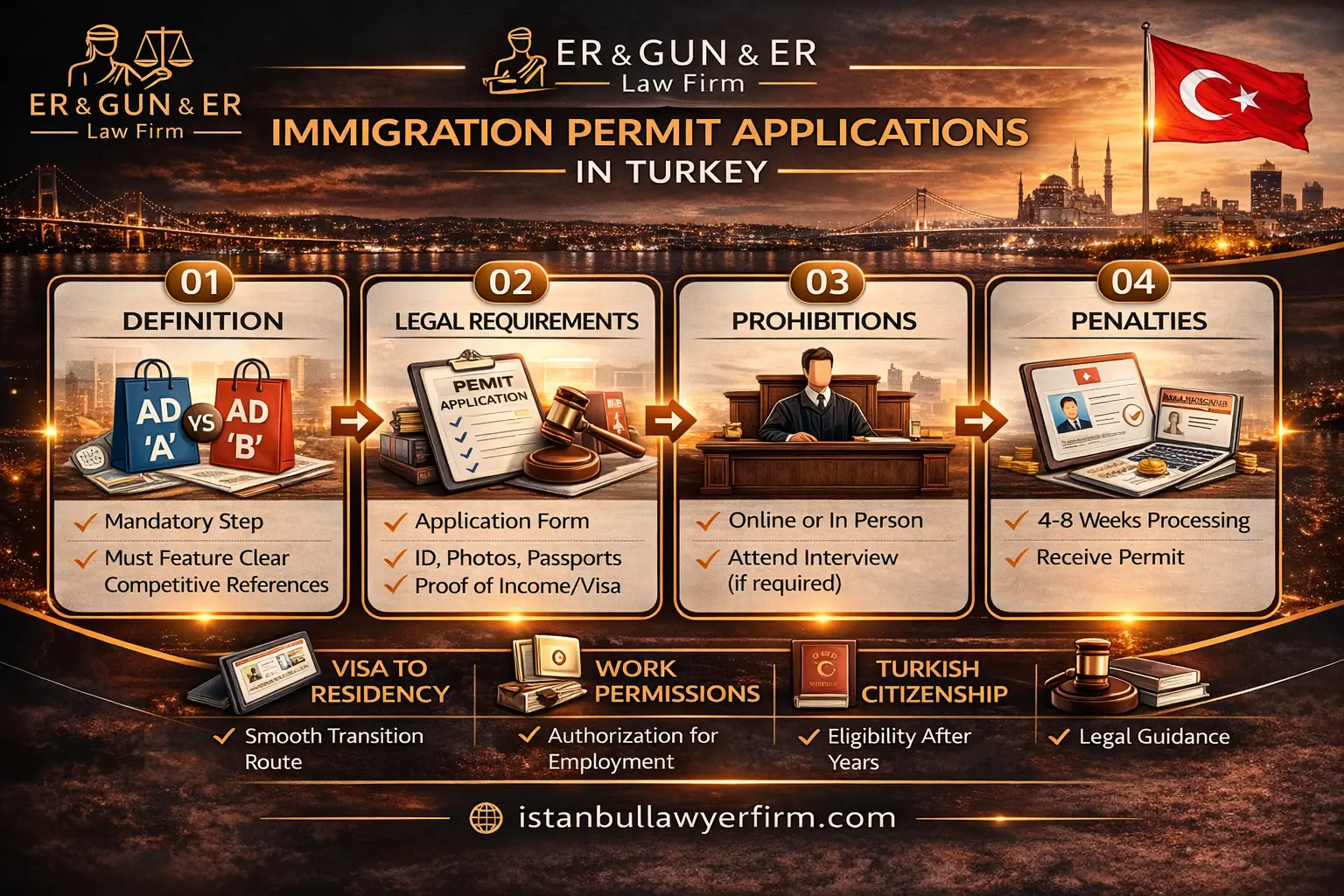
A lawyer in Turkey who advises on immigration permit applications understands that immigration status in Turkey is managed through a set of permits that do different legal jobs and require different evidence—and that the most common source of application failures is not substantive ineligibility but rather a mismatch between the story presented in the application form and the story told by the supporting documents. An Istanbul Law Firm that advises on immigration permit applications for expats provides the integrated procedural guidance covering every stage from permit type selection through ongoing compliance: identifying which permit category correctly matches the applicant's actual purpose of stay and proving it with a coherent evidence file; building the core document pack for identity, entry, address, and insurance in a format that can be reused at renewal without reconstructing history; managing the e-ikamet application Turkey portal submission to ensure form data matches exhibit data; coordinating notarization and translation with a token sheet that prevents the name and date drift that causes avoidable rejections; maintaining address and insurance compliance as ongoing obligations rather than one-time uploads; planning renewals as controlled projects that test continuity rather than repeating a first application; managing work permit authorization as a separate but related status stream; and responding to rejections and enforcement measures through structured, document-led remedy processes. A Turkish Law Firm that advises on immigration applications for foreign nationals understands that the Directorate of Migration Management Turkey makes decisions from the documentary record rather than from personal narratives—and that a well-organized, indexed, internally consistent evidence file consistently produces more reliable results than a persuasively written application supported by a fragmented document pack. An English speaking lawyer in Turkey who advises on immigration permit applications provides the bilingual guidance that enables expats to build the correct evidence file and navigate Turkish immigration procedures without the language barrier creating additional compliance risk. Practice may vary by authority and year — verify current permit category requirements, current document acceptance standards, current portal procedures, and current provincial office practices with qualified counsel before submitting any immigration application in Turkey, since the administrative requirements can change in ways that affect the specific obligations applicable to each applicant's situation, and since provincial office practice can differ from central guidance in ways that make local professional advice more reliable than general procedural descriptions. Practice may vary by authority and year.
Immigration Permits Overview: Permit Types, Categories and Filing Logic
A lawyer in Turkey who advises on immigration permit applications explains that the first practical step for any expat planning to remain in Turkey beyond the initial visitor period is to identify which permit type correctly matches their actual purpose of stay—because the permit is not only a label but a proof framework that defines what documents are expected, what ongoing conditions must be maintained, and how the file will be evaluated at renewal. An Istanbul Law Firm that advises on permit type selection helps expats understand the specific categories most significant for each situation: short-term residence permits for general residence purposes including property owners and certain other declared profiles; family residence permits based on civil status ties to Turkish citizens or legal residents; student residence permits based on active enrollment at Turkish educational institutions; work permits that serve as both employment authorization and lawful stay basis under employer sponsorship; and long-term residence permits for individuals who have maintained stable lawful continuous presence for the required period. Turkish lawyers advising on permit selection help expats understand the critical principle that the category must match real-life facts—selecting a category because it appears simpler while the real situation fits a different category creates a consistency problem that becomes visible during renewal review when the officer compares the declared purpose against documented behavior, and that the compliance obligations specific to each category must be planned for from the beginning of the permit period rather than managed reactively when renewal approaches. Practice may vary by authority and year.
An Istanbul Law Firm that advises on the filing logic for Turkish immigration applications explains that the application system is document-led and evidence-driven rather than explanation-driven—meaning that each element of the application form should be treated as a declaration linked to a specific supporting exhibit, and that the overall file should be organized so a reviewer can verify any statement quickly without inference. Turkish lawyers advising on filing logic help expats implement the specific approach most effective for each application situation: building an evidence pack with a cover index that lists each exhibit, its date, and what specific element of the application it proves; writing the purpose statement in plain factual language and ensuring it is repeated consistently across forms, cover notes, and interview answers; maintaining a submission log that records portal confirmation numbers, appointment reference numbers, and any official receipts as dated exhibits; and using a token sheet that records the applicant's name exactly as spelled in the passport to prevent the identity inconsistencies that are among the most common triggers for authority requests. An English speaking lawyer in Turkey who manages immigration application files for expats provides the quality-control function that tests the file for internal consistency before submission—identifying mismatched names, misaligned dates, and missing exhibits at the preparation stage rather than at the appointment window. Practice may vary by authority and year.
A Turkish Law Firm that advises on immigration compliance obligations explains that permit applications are not isolated events but the starting point of an ongoing compliance relationship—and that the strongest first application is one built as a reusable template for future renewals rather than as a one-time document assembly. An English speaking lawyer in Turkey who advises on immigration compliance for expats in Turkey helps individuals understand that the compliance obligations that attach to each permit category—address registration currency, health insurance continuity, identity token consistency, and purpose-aligned behavior—are evaluated at renewal rather than only at the original application stage. This means that every compliance action taken during the permit period becomes part of the renewal file, and that a well-maintained file with organized address and insurance records, consistent submissions, and documented change events will produce a significantly smoother renewal experience than a file assembled reactively from memory shortly before the permit expires—because the renewal officer's review is backward-looking and the quality of the interim record directly determines how much scrutiny the renewal triggers. Practice may vary by authority and year.
Residence Permit Categories: Short-Term, Family and Student Routes
A lawyer in Turkey who advises on short-term residence permits explains that the short-term residence permit Turkey category covers a wide range of practical fact patterns—including property owners, retirees, and individuals with general residence purposes—and that the central compliance challenge is demonstrating a credible and consistent declared purpose that is supported by a stable address and the required ongoing conditions. An Istanbul Law Firm that advises on short-term permit applications helps expats structure the evidence most effectively for each declared purpose: confirming that the purpose statement is factually accurate and specific enough to be supported by documents rather than vague enough to be questioned; ensuring that address proof is the primary exhibit lane because address evidence is the most commonly challenged element in short-term permit reviews; maintaining continuous health insurance coverage whose policy period aligns with the intended permit period without gaps; and building the file as a template for residence permit renewal Turkey by organizing every exhibit with a consistent naming and dating convention that allows direct reuse at the next filing. Turkish lawyers advising on short-term permits help expats understand that the permit is not a work authorization and that activities that generate income or provide commercial services require a separate work authorization route. Practice may vary by authority and year.
An Istanbul Law Firm that advises on family residence permit Turkey applications explains that the family permit category depends on proving both the qualifying relationship and the sponsor's status—and that the civil status documents proving the family relationship are among the most frequently challenged elements because they often come from foreign jurisdictions with different formats and require legalization and consistent sworn translation. Turkish lawyers advising on family permit applications help applicants structure the evidence most effectively for each family situation: building a legalization plan and a translation plan for civil status documents before collecting any other exhibits; ensuring that name spellings across passports, civil documents, and translated versions are identical using a token sheet; documenting the household address consistently across the sponsor's status records and the applicant's address declarations; confirming that health insurance covers each family member separately with verifiable identity linkage; preparing the sponsor change checklist that identifies what must be updated in the family file whenever the sponsor's address, employment, or permit category changes; and anticipating that children's documents—birth certificates, custody arrangements—may require additional authentication steps that should be initiated early. An English speaking lawyer in Turkey who manages family permit applications coordinates the civil document chain—legalization, translation, and notarization—in a single controlled process rather than allowing different documents to be prepared by different parties with different naming conventions. Practice may vary by authority and year.
A Turkish Law Firm that advises on student residence permit Turkey applications explains that student permits are built around a genuine ongoing education relationship—and that the key compliance challenge is maintaining the enrollment evidence as a living file that is updated when the school issues new letters rather than relying on the original admission document throughout a multi-year program. An English speaking lawyer in Turkey who manages student permit renewals helps students implement the specific filing approach most effective for each academic situation: collecting current enrollment confirmation letters from the institution at the time of each application rather than using older letters that may no longer accurately reflect the student's status; documenting address changes as dated events with supporting official proof since students commonly move between academic years; maintaining insurance coverage whose dates align with the permit period; and planning the first permit application as a template for renewal Turkey by storing each exhibit in a labeled, reusable format alongside its date and source. Practice may vary by authority and year.
Work Permits as Lawful Status, Employer Duties and Route Transitions
A lawyer in Turkey who advises on work permit authorization explains that work permits in Turkey serve a dual function—authorizing the foreign national to perform work activities within the described scope while simultaneously providing the lawful stay basis for the permit period—and that expats must understand this dual function to avoid the common error of assuming that a residence permit held for another purpose also authorizes employment. An Istanbul Law Firm that advises on work permit applications Turkey expats helps workers and employers understand the specific filing approach most effective for each employment situation: confirming the legal employer identity, the employer's authorization to sponsor foreign workers, and the internal HR records that must align with the authorization file before any application is submitted; ensuring that the job title, work location, duties, and reporting line described in the permit application match the employment contract and the actual operational reality—because inspectors compare authorization scope against observed activities; managing the onboarding control so no work tasks begin before the authorization is documented and archived; and maintaining a compliance calendar that monitors permit validity, passport expiry, and any material role changes that require assessment of whether an update to the authorization is needed. Turkish lawyers advising on work permit compliance help both the employer and the employee understand that the permit is a scope document whose conditions must be maintained throughout the employment period rather than a one-time filing whose requirements end at issuance. Practice may vary by authority and year.
An Istanbul Law Firm that advises on employer immigration compliance Turkey explains that the employer's obligations do not end when the work permit is issued—because changes in role, worksite, or employment structure during the permit period can create compliance exposure if they are not assessed against the authorization scope before they take effect. Turkish lawyers advising on employer immigration compliance help companies implement the specific ongoing management approach most effective for each corporate situation: maintaining payroll, attendance, and social security records that are internally consistent with the work permit details so these parallel systems do not contradict the immigration file during inspections; implementing a change management protocol that requires compliance assessment before any role or worksite change for a sponsored foreign worker takes effect; managing travel clearance so foreign employees' status is verified before international travel is approved; and treating termination as a compliance event by closing employment records in HR and immigration systems consistently and promptly. An English speaking lawyer in Turkey who advises on employer immigration compliance for international companies provides the coordination across HR, payroll, and immigration records that prevents the most common type of inspection finding—internal system inconsistency that creates the appearance of unauthorized activity even when the underlying employment was lawful—and maintains the standardized file structure and token sheet that ensures every new hire in the company follows the same documentation approach rather than each case being managed differently by whichever manager first encounters the new employee. Practice may vary by authority and year.
A Turkish Law Firm that advises on route transitions from residence permits to work permits explains that switching from a residence-based stay to an employment-based stay should be managed as a controlled transition with explicit documented change events rather than as parallel filings with different declared purposes. An English speaking lawyer in Turkey who manages route transitions for expats helps individuals implement the specific approach most effective for each transition situation: preserving the prior permit history and the prior declarations as the baseline from which the transition is assessed for consistency; documenting the date employment began and confirming that no work was performed before authorization was obtained; planning the transition timeline to avoid gaps in lawful stay between the end of the residence basis and the beginning of the employment-based stay; and ensuring that address registration and insurance records are updated to remain consistent with the new employment-based status. Practice may vary by authority and year.
Document Preparation: Core Checklist, Notarization and Translation Standards
A lawyer in Turkey who advises on document preparation for immigration applications explains that the core checklist for a Turkish residence permit application should be organized as an evidence map rather than a random document collection—with each item identified as proof of a specific element: identity and entry, purpose of stay, address and registration, health insurance and coverage continuity, and financial capacity where required by the specific category. An Istanbul Law Firm that advises on document preparation helps expats structure the evidence pack most effectively for each permit type: building the checklist as an indexed exhibit set where every item has a label, a date, and a specific element it proves; using a data sheet prepared from the passport before completing any form to prevent name and number inconsistencies between portal entries and paper documents; storing originals, certified copies, and translated versions in separate clearly-labeled folders to prevent mix-up during appointment; and treating the checklist as a reusable template for residence permit renewal Turkey by labeling each exhibit in a format that supports direct reuse at subsequent filings. Turkish lawyers advising on document preparation help expats understand that missing documents at appointment cannot be resolved with verbal explanations and that the application will typically be paused or rejected—making pre-appointment document readiness the single most practically significant factor in application success, and that the effort invested in organizing a complete indexed file before booking the appointment is consistently recovered through a faster, smoother appointment process. Practice may vary by authority and year.
An Istanbul Law Firm that advises on notarization and translation for immigration applications explains that translation and notarization failures are one of the most common sources of application rejection—not because the underlying civil documents are incorrect but because identity tokens drift between the source document and the translation due to different transliteration conventions or different name format choices by different translators. Turkish lawyers advising on translation compliance help expats implement the specific approach most effective for preventing token drift: creating a token sheet before any translation is commissioned that records the applicant's name, date of birth, and document numbers exactly as they appear in the passport; checking every translation against the token sheet before notarization because post-notary corrections are significantly more time-consuming than pre-notary checks; keeping the source document, the sworn translation, and the notary certification pages together as one exhibit bundle in the file; and confirming that the notary pages reference the correct source document without omitting any annexes that contain relevant identifying data. An English speaking lawyer in Turkey who coordinates notarization and translation for immigration application files manages the quality-control process in a way that ensures semantic consistency across all translated terms—preventing situations where a role title, relationship description, or address element is translated differently on two documents in the same application file, which can cause the reviewer to question whether two different translations are describing the same person or the same property. Practice may vary by authority and year.
A Turkish Law Firm that advises on power of attorney for immigration applications explains that when an expat will not personally attend filings or manage communications with the Directorate of Migration Management Turkey, the representation authority chain must be prepared early and must use the same name tokens as every other document in the file. An English speaking lawyer in Turkey who prepares power of attorney for residence permit Turkey arrangements helps expats understand the specific documentation most effective for each representation situation: ensuring the authority document specifically covers the tasks the representative will perform—including attending appointments, submitting documents, and receiving official correspondence; using the exact passport spelling of the principal's name in the power of attorney so it matches the application form and all exhibits; and storing the notarized and translated authority document with the main application file rather than in a separate location where it might be missing when needed. Practice may vary by authority and year.
Address Registration, Insurance Compliance and Portal Submission
A lawyer in Turkey who advises on address compliance explains that address proof is consistently the most fragile element of Turkish residence permit applications for expats—because it connects to both the documentary requirement of a verifiable lease or accommodation proof and the administrative requirement of address registration for foreigners Turkey that links the applicant to a provincial file, and because inconsistencies between the declared address in the portal and the address in the lease or registration system are among the most common triggers for additional authority scrutiny. An Istanbul Law Firm that advises on address compliance for expats helps individuals structure the address evidence most effectively for each accommodation situation: treating every address change as a compliance event requiring prompt documentation with a dated lease bundle and any available official registration confirmation; normalizing the address format to a single consistent string that matches the official record rather than allowing abbreviation and capitalization differences to create apparent inconsistencies across documents; maintaining an address change log that records the date each move occurred and the documentary proof used so that the officer reviewing a renewal can trace the address history without inference; and confirming before every portal submission that the address entered in the e-ikamet application Turkey form exactly matches the address shown in the lease bundle being submitted as the primary exhibit. Turkish lawyers advising on address compliance help expats understand that even a genuine stable address can create problems if its documentation is inconsistent—and that investing in proper address documentation at the beginning of the permit period avoids the need to reconstruct or explain inconsistencies at renewal. Practice may vary by authority and year.
An Istanbul Law Firm that advises on health insurance compliance for residence permit applications explains that health insurance for residence permit Turkey is a recurring acceptance gate whose management requires ongoing attention because the insurance must be continuously in force throughout the permit period and must be documented in a way that allows the authority reviewer to verify coverage quickly. Turkish lawyers advising on insurance compliance help expats implement the specific management approach most effective for each insurance situation: storing the full policy text—not only a summary page—with payment evidence and any renewal endorsements in the same archive as the permit file; ensuring the insured party's name and identification tokens match the passport spelling exactly throughout the policy period; tracking insurance validity end dates separately from permit validity end dates and triggering insurance renewal before coverage gaps occur; and confirming that dependent family members have individually traceable coverage records rather than assuming inclusion in a family policy without documentary verification. An English speaking lawyer in Turkey who coordinates insurance compliance for expat clients provides the pre-submission audit that confirms the insurance documentation matches current authority acceptance standards before the application is assembled—preventing the common situation where an expat believes their insurance is compliant but the documentation does not clearly show coverage dates and named insured in a format the reviewing officer can quickly verify. Practice may vary by authority and year.
A Turkish Law Firm that advises on the e-ikamet application Turkey portal process explains that the online application portal is not a scheduling tool but a declaration system—and that each field entered must be treated as a statement linked to the supporting exhibits rather than as administrative data entry that can be corrected informally if it does not match the documents. An English speaking lawyer in Turkey who manages portal submissions for expat clients implements the specific discipline most important for each submission: preparing all supporting documents and completing the token sheet before entering any data in the portal so that name spellings, document numbers, and addresses are copied from verified sources rather than typed from memory; saving the portal submission confirmation and any generated output form as dated exhibits immediately after submission; treating any post-submission correction as a change log event with a record of what was changed and why; and confirming that the printed or saved portal output matches the entered data before assembling it with the exhibit pack for the appointment. Practice may vary by authority and year.
Renewal Strategy, Category Switching and Long-Term Residence Planning
A lawyer in Turkey who advises on residence permit renewal Turkey explains that renewal is evaluated as a continuity review rather than a fresh application—meaning that officers compare the current declared facts against the prior application record, the address and insurance history during the permit period, and the travel patterns that either support or undermine the claimed residence intent. An Istanbul Law Firm that advises on renewal strategy helps expats implement the specific renewal approach most effective for each permit history situation: beginning with an internal continuity audit that checks address record currency, insurance continuity dates, identity token consistency across old and new passports, and whether any category-defining fact has changed; compiling the prior permit approvals and submission receipts to allow the officer to see the full lawful stay history without searching multiple systems; explaining any address changes, employment changes, or status transitions as documented events with dated exhibit bundles rather than as background context; and updating the token sheet before portal entry so the renewed application uses exactly the same name spellings as prior accepted submissions unless a documented correction is needed. Turkish lawyers advising on renewal strategy help expats understand that a renewal file that presents a coherent chronological story consistently produces better results than one that appears to be assembling documentation at the last moment—and that the internal continuity audit conducted before renewal preparation is the most reliable way to identify compliance gaps when there is still time to cure them rather than discovering them at the appointment window. Practice may vary by authority and year.
An Istanbul Law Firm that advises on category switching explains that switching permit categories should be treated as a controlled transition with documented change events rather than as a cosmetic update—because the officer reviewing the new application will compare the new declared basis against prior applications and will expect any change to be explained by documented changes in the applicant's real situation. Turkish lawyers advising on category switches help expats implement the specific transition approach most effective for each switching scenario: writing a transition memo that identifies the old basis, the new basis, and the date the relevant change occurred; preserving prior permit history, prior declarations, and prior submission receipts as the baseline against which the switch is assessed for consistency; ensuring that address and insurance records are updated to reflect the new basis period; and confirming that the new permit application does not contradict prior declarations unless the contradiction is explicitly explained and supported by objective dated evidence. An English speaking lawyer in Turkey who manages category transitions for expats provides the single-coordinator oversight that prevents the inconsistent narratives that arise when applicants submit parallel applications to different offices with different declared purposes—maintaining one master chronology and one approved narrative memo that every new filing is checked against before submission. Practice may vary by authority and year.
A Turkish Law Firm that advises on long-term residence planning explains that the long-term residence permit Turkey pathway requires building and maintaining a multi-year evidence archive whose organization and consistency are at least as important as the period of continuous presence. An English speaking lawyer in Turkey who advises on long-term residence planning helps expats implement the specific archive approach most effective for each residence history: creating an indexed permit history tab that covers every prior approval and renewal receipt for the full required period; maintaining an address history tab with dated proofs of each registered address and a reconciliation note for any municipal changes to street names or building identifiers; keeping an insurance history tab showing continuous coverage without gaps; and recording a travel history ledger with documented significant absences whose presence in the file shows the applicant is presenting a transparent account of their residence rather than concealing information. A lawyer in Turkey for immigration permit applications combines knowledge of the Law on Foreigners and International Protection No. 6458, residence permit category eligibility requirements, work permit authorization procedures, address registration obligations, health insurance compliance standards, e-ikamet portal procedures, notarization and translation requirements, renewal assessment methodology, enforcement risk management, and administrative objection and court appeal procedures with the English-language communication that enables expats to navigate Turkish immigration applications effectively. Practice may vary by authority and year.
Overstay Risk, Entry Bans and Enforcement Measures
A lawyer in Turkey who advises on overstay prevention explains that overstay risk is primarily a tracking and systems failure rather than a substantive ineligibility problem—and that the most effective prevention approach is building a personal compliance system that monitors the lawful stay expiry date, the permit validity end date, and the renewal preparation window as distinct tracked items with internal alerts that trigger action well before any deadline. An Istanbul Law Firm that advises on visa overstay penalties Turkey compliance helps expats understand the specific risk management approach most important for each compliance situation: treating the lawful stay expiry date as a hard planning deadline rather than an approximate guideline; preserving entry stamps, exit stamps, and permit card copies in an organized travel file that can be retrieved immediately if questions arise at a border interaction; documenting every filing step—submission confirmations, appointment references, and official receipts—so the file can demonstrate diligent compliance intent if the timeline is ever questioned; and acting promptly when a potential overstay risk is identified because early action consistently produces more options than crisis response. Turkish lawyers advising on overstay compliance help expats understand that the consequences of overstay depend heavily on the specific documented facts—the duration, whether any application was pending, and the applicant's complete status history—and that general information about overstay consequences cannot substitute for assessment of the individual's specific record, which is why maintaining organized entry, exit, and filing records from the beginning of the stay is the most practical protection against unexpected enforcement at a later border interaction. Practice may vary by authority and year.
An Istanbul Law Firm that advises on entry ban risk management Turkey explains that entry restrictions are often discovered only at a subsequent border interaction—which means that proactive maintenance of a clean immigration record is the most effective protection against this risk rather than reactive response after the restriction has already been recorded. Turkish lawyers advising on entry ban situations help expats implement the specific response approach most effective for each restriction scenario: preserving any written notice or border reference number received as a compliance artifact to be stored and referenced; avoiding repeated unplanned border attempts that generate additional adverse records without a documented strategy; building a complete factual chronology of entries, exits, filings, and status records before any challenge or inquiry is made; and—where the restriction appears to be based on an incorrect identity match or date calculation—identifying the specific documentary discrepancy that explains the error before filing any challenge. An English speaking lawyer in Turkey who advises on entry ban situations helps expats understand that the entry ban appeal Turkey process is an evidence-led procedural pathway whose success depends on building a coherent documented case file rather than on persuasive informal arguments about what should have happened—and that the file should be assembled before any communication with the authority is initiated, because statements made without a complete factual record are difficult to retract if they prove inconsistent with the documentary evidence. Practice may vary by authority and year.
A Turkish Law Firm that advises on deportation proceedings for foreign nationals explains that when enforcement measures escalate beyond an entry ban to deportation or removal, the quality and organization of the individual's documentation becomes the most practically significant factor in both the speed of legal response and the availability of procedural remedies. An English speaking lawyer in Turkey who advises on deportation appeal Turkey situations helps individuals implement the specific response approach most effective for each enforcement situation: obtaining the written decision and preserving the notification proof as the first priority because both the appeal deadline and the available remedies depend on what was formally decided and when formal notification occurred; compiling a complete chronology of the prior permit and address history that demonstrates lawful compliance throughout the residence period; and coordinating a single narrative and a single communication channel so that statements made to different offices by different parties are consistent rather than contradictory. Practice may vary by authority and year.
Rejections, Administrative Objections and Practical Remedy Procedures
A lawyer in Turkey who advises on permit rejections explains that many residence permit rejections are driven by evidential gaps—missing documents, inconsistent identity tokens, misaligned insurance dates, or mismatched address formatting—rather than by substantive ineligibility, which means that the first analytical step after receiving a rejection is to conduct a structured gap audit comparing the rejection's stated reasons against the submitted evidence pack. An Istanbul Law Firm that advises on rejection response helps expats implement the specific gap audit approach most effective for each rejection type: identifying precisely which document was missing or which data was inconsistent in the submitted file; preparing a cure bundle that addresses the stated reason with official documentary evidence rather than explanatory letters; writing a short factual memo that describes the cure and links it to the dated exhibits; and preserving both the original submission and the correction as versioned exhibits in the change log so future filings can show how the issue was addressed. Turkish lawyers advising on rejection response help expats understand that submitting a corrected file is typically more effective than arguing about whether the rejection was justified—because the authority's evaluation process is evidence-driven and a complete corrected file resolves the stated concern directly, and because the gap audit approach prevents the common response failure of submitting an additional document that does not address the actual stated reason for rejection. Practice may vary by authority and year.
An Istanbul Law Firm that advises on administrative objections in immigration cases explains that where a permit decision warrants formal challenge rather than a voluntary correction, the objection should be structured as an indexed, evidence-backed request that addresses the stated reasoning of the decision rather than a general complaint about the outcome. Turkish lawyers advising on administrative objection procedures help expats implement the specific objection preparation approach most effective for each case situation: identifying the issuing authority, the decision date, and the reference number; stating the specific remedy requested in operational terms; attaching an indexed exhibit set that directly responds to each stated reason; using the same name tokens, date formats, and address strings as the prior application so the objection file reads as a continuation of the same coherent record; and preserving the filed objection bundle and the proof of submission as dated exhibits in the master compliance file. An English speaking lawyer in Turkey who manages administrative objections for expat clients provides the bilingual quality check that ensures the Turkish-language objection accurately reflects the client's factual position and maintains complete consistency with all prior submissions. Practice may vary by authority and year.
A Turkish Law Firm that advises on remedy planning after immigration enforcement explains that where more serious enforcement measures are involved—including entry bans, deportation orders, or removal proceedings—the remedy must be managed as a separate, urgent legal project rather than as a continuation of the routine permit compliance process. An English speaking lawyer in Turkey who advises on enforcement remedy procedures helps expats understand that deportation-related processes differ procedurally from routine residence permit administration in timing, evidence requirements, and the interaction between administrative objection and court appeal—and that any response strategy must be calibrated to the specific formal classification of the measure issued. Practice may vary by authority and year — verify current procedural requirements, current appeal deadlines, and current remedy availability for each decision type with qualified counsel before taking any action based on general guidance about Turkish immigration enforcement procedures, since the specific remedies and timelines applicable to enforcement measures have been subject to administrative and legislative developments whose current versions determine what is actually available in each individual situation. Practice may vary by authority and year.
Frequently Asked Questions
- What is the first step in applying for a residence permit in Turkey? The first step is identifying which permit category correctly matches your actual purpose of stay, then building an evidence pack with an indexed set of exhibits that proves identity and lawful entry, purpose, address, and health insurance coverage. The application form should be completed from a data sheet prepared from your passport to prevent inconsistencies. All supporting documents should be ready before the appointment is booked. Practice may vary by authority and year.
- What categories of residence permits are available to expats in Turkey? Available categories include short-term permits for general residence purposes including property owners; family permits based on qualifying civil status ties; student permits based on active enrollment; and long-term permits for individuals with stable continuous lawful residence over the required period. Work permits serve as both employment authorization and lawful stay basis under employer sponsorship. Category selection must match genuine declared facts. Practice may vary by authority and year.
- How does the e-ikamet online application portal work? The e-ikamet application Turkey portal is the online system for submitting residence permit applications. Each field should be treated as a declaration linked to a supporting exhibit. Prepare a token sheet from your passport before entering any data so names and numbers are copied from verified sources. Save the submission confirmation and the generated output form as exhibits immediately after submitting. Practice may vary by authority and year.
- What address documentation is required for a Turkish residence permit? The declared address in the portal must match the address in the lease or accommodation documentation, and both must be consistent with any official address registration. A signed, complete lease with landlord identity pages is the standard primary proof for most situations. Address changes during the permit period should be documented as dated events with new lease bundles and any available official registration confirmation. Practice may vary by authority and year.
- What health insurance is required for a Turkish residence permit? Health insurance for residence permit Turkey must cover the applicant for the intended permit period without gaps. The policy text showing the named insured, coverage dates, and coverage scope should be stored in the application file. The insured person's name must match the passport spelling exactly. Dependent family members require individual verifiable coverage records. Practice may vary by authority and year.
- How should documents from foreign countries be prepared for Turkish immigration applications? Foreign documents typically require legalization—apostille from Hague Convention countries or consular authentication from others—and sworn translation by a court-registered translator. A token sheet should be prepared before commissioning translations to ensure name spellings are consistent across all documents. Source documents, translations, and notarization pages should be kept together as a single exhibit bundle. Practice may vary by authority and year.
- Can an agent or lawyer submit a residence permit application on behalf of an expat? Yes, representation is possible through a properly prepared power of attorney for residence permit Turkey. The authority document must specifically cover the tasks the representative will perform and must use the exact passport spelling of the principal's name. The notarized and translated authority document should be included in the main application file. Practice may vary by authority and year.
- How should residence permit renewal Turkey be approached? Renewal should begin with an internal continuity audit checking address currency, insurance continuity, passport and identity token consistency, and whether any category-defining facts have changed since the prior permit. Prior approvals and submission receipts should be compiled to show the continuous permit history. Any changes during the permit period should be documented as dated events with supporting exhibits. Practice may vary by authority and year.
- How does a work permit serve as lawful status in Turkey? A Turkish work permit authorizes the foreign national to work within the scope described in the authorization and simultaneously provides the lawful stay basis for the permit period. Both the employer and the worker must ensure actual activities match the authorized scope throughout the permit period. The permit does not cover activities outside the described role. Practice may vary by authority and year.
- What should an expat do if their residence permit application is rejected? The first step is to identify the formal stated reason for the rejection and to conduct a gap audit comparing that reason against the submitted evidence. Many rejections result from evidential gaps that can be cured with official documentation. A corrected file addressing the stated reason with dated exhibits should be assembled as the remedy. The filed bundle should be preserved as a versioned exhibit. Practice may vary by authority and year.
- What are the risks of overstaying a Turkish visa or permit? Overstay creates enforcement risk whose specific consequences depend on the duration of the overstay, the applicant's complete documented entry and status history, and whether any application was pending during the period. The safest approach is to track lawful stay expiry dates as hard deadlines and to document every filing step so diligence can be demonstrated. General information about overstay consequences should not be applied to specific situations without case-specific assessment. Practice may vary by authority and year.
- What should an expat do if they discover an entry ban recorded against them in Turkey? Preserve any written notice or border reference number received, avoid repeated unplanned entry attempts, and build a complete documented chronology of prior entries, exits, filings, and permits before any challenge is initiated. The entry ban appeal Turkey process is evidence-led and requires a structured file rather than informal arguments. Qualified legal advice should be sought before any action is taken. Practice may vary by authority and year.
- How should switching permit categories be managed? Category switching should be treated as a controlled transition with explicit documented change events. A transition memo should identify the old basis, the new basis, and the date the relevant change occurred with supporting exhibits. Prior permit history should be preserved as the baseline for consistency assessment. Address and insurance records should be updated to match the new basis period. Practice may vary by authority and year.
- What is the long-term residence permit pathway in Turkey? The long-term residence permit Turkey requires demonstrating stable lawful continuous presence for the required period through an indexed archive of prior permits and renewals, an address history with dated proofs, continuous insurance records, and a travel ledger that shows the residence was genuine. The pathway is built through years of consistent compliance documentation rather than through a single application. Practice may vary by authority and year.
- Does ER&GUN&ER Law Firm provide legal services for immigration permit applications in Turkey? Yes. ER&GUN&ER Law Firm provides comprehensive legal services for expat immigration permit applications in Turkey including permit category selection, evidence pack preparation, portal submission coordination, notarization and translation quality control, address and insurance compliance review, power of attorney preparation, renewal strategy and continuity audits, category switching advisory, long-term residence planning, work permit and employer compliance coordination, overstay risk assessment, entry ban challenge management, deportation appeal representation, administrative objection drafting, and post-rejection remedy preparation—with English-language client communication and bilingual documentation throughout each engagement.
Author: Mirkan Topcu is an attorney registered with the Istanbul Bar Association (Istanbul 1st Bar), Bar Registration No: 67874. His practice focuses on cross-border and high-stakes matters where evidence discipline, procedural accuracy, and risk control are decisive.
He advises individuals and companies across Immigration and Residency, Real Estate Law, Tax Law, and cross-border documentation matters where procedural accuracy and evidence discipline are decisive.
Education: Istanbul University Faculty of Law (2018); Galatasaray University, LL.M. (2022). LinkedIn: Profile. Istanbul Bar Association: Official website.