

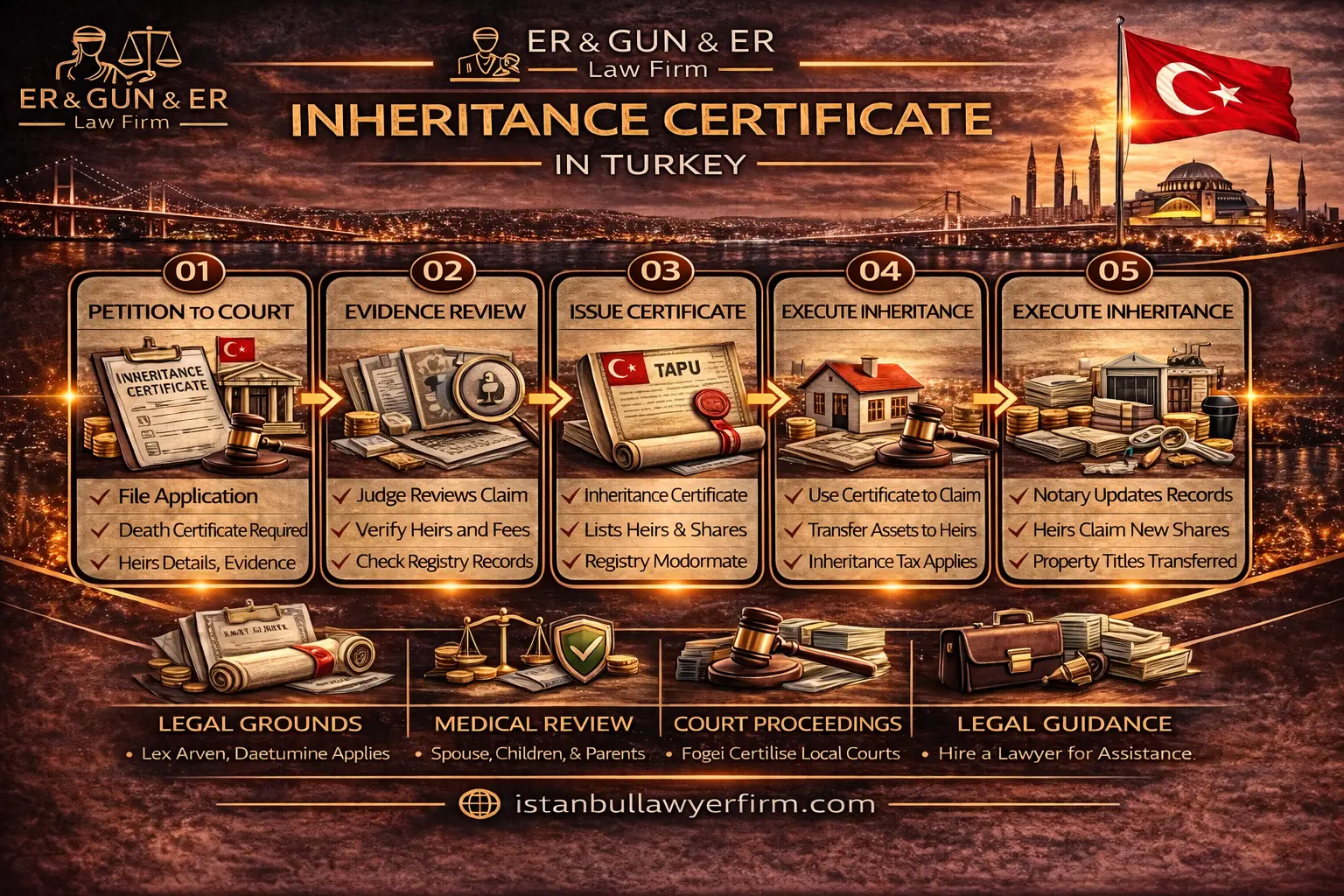
A lawyer in Turkey who advises on inheritance law understands that the inheritance certificate—called veraset ilamı in Turkish practice and referred to in English files as the certificate of inheritance Turkey or heirship certificate Turkey—is the official document that proves who the heirs are and what their shares are, and that it functions as the "standing proof" that banks, land registries, and tax offices require before they will process any estate administration step. An Istanbul Law Firm that advises on inheritance certificate Turkey applications provides the integrated guidance covering every stage of this process: understanding the legal function and institutional effect of the certificate; determining who can apply and which route—court or notary—is appropriate for the specific file; assembling the complete document bundle required for identity, death, and kinship proof; managing the foreign document pathway for international estates including apostille certification and notarized translation; computing shares accurately and avoiding the common errors that cause rejection and downstream blockages; using the certificate to access estate bank accounts and release funds; using the certificate to register inherited title deed shares at the land registry; managing corrections when errors are discovered; and coordinating power of attorney arrangements for heirs who cannot personally attend office steps. A Turkish Law Firm that advises on inheritance certificate applications understands that the certificate is not a private family agreement but a procedural proof designed so that third parties can rely on one standardized share table—and that building this file with disciplined document management, consistent identity tokens, and a coherent heir map is the most practical way to reduce rejections, corrections, and downstream delays. An English speaking lawyer in Turkey who advises on inheritance certificate matters provides the bilingual coordination that enables foreign heirs and international families to navigate the Turkish inheritance administration system without the language barrier creating additional complications at each procedural stage. Practice may vary by authority and year — check current guidance on the applicable route, document requirements, and office acceptance standards before submitting any inheritance certificate application, since the procedural requirements for obtaining and using the certificate can differ between courts, notary offices, and downstream institutions.
Inheritance Certificate Turkey: Legal Framework, Purpose and Institutional Function
A lawyer in Turkey who advises on the legal framework of the inheritance certificate explains that the certificate's core function is procedural proof of heirship and shares rather than a mechanism for creating or distributing inheritance rights—because the Turkish Civil Code's succession rules determine who the heirs are and what their shares are by operation of law, while the certificate simply proves those facts to third parties who need a standardized document to rely on. An Istanbul Law Firm that advises on inheritance certificate applications helps heirs understand the specific institutional functions that make the certificate the first deliverable in any estate administration process: banks use it as the entitlement gate before they will provide account information or release funds to anyone other than an authorized heir; land registries use it as the entitlement gate before they will register inherited shares on the title deed; tax offices use it as the reference document for allocating estate tax declaration entries to the correct heirs with the correct shares; and any other institution or party holding estate assets uses it as the standing proof that establishes who has the right to make requests. Turkish lawyers advising on inheritance certificate function help heirs understand that the certificate does not itself transfer ownership, does not adjudicate disputes about the validity of a will, and does not create an allocation among heirs—but that it enables all subsequent transfer, release, and reporting steps to proceed because institutions have one official document to rely on rather than competing informal claims. Practice may vary by authority and year.
An Istanbul Law Firm that advises on the legal effect of the inheritance certificate explains that the certificate creates an administrative perimeter that protects the estate by preventing unauthorized access—because institutions will not recognize instructions from persons who are not listed on the certificate as heirs with documented shares. Turkish lawyers advising on inheritance certificate legal effect help heirs understand that the certificate forces early identity reconciliation across all family documents, which reduces both later disputes between heirs and later rejections by offices whose records show different name spellings for the same person. An English speaking lawyer in Turkey who advises on inheritance certificate effect for foreign heirs provides the structured explanation that enables international family members to understand what the veraset ilamı Turkey accomplishes in practice—and why it must be treated as the master share table that is reused consistently across bank, registry, and tax lanes rather than as a one-time filing that can be varied at each office. Practice may vary by authority and year.
A Turkish Law Firm that advises on how the inheritance certificate fits within the broader probate process Turkey inheritance certificate framework explains that the certificate should be treated as the first tab in a complete probate evidence pack—because the probate process includes obtaining the certificate, collecting bank and property information using the certificate as standing proof, managing estate tax reporting, executing title transfers, and resolving any disputes, and each of these steps uses the certificate as a foundational exhibit whose accuracy and consistency affects every subsequent step. An English speaking lawyer in Turkey who advises on probate evidence pack design helps heirs implement the specific archive approach most effective for each estate profile: keeping the certificate as the master exhibit that anchors the heir list and share table; building each downstream lane—bank, registry, tax, dispute—around the same certificate version; maintaining a version control rule that ensures all offices receive the current certificate and that old copies are retired when corrections are issued; and storing every office request and response as dated exhibits in a chronology that allows later questions about timing and process to be answered with objective records rather than memory. Practice may vary by authority and year.
Who Can Apply, Route Selection and Jurisdiction Planning
A lawyer in Turkey who advises on application eligibility explains that heirs and other persons with a direct legal interest in proving heirship and shares can apply for the inheritance certificate—and that the application is not automatic but must be initiated by an interested person who provides the evidence required to support the heir map and share computation. An Istanbul Law Firm that advises on inheritance certificate applications helps applicants understand the specific preparation approach most effective for each application profile: confirming the complete heir list before applying rather than filing with an incomplete heir map, because omissions create later correction work and block downstream office processing; building a token sheet from passports and official identity records that defines exactly how each name will appear in all documents and translations; planning for foreign heirs early in the process, because foreign documents require legalization and translation whose completion is often the critical path in the application timeline; and planning for minors and predeceased heirs whose representation requirements and substitution chain proof must be addressed before the file is complete. Turkish lawyers advising on application preparation help heirs understand that the inheritance certificate application Turkey is an evidence-led process rather than a narrative-led process—meaning that each heir, each relationship, and each share must be proven by a specific document rather than asserted through explanation. Practice may vary by authority and year — check current guidance from the applicable office on the specific documents required for the heir profile being presented.
An Istanbul Law Firm that advises on route selection for the inheritance certificate court Turkey versus the inheritance certificate notary Turkey explains that both routes produce the same type of document but are applied through different offices whose suitability depends on the file profile, the complexity of the heir map, and the local office practice. Turkish lawyers advising on route selection help applicants implement the specific evaluation most appropriate for each estate: assessing whether the file is straightforward with all kinship documented in accessible Turkish registry records—which generally supports a notary route—or whether the file involves foreign elements, disputed relationships, contested wills, or unclear marital history—which generally requires a court route; avoiding the assumption that either route is inherently faster, because processing timelines depend on workload, file completeness, and office practice; planning certified copy sets based on the downstream needs for bank, registry, and tax submissions; and preparing a fallback plan so the file is ready to move to the other route without rebuilding everything if the first route declines due to complexity. An English speaking lawyer in Turkey who advises on route selection for international estate files provides the locally-informed guidance that prevents international families from choosing a route that the applicable office cannot process given the foreign document load in the specific file. Practice may vary by authority and year.
A Turkish Law Firm that advises on jurisdiction and venue planning explains that venue is an evidence question rather than an arbitrary choice—because the office that processes the application typically has easier access to the underlying civil registry records associated with the deceased's last registered profile, and a venue that fits the records reduces follow-up requests and rejections. An English speaking lawyer in Turkey who advises on venue planning for inheritance certificate applications helps families implement the specific venue approach most effective for each estate profile: documenting the venue choice in a short factual memo that explains the connection to the record base rather than making administrative arguments; planning a single service address and communications owner where heirs are abroad so office notices are received and logged consistently; keeping the venue file consistent with a token sheet so name spellings do not drift across different submissions to the same office; and ensuring that the certificate produced at the chosen venue will be accepted by the banks, registries, and tax offices where the estate assets are located. Practice may vary by authority and year.
Document Requirements, Death Record Handling and Family Registry Evidence
A lawyer in Turkey who advises on document requirements explains that the documents for inheritance certificate Turkey are best understood as proof bundles organized around four core elements: identity proof for each applicant and each heir linked to a token sheet; death record proof establishing the death event in an office-usable format; kinship proof establishing the relationships between heirs and the deceased through official registry evidence; and representation proof if a power of attorney is used. An Istanbul Law Firm that advises on inheritance certificate document preparation helps applicants build the specific evidence pack most effective for each heir profile: mapping each required document to the specific element it proves so the pack has no unexplained pages; storing the source document, any legalization pages, the translation, and the notary declaration together as a single indexed bundle for every foreign document so no pages are missing when the office reviews the file; preserving every exhibit as a dated item with a stable filename so later corrections and downstream submissions reference the same source; and avoiding the common mistake of mixing asset valuation documents into the certificate pack, because the certificate lane focuses on heirship and shares rather than on what assets exist. Turkish lawyers advising on document requirements help applicants understand that most rejections come not from complicated law but from preventable problems—mismatched name spellings, missing annexes, and incomplete heir maps—and that a disciplined token sheet enforced across every document in the file is the most effective single tool for preventing these problems. Practice may vary by authority and year.
An Istanbul Law Firm that advises on death record handling explains that the death record is the anchor exhibit of the entire inheritance file because every subsequent step depends on confirming the death event in an office-usable format—and that a death record whose identity tokens do not match the deceased's records at banks and registries will cause those institutions to request reconciliation before processing any inheritance step. Turkish lawyers advising on death record management help applicants implement the specific anchor exhibit approach most effective for each estate profile: obtaining the death record in a complete format that includes identity tokens rather than a short extract that omits identifiers; checking that the death record's name and identification data matches the tokens on title and bank records before the certificate application is submitted; storing the death record as a custody-controlled anchor exhibit with high-resolution scans of all stamps and seals; and maintaining one consistent version of the death record across all lanes—certificate, bank, registry, and tax—rather than creating multiple translations with different wording. An English speaking lawyer in Turkey who advises on death record management for cross-border estates where the deceased died abroad provides the specific guidance on how to make a foreign death record usable in Turkish practice through the correct legalization and translation process. Practice may vary by authority and year.
A Turkish Law Firm that advises on family registry evidence explains that registry evidence is the backbone of heir mapping because it provides the official kinship map that courts and notary offices rely on to produce the heir list—and that the accuracy and completeness of the registry evidence directly determines whether the inheritance certificate reflects the correct heir set and the correct shares. An English speaking lawyer in Turkey who advises on registry evidence preparation for inheritance certificate applications helps applicants implement the specific registry approach most effective for each kinship situation: obtaining current registry extracts that include all civil events—marriages, divorces, children, deaths of prior heirs—whose presence or absence affects the heir set and shares; creating a reconciliation memo when name spellings or date formats differ between registry records and passport data; building a short factual family tree memo that cites registry exhibits and helps the office reviewer confirm the heir map without inference; and keeping the registry tab synchronized with the certificate so any later registry correction triggers a corresponding certificate correction. Practice may vary by authority and year.
Foreign Documents, Apostille Certification and Notarized Translation
A lawyer in Turkey who advises on the foreign documents pathway explains that international estates—where the deceased was foreign, where heirs are foreign, or where civil events occurred abroad—require a systematic approach to making foreign civil records usable in Turkish procedure through the legalization and translation pipeline whose completion is often the critical path that determines the overall timeline of the inheritance administration. An Istanbul Law Firm that advises on foreign heirs inheritance certificate Turkey matters implements the specific foreign document approach most effective for each cross-border profile: listing every foreign document needed for the heir map—death records, birth certificates, marriage certificates, divorce records—and assigning each an owner who will manage issuance, legalization, translation, and archiving; confirming the legalization method applicable to each document based on whether the issuing country is within the Hague Convention apostille system or requires consular legalization; bundling the source document with its legalization pages as a single exhibit to prevent the missing-page rejections that are among the most common causes of delay; and applying a token sheet to every translation so name spellings and date formats are consistent across all foreign document bundles. Turkish lawyers advising on foreign document management help families understand that the same legalized and translated bundles should be reused across the certificate application, the bank submission, the land registry filing, and the tax reporting lane rather than producing new translations for each office. Practice may vary by authority and year — verify the correct legalization path for each issuing country with qualified counsel before initiating the foreign document pipeline.
An Istanbul Law Firm that advises on apostille inheritance documents Turkey processing explains that apostille certification—issued by the competent authority of the country that produced the document—is the legalization method applicable when both the issuing country and Turkey are parties to the Hague Convention, and that the apostille verifies the origin authenticity of the document rather than its factual content. Turkish lawyers advising on apostille processing help applicants implement the specific apostille approach most effective for each document type: obtaining the document in the format issued by the competent authority rather than in an unofficial extract; confirming the correct domestic authentication step required in the issuing country before the apostille authority will certify the document; keeping the source document and the apostille pages together as a single bundle with a dated custody log; scanning the completed apostilled bundle in high resolution and storing it in the archive before moving to translation; and recording the apostille reference details in the pipeline memo so the family can confirm completion at each stage. An English speaking lawyer in Turkey who coordinates apostille processing for international estate files provides the foreign document pipeline management that tracks each document from issuance through legalization through translation to archive, preventing the gaps and delays that arise when different heirs manage different documents without coordination. Practice may vary by authority and year.
A Turkish Law Firm that advises on notarized translation inheritance Turkey requirements explains that translation and notarization is the step that converts legalized foreign-language records into Turkish-file exhibits that offices can read and rely on—and that the quality of this step determines whether the translated documents are accepted consistently across all offices or generate repeated rejection requests due to name drift, missing pages, or unclear formalization. An English speaking lawyer in Turkey who manages translation and notarization for inheritance certificate files implements the specific translation approach most effective for each document bundle: providing the translator with a token sheet that defines exactly how each name and date will appear in Turkish so the translator cannot apply different transliteration choices for the same person across different documents; reviewing every translation line by line against the source document before notarization because post-notary corrections require rebuilding the entire bundle; keeping the source document, legalization pages, translation, and notary declaration together as one indexed bundle with a single exhibit number; and maintaining a glossary of kinship relationship terms so different translators do not use different Turkish words for the same relationship—creating semantic drift that later causes confusion about who qualifies as which type of heir. Practice may vary by authority and year.
Share Computation, Common Errors and Certificate Corrections
A lawyer in Turkey who advises on share computation explains that the share table is the practical output that banks, land registries, and tax offices use for every subsequent step—and that share accuracy is more operationally important than the precision of any other element in the certificate, because a wrong share number propagates across every downstream step until it is corrected through a formal process that updates every file in every institution. An Istanbul Law Firm that advises on share computation for inheritance certificate applications helps applicants build the specific computation approach most defensible for each heir configuration: computing shares from the official kinship map reflected in registry evidence rather than from family statements; showing the arithmetic in a reproducible computation memo that references specific registry exhibits for each heir; checking that all fractions sum to the whole by testing the arithmetic before the certificate is issued; and identifying the kinship scenarios that commonly generate computation errors—including the omission of a surviving spouse who changes the shares of all blood heirs; the misclassification of a child as deceased when they actually predeceased the testator and should be represented by their own children through substitution; and the arithmetic error of using incorrect fractional representations for multi-heir families. Turkish lawyers advising on share computation help applicants understand that the certificate's share table will become the master allocator used for bank account releases, title deed registrations, and estate tax declarations—and that a computation error discovered after these steps have been initiated creates a correction process that must be propagated across every institution that has already relied on the incorrect share table. Practice may vary by authority and year.
An Istanbul Law Firm that advises on correcting inheritance certificate Turkey explains that corrections are possible through proper official channels and must be handled systematically rather than informally because the corrected certificate must replace every instance of the old certificate across all institutions that have already received it. Turkish lawyers advising on certificate correction management help families implement the specific correction approach most effective for each error type: identifying the error precisely and tying it to a specific supporting document such as a registry extract or a corrected civil record; building a correction pack with an indexed exhibit set that shows both the error and the evidence that supports the proposed correction; documenting the discovery of the error as a dated event whose record supports later questions about when correction was possible; pursuing the correction through the issuing office rather than patching the existing certificate with handwritten notes or unofficial addenda whose modification will not be accepted by banks and registries; and propagating the corrected certificate to every institution that received the old version—maintaining a "retire old copies" memo that instructs all heirs and representatives to stop using the superseded version. An English speaking lawyer in Turkey who manages certificate correction coordination provides the centralized propagation service that ensures every bank, land registry, and tax file is updated to reflect the corrected share table without the family having to manage this simultaneously across multiple institutions. Practice may vary by authority and year.
A Turkish Law Firm that advises on practical error prevention for inheritance certificate files explains that most corrections could be prevented through three specific controls applied before the certificate application is submitted: a token sheet check that verifies every name in the heir list against the same spelling used in all supporting documents; a completeness check that confirms every heir recognized by the succession rules appears in the application with the kinship proof required to support their inclusion; and a computation audit that tests the arithmetic of the share table and confirms that the fractions are correctly calculated given the applicable substitution rules for any predeceased heirs. An English speaking lawyer in Turkey who provides pre-submission audit services for inheritance certificate applications performs these three checks on the completed document pack before the application is submitted—reducing the probability that the certificate is issued with an error that triggers both a correction process and a downstream propagation exercise across all institutions. Practice may vary by authority and year.
Using the Certificate for Bank Account Access and Fund Release
A lawyer in Turkey who advises on bank account access in inheritance situations explains that the inheritance certificate for bank account Turkey is the primary standing proof that banks require before they will provide account balance information, account history, or authorization for fund release to any heir or heir representative—and that preparing a dedicated bank pack that combines the certificate with identity proofs and the bank's own checklist creates a smoother interaction than arriving at the bank with unorganized documents. An Istanbul Law Firm that advises on bank access for inheritance matters helps heirs implement the specific bank approach most effective for each estate profile: preparing the bank pack with a certified copy of the certificate, identity documents for the heirs or the authorized representative, and any additional documents the specific bank has identified as required; preserving the bank's request list as a dated exhibit because bank acceptance practice can differ by institution and branch; maintaining a bank communication log that records who contacted the bank, what was requested, what was submitted, and what was received; and keeping a single spokesperson rule so the bank does not receive conflicting instructions from different heirs making different requests with different document versions. Turkish lawyers advising on bank access help heirs understand that token consistency between the certificate and the bank's customer record is the most common practical obstacle—and that a name mismatch between how the deceased or an heir appears in the certificate and how they appear in the bank's records will require reconciliation evidence before the bank will proceed. Practice may vary by authority and year.
An Istanbul Law Firm that advises on fund release from estate accounts explains that the distribution of funds from estate accounts among heirs requires both the certificate as the standing proof and a distribution agreement or distribution plan that records how the funds are allocated by share—and that keeping these two documents in separate lanes prevents confusion between the official standing proof and the internal family governance document. Turkish lawyers advising on fund release management help heirs implement the specific distribution approach most effective for each family configuration: maintaining a distribution memo that records how funds were allocated among heirs by their certified shares supported by bank receipts and transfer confirmations; keeping the distribution memo as a family governance document that is stored separately from the official bank correspondence; coordinating the fund release with the tax reporting lane because bank distributions from estate accounts must typically be reflected in the estate tax declaration whose structure uses the same share table as the certificate; and preserving the bank's confirmation of each distribution as a dated exhibit that can be referenced in later accounting, disputes, or tax proceedings. An English speaking lawyer in Turkey who advises on fund release coordination for estates with foreign heirs provides the cross-border management that ensures foreign heirs can receive their shares through international transfer arrangements that satisfy both Turkish bank requirements and the foreign heir's receiving country's documentation expectations. Practice may vary by authority and year.
A Turkish Law Firm that advises on bank evidence preservation for estate files explains that bank documents from estate accounts—statements, release confirmations, distribution records, and correspondence—often become evidence in later disputes about disguised gifts, unauthorized transactions, and capacity challenges, and that preserving this evidence systematically from the beginning of the estate administration creates a protective record that supports any future dispute position. An English speaking lawyer in Turkey who advises on bank evidence preservation for inheritance files helps families implement the specific archive approach that treats bank documents as a permanent exhibit set rather than as transactional paperwork that can be discarded after the distribution is complete. A lawyer in Turkey for inheritance certificate matters combines knowledge of the Turkish Civil Code succession rules, the inheritance certificate application procedure through both court and notary routes, the document requirements for domestic and foreign heir profiles, the share computation logic, the bank access and fund release mechanics, the land registry registration procedure, the estate tax reporting framework, the correction procedure, and the power of attorney requirements with the English-language communication that enables foreign heirs and international families to navigate the Turkish inheritance administration system effectively. Practice may vary by authority and year.
Using the Certificate for Title Deed Transfer and Real Estate Registration
A lawyer in Turkey who advises on title deed transfer in inheritance situations explains that the inheritance certificate for title deed transfer Turkey is the entitlement proof that land registry offices require before they will register inherited shares on the title deed—and that combining the certificate with the property-specific documents that identify the parcel creates the registration pack that enables the formal title change that converts inherited shares from a legal right into a registered ownership entry. An Istanbul Law Firm that advises on title deed registration for inherited property helps heirs implement the specific registry approach most effective for each property profile: preparing one property tab per parcel with the parcel identifier, the current title extract showing the deceased as registered owner, and any encumbrance or annotation information that affects the registered status; verifying that the identity tokens in the certificate match the spelling of the deceased's name in the title record, because older title records can contain transliteration differences that must be reconciled before registration will proceed; confirming that the certificate share table covers all heirs who will be registered, because the registry will register the shares as stated in the certificate without modification; and obtaining an updated title extract after registration to confirm the new registered ownership and preserve it as the closing exhibit of the property lane. Turkish lawyers advising on title deed registration help heirs understand that registered co-ownership—which results from inheriting a property along with other heirs—creates a governance need because all co-owners must consent to sale, mortgage, or other disposals of the property. Practice may vary by authority and year.
An Istanbul Law Firm that advises on real estate administration in inheritance situations explains that the title registration of inherited shares is often just the beginning of the real estate management challenge, because co-owned inherited property requires heirs to coordinate on use, maintenance costs, tax obligations, and eventual disposition—and that the absence of a co-ownership governance arrangement creates friction that increases over time as the co-owners' interests diverge. Turkish lawyers advising on co-ownership governance for inherited real estate help heirs implement the specific coordination approach most effective for each property and family configuration: documenting the co-owners' decisions about property use and cost allocation in a dated memo that is stored separately from the official registry submission; confirming whether any heir intends to request a formal partition of the inherited property, which would require a separate process; and ensuring that estate tax obligations associated with inherited real estate are addressed in coordination with the tax reporting lane rather than ignored while the registration focus consumes all attention. An English speaking lawyer in Turkey who advises on inherited real estate management for international families provides the coordinated advisory that connects the title registration step to the ongoing ownership governance and eventual disposition planning in a single coherent strategy. Practice may vary by authority and year.
A Turkish Law Firm that advises on real estate inheritance fraud prevention explains that early and consistent use of the inheritance certificate for requesting official property history and for initiating title registration creates a dated record of the heirs' active management of the estate—which both protects the estate from unauthorized transactions during the administration period and provides standing evidence for any later objection to transactions that occurred before registration. An English speaking lawyer in Turkey who advises on real estate inheritance fraud prevention for foreign heir families provides the monitoring and response service that identifies unauthorized title changes through periodic title extract requests and coordinates the formal objection procedures available through the land registry when unauthorized transactions are detected. Practice may vary by authority and year — verify current land registry procedures for inherited property registration and current procedures for monitoring and objecting to unauthorized transactions with qualified counsel before submitting any registration request.
Power of Attorney, Representation and Long-Term Compliance Management
A lawyer in Turkey who advises on power of attorney use in inheritance administration explains that a properly drafted and legalized power of attorney is often the practical tool that enables foreign heirs and heirs who cannot personally attend Turkish offices to participate in the inheritance certificate application, bank access, land registry registration, and tax reporting steps without being physically present at each office. An Istanbul Law Firm that advises on power of attorney preparation for inheritance matters implements the specific authority instrument most effective for each representation scenario: drafting the scope to specifically cover the steps the representative will perform—applying for and collecting the inheritance certificate, submitting documents to banks and registries, signing tax declarations—rather than using a generic template whose scope may not clearly cover the specific required actions; ensuring that the identity tokens in the authority instrument match the token sheet used throughout the inheritance file so the representative's name and the authorizing heir's name appear in exactly the same form as in all other documents; confirming the correct legalization method—apostille or consular—for the country where the authority is signed; and planning the translation and notarization of the authority instrument as part of the same foreign document pipeline used for other foreign civil documents in the file. Turkish lawyers advising on power of attorney preparation for inheritance matters help heirs understand that an authority whose scope does not clearly cover a required step will be rejected by the office whose function requires that specific coverage, creating delays that require a corrected or supplementary authority. Practice may vary by authority and year.
An Istanbul Law Firm that advises on representation management in inheritance administration explains that designating one coordinator who acts under a properly scoped authority for multiple heirs reduces internal coordination friction and reduces the risk of contradictory submissions to offices—because one consistent spokesperson maintains one consistent narrative and one consistent document set rather than different heirs presenting different versions of the same information to the same office. Turkish lawyers advising on representation coordination help heir groups implement the specific coordination approach most effective for each family configuration: maintaining a communications log that records every interaction with banks, registries, and tax offices including the date, the officer, the request, and the response; keeping a document distribution log that records who received which certified copy and when so later questions about which version of the certificate a specific heir or institution is using can be answered objectively; documenting internal approval rules for decisions that affect all heirs—such as acceptance of a bank release offer or consent to a property sale—so the representative can act with documented authority rather than informal family consensus that may later be disputed; and maintaining the same token sheet discipline for all representative communications that applies to official document submissions. An English speaking lawyer in Turkey who provides representation coordination services for international inheritance files manages these functions as an ongoing engagement rather than a one-time service—providing the consistent oversight that ensures the estate administration file remains coherent across multiple months or years of administration. Practice may vary by authority and year.
A Turkish Law Firm that advises on long-term compliance management for inheritance files explains that inheritance administration files often remain relevant long after the initial certificate is obtained and the first bank and registry steps are completed—because tax reporting obligations, property management decisions, later property sales, and eventual dispute resolution all draw on the same evidence pack whose quality at the beginning determines its usefulness years later. An English speaking lawyer in Turkey who advises on long-term inheritance file management implements the specific archive approach most effective for each estate: maintaining a version-controlled master exhibit index that is updated each time a new document is added or an old document is superseded; keeping a single custodian who controls the current certified copy of the inheritance certificate and logs every issuance to ensure all institutions are working with the same version; preserving a privacy discipline that limits sharing of identity-containing documents to those who genuinely need them for a specific step; and maintaining a "pending actions memo" that records outstanding steps—corrections, tax filings, registry confirmations, bank distributions—and updates it as each step is completed. Practice may vary by authority and year — check current guidance on any pending obligations, correction procedures, and compliance requirements applicable to the specific estate file with qualified counsel before treating the inheritance administration as complete.
Frequently Asked Questions
- What is an inheritance certificate in Turkey and why is it needed? The inheritance certificate—veraset ilamı in Turkish—is the official document proving who the heirs are and what their fractional shares of the estate are under the Turkish Civil Code succession rules. It is required by banks before they will provide account information or release funds, by land registries before they will register inherited title shares, and by tax offices for estate tax declaration allocation. Without it, most estate administration steps cannot formally proceed. Practice may vary by authority and year.
- What is the difference between the court route and the notary route for obtaining the certificate? The inheritance certificate court Turkey route is processed through the peace civil court and may be required for files with complex heir maps, foreign elements, disputed relationships, or contested wills. The inheritance certificate notary Turkey route is processed through notary offices and is generally available for simpler files where all kinship is documented in accessible Turkish registry records. The applicable route depends on the specific file profile and current office practice. Practice may vary by authority and year.
- What documents are required for an inheritance certificate application in Turkey? The core documents for inheritance certificate Turkey applications are organized around four proof elements: identity proof for each applicant and heir consistent with a token sheet; death record proof establishing the death event; kinship proof through family registry evidence showing the relationships between heirs and the deceased; and representation proof if a power of attorney is used. Foreign documents require additional legalization and translation. Practice may vary by authority and year.
- How should foreign heirs obtain an inheritance certificate for a Turkish estate? Foreign heirs must provide foreign civil documents—birth certificates, marriage records, or death records establishing their kinship to the deceased—through the foreign document pipeline that includes legalization through apostille or consular certification and sworn Turkish translation. The same legalized and translated bundles should be built once and reused across the certificate application, bank submission, and land registry filing. Practice may vary by authority and year.
- What is the apostille process for inheritance documents in Turkey? Apostille inheritance documents Turkey certification applies when the document was issued in a country that is party to the Hague Convention on Apostille. The apostille certifies the origin authenticity of the document from the competent authority in the issuing country. Countries that are not party to the Convention require consular legalization instead. The correct path must be confirmed for each issuing country before the legalization process is started. Practice may vary by authority and year.
- When is notarized translation required for inheritance documents? Notarized translation inheritance Turkey is typically required when foreign-language documents are submitted to Turkish offices—the translation must be prepared by a sworn translator and the translator's declaration must be formalized. Office acceptance of specific translation formats can vary by institution and city. A token sheet should be used to ensure consistent name spellings across all translations in the file. Practice may vary by authority and year.
- How is the certificate used for bank account access in inheritance situations? The inheritance certificate for bank account Turkey is the primary standing proof that banks require before providing account information or authorizing fund releases. A dedicated bank pack combining the certificate with heir identity documents and any bank-specific checklist items creates the most efficient interaction. A single spokesperson rule and a communications log that records every interaction with the bank reduces the risk of contradictory submissions from different heirs. Practice may vary by authority and year.
- How is the certificate used for title deed transfer in inheritance situations? The inheritance certificate for title deed transfer Turkey is submitted to the land registry together with property-specific documents including the parcel identifier and current title extract. The identity tokens in the certificate must match the name of the deceased in the title record. After registration, an updated title extract confirming the new ownership should be obtained and preserved as the closing exhibit. Practice may vary by authority and year.
- What are the most common errors in inheritance certificates? Common errors include: omitting an heir from the application; misclassifying a surviving spouse's share; failing to apply substitution rules when an heir predeceased the deceased; arithmetic errors where fractional shares do not sum correctly; and identity token drift where the same person appears under different name spellings in different documents. A pre-submission audit using a token sheet and a share computation memo prevents most of these errors. Practice may vary by authority and year.
- How can errors in an inheritance certificate be corrected? Correcting inheritance certificate Turkey requires obtaining a corrected certificate from the issuing office through a formal correction pack that identifies the error and provides the supporting evidence for the proposed correction. After the corrected certificate is issued, the old version must be retired and the corrected version must be distributed to every institution—bank, registry, tax office—that previously received the incorrect version. Handwritten corrections to existing certificates are not accepted. Practice may vary by authority and year.
- How does a power of attorney work for inheritance administration in Turkey? A power of attorney allows a representative to act on behalf of one or more heirs in the inheritance administration steps—applying for and collecting the certificate, submitting documents to banks and registries, and signing tax declarations. If issued abroad, the authority must be legalized through apostille or consular certification and translated into Turkish. The scope must specifically cover the steps the representative will perform, and the identity tokens must match the file's token sheet. Practice may vary by authority and year.
- How does the inheritance certificate connect to estate tax reporting? The certificate's share table is used in the estate tax declaration to allocate declared asset values among heirs by their shares. The same certificate is reused as an exhibit in the tax reporting lane rather than a new document being produced for that purpose. The tax reporting process is a separate lane from the certificate application and bank access steps, and it has its own documentation and timing requirements that must be verified from current guidance. Practice may vary by authority and year.
- Can the inheritance certificate be used for estates that include a will? A will may affect the distribution of the estate, but institutions typically still require the inheritance certificate as the standing proof of who the statutory heirs are and what their shares are—because the certificate provides a standardized baseline for administration even when a will exists. The will opening and application of will provisions is handled through a separate process. Practice may vary by authority and year.
- How long should inheritance file documents be preserved? Inheritance file documents—including the certificate, bank correspondence, title extracts, and tax declarations—should be preserved long-term because they can be needed for later property sales, audits, dispute resolution, and re-registration. The archive should use version control so only the current certificate version is used in new submissions and old versions are clearly marked as superseded. Practice may vary by authority and year.
- Does ER&GUN&ER Law Firm provide legal services for inheritance certificate matters in Turkey? Yes. ER&GUN&ER Law Firm provides legal services for inheritance certificate Turkey matters including application preparation and submission, route selection assessment, document bundle organization, token sheet management, share computation review, foreign document pipeline coordination including apostille and notarized translation management, power of attorney preparation and legalization, bank access coordination, land registry registration support, certificate correction management, estate tax reporting coordination, and long-term inheritance file management—with English-language client communication and bilingual documentation throughout each engagement.
Author: Mirkan Topcu is an attorney registered with the Istanbul Bar Association (Istanbul 1st Bar), Bar Registration No: 67874. His practice focuses on cross-border and high-stakes matters where evidence discipline, procedural accuracy, and risk control are decisive.
He advises individuals and companies across Immigration and Residency, Real Estate Law, Tax Law, and cross-border documentation matters where procedural accuracy and evidence discipline are decisive.
Education: Istanbul University Faculty of Law (2018); Galatasaray University, LL.M. (2022). LinkedIn: Profile. Istanbul Bar Association: Official website.