

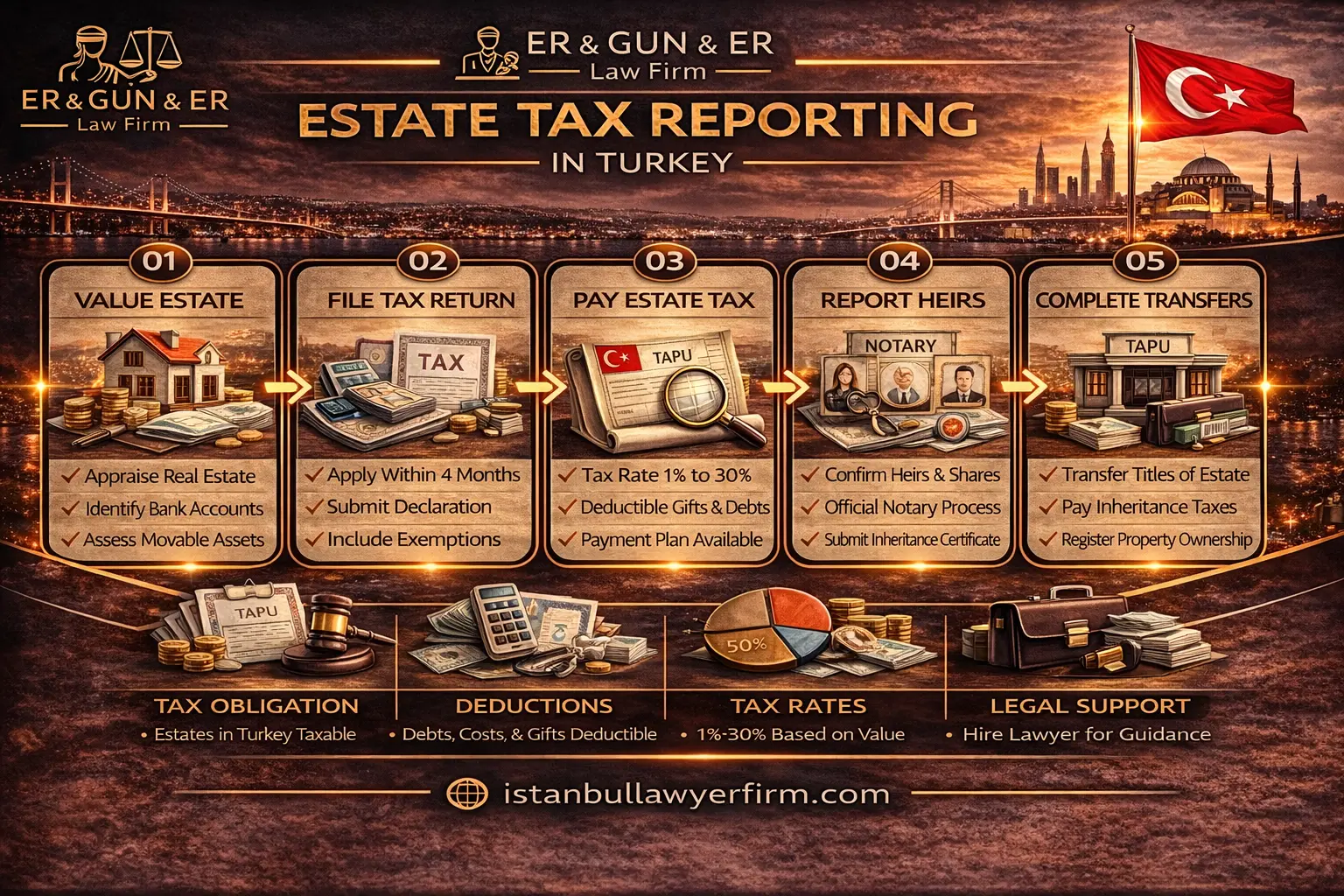
A lawyer in Turkey who advises heirs and estate administrators on inheritance matters understands that estate tax reporting in Turkey—the practical workflow of declaring inherited and gifted assets to the tax office with a defensible valuation and a complete evidence package—is a document-led process whose successful completion depends on building the evidentiary foundation correctly before any declaration is filed rather than attempting to compile evidence reactively when tax office queries arrive. An Istanbul Law Firm that guides families through Turkish estate tax reporting provides comprehensive support across the complete reporting workflow: identifying the specific assets and transfers within the reporting perimeter; obtaining the heirship documentation that establishes legal standing to file; gathering asset existence and ownership evidence from Turkish and foreign institutions; applying the correct valuation methodology to each asset class; preparing the inheritance and gift tax declaration with a complete exhibit package; managing the tax office's follow-up requests through indexed supplement filings; coordinating post-declaration steps with banks and land registries whose own processes require proof that the tax reporting lane is being addressed; and managing the payment and installment obligations once assessment is received. A Turkish Law Firm that manages estate tax reporting engagements understands that the most common source of audit risk and office friction is not an intentional disclosure failure but a procedural failure—inconsistent identity tokens across documents, asset lists not anchored to official evidence, and valuation entries without a stated basis—all of which are preventable through systematic file architecture rather than through detailed knowledge of tax rate tables. An English speaking lawyer in Turkey who coordinates estate tax reporting for foreign heirs and international families ensures that Turkish institutional filings and English-language estate records remain consistent and aligned, preventing the contradictions between Turkish declarations and foreign probate filings that attract audit attention. Practice may vary by authority and year — verify current Turkish inheritance and gift tax procedural requirements, current tax office filing practices, and current valuation standards with qualified counsel before implementing any reporting strategy.
Scope of Estate Tax Reporting in Turkey
A lawyer in Turkey who advises on the scope of estate tax reporting explains that the first and most important step in any estate tax reporting engagement is defining precisely what is being reported and why—because mixing different tax categories, different transfer events, and different reporting obligations into one undifferentiated narrative creates a file that is difficult to manage, difficult to defend, and prone to the internal contradictions that trigger tax office queries. An Istanbul Law Firm that scopes estate tax reporting engagements for its clients implements the specific scoping disciplines that most effectively prevent downstream complications: distinguishing clearly between transfers by death subject to Turkish inheritance tax and lifetime transfers treated as gifts for Turkish gift tax purposes, because the reporting procedures, timing rules, and valuation principles applicable to each may differ; identifying who will serve as the declarant or filing coordinator for the estate and documenting that person's authority before approaching any Turkish institution, because tax offices and banks both require evidence of standing before processing any request; defining the reporting perimeter as specific assets and heirship shares anchored to official documents rather than as a family narrative that cannot be verified by reference to an exhibit; and identifying which assets are unambiguously within the Turkish reporting scope, which are unambiguously outside it, and which require further analysis—keeping the unresolved category documented as a pending verification task rather than defaulting to inclusion or exclusion without a documented basis. Turkish lawyers advising on estate tax scope help families understand that the declaration is not only a tax document but also a record that banks and land registries will rely on when processing asset releases and title transfers, making the declaration's accuracy and internal consistency important well beyond its immediate tax function. Practice may vary by authority and year — verify current Turkish inheritance and gift tax scope rules, current definitions of taxable transfers, and current reporting perimeter determinations with qualified counsel before completing any scope analysis.
An Istanbul Law Firm that advises on estate reporting scope explains that a well-defined scope memo serves as the living architecture document for the entire reporting engagement—because it establishes which asset categories will be covered, which institutions will be contacted, who has authority to act, and how the file will handle assets discovered after the initial inventory is complete. Turkish lawyers advising on scope development help clients understand the specific scope elements that most frequently create downstream complications when left unaddressed: the treatment of assets jointly owned with non-heirs, where only the deceased's fractional interest is within the inheritance reporting perimeter; the treatment of assets transferred to the deceased's family members in the period before death, where the characterization as gift or as ordinary transfer affects whether reporting obligations arise; the treatment of life insurance proceeds, which may or may not be within the inheritance tax reporting perimeter depending on beneficiary designation and policy structure; and the treatment of assets whose ownership is disputed between heirs or with third parties, where the reporting lane should remain neutral and evidence-led while the dispute is resolved in a separate litigation or mediation lane. An English speaking lawyer in Turkey who develops scope memos for international estate clients ensures that the Turkish reporting perimeter is analyzed independently from the reporting perimeters applicable in the heirs' countries of residence, avoiding the assumption that the Turkish scope mirrors the foreign jurisdiction's scope when the two legal frameworks may reach different conclusions about the same asset.
A Turkish Law Firm that advises on maintaining scope discipline explains that scope creep—expanding the filing narrative to include informal family history, speculative asset claims, and unverified value assumptions—produces internally inconsistent documents that may assert facts the filer cannot prove when queried. An English speaking lawyer in Turkey who manages estate tax reporting for complex portfolios implements the specific scope maintenance disciplines that prevent this risk: treating the scope memo as a version-controlled document updated as new information becomes available; maintaining separate file lanes for reporting, dispute, payment, and bank/registry coordination so complications in one lane do not contaminate others; and applying a "no numeric assertion without verified source" rule that prohibits including tax rates, payment deadlines, or bracket thresholds in any communication unless confirmed by a current primary source. Practice may vary by authority and year — verify current guidance before committing to any scope determination.
A lawyer in Turkey who advises on the institutional landscape for estate tax reporting explains that a Turkish estate involves multiple authorities and institutions—each with distinct documentary requirements, each issuing specific documents that other authorities require—and that mapping these authority relationships correctly before beginning document collection prevents the wasted effort and delays that result from approaching institutions in the wrong order or requesting documents from the wrong authority. An Istanbul Law Firm that manages institutional coordination for estate tax reporting clients implements the specific mapping disciplines that most effectively sequence authority interactions: identifying the specific Turkish tax office with jurisdiction over the estate and the specific documents it requires to process an inheritance and gift tax declaration; identifying the probate authority responsible for issuing the inheritance certificate whose share table anchors the entire declaration; identifying each land registry office with records relevant to real estate assets in the estate and the specific parcel identifier information needed to retrieve current extracts; identifying each bank or financial institution holding estate assets and the specific standing documentation each institution requires before issuing account confirmation letters; and identifying any foreign authorities whose documents will need to be legalized and translated before use in Turkish institutional filings. Turkish lawyers advising on authority coordination help families understand that each authority's outputs unlock subsequent steps—because the inheritance certificate unlocks bank requests, bank confirmation letters support valuation, and the completed declaration supports downstream bank release and land registry transfer requests. Practice may vary by authority and year — verify current documentary requirements with each specific Turkish institution rather than assuming uniform practice across offices.
An Istanbul Law Firm that advises on institutional sequencing explains that the dependency relationships between institutional steps create a critical path requiring explicit management—because heirs who approach institutions out of sequence waste time on requests refused for lack of prerequisite documentation. Turkish lawyers advising on institutional sequencing help clients implement the appropriate sequence: establishing heirship and obtaining the inheritance certificate as the first step; making initial contact with each bank and registry to obtain their specific document checklist before compiling any package; collecting land registry extracts for real estate using confirmed parcel identifiers before attempting valuation; and obtaining bank confirmation letters for all deposit accounts before completing the asset inventory. An English speaking lawyer in Turkey who manages institutional sequencing for international estate clients coordinates powers of attorney, sworn translations, and remote representation arrangements so institutional steps proceed without requiring each heir's physical presence in Turkey for every interaction. Practice may vary by authority and year — verify current documentary requirements with each specific institution.
A Turkish Law Firm that advises on managing authority communications explains that every institutional interaction in the estate tax reporting process should be documented as a dated event with stored evidence of both the request made and the response received—because authority communications serve as both the source of official documents needed for the declaration and as the record of diligence that protects the estate from claims that institutional steps were handled improperly. An English speaking lawyer in Turkey who manages authority communications for estate clients implements the specific documentation practices most effective for each institutional relationship: maintaining a request log that records the date, channel, and specific documents requested from each institution; storing each institution's response—whether a confirmation letter, an extract, a balance statement, or a refusal—as a dated exhibit in the master file; following up on outstanding requests at defined intervals and documenting follow-up actions, because some institutions process requests slowly and periodic follow-up demonstrates diligence; and maintaining a "single spokesperson" rule for institutional communications so different heirs do not approach the same institution with different requests or inconsistent identity information that creates confusion and rejection risk. Authority documentation assembled through consistent, methodical institutional engagement produces a file that can demonstrate to the tax office exactly how the estate's assets were identified and valued, reducing audit risk by showing that the declaration is based on official evidence rather than on estimation.
Inheritance Certificate and Heirship Documentation
A lawyer in Turkey who advises on the role of the inheritance certificate in estate tax reporting explains that the inheritance certificate—veraset ilamı in Turkish—is the foundational document from which every other element of the estate tax reporting process flows, because it establishes the legal identity of the heirs, their fractional shares of the estate, and their standing to make requests to banks, registries, and the tax office on behalf of the estate. An Istanbul Law Firm that manages inheritance certificate procurement for estate clients implements the specific practices that most effectively establish the heirship foundation: obtaining the inheritance certificate through the competent civil court or notarial procedure with the correct identification and legal standing documentation for all heirs; storing a certified copy of the inheritance certificate as the master exhibit from which all other documents are derived, with no alterations to the names, identification numbers, or share fractions stated in the certificate; creating an identity token sheet that records each heir's name spellings, identification numbers, and contact information exactly as they appear in the inheritance certificate, and using this token sheet consistently across every subsequent document to prevent the identity mismatch errors that cause institutional rejection; and planning early for foreign heirs whose identification documents require legalization and translation before Turkish institutions will accept them as proof of standing. Turkish lawyers advising on inheritance certificate timing help families understand that obtaining the certificate early in the process—before making detailed asset inquiries to banks and registries—produces a more efficient overall process because most institutions will not release information to heirs without confirmed standing. Practice may vary by authority and year — verify current Turkish inheritance certificate procedures and current identification requirements for foreign heirs before beginning the heirship documentation process.
An Istanbul Law Firm that advises on inheritance certificate use across the estate reporting process explains that the certificate's share table must function as the master allocator for every asset in the estate—because inconsistencies between the certificate's share fractions and the allocation reflected in the tax declaration create easily detectable errors that trigger tax office queries and may also create disputes among heirs about whether the declaration accurately reflects their legal entitlements. Turkish lawyers advising on share table management help families implement the specific allocation disciplines that most effectively maintain consistency: creating a master allocation table that lists every identified estate asset, assigns each asset to heirs according to the certificate's share fractions, and calculates each heir's share value for every asset with exhibit references to the valuation documents supporting each value; updating the allocation table through version control whenever new assets are discovered or values are revised, so the current version can always be traced to the exhibits supporting it; and checking the allocation table against the declaration entries before filing to confirm that every declaration line is consistent with both the inheritance certificate and the valuation exhibits. An English speaking lawyer in Turkey who manages share allocation for international estates coordinates the Turkish allocation table with foreign estate administrators and foreign legal advisers to ensure that the total asset values allocated across all jurisdictions are internally consistent—preventing the contradictions between Turkish and foreign estate filings that create cross-border audit risk. A stable, version-controlled allocation table anchored to the inheritance certificate is the single most important risk management tool in the estate tax reporting process because it prevents the inconsistencies that distinguish a defensible filing from one that invites scrutiny.
A Turkish Law Firm that advises on heirship documentation for contested and complex estates explains that the heirship foundation requires additional management attention when the estate includes disputed transfers, potential additional heirs, or assets whose ownership was restructured before death—because each of these complications can affect the inheritance certificate's accuracy and therefore the reliability of every document derived from it. An English speaking lawyer in Turkey who advises on heirship documentation in complex estates helps clients implement the specific practices most effective for each complication: maintaining a separate dispute lane for any contested heirship or asset ownership claim that is proceeding through court or mediation, keeping the dispute lane's documentation completely separate from the reporting lane so that disputed facts are not inadvertently incorporated into the tax declaration; documenting any discovered assets that were not reflected in the initial inheritance certificate with a clear discovery event record that shows when the asset was identified and what official evidence supports its inclusion; and maintaining a "correction protocol" for any changes to the inheritance certificate—including corrections of heir identification information or share fractions—that ensures the corrected certificate is substituted consistently throughout every document in the reporting file rather than having different documents reference different versions of the certificate. Practice may vary by authority and year — verify current Turkish court procedures for inheritance certificate correction and current tax office procedures for amended declarations before implementing any correction process for a filed declaration.
Identifying and Inventorying Taxable Assets
A lawyer in Turkey who advises on estate asset inventory explains that building a complete, accurate, and evidence-based asset inventory is the most critical preparatory step in estate tax reporting—because the declaration's credibility depends entirely on whether its asset entries can be traced to official documentary sources rather than to family recollection, and because assets discovered after filing that were not included in the initial declaration require amended filings whose existence raises questions about the completeness of the original submission. An Istanbul Law Firm that builds asset inventories for estate tax reporting clients implements the systematic evidence-based inventory approach: organizing the inventory into asset class tabs—real estate, bank deposits, securities, business interests, receivables, personal property, and foreign assets—with each tab containing the asset's official identifier, the institution or registry that issued the ownership proof, the date of the confirming document, and a reference to the valuation method that will be applied; mapping each asset class to the specific institution whose records must be consulted to verify existence and ownership, and preparing institution-specific request packages that include the inheritance certificate and required identification documents before making any information request; maintaining a "missing assets log" that records assets whose existence is suspected from family knowledge or from references in other documents but whose official confirmation is pending, with a documented verification plan for each item; and conducting a systematic cross-check after the initial inventory is assembled to identify any duplicated entries where the same asset appears under different identifiers, and to identify any assets referenced in other documents—sale contracts, insurance policies, loan agreements—that do not appear in the inventory. Turkish lawyers advising on asset inventory management help clients understand that an incomplete inventory creates a larger legal risk than a complete inventory that includes an asset whose tax treatment requires analysis—because a complete, documented inventory demonstrates diligence while an inventory later shown to have gaps raises questions about the reliability of the entire filing. Practice may vary by authority and year — verify current documentary requirements for each asset class with the specific Turkish institutions relevant to the estate.
An Istanbul Law Firm that advises on business interest identification explains that estates including Turkish company ownership interests require additional inventory discipline—because assets held through entities are not directly visible in land registry or bank records and require corporate documentation. Turkish lawyers advising on business interest inventory help clients obtain current trade registry extracts for Turkish companies where the deceased held shares; identify the shareholder register as the authoritative ownership evidence alongside any shareholder agreements or pledge arrangements; and obtain corporate financial statements for valuation, because business interest valuation requires financial analysis rather than a simple registry value. An English speaking lawyer in Turkey who identifies business interests for international estate clients ensures that Turkish corporate documentation is coordinated with foreign entity documentation, as inconsistencies between Turkish corporate records and foreign business registration evidence create cross-border audit risk. Practice may vary by authority and year — verify current documentary requirements for each asset class with the specific Turkish institutions relevant to the estate.
A Turkish Law Firm that advises on foreign asset identification within Turkish estate reporting explains that Turkish heirs' obligation to include foreign assets in their Turkish estate tax reporting depends on specific legal analysis rather than on a blanket rule, and that this analysis must be documented in the reporting file so that the treatment of each foreign asset—whether included or excluded from the Turkish declaration—is a documented and reasoned decision rather than a silent omission. An English speaking lawyer in Turkey who manages foreign asset identification for international estates implements the specific identification disciplines most relevant to cross-border estates: creating a foreign assets register that lists each foreign asset, the jurisdiction where it is located, the institution or registry holding confirmation, and the documented basis for the Turkish reporting treatment applied to it—inclusion with Turkish valuation, inclusion with foreign valuation basis and bridge memo, or exclusion with stated rationale; coordinating with foreign legal advisers to obtain the specific foreign documents—account statements, foreign title certificates, company ownership records—needed to support the Turkish reporting treatment; and maintaining the foreign assets register as a version-controlled document updated as foreign institution confirmations are received, so that the reporting treatment of each foreign asset can be traced to the specific evidence available at the time of filing. Foreign asset identification that is handled through this systematic approach produces a reporting file that can explain the treatment of every foreign asset through reference to a documented, verified basis rather than through post-hoc rationalization after a query is received. Practice may vary by authority and year — verify current Turkish foreign assets disclosure requirements and current situs analysis standards with qualified Turkish tax counsel before finalizing any foreign asset reporting treatment.
Valuation Principles and Methodology for Inheritance Tax
A lawyer in Turkey who advises on estate valuation explains that valuation for inheritance tax Turkey purposes is a legally significant activity whose quality determines both the reliability of the declaration and the estate's audit risk profile—because declarations that state asset values without identifying the valuation basis, the source document, and the valuation date context are unable to defend those values if the tax office questions them, while declarations that present values with clear methodology and supporting exhibits can be explained and, where necessary, adjusted through documented correction events. An Istanbul Law Firm that manages estate valuation for tax reporting purposes implements the specific valuation disciplines that most effectively support a defensible declaration: defining the valuation methodology for each asset class in a concise memo that identifies the specific recognized basis applicable to that class under Turkish tax practice for the relevant period—without asserting that a particular rate or method is legally mandatory without primary source verification; storing the specific source document that supports each asset's stated value as an exhibit with its issuance date and issuing institution clearly identified; maintaining a "valuation method consistency rule" that ensures the same methodology is applied to similar assets throughout the file rather than switching approaches for different assets of the same type without a documented reason; and preserving version control for the valuation working papers so that any changes to a stated value can be traced to a documented event—a corrected bank letter, an updated registry extract, or a revised corporate statement—with both the original and corrected values preserved. Turkish lawyers advising on estate valuation help families understand that valuation quality is not primarily a mathematical issue but an evidentiary one—the question is not whether the stated value is exactly correct but whether it is defensibly derived from recognized evidence using an identifiable methodology. Practice may vary by authority and year — verify current Turkish inheritance tax valuation standards applicable to each asset class with qualified counsel before completing any valuation work.
An Istanbul Law Firm that advises on cross-border valuation consistency explains that estates with assets in multiple jurisdictions frequently encounter different countries using different valuation bases for the same asset—creating the risk that Turkish and foreign declarations state different values in ways that attract audit attention. Turkish lawyers advising on cross-border valuation help families create a "valuation bridge memo" that documents, for each asset where Turkish and foreign valuation bases differ, the specific reason—whether a different valuation date, statutory reference, or market convention—preserving the rationale as a documented decision. An English speaking lawyer in Turkey who coordinates cross-border valuation maintains communication with foreign advisers throughout the process to identify and document differences early—when they can be addressed through a bridge memo—rather than discovering inconsistencies after declarations have been filed in both jurisdictions. Practice may vary by authority and year — verify current Turkish inheritance tax valuation standards applicable to each asset class before completing any valuation work.
A Turkish Law Firm that advises on valuation governance for complex estates explains that the valuation process requires internal governance controls—review by a person other than the initial preparer and documented sign-off confirming that each value has an exhibit and allocations match the inheritance certificate—because single-person processes without review allow compounding errors to reach the filing. An English speaking lawyer in Turkey who manages valuation governance implements the specific controls most effective for each estate: a "valuation review checklist" confirming for each asset that an exhibit exists, the exhibit's date is within an appropriate range, the stated value matches the exhibit, and the allocation follows the inheritance certificate share table; a "working paper log" recording the current version of each valuation working paper and the event triggering each update; and a "downstream consistency check" before filing that compares each declaration entry with the corresponding inventory entry and valuation exhibit to confirm all three documents use the same identifier, description, and value. Practice may vary by authority and year — verify current Turkish tax office valuation standards before finalizing any methodology.
Real Estate Valuation and Bank Account Reporting
A lawyer in Turkey who advises on real estate valuation for inheritance tax purposes explains that real estate valuation inheritance tax Turkey requires specific discipline with property identifiers—parcel numbers, building block identifiers, and land registry reference numbers—because the tax office, land registry, and any downstream buyer conducting due diligence will compare the declaration's property descriptions against official registry records, and discrepancies in identifiers trigger queries regardless of whether the stated value is otherwise appropriate. An Istanbul Law Firm that manages real estate valuation for estate tax reporting implements the specific property documentation practices most effective for each property type: obtaining current title extracts from the land registry for each property using confirmed parcel identifiers before beginning any valuation work, because valuation applied to an incorrectly identified property must be completely redone when the correct property is confirmed; recording each property in a separate, dedicated tab in the asset inventory that contains the parcel identifier, the property description copied verbatim from the registry extract, any encumbrances or annotations recorded at the registry, and the valuation basis exhibit with its issuance date; applying the recognized Turkish valuation basis for the relevant year and tax office to each property rather than using sale listing prices or informal appraisals unless the recognized basis for the specific context is a market appraisal by a licensed expert; and maintaining a "property corrections log" for any amendments to property identifiers or valuations, preserving both the original and corrected versions with the evidence source for the correction. Turkish lawyers advising on real estate valuation help families understand that the property lane in the estate file must be designed to serve multiple downstream uses—including the land registry transfer request and any future sale transaction—so that the property documentation assembled for tax reporting does not need to be reassembled from scratch for each subsequent use. Practice may vary by authority and year — verify current Turkish real estate valuation standards for inheritance tax and current land registry documentation requirements before completing any property valuation work.
An Istanbul Law Firm that advises on bank account reporting after death Turkey explains that banks are among the most documentation-intensive institutions in the estate process because they require strict standing proof before releasing any account information, they issue account confirmation letters only in specific formats, and they coordinate their release processes with the inheritance tax declaration rather than proceeding independently of it. Turkish lawyers advising on bank account reporting help families implement the specific practices that most effectively manage the bank coordination process: preparing a bank request package that includes the inheritance certificate, heir identification documents, and any powers of attorney needed for heirs who cannot attend in person, and verifying each bank's specific requirements before submitting the package; requesting from each bank a formal account confirmation letter or balance certificate that shows the account identifiers, the balance as of the relevant date, and the account ownership status—and storing each bank's response as a dated exhibit with the bank's letterhead and officer identification visible; maintaining a separate bank tab for each institution rather than consolidating multiple banks into a single spreadsheet, because banks may later ask for the specific letter they issued and cross-bank consolidation can obscure the source; and creating a bank-to-declaration reconciliation memo that maps each bank exhibit to the corresponding declaration entry by account identifier and value, confirming that no bank accounts are present in the exhibits but absent from the declaration or vice versa. An English speaking lawyer in Turkey who manages bank coordination for international estate clients ensures that foreign heirs are represented through properly authenticated powers of attorney that satisfy each bank's specific requirements for remote representation, preventing the repeated rejection and resubmission cycles that occur when banks refuse to accept inadequately authenticated authority documents. Practice may vary by authority and year — verify current bank documentation requirements and current balance confirmation letter formats with each specific bank rather than assuming uniform practice.
A Turkish Law Firm that advises on securities and other financial assets explains that publicly traded securities, investment fund units, government bonds, and private company shares each require valuation evidence specific to the instrument type—because the valuation date context, pricing source, and confirmation letter format all differ across these categories. An English speaking lawyer in Turkey who manages financial asset reporting implements the documentation practices most relevant to each type: obtaining custodian statements identifying each holding by ISIN or recognized identifier, quantity, price per unit at the relevant valuation date, and total value; maintaining complete statement header information—institution name, account identifier, statement date—as part of each exhibit; documenting any currency conversion method for foreign currency holdings without asserting a mandatory conversion source unless verified; and keeping post-death income generated by estate securities in a separate tab as an income matter rather than an inheritance tax matter. Practice may vary by authority and year — verify current bank documentation requirements and balance confirmation formats with each specific institution.
Foreign Asset Disclosure and Cross-Border Coordination
A lawyer in Turkey who advises on foreign assets disclosure inheritance Turkey explains that cross-border estates—estates where the deceased held assets in multiple countries or where heirs are resident in different jurisdictions—require a coordinated approach that prevents the Turkish declaration from contradicting the foreign filings in ways that appear to a tax authority as inconsistency attributable to concealment rather than to legitimate differences in each country's legal framework. An Istanbul Law Firm that manages foreign asset disclosure for Turkish estate reporting provides the specific coordination framework most effective for each cross-border situation: creating a master asset inventory that lists every asset across all jurisdictions with a situs note indicating where each asset is located and a disclosure status note indicating whether the asset will be declared in Turkey, in another jurisdiction, or in both—with a documented rationale for each status determination; maintaining the Turkish declaration scope analysis as a separate document from the foreign filings rather than assuming the Turkish scope mirrors the foreign scope, because different countries' inheritance tax laws reach different conclusions about which assets are reportable in that country; and coordinating with foreign legal advisers to confirm that the values used in each country's filing are consistent where the same valuation basis applies and documented as different where different national valuation bases produce different results. Turkish lawyers advising on cross-border disclosure help families understand that the goal is not to achieve identical declarations in every jurisdiction—which is often impossible given different legal frameworks—but to achieve declarations in each jurisdiction that are internally consistent, supported by appropriate evidence, and not contradicted by the declarations filed in other jurisdictions. Practice may vary by authority and year — verify current Turkish foreign asset disclosure requirements and current cross-border situs analysis standards with qualified Turkish tax and inheritance counsel before completing any foreign asset reporting determination.
An Istanbul Law Firm that advises on the double taxation inheritance Turkey question explains that the risk of the same estate transfer being subject to inheritance tax in two or more countries arises in many cross-border estates—particularly where the deceased was resident in one country and held assets in another, or where heirs are resident in countries that apply worldwide taxation of inherited assets—and that managing this risk requires systematic analysis rather than assumption that bilateral tax treaties or other relief mechanisms will automatically prevent double taxation. Turkish lawyers advising on double taxation risk management help families implement the specific analytical and documentation steps that most effectively address this risk: identifying where the deceased was treated as resident for inheritance tax purposes in each relevant jurisdiction, because residence classification is a threshold question that determines each country's jurisdictional claim; identifying where each significant asset is located and whether its situs in that country gives that country's inheritance tax a claim regardless of the deceased's residence; mapping the applicable bilateral tax treaties between Turkey and each relevant country to identify whether any treaty provisions address inheritance tax double taxation—noting that many bilateral treaties do not address inheritance taxes even when they address income taxes; and documenting any foreign inheritance tax paid on assets that are also within Turkey's reporting perimeter as a separate evidence tab, because the Turkish treatment of foreign inheritance tax paid may depend on specific treaty or domestic relief provisions that must be verified from current primary sources. An English speaking lawyer in Turkey who manages double taxation analysis for cross-border estate clients maintains communication with foreign advisers throughout the process to ensure that coordinated positions are developed before declarations are filed in each jurisdiction rather than discovering cross-border inconsistencies after declarations have already been submitted and correcting them requires coordinated amendment filings across countries.
A Turkish Law Firm that advises on foreign document legalization and translation explains that foreign documents used in Turkish institutional proceedings must satisfy specific authentication and translation requirements that add timeline considerations to cross-border estates. An English speaking lawyer in Turkey who manages foreign document preparation implements the procedures that satisfy Turkish institutional requirements: planning apostille certification or consular authentication of required documents at the earliest stage because the authentication pipeline typically has the longest lead time; commissioning sworn Turkish translations from certified translators whose qualifications comply with the specific receiving institution's requirements; maintaining a single translation token sheet that records each foreign-language term's confirmed Turkish translation and uses it consistently across every document; and storing each foreign document alongside its complete authentication chain—original, apostille, and sworn translation—in a single exhibit bundle. Practice may vary by authority and year — verify current Turkish authentication requirements with qualified counsel before beginning any authentication process.
Filing the Declaration and Supporting Documentation
A lawyer in Turkey who advises on preparing the inheritance and gift tax declaration explains that the declaration itself should be the last document prepared in the estate reporting process rather than the first—because a declaration drafted before the inventory is complete, the valuations are verified, and the allocation table is confirmed against the inheritance certificate will contain errors whose correction requires amended filings that raise questions about the filing's overall reliability. An Istanbul Law Firm that prepares inheritance tax declarations for its clients implements the specific drafting and verification sequence that most effectively produces a reliable first filing: verifying that every asset in the inventory has a corresponding valuation exhibit and that the stated value in the valuation working paper matches the exhibit exactly; verifying that the allocation of each asset's value to heirs uses the exact share fractions from the inheritance certificate rather than rounded or approximated fractions; verifying that every identity token used in the declaration—heir names, identification numbers, and property identifiers—matches the corresponding official document exactly, without the typographical variations that cause institutional rejection; and preparing an exhibit index that maps every declaration entry to the specific exhibit that supports it, enabling the tax office to verify each entry by locating the referenced exhibit without requiring the filer to provide supplementary explanation. Turkish lawyers advising on declaration preparation help families understand that a well-organized, exhibit-indexed declaration filed with a complete evidence package is processed more efficiently and generates fewer follow-up requests than a declaration filed without exhibits and supplemented reactively when the tax office requests documentation. Practice may vary by authority and year — verify current Turkish inheritance tax declaration format requirements, current exhibit bundling standards, and current submission procedures with the specific competent tax office before finalizing any declaration filing.
An Istanbul Law Firm that advises on post-filing management explains that tax office follow-up requests are a normal part of the inheritance tax declaration process and should be managed through a systematic supplement protocol rather than through ad-hoc responses that may introduce inconsistencies into the filing record. Turkish lawyers advising on post-filing management help families implement the specific supplement protocol disciplines that most effectively serve both the immediate response need and the long-term file integrity: treating each tax office request as a discrete ticket with a documented response plan that identifies the specific evidence to be provided and the specific question or clarification the evidence addresses; preparing each supplement as a separate, indexed document package with a cover memo that quotes the office's request and explains how the attached evidence responds to it—rather than providing unorganized documents without explanation that require the office to determine their relevance independently; storing proof of submission for each supplement—delivery receipt, online submission confirmation, or office acknowledgment—as a dated exhibit in the follow-up lane; and preserving the original filing version alongside each supplement in a way that makes the chronological development of the filing clear, so an auditor can trace the evolution of the declaration from initial submission through each supplement without needing to reconstruct the sequence from disparate documents. An English speaking lawyer in Turkey who manages post-filing coordination for international estate clients provides regular status updates in English to foreign heirs who cannot independently monitor Turkish administrative proceedings, ensuring that the clients remain informed about the declaration's processing status and about any actions required on their part. Practice may vary by authority and year — verify current Turkish tax office supplement filing procedures before implementing any post-filing protocol.
A Turkish Law Firm that advises on the downstream use of the inheritance tax declaration explains that the declaration and its assessment outcomes are relied upon by multiple downstream processes—bank account release, land registry title transfer, and foreign estate administration—making declaration quality important well beyond its immediate tax function. An English speaking lawyer in Turkey who coordinates downstream use helps implement the specific practices most effective for each interaction: preparing redacted declaration summaries for bank and registry use that provide tax compliance evidence without exposing unnecessary sensitive information; coordinating the timing of bank release requests and registry transfer applications with the declaration's processing status, as different institutions have different requirements for when tax documentation must be complete; and maintaining a "downstream readiness checklist" confirming which downstream steps can proceed with available documentation and which must await additional assessment steps. Practice may vary by authority and year — verify current downstream institutional requirements with each specific bank, registry, and authority before planning any filing timeline around downstream dependencies.
Audit Risk, Penalty Framework and Payment Planning
A lawyer in Turkey who advises on inheritance tax audit risk Turkey explains that audit risk in estate tax reporting is primarily driven by three categories of file weakness—inconsistent identity tokens across documents, asset values stated without identified sources, and differences between the declared assets and assets that appear in other official contexts—all of which are preventable through the systematic file architecture disciplines that transform an ad-hoc estate documentation collection into a defensible compliance record. An Istanbul Law Firm that advises on audit risk management for estate tax reporting helps clients implement the specific risk reduction practices most effective for each file weakness category: conducting a "token audit" before declaration filing that confirms every occurrence of each heir's name, identification number, and property identifier across every document in the file uses exactly the same spelling and format as the controlling official document—the inheritance certificate or the land registry extract; requiring a "value exhibit rule" that no asset value appears in the declaration without a corresponding line in the valuation working paper and a corresponding exhibit documenting the source; and maintaining an "asset cross-check" that compares the declared asset inventory against any asset references in other documents in the file—sale contracts, insurance policies, corporate governance records—to identify any assets mentioned elsewhere that are not in the inventory, so their absence can be documented as a confirmed exclusion rather than discovered as a potential omission during audit. Turkish lawyers advising on audit risk reduction help families understand that audit readiness is primarily a response readiness question—whether the file can respond quickly, completely, and consistently to any specific exhibit request—and that investing in organized, indexed file architecture from the beginning of the process reduces audit exposure more effectively than attempting to improve file quality under the time pressure of an active audit. Practice may vary by authority and year — verify current Turkish tax audit procedures and current documentation standards with qualified counsel before finalizing any audit risk management approach.
An Istanbul Law Firm that advises on the penalty exposure framework for late or incomplete inheritance tax filings explains that the correct approach to managing penalty risk is through diligence and documentation rather than through memorized rate tables—because the specific penalty consequences applicable to each filing situation depend on facts and verified current legal provisions that change over time and may differ between tax offices. Turkish lawyers advising on penalty risk management help families implement the specific disciplines that most effectively reduce avoidable penalty exposure: building the declaration filing timeline around the earliest realistic date on which a complete, exhibit-supported filing can be submitted rather than around the deadline—because filing a complete declaration before any deadline expires is the most effective risk management action available; documenting the steps and timeline of evidence collection as the work proceeds, so that any filing that occurs after the ideal timing can be accompanied by evidence of continuous diligent effort rather than appearing as a sudden submission without demonstrated prior work; responding to any tax office requests for additional information within the shortest practical timeframe rather than allowing response periods to extend without communication, because prompt, complete responses demonstrate compliance intent; and treating any discovered errors in a filed declaration as correction events to be addressed through documented amended filings rather than as problems to be managed through silence, because voluntary correction of identified errors is treated differently from errors discovered through audit. An English speaking lawyer in Turkey who manages penalty risk for international estate clients coordinates the filing timeline with the legalization and translation timelines for foreign documents—which often represent the critical path in cross-border estates—to ensure that foreign document delays are documented and do not create unexplained gaps in the filing record. Practice may vary by authority and year — verify current Turkish inheritance tax penalty provisions and current grace period rules with qualified counsel before making any decisions based on penalty timing.
A Turkish Law Firm that advises on payment planning for inheritance tax obligations explains that payment planning should be approached as a downstream lane that depends entirely on official assessment instructions rather than on pre-filing estimates—because the actual tax liability depends on the office's assessment of the declared assets and values, which may differ from the filer's internal calculations, and because payment modalities including installment payment inheritance tax Turkey arrangements are subject to current official rules that must be verified from primary sources for the relevant year rather than assumed from general knowledge. An English speaking lawyer in Turkey who manages payment planning for estate clients implements the specific payment documentation practices that most effectively serve both compliance and internal family governance needs: storing the official assessment or payment instruction document as the authoritative exhibit for the payment obligation amount and timing; maintaining payment receipts with official reference numbers and issuance dates as dated exhibits in the payment lane; creating a reconciliation memo that maps each payment receipt to the specific assessed amount it satisfies, so the payment record can be presented to banks, registries, or other institutions that request evidence of tax compliance without requiring access to the complete tax file; and maintaining separate payment records for each heir where the inheritance tax obligation is shared across multiple heirs in different proportions, because consolidated receipts without heir-specific allocation create internal disputes about who paid and who owes reimbursement. Payment planning discipline that is built on official assessment documents and verified compliance requirements produces a payment record that supports the estate's downstream administrative steps and protects the heirs against both tax office recalculation claims and internal family disputes about payment allocation. Practice may vary by authority and year — verify current Turkish inheritance tax payment procedures and current installment payment rules with qualified counsel before implementing any payment plan based on general regulatory knowledge rather than current official instructions specific to the assessed case. A lawyer in Turkey for estate tax reporting combines specific knowledge of Turkish inheritance tax procedure with the systematic file architecture disciplines that convert a complex multi-asset estate into a defensible declaration supported by complete, consistent, and official evidentiary documentation.
Frequently Asked Questions
- What is estate tax reporting in Turkey and what does the process involve? Estate tax reporting in Turkey is the process of declaring inherited assets to the competent Turkish tax office through an inheritance and gift tax declaration supported by official documentation establishing heirship shares, asset existence, and asset values. The process involves obtaining the inheritance certificate establishing heirs' legal shares, collecting official asset evidence from banks and land registries, applying recognized valuation methodology to each asset class, preparing the declaration with an exhibit package, and managing post-filing tax office interactions. The process should be built on official documents rather than family recollection. Practice may vary by authority and year.
- What is the inheritance certificate and why is it needed for estate tax reporting? The inheritance certificate is the court-issued or notarially-issued document establishing the legal identity of heirs and their fractional shares of the estate under Turkish law. It is the foundational document for estate tax reporting because it establishes the filer's legal standing to request information from banks and registries, provides the share table used to allocate asset values among heirs in the declaration, and must be consistent with every other document in the reporting file. Its share fractions should be used as the master allocator for all asset values. Practice may vary by authority and year.
- How are real estate assets valued for Turkish inheritance tax purposes? Real estate valuation for Turkish inheritance tax purposes should use the recognized valuation basis applicable to the relevant tax year and tax office, which must be verified from current primary sources rather than assumed from general knowledge. Land registry extracts confirming parcel identifiers and ownership should be obtained before valuation work begins. The property description in the declaration should match the registry extract exactly. Each property should have its own documentation tab with the parcel identifier, the valuation basis exhibit, and the share allocation calculation. Practice may vary by authority and year.
- What documentation does the Turkish tax office require for bank accounts and deposits? Turkish tax office filings for bank account assets require bank-issued confirmation letters or account statements that identify the account by its official identifier, state the balance as of the relevant date, and confirm the account's ownership status. These letters require standing proof—including the inheritance certificate and heir identification documents—before banks will issue them. Each bank's specific letter format requirements should be verified with that institution before requesting documents. Balance values from bank letters should be transcribed to valuation working papers with reference to the exhibit number and issuance date. Practice may vary by authority and year.
- How should foreign assets be handled in a Turkish estate tax declaration? Foreign assets should be analyzed for Turkish reporting scope based on current Turkish inheritance tax law—which depends on factors including the deceased's residence status and each asset's situs—rather than assumed to be included or excluded without analysis. Each foreign asset whose Turkish reporting treatment has been determined should be documented in a foreign assets register with the determination's rationale and supporting evidence. Foreign documents used in Turkish filings must be apostilled and sworn-translated. A bridge memo should explain any valuation differences between Turkish and foreign filings for the same asset. Practice may vary by authority and year.
- What are the main audit risk factors in Turkish inheritance tax reporting? The main audit risk factors in Turkish inheritance tax reporting are inconsistent identity tokens across documents, asset values stated without identified source exhibits, differences between declared assets and assets appearing in other official contexts, large valuation changes between filing versions without documented correction events, and foreign asset narratives that contradict filings in other jurisdictions. These risks are managed through systematic file architecture including a token sheet, a value exhibit rule, an asset cross-check, and version-controlled working papers. Practice may vary by authority and year.
- How should discovery of additional assets after the initial declaration be handled? Assets discovered after an initial inheritance tax declaration has been filed should be addressed through a documented supplement filing rather than through silent correction of the original declaration. The supplement should include a discovery event record showing when the asset was identified and what official evidence confirms its existence, a valuation exhibit for the newly discovered asset, an updated allocation table reflecting the additional asset, and a cover memo explaining what the supplement adds to the original filing and why. Voluntary supplement filings should be prepared promptly after discovery. Practice may vary by authority and year.
- Can inheritance tax be paid in installments in Turkey? Turkish inheritance tax law provides payment modalities that may include staged payment arrangements depending on official instructions and case-specific circumstances. The specific installment rules—including the number of installments available, the payment intervals, and any eligibility conditions—must be verified from current primary sources for the relevant tax year rather than assumed from general knowledge. Payment planning should be based on the official assessment document received from the tax office rather than on pre-filing estimates of the likely tax obligation. Practice may vary by authority and year.
- What is the penalty framework for late or incomplete inheritance tax filings in Turkey? Penalty exposure for late or incomplete inheritance tax filings in Turkey depends on the specific nature of the delay or deficiency and on current Turkish tax procedure law provisions that must be verified from primary sources. The most effective penalty risk management approach is filing a complete, exhibit-supported declaration as early as possible, documenting the steps and timeline of evidence collection throughout the process, and addressing any identified errors through voluntary correction rather than allowing them to be discovered through audit. Specific penalty rates and conditions must be verified from current official sources. Practice may vary by authority and year.
- How are cross-border double taxation risks managed in Turkish estate reporting? Cross-border double taxation risk in Turkish estate reporting is managed through systematic analysis—not through assumption of automatic relief—identifying each relevant country's basis for claiming inheritance tax jurisdiction, mapping any applicable bilateral tax treaties between Turkey and each relevant country, and documenting the treatment of each asset in each jurisdiction with reference to verified legal provisions. Foreign inheritance tax paid on assets also within Turkey's reporting scope should be documented as a separate evidence tab. Treaty relief or credit claims must be verified from current applicable instruments rather than assumed. Practice may vary by authority and year.
- What documents are required for a complete Turkish inheritance tax declaration package? A complete Turkish inheritance tax declaration package typically includes the inheritance certificate with certified copies for institutional recipients; identification documents for all heirs and authorized representatives; land registry extracts for each real estate asset with correct parcel identifiers; bank confirmation letters for all deposit accounts with balances as of the relevant date; securities custodian statements for investment holdings; corporate documentation for business interests; foreign asset documents with applicable apostilles and sworn translations; valuation working papers with exhibit references; an allocation table consistent with the inheritance certificate; and an exhibit index mapping every declaration entry to its supporting document. Practice may vary by authority and year.
- How should the inheritance tax declaration be coordinated with bank release requests? Bank release requests should be coordinated with the inheritance tax declaration by timing the bank approach after the declaration filing is underway and preparing bank-specific documentation packages that include evidence of the declaration filing alongside the inheritance certificate and heir identification documents. Each bank has specific requirements for what it will accept as evidence of tax compliance, which should be verified with the specific bank before preparing the coordination package. Redacted summaries of the declaration are typically more appropriate for bank release than complete declaration copies. Practice may vary by authority and year.
- What internal governance measures protect against family disputes in estate tax reporting? Internal governance measures that protect against family disputes in estate tax reporting include maintaining a single filing coordinator with documented authority to act on the estate's behalf, using a single spokesperson for all institutional communications, maintaining a version-controlled master asset inventory accessible to all heirs, preserving all institutional communications as dated exhibits rather than relying on oral accounts, maintaining a documented internal approval record for any decisions about asset inclusion or valuation methodology, and keeping dispute matters in a separate litigation lane that does not contaminate the reporting file. Practice may vary by authority and year.
- How long should estate tax reporting documentation be retained after filing? Estate tax reporting documentation should be retained for the full period during which the tax assessment can be reviewed, supplemented, or audited under applicable Turkish tax procedure law—a period that must be verified from current primary sources. Practical guidance suggests retaining the complete reporting file, including all exhibits, working papers, and correspondence, for at least the duration of any open tax assessment plus the applicable audit period. Documents that will be reused for downstream processes—bank release, registry transfer, and subsequent sale transactions—should be retained in accessible form throughout the relevant periods. Practice may vary by authority and year.
- Does ER&GUN&ER Law Firm advise on estate tax reporting and inheritance tax declaration preparation in Turkey? Yes. ER&GUN&ER Law Firm provides comprehensive legal advisory services for Turkish estate tax reporting including scope analysis and reporting perimeter determination, inheritance certificate procurement coordination, institutional sequencing and authority communication management, asset inventory development and evidence collection, valuation methodology documentation, real estate and bank account reporting, foreign asset disclosure and cross-border coordination, declaration preparation with exhibit indexing, post-filing supplement management, payment planning based on official assessment instructions, audit risk management and response preparation, and downstream coordination with banks and land registries—with English-language client communication throughout each engagement.
Author: Mirkan Topcu is an attorney registered with the Istanbul Bar Association (Istanbul 1st Bar), Bar Registration No: 67874. His practice focuses on cross-border and high-stakes matters where evidence discipline, procedural accuracy, and risk control are decisive.
He advises individuals and companies across Immigration and Residency, Real Estate Law, Tax Law, and cross-border documentation matters where procedural accuracy and evidence discipline are decisive.
Education: Istanbul University Faculty of Law (2018); Galatasaray University, LL.M. (2022). LinkedIn: Profile. Istanbul Bar Association: Official website.