

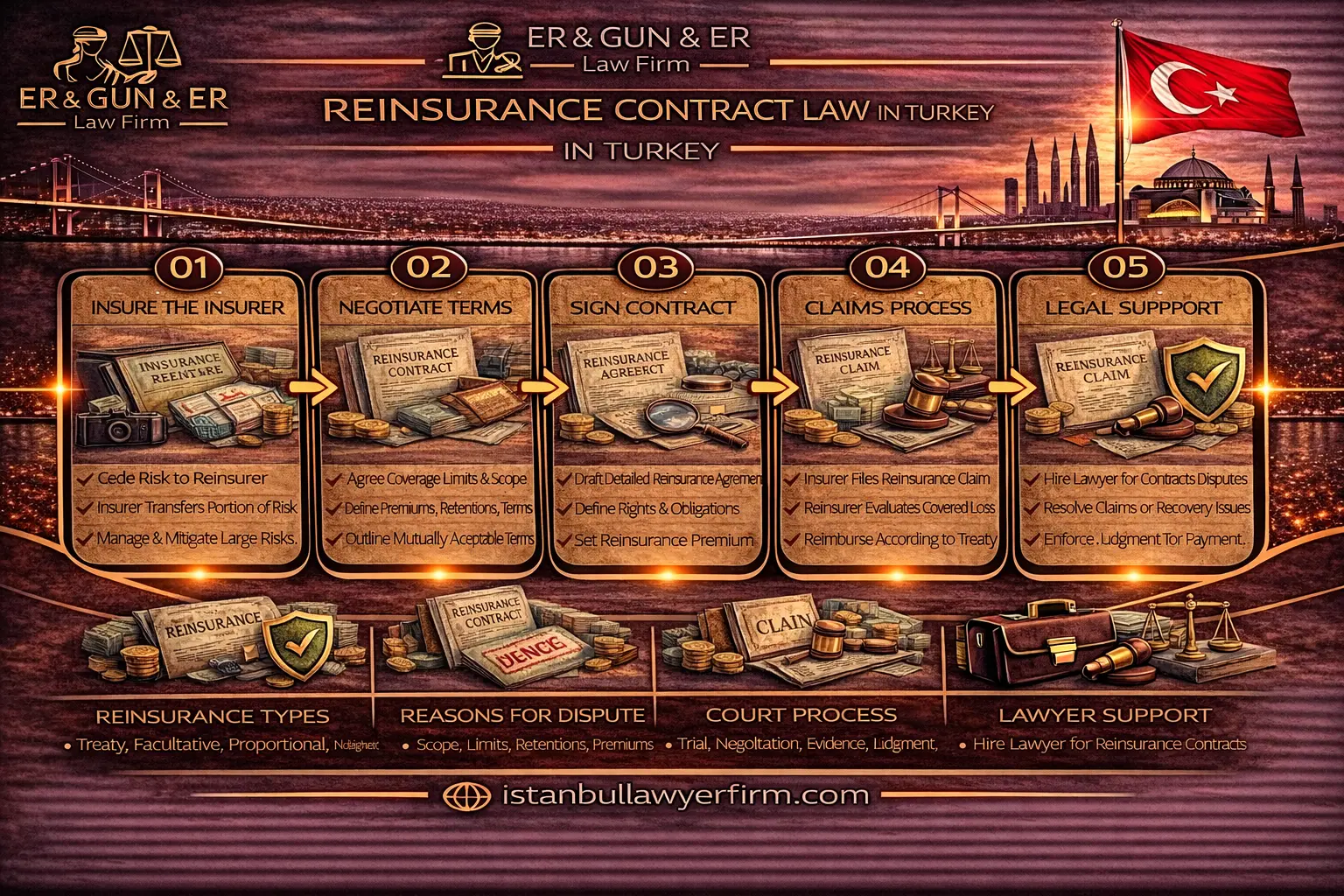
Reinsurance transfers part of an insurer's portfolio risk to a reinsurer under a separate commercial contract distinct from the underlying direct insurance relationship. Unlike direct insurance, the insured party under the primary policy is not normally a party to the reinsurance and cannot rely on it for payment. The practical consequence is that recoverability depends on what the cedant can prove to the reinsurer, not only what the insured can prove to the cedant. The framework that governs the relevant questions is set primarily by the 6102 sayılı Türk Ticaret Kanunu (TTK) sigorta provisions (m.1401 vd.) governing the general insurance contract framework with reinsurance treated as a commercial contract supplementing the underlying direct insurance; the 5684 sayılı Sigortacılık Kanunu (Insurance Law) governing the supervisory and prudential framework for insurance and reinsurance activity; the supervisory framework administered through the Sigortacılık ve Özel Emeklilik Düzenleme ve Denetleme Kurumu (SEDDK) — established 18 October 2019 separating insurance supervision from the prior Hazine ve Maliye Bakanlığı framework; the 6098 sayılı Türk Borçlar Kanunu (TBK) governing the general contract law framework; the 5549 sayılı Suç Gelirlerinin Aklanmasının Önlenmesi Hakkında Kanun governing AML compliance through MASAK; the 6698 sayılı Kişisel Verilerin Korunması Kanunu (KVKK) governing personal data handling in claim files and bordereaux; the 5718 sayılı Milletlerarası Özel Hukuk ve Usul Hukuku Hakkında Kanun (MÖHUK) governing cross-border coordination including m.50-59 tenfiz; the 4686 sayılı Milletlerarası Tahkim Kanunu (MTK) and the 6100 sayılı Hukuk Muhakemeleri Kanunu (HMK) m.407 vd. governing arbitration; the 2004 sayılı İcra ve İflas Kanunu (İİK) governing enforcement and insolvency; and the New York Convention 1958 governing international arbitral award recognition. Practice may vary by authority and year.
An English speaking lawyer in Turkey advising on Turkish reinsurance contracts will explain that Turkish reinsurance practice operates as a commercial contract framework where wording and operational discipline matter substantially more than statutory background. Treaty programs and facultative placements use different documentation and reporting mechanics, so drafting choices must match operational workflows. The most common loss drivers in reinsurance disputes are late notice, inconsistent allocation, and unclear claims control language. The most common compliance pressures are audit readiness, privacy-safe data sharing, and consistent internal approvals for settlement and commutation. In cross-border placements, bilingual communication and authority documentation are as important as the clause wording, because misunderstandings become disputes. The body of this guide walks through the reinsurance contract concept and treaty-versus-facultative distinction; the parties, insurable interest, scope and attachment points; the follow-the-fortunes, claims control and cooperation framework; the notice duties, bordereaux reporting and documentation discipline; the settlements, allocation and cut-through/insolvency provisions; the choice of law and arbitration architecture under MTK; the regulatory compliance with sanctions and AML coordination; and the structured dispute management roadmap. For procedural orientation on adjacent topics, our notes on insurance policy review discipline, the claims workflow guide and insurance risk compliance governance can be read alongside this material.
1) Reinsurance Contract Concept and Treaty-versus-Facultative Distinction under TTK Sigorta Framework
A lawyer in Turkey advising on the reinsurance contract concept will explain that reinsurance is a contract where a direct insurer transfers part of its underwriting risk to another insurer, with the cedant remaining responsible to the policyholder under the original policy. The reinsurer's obligation is owed to the cedant under a separate contract, not to the insured. This separation is why reinsurance contract analysis under Turkish law starts with contract structure and evidence rather than consumer narratives. The reinsurance agreement typically incorporates a slip, a wording, and operational schedules that define reporting and claims cooperation. Parties should confirm which document prevails if slip and wording differ, and which definitions are back-to-back with the underlying policy versus bespoke. A back-to-back structure reduces coverage gaps but can import ambiguity from the underlying book; a bespoke structure can be clearer but may create mismatch with underlying policies if governance is weak. The cedant should maintain a central register of underlying policy forms and endorsements because they drive the ceded exposure. For practical discipline, the same document-control approach used in policy review discipline should be applied to ceded layers. The register should record effective dates, version numbers, and approval history for each form, and should record which reinsurance layer responds to which underlying portfolio segment. This mapping lets claims teams open a reinsurance file at first notice rather than at final settlement, with early file opening making later recoveries easier because facts and documents are captured contemporaneously. Practice may vary by authority and year.
An Istanbul Law Firm advising on the contract architecture will note that Turkish practice typically treats reinsurance as a commercial contract governed by negotiated wording and general contract principles. Parties often reference TTK Law No. 6102 sigorta provisions and the 5684 sayılı Sigortacılık Kanunu concepts for background, but the decisive text remains the reinsurance wording. A common drafting error is leaving definitions undefined and relying on market assumptions that differ between brokers and claims teams. Another error is inconsistent signature authority and corporate approvals, which later allows a counterparty to challenge binding. The cedant should keep board or management approvals for the program and for any later commutation discussions. The reinsurer should keep evidence of capacity and internal underwriting approval for the placement. Both sides should maintain a clean chain of correspondence showing who negotiated and confirmed each term. If the contract uses email placement, archive the full email thread with headers and timestamps. If the contract uses a broker, archive the broker's placing slip and all endorsements issued after placement. Claims teams should not assume that premium and commission mechanics are irrelevant, because accounting disputes often surface during recovery. When a dispute emerges, counsel will be asked to reconstruct intent from documents, and missing drafts create avoidable uncertainty. Engaging counsel early in the drafting stage often prevents later disputes about incorporation and precedence. The drafting file should include a precedence clause, an integration clause, and a clear amendment mechanism requiring written agreement and prohibiting informal oral modifications. Clear amendment rules reduce the risk that operational emails are misread as contractual concessions.
A Turkish Law Firm advising on the treaty-versus-facultative structural choice will note that treaty programs are portfolio arrangements where the reinsurer assumes a defined share of a book of business, while facultative placements are risk-by-risk and usually have more bespoke negotiation. In treaty placements, the operational challenge is consistent bordereaux data and consistent definition alignment across thousands of risks, with the treaty wording defining underwriting years, risk classes, and exclusion carve-outs with enough clarity for automated reporting. The wording must also define how new products or new territories are added, because silent expansion creates disputes. Even in treaties, parties often use market slips and then issue a full wording later, so precedence clauses are critical. If slip and wording differ, disputes arise about whether the cedant priced the program on the slip or on the wording. A treaty must also define how commutations are handled, because commutation affects accounting and reporting across years, and should include clear definitions for loss, expense, and salvage categories so allocations are consistent. Where multiple layers exist, define how the treaty interacts with facultative covers and retrocession. Operational teams should maintain a layer diagram that maps each underlying policy to each reinsurance response. Without a layer diagram, recoveries are delayed because teams argue about which treaty responds first. Facultative placements are negotiated for a specific risk and usually follow the risk's technical profile closely, with the slip often including bespoke warranties, exclusions, and claims control rights tailored to that one insured. Because the cover is bespoke, the file should preserve the full placing correspondence and any late endorsements; facultative disputes often arise when a late endorsement is issued on the underlying policy but not communicated to the reinsurer. To prevent that, the facultative file should include an endorsement notification protocol with delivery proof. Practice may vary by authority and year.
2) Parties, Insurable Interest, Scope and Attachment Points
Turkish lawyers who advise on parties and insurable interest will note that the parties to a reinsurance contract are typically a cedant insurer and a reinsurer, sometimes acting through a broker, with the insured under the direct policy not normally being a party to the reinsurance and having no direct claim against the reinsurer absent special arrangements. Because of this separation, drafting should define rights and duties solely between cedant and reinsurer. Authority to bind each party should be documented through corporate signatory evidence and broker authority letters where applicable. The cedant should confirm that the reinsurer has capacity and that the signing entity is the correct entity. The reinsurer should confirm that the cedant is the entity that issued the underlying policies and will control claims. If the cedant is part of a group, clarify whether the treaty covers one entity's book or multiple affiliated books. If multiple cedants are included, define reporting responsibilities and allocation rules so a dispute does not arise about whose loss it was. Insurable interest in reinsurance is typically derived from the cedant's exposure under underlying policies and its obligation to pay. The contract should define what underlying policies are in scope so that interest is not argued case by case after a loss. Where fronting arrangements exist, define who bears ultimate risk and how recoveries flow, because fronting creates additional trust risk. Brokers can facilitate placement, but broker role should not be confused with party role, because misdirected notices are common. A clean parties section is therefore a preventative control that supports later claims handling and arbitration.
A lawyer in Turkey advising on the broader insurable interest framework will note that insurable interest in the reinsurance context is economic, meaning the cedant has a genuine risk of paying underlying losses. That risk can arise from indemnity obligations, defense obligations, and expense obligations under the direct book. The contract should specify whether expenses are ceded and under what definition, because expense disputes are frequent. The contract should also specify whether cover is risk attaching, loss occurring, or another trigger concept so that interest is mapped to time. When a cedant uses delegated underwriting or delegated claims handling, the reinsurer may demand additional oversight rights. Those rights should be expressed as audit and reporting rights rather than as informal expectations. If a broker intermediates, the broker's authority should be documented so that notice delivered to the broker is not later contested. If the reinsurer is a branch or operates through a coverholder, the signing authority and service address must be clear. If the cedant's book includes consumer policies, confidentiality and data handling obligations become more sensitive. If the cedant's book includes corporate liability, the file will include third-party data and defense counsel communications that require controlled sharing. Capacity issues also arise when the reinsurer participates through multiple treaties and facultatives on the same risk. The contract should define how overlapping participations are handled so double counting does not occur. Party clauses should also anticipate insolvency and restructuring risk because counterpart insolvency changes practical enforcement. Where group reinsurers are involved, define whether group guarantees exist and whether they are enforceable. In cross-border files, service and enforcement often require legalized authority documents (apostille or consular legalization), so prepare them early. Practice may vary by authority and year.
An Istanbul Law Firm advising on scope and attachment points will note that scope defines what underlying risks are ceded and what exclusions and limits apply at the reinsurance layer. The contract should define whether cover is proportional, excess of loss, quota share, surplus, or another structure; which lines of business are included and how new products are added; whether treaties are per policy, per risk, or per portfolio segment, because scope drift is a common dispute trigger. Attachment points define when the reinsurer begins to pay, and they must be mapped to the underlying retentions and deductibles. If the cedant changes underlying deductibles, the reinsurance may not automatically adjust unless the contract says so. The contract should therefore specify how deductible changes are treated and how the cedant reports such changes. Occurrence definitions and aggregation rules should be drafted with operational examples in mind. Aggregation disputes are common because catastrophes create multiple claimants and multiple policies across one event. The cedant should preserve event logs and claim coding rules so aggregation is applied consistently across bordereaux and claim files. If the contract includes reinstatements, define how they are calculated and what documentation supports them. If the contract includes annual aggregates, define how those aggregates are tracked and reported. Attachment disputes often arise when the underlying loss includes both covered and uncovered parts and allocation is contested. The cedant should therefore define allocation methodology in the contract or in a referenced internal standard incorporated by agreement. The contract should specify whether defense costs erode retentions or sit outside retentions, because cost treatment changes attachment, and whether expenses are included in loss, because some markets treat expenses differently across classes. Where a loss spans multiple policy years, define whether the contract uses risk attaching or loss occurring triggers. Practice may vary by authority and year.
3) Follow-the-Fortunes, Claims Control and Cooperation Architecture
A Turkish Law Firm advising on follow-the-fortunes drafting will note that the reinsurance relationship works best when the reinsurer does not relitigate every underlying coverage nuance after the cedant has already investigated and decided. In follow-the-fortunes drafting, the parties often aim to allocate decision latitude to the cedant while preserving the reinsurer's right to contest out-of-scope settlements. The clause should be read together with the scope, exclusions, and any claims control language, because it cannot expand cover beyond the contract. The cedant should document that its underlying settlement was made in good faith and on a reasoned evaluation of liability and quantum. The reinsurer will typically test whether the settlement fits within the class of business and policy years ceded under the treaty or placement. If the cedant paid an amount for purely commercial peace without a defensible coverage basis, the reinsurer may characterize that amount as unrecoverable. The safest practice is to create a contemporaneous settlement memo that cites the key pleadings, expert views, and exposure assumptions that drove the compromise. Where allocation is required across multiple causes, the memo should explain why the chosen allocation method is consistent with the wording and market practice. If the cedant deviated from its internal authority matrix, it should record the exception and the approval path so the file does not look improvised. If the reinsurer asks for the underlying claim file, the cedant should share an indexed bundle rather than a data dump, because traceability is a credibility signal. The reinsurer's objections should be required to be specific, because generic objections create unnecessary delay and cost for both parties. A well-designed clause can reduce friction by stating that reasonable settlements within the scope are binding unless a clear carve-out applies. Where a carve-out exists, it should identify the carve-out factually, such as fraud, manifest error, or payments clearly outside the covered peril definition. Practice may vary by authority and year.
An English speaking lawyer in Turkey advising on the underlying handling record discipline will explain that a follow-the-fortunes clause becomes meaningful only when the cedant's underlying handling record is transparent and consistent. Reinsurers assess reinsurance claims handling by looking at what the cedant requested, what the insured produced, and what the cedant concluded. The cedant should preserve the underlying policy wording, endorsements, and delivery proof so the coverage map is stable. The cedant should also preserve the adjuster mandate and the signed adjuster report versions so later disputes do not become version disputes. If an expert was used, the expert instructions should be stored alongside the raw data basis, such as photographs, measurements, and lab outputs. The cedant should maintain a diary that records when the loss was first reported internally and when it was first reported externally to reinsurers. A diary without timestamps is weak evidence, so entries should be supported by email headers, portal logs, or meeting minutes. Where settlement discussions occurred, the cedant should preserve counsel risk assessments that explain what uncertainty was being priced. Where defense costs are material, the cedant should preserve invoices and engagement letters so expense allocation can be audited. If the reinsurer challenges reasonableness, the cedant should respond with the contemporaneous settlement memo rather than reconstructing a narrative later. Cross-border placements require disciplined translation, because a mistranslated technical term can look like a changed fact. A single terminology sheet should be used for occurrence, aggregation, and expense categories so correspondence remains consistent. If the underlying insured is also litigating, the cedant should ensure that statements made in pleadings do not contradict statements made to reinsurers. Practice may vary by authority and year.
A lawyer in Turkey advising on claims control and cooperation provisions will note that claims control provisions allocate who leads defense and who can influence settlement decisions at the reinsurance layer. In claims cooperation drafting, the key is to balance cedant autonomy with reinsurer visibility. A workable clause defines what information must be shared and what decisions require consultation or consent. If consent is required, the clause must define how consent is requested and how the request is evidenced. If the clause is silent, parties often fight about whether silence is approval, and that fight delays recovery. The cedant should maintain a standing data room structure so the same packet format is reused for every large loss. The packet should include the chronology, the pleadings, the key expert reports, and a settlement evaluation memo. The reinsurer should respond with specific questions and should avoid generic reservations that create uncertainty. Where counsel is involved, counsel instructions should be documented so later tribunals can see what was asked and why. If multiple reinsurers subscribe, the clause should address whether one lead reinsurer can coordinate responses for all. If responses are fragmented, the cedant can receive conflicting directions that make compliance impossible. The clause should also address confidentiality so sensitive insured data is shared proportionately and with safeguards. Claims control language should be drafted as an operational instruction, not as aspirational prose. The reinsurance agreement should therefore attach or reference a clear reporting pack standard that claims teams can actually produce — including a loss summary, a document index, and a status table that records what remains uncertain. A useful internal benchmark is the structured approach in the claims workflow guide, adapted for reinsurance confidentiality and commercial scope.
4) Notice Duties, Bordereaux Reporting and Documentation Discipline
An Istanbul Law Firm advising on notice obligations will note that notice is the first procedural battleground because the reinsurer will test whether it was informed in time to protect its interests. Notice obligations should be drafted with objective triggers rather than vague phrases like "prompt notice." An objective trigger can be framed around a reasonable expectation that a loss may erode retention or pierce attachment. The contract should state whose knowledge counts for triggering that expectation, such as the claims manager or the treaty manager. The contract should also state the channel for notice, such as email to named addresses, portal upload, or broker delivery with confirmation. If broker delivery is used, the contract should state whether broker delivery is deemed delivery to the reinsurer. The cedant should keep delivery proof, including email headers, portal timestamps, and read receipts where available. The reinsurer should acknowledge receipt to reduce later factual disputes about whether notice was sent. If initial notice is preliminary, the cedant should label it clearly as preliminary and state what facts are still uncertain. The cedant should then issue periodic updates when material developments occur, and it should record update dates in a diary. The contract should define material development, because different teams interpret it differently. The reinsurer should raise data questions early, because late objections look tactical and weaken credibility. If the reinsurer needs to attend inspections, the contract should state what lead time is required for invitations. If the cedant cannot provide lead time due to emergency, the cedant should document the emergency and the alternative offered. Practice may vary by authority and year.
A Turkish Law Firm advising on bordereaux reporting governance will note that periodic reporting is the administrative backbone of a treaty program because it is how the reinsurer prices and monitors exposure. Bordereaux reporting should be treated as data governance with defined fields, formats, and correction protocols. The contract should list the minimum fields required, such as policy identifiers, inception dates, limits, retentions, and premium figures. It should also define loss fields, such as claim number, occurrence date, paid amounts, case reserves, and expense components where relevant. The reporting schedule should be stated in a way that can be executed by systems and verified by audit, not as an informal expectation. If the cedant changes systems, it should preserve the mapping table that links old codes to new codes. Without mapping, the reinsurer may treat differences as concealment when they are actually code translation issues. The cedant should archive each report version and the delivery proof so later disputes can identify what was reported and when. If errors are discovered, the correction workflow should be documented and the corrected report should reference the prior version. The reinsurer should confirm receipt and should raise reconciliation questions promptly to avoid end-of-year surprises. Audit rights should be drafted with confidentiality safeguards so claim-level files are shared proportionately. KVKK considerations under the 6698 sayılı Kişisel Verilerin Korunması Kanunu apply because bordereaux often contain personal data fields, with structured data minimization, lawful basis analysis, and cross-border transfer compliance under the post-Law No. 7499 amended m.9 framework supporting compliant reporting.
Turkish lawyers who advise on documentation discipline will note that documentation is the real currency of reinsurance contract law because recoveries are paid on proof rather than on goodwill. Each program should have a single contract pack that includes the slip, the wording, endorsements, schedules, and any side letters that were formally incorporated. That pack should also include precedence language and amendment mechanics so later emails are not misread as binding variations. Keep corporate authority documents, signatory evidence, and broker authorities in the same pack so standing is never disputed when a loss hits. Create a layer map that links each underlying product form and underwriting year to the treaty or facultative layer that responds. Store the underlying form library with version numbers, because a reinsurer will often ask which underlying wording governed the ceded claim. Maintain a separate claims pack for each large loss that mirrors the underlying claim chronology and includes the settlement memo and expert materials. Use stable exhibit labels so every update can reference the same documents without renaming or reordering. Preserve email headers, portal logs, and meeting minutes because they prove when notice was given and when consent was requested. Do not rely on recollection about what was shared, because disputes are usually decided on delivery proof. When confidentiality is a concern, create a redaction protocol that removes personal data but keeps the decisive facts and measurements. If you use a data room, log who accessed which folders and when, because access logs rebut later claims of non-disclosure. Audit rights and file inspection requests should be drafted to be usable in practice and defensible in disputes — defining in advance which documents can be requested at portfolio level and which require loss-level triggers. Practice may vary by authority and year.
5) Settlements, Allocation, Cut-Through and Insolvency Provisions under İİK Coordination
A lawyer in Turkey advising on settlement architecture will note that settlement is where the cedant's commercial judgment is tested against reinsurance scope and cooperation terms. Settlement allocation becomes critical when one settlement resolves multiple causes, years, or coverages. The cedant should prepare an allocation memo that explains the method and ties each allocation component to an exhibit. If the method is exposure-based, the memo should include the exposure model inputs and the counsel advice that supported them. If the method is policy-limit-based, the memo should show why that method reflects the underlying risk and not convenience. If the settlement includes defense costs, the memo should separate defense from indemnity and explain treatment under the wording. If the settlement includes structured payments, the memo should record expected payment dates and update reinsurers as payments are made. If the cedant compromises a coverage defense for commercial peace, the memo should explain why the compromise was within the contract's fortunes standard. If the reinsurer has consent rights, the cedant should send the consent packet before finalizing terms and keep delivery proof. If the reinsurer raises objections, the cedant should answer with line-item responses and updated worksheets, not with general explanations. The reinsurer should identify which allocation element it disputes and what alternative it proposes so the dispute is actionable. A settlement packet that is indexed and dated reduces later arguments about what information was available at decision time. Settlement packets should be stored in the reinsurance archive with version control so later audits can retrieve the final signed terms. A recurring settlement failure mode is mismatch between internal settlement approvals and external communications to reinsurers — to prevent mismatch, the cedant should implement a settlement approval checklist that includes reinsurance triggers and consent conditions.
A Turkish Law Firm advising on cut-through provisions will note that cut-through provisions attempt to give a primary insured or another third party a direct right against the reinsurer. In many programs they are requested to manage counterparty risk when the cedant's credit profile is weak. However, a cut-through changes the normal privity structure of reinsurance and must be drafted with extreme precision. The contract should state who can claim, under what conditions, and whether the claim is limited to specified losses. It should also address whether the cedant's defenses and the reinsurer's defenses can still be raised against the third party. If the clause is vague, it creates multiple competing claimants and can undermine orderly claims handling. For that reason, cut-through clause discussions should begin with a clear matrix of parties, triggers, and payment mechanics. The clause should define how notices are served and how disputes are resolved so the reinsurer is not exposed to duplicative proceedings. Data protection and confidentiality should be addressed because third-party access to reinsurance files can expand disclosure risk. If the program includes multiple reinsurers, define whether the cut-through applies to all participants or only to specific subscribers. If the program is layered, define whether the cut-through can bypass lower layers or is limited by attachment and exhaustion rules. The cedant should also document how the cut-through was priced, because pricing evidence may be relevant when enforceability is challenged. Operationally, claims teams must know whether a cut-through is live so that communications and settlement releases are drafted correctly. Practice may vary by authority and year.
An English speaking lawyer in Turkey advising on insolvency clauses will explain that insolvency provisions address what happens if the cedant enters insolvency, administration, or another collective process under the 2004 sayılı İcra ve İflas Kanunu (İİK) framework, and what happens if the reinsurer becomes insolvent and cannot honor recoveries. A well-drafted insolvency clause clarifies whether reinsurance proceeds are payable to the estate, to a liquidator (iflas masası), or to a designated account. It should also state how set-off (mahsup / takas) will be treated, because set-off positions are often contested in insolvency under İİK framework. Define whether premium debts can be netted against loss recoveries and what documentation supports netting. If the clause is silent, disputes often arise between administrators and reinsurers about whether netting is permissible. The clause should also clarify whether the reinsurer can insist on proof-of-debt style filings before paying. If proof-of-debt is required, define how the cedant will provide it and how the reinsurer will acknowledge receipt. Insolvency clause drafting should be coordinated with the governing law and arbitration clauses to prevent forum fragmentation. Where fronting arrangements exist, define whether the fronting carrier's insolvency affects downstream reinsurance payments. If the program includes collateral, define how collateral is valued and released during insolvency without relying on informal understandings. Counterparty insolvency is not hypothetical in reinsurance because recoverables often concentrate on a small panel of reinsurers; cedants should therefore maintain a credit-risk dashboard and link it to contract clauses on security and payment routing. A practical orientation to insolvency mechanics is available in the bankruptcy procedures guide and should be used to align internal workflows with external administration requests.
6) Choice of Law, Jurisdiction and Arbitration under MTK Law No. 4686 and HMK m.407 vd.
An Istanbul Law Firm advising on choice of law architecture will note that governing law determines how ambiguous clauses are interpreted and which mandatory rules may override contract drafting. Parties should select governing law deliberately rather than copying a market template without analysis. In choice of law negotiations, the key question is whether the chosen law aligns with the operational center of the program and the dispute forum. If the cedant's underwriting and claims teams operate in Turkey, Turkish-law governance can reduce translation risk and improve predictability on document admissibility. If the reinsurer's panel is global, foreign-law governance may be requested to match panel expectations and arbitration norms. Whatever is chosen, the clause should define whether it applies to formation, interpretation, performance, and non-contractual claims. It should also define whether any mandatory public policy rules are preserved, because Turkish courts may apply them under MÖHUK kamu düzeni framework regardless of party choice. Avoid mixed clauses that select one law for interpretation and another for performance unless you can administer that split in practice. If the contract uses a slip and a final wording, ensure the governing law is consistent across both documents to avoid precedence disputes. Define the contract language and the prevailing version if bilingual texts exist, because language disputes often become proxy disputes about meaning. If the cedant expects to rely on market custom, state whether custom is admissible and how it will be proven. If the contract incorporates underwriting guidelines or claims manuals, state whether those documents are contractual or merely operational references. Because governing law affects remedies and evidence expectations, counsel review should be integrated into program governance rather than treated as a closing formality. Practice may vary by authority and year.
Turkish lawyers who advise on arbitration architecture will note that dispute forum selection determines speed, confidentiality, and enforceability in reinsurance. Commercial parties often prefer arbitration because it allows specialist decision makers and procedural flexibility under the 4686 sayılı Milletlerarası Tahkim Kanunu (MTK) framework for international arbitration or under the 6100 sayılı Hukuk Muhakemeleri Kanunu (HMK) m.407 vd. framework for domestic arbitration. However, arbitration is only as clear as the clause, so drafting must be precise on seat, language, and rules. If the clause is ambiguous, parties can spend months litigating procedure before any merits are heard. In arbitration disputes, the record usually turns on correspondence logs, bordereaux archives, and settlement packets rather than on witness testimony. For that reason, the clause should require structured document exchange and define whether discovery-like requests are allowed. Institutional arbitration through ISTAC (İstanbul Tahkim Merkezi) provides Turkish-seat institutional support; ICC (International Chamber of Commerce) and other major international institutions provide alternative pathways. The clause should also define whether the tribunal can appoint experts and how expert costs are allocated. If multiple reinsurers subscribe, define whether disputes can be consolidated or must proceed separately, because separate proceedings increase cost and can produce inconsistent findings on the same occurrence definition. If consolidation is desired, define the mechanism and consent requirement in the clause. If the program includes retrocession, align forum clauses to reduce back-to-back mismatch that creates three-way litigation. If interim relief is needed, define whether courts at the seat can grant it and how that interacts with tribunal jurisdiction. Cross-border arbitral award enforcement operates through the New York Convention 1958 framework with Article V refusal grounds; Turkish enforcement of foreign awards proceeds through MÖHUK m.50-59 tenfiz framework before Asliye Hukuk Mahkemesi.
A lawyer in Turkey advising on dispute escalation pathways will note that regardless of forum, dispute management succeeds when the contract contains a clear escalation pathway before formal proceedings. An escalation pathway can require senior claims meetings, exchange of position papers, and a defined document packet for each position. Position papers should be evidence-led and should cite exhibit labels from the shared index. If the contract requires mediation under the 6325 sayılı Hukuk Uyuşmazlıklarında Arabuluculuk Kanunu framework or any private mediation framework, define the mediator selection method and confidentiality rules. If mediation fails, define when arbitration or litigation can be started and what notice is required. Define whether partial payments are without prejudice, because partial payments are common in commutation and allocation disputes. Define how interest and costs are treated in settlements to prevent secondary disputes about accounting. When a dispute is foreseeable, trigger a contract-level litigation hold that freezes emails, bordereaux versions, and data room access logs. If one party sends a reservation of rights, require specificity so the other party can respond with targeted documents. Generic reservations create noise and increase cost because they do not narrow issues. If the dispute turns on technical allocation, agree a joint expert protocol early to reduce dueling reports. If the dispute turns on interpretation, agree a clause map so the tribunal can see the disputed text and the agreed text side by side. Keep all communications professional because reinsurance disputes often last years and correspondence becomes part of the permanent record. After resolution, document lessons learned and update templates so the same ambiguity is not repeated at renewal. Practice may vary by authority and year.
7) Regulatory Compliance under SEDDK Framework, Sanctions and AML Architecture
A Turkish Law Firm advising on regulatory compliance architecture will note that reinsurance sits under supervisory expectations because ceded risk affects solvency reporting, reserving credibility, and market stability. Insurance regulatory compliance for reinsurance therefore begins with governance over placement, documentation, and recoverability under the supervisory framework administered through the Sigortacılık ve Özel Emeklilik Düzenleme ve Denetleme Kurumu (SEDDK) — established 18 October 2019 separating insurance supervision from the prior Hazine ve Maliye Bakanlığı framework. The cedant should maintain a reinsurance register that lists treaties, facultatives, endorsements, and effective dates with version control. The register should also map each underlying line of business to the ceded layer so internal financial reporting is consistent. Placement approvals should be documented through authority matrices so only authorized persons bind capacity. Broker oversight should be documented because broker placement does not remove cedant accountability for accurate terms and disclosures. The cedant should also maintain a recoverables governance process that reconciles claim files, bordereaux, and reinsurer statements on a recurring basis. Discrepancies should be logged as action items with owners and deadlines so repeat mismatches do not become systemic. Where contracts are cross-border, authority documents and translations should be prepared early so supervisory requests can be answered without reconstruction. Data handling is also part of compliance because underlying claim files contain personal data and confidential underwriting information. The cedant should use redaction and access control in data rooms and record who accessed what and when. A structured approach aligned with insurance risk compliance governance helps integrate reinsurance controls into the overall compliance program. Practice may vary by authority and year.
An English speaking lawyer in Turkey advising on the recoverability framework will explain that compliance is tested most often through the question of recoverability, because an overstated recoverable distorts financial statements and capital decisions. The cedant should therefore document why a recoverable is booked, what contract layer supports it, and what evidence exists for it. If a reinsurer has reserved rights, the cedant should record the reservation and treat the recoverable as a managed risk item rather than as a fixed asset. If a reinsurer disputes allocation, the cedant should record the disputed component separately and preserve the allocation memo and exhibits. This discipline prevents later allegations that the cedant ignored known dispute risk. Where commutations occur, the cedant should preserve the commutation calculation and the approval minutes, because commutations change recoverables and future reporting. If a reinsurer is under financial stress, the cedant should document credit monitoring and any collateral discussions, because supervisors may ask how counterparty risk is managed. If the cedant expects to rely on insolvency clauses, the clause map and the operational plan should be documented before insolvency occurs. Compliance also includes ensuring that contract amendments are formal and traceable, because informal amendments create reporting ambiguity. If a broker issues an endorsement, ensure the endorsement is countersigned as required and stored in the register. If the cedant changes underlying products, record whether treaty parameters allow the change and whether reinsurers were notified. If the cedant cannot prove notification, disputes expand into scope questions. Where the program is large, structured register and remediation workflow design supports audit-readiness across the multi-year compliance horizon.
A lawyer in Turkey advising on sanctions and AML architecture will note that sanctions and AML risks arise because reinsurance involves cross-border premium flows, claim recoveries, and sometimes high-risk counterparties. Even when the underlying insured is legitimate, the reinsurer panel may include jurisdictions with heightened sanctions screening expectations. The 5549 sayılı Suç Gelirlerinin Aklanmasının Önlenmesi Hakkında Kanun framework administered through MASAK (Mali Suçları Araştırma Kurulu) within Hazine ve Maliye Bakanlığı applies to insurance and reinsurance entities (as yükümlü / obligated entities). The contract should allocate responsibility for screening and should define what information each party must provide to support screening. If a reinsurer requires certifications, the certification language should be negotiated and stored with version control to avoid later disputes about scope. Payment routing should be controlled because rerouting can trigger screening issues and delay recoveries. The cedant should document payee identity and bank details and should verify changes through a dual-approval process. If a broker is involved, broker routing instructions should be documented and reconciled against the contract. AML screening should also be applied to refund patterns and unusual payment requests, because refunds can be used for layering. Sanctions and AML risk also intersects with insolvency and commutation, because commutation payments can be large and can involve unusual routing. The commutation approval file should include screening checks and routing confirmations so the payment can be executed without last-minute blocking. If insolvency proceedings are underway, payment may need to be made to an administrator account, and administrator identity must be verified carefully to avoid fraud. Eight-year MASAK record retention under Law No. 5549 m.8 applies to all yükümlü entities including reinsurance participants. Practice may vary by authority and year.
8) Dispute Management Strategy and Practical Implementation Roadmap
An Istanbul Law Firm advising on dispute management strategy will note that dispute strategy should start before a dispute exists because the contract should include a usable escalation mechanism. The first stage is internal triage, where the cedant identifies whether the dispute is about scope, notice, allocation, or claims control. The second stage is evidence packaging, where the cedant prepares an indexed bundle tied to the disputed elements. The third stage is a position letter that is short, factual, and exhibit-driven, not a long narrative. The position letter should identify the precise clause text and the precise factual trigger in dispute. If the reinsurer disputes allocation, attach the allocation worksheet and the settlement memo used at the time. If the reinsurer disputes notice, attach the notice log and delivery proofs. If the reinsurer disputes consent, attach the consent request packet and response record. If the reinsurer disputes scope, attach the treaty scope map and the underlying policy version evidence. The reinsurer's response should likewise be specific and should identify what additional document would change its position. If responses are generic, the dispute will widen and become expensive. A disciplined strategy also includes maintaining a single chronology that both sides can verify rather than arguing about dates. Dispute management should also include financial reporting discipline because disputed recoverables affect reserves and governance decisions. The cedant should record the dispute status, the disputed amount, and the evidence status in a recoverables register reviewed periodically at committee level. For Turkish market parties, aligning dispute strategy with broader litigation discipline in insurance litigation guidance is useful because the evidence expectations are similar even if the forum is arbitral. Practice may vary by authority and year.
Turkish lawyers who advise on settlement-of-dispute architecture will note that settlement of reinsurance disputes should be approached as a contract enforcement exercise, not as a relationship gesture. If a compromise is reached, document it in a written settlement that defines amounts, allocation, currency, and payment mechanics. Define whether the settlement is without prejudice to other treaty years or whether it includes releases across periods. Define how future recoveries, such as subrogation proceeds, will be credited after settlement. Define confidentiality narrowly so that the cedant can still report to auditors and supervisors where required. Define a dispute clause for the settlement itself so a settlement does not create a new forum fight. If the reinsurer insists on a commutation style resolution, document the commutation valuation method and store it with the settlement. If multiple reinsurers are involved, define whether settlement is global or individual and how non-settling reinsurers are treated. Keep a payment log with receipts and bank confirmations because payment disputes are common even after settlement. After settlement, run a post-mortem and update templates so the same ambiguity is not repeated at renewal. The best indicator of dispute maturity is that lessons are converted into clause changes and reporting controls. When dispute management is disciplined, recoveries are faster, audit risk is lower, and arbitration becomes the exception rather than the default.
A Turkish Law Firm advising on the practical implementation roadmap will note that a practical roadmap begins with building a reinsurance operating system, not only a contract file. Step one is a contract register that stores slip, wording, endorsements, effective dates, and precedence notes. Step two is a layer map that ties each underlying product and underwriting year to each treaty or facultative participation. Step three is a notice and consent diary template that claims teams open at first notice and update with delivery proofs. Step four is a bordereaux governance process with version control, correction logs, and mapping tables for code changes. Step five is a settlement packet template that includes pleadings, expert reports, exposure analysis, and allocation worksheets. Step six is an audit protocol that defines how requests are handled, how confidentiality is preserved, and how disclosures are logged. Step seven is an insolvency protocol that identifies who receives payments and how set-off and netting are handled under the contract. Step eight is a sanctions and AML protocol that defines screening, account-change verification, and escalation. Step nine is a dispute playbook that requires issue triage, evidence packaging, and position letters before arbitration. Step ten is a training program for claims and underwriting teams so triggers are recognized early. Step eleven is an internal committee review cadence that documents disputes and remediation in minutes. Step twelve is a clause library update process that turns dispute lessons into drafting improvements. Operationalizing the roadmap requires testing because reinsurance failures often come from drift, not from intentional breach — quarterly sampling of large losses, bordereaux, consent packets, settlements and sanctions checks converts findings into action items with owners and completion dates. The final objective is dispute minimization through clarity, not dispute readiness through aggression. Practice may vary by authority and year.
9) Frequently Asked Questions for Cedants, Reinsurers and Brokers
- What is the legal nature of reinsurance under Turkish law? Reinsurance is a commercial contract between a cedant and a reinsurer that is separate from the direct policy. The direct insured usually has no direct right to the reinsurer unless a special clause (such as a cut-through clause) changes that. Drafting therefore focuses on evidence, reporting, and claims control between commercial parties under the TTK Law No. 6102 sigorta provisions framework supplemented by the 5684 sayılı Sigortacılık Kanunu supervisory framework administered through SEDDK.
- What is the difference between treaty and facultative reinsurance? Treaty reinsurance covers a defined book of business while facultative reinsurance covers a specific risk. Treaty disputes often start as data and reporting disputes, while facultative disputes often start as consent and notice disputes. Treaty drafting prioritizes definition consistency and bordereaux discipline; facultative drafting prioritizes slip-level bespoke terms and endorsement notification protocols.
- How does follow-the-fortunes operate? Follow-the-fortunes language aims to prevent relitigation of reasonable cedant settlements within scope. It does not expand cover beyond the contract. The safest approach is a contemporaneous settlement memo tied to exhibits — citing pleadings, expert views, and exposure assumptions — supporting the reasonableness and good-faith determination at the time of settlement.
- How should claims control clauses be drafted? Claims control clauses should define what information must be shared, when consent is required, and how silence is treated. If consent is required, define the consent packet (chronology, pleadings, expert reports, settlement evaluation memo) and response workflow. Keep delivery proofs and a diary for every trigger event. If multiple reinsurers subscribe, address whether one lead reinsurer can coordinate responses for all.
- What discipline governs notice obligations? Notice duties should be drafted with objective triggers (such as reasonable expectation that loss may erode retention or pierce attachment) and defined channels (named email addresses, portal upload, broker delivery with confirmation) with acknowledgment of receipt. Late notice disputes are usually framed as prejudice, so delivery proofs and invitation logs are decisive. The contract should state whose knowledge counts for triggering notice expectations.
- How should bordereaux reporting be governed? Bordereaux is a controlled dataset that should be versioned, archived, and corrected through documented protocols. The contract should list minimum fields (policy identifiers, inception dates, limits, retentions, premium figures, claim numbers, occurrence dates, paid amounts, case reserves). System migrations require mapping tables so field changes do not create phantom discrepancies. Keep a disclosure log for audit requests. KVKK compliance under Law No. 6698 applies to personal data fields in bordereaux.
- What are cut-through and insolvency clauses? Cut-through clauses attempt to create direct rights for third parties (typically primary insureds) and must be drafted carefully to avoid duplicative claims and confidentiality problems. Insolvency clauses should define payee routing under İİK insolvency framework, set-off (mahsup) treatment, and proof requirements. Coordinate insolvency clauses with governing law and arbitration clauses to prevent forum fragmentation.
- How should choice of law and arbitration clauses be drafted? Choice of law and arbitration clauses should be aligned and precise on seat, language, and rules. International arbitration operates under the 4686 sayılı Milletlerarası Tahkim Kanunu (MTK); domestic arbitration under HMK m.407 vd. ISTAC (İstanbul Tahkim Merkezi), ICC, and other major institutional providers offer different procedural frameworks. Foreign award enforcement proceeds through the New York Convention with Article V refusal grounds and MÖHUK m.50-59 tenfiz framework before Asliye Hukuk Mahkemesi.
- What supervisory framework governs Turkish reinsurance? The 5684 sayılı Sigortacılık Kanunu administered through the Sigortacılık ve Özel Emeklilik Düzenleme ve Denetleme Kurumu (SEDDK) — established 18 October 2019 separating insurance supervision from the prior Hazine ve Maliye Bakanlığı framework. Compliance focuses on governance, recoverables integrity, and audit-ready documentation. Maintain a contract register, a recoverables register, and periodic sampling and remediation logs.
- What AML and sanctions obligations apply? Sanctions and AML risks under the 5549 sayılı Suç Gelirlerinin Aklanmasının Önlenmesi Hakkında Kanun framework administered through MASAK require screening logs, account-change verification, and proportionate data sharing. Eight-year record retention under m.8 applies. Delays should be documented with written explanations and escalation records. Commutation and insolvency-driven payments warrant enhanced screening discipline.
- How should KVKK compliance be integrated? Under the 6698 sayılı Kişisel Verilerin Korunması Kanunu administered through the KVKK Kurulu, reinsurance file handling involves personal data processing requiring data inventory mapping, lawful basis analysis under m.5/m.6, data subject rights handling, VERBIS registration where threshold-applicable, cross-border transfer compliance under the post-Law No. 7499 amended m.9 framework, and structured ongoing compliance.
- What is dispute management best practice? Dispute management works best when issues are triaged into scope, notice, allocation, or control and addressed with an indexed packet. Generic objections widen disputes and increase cost. Settlement should be documented with enforceable payment mechanics and clear release scope. Maintain financial reporting discipline through a recoverables register reviewed at committee level.
- How should commutation be handled? Commutation should be documented with a commutation valuation memo, approval minutes, and supporting calculation worksheets. Commutations change recoverables and future reporting, so preserve the commutation calculation alongside the underlying treaty year mapping. If the program is layered, document how commutation affects attachment and exhaustion.
- What is the practical implementation roadmap? A practical roadmap is a set of repeatable diaries, pack templates, and sampling tests that produce the same evidence trail every time — twelve structured steps from contract register through layer map, notice diary, bordereaux governance, settlement template, audit protocol, insolvency protocol, sanctions/AML protocol, dispute playbook, training program, committee review cadence, and clause library update process. Update the clause library after each dispute and convert lessons into drafting and reporting improvements.
- Does ER&GUN&ER Law Firm advise on reinsurance contract law? Yes. ER&GUN&ER Law Firm is an Istanbul-based law firm advising cedants, reinsurers, brokers, fronting carriers and corporate participants on Turkish reinsurance, including treaty and facultative drafting under TTK Law No. 6102 sigorta provisions and Sigortacılık Kanunu (Law No. 5684) coordination; SEDDK supervisory framework navigation; follow-the-fortunes and claims cooperation clause architecture; notice and bordereaux reporting governance with KVKK Law No. 6698 personal data compliance and post-Law No. 7499 cross-border transfer framework; settlement allocation discipline including contemporaneous settlement memos; cut-through clauses and insolvency clauses with İİK Law No. 2004 coordination; choice of law analysis and arbitration architecture under MTK Law No. 4686 international arbitration framework, HMK m.407 vd. domestic arbitration framework, ISTAC and ICC institutional coordination, and MÖHUK Law No. 5718 m.50-59 tenfiz framework with New York Convention 1958 Article V analysis; sanctions and AML compliance under Law No. 5549 with MASAK supervision and m.8 eight-year record retention; structured dispute management roadmap with internal triage, evidence packaging, and position letter discipline — with English-language client communication and bilingual documentation throughout each engagement. Files in this area are typically led personally by the managing partner rather than delegated.
Author: Mirkan Topcu is an attorney registered with the Istanbul Bar Association (Istanbul 1st Bar), Bar Registration No: 67874. His practice focuses on cross-border and high-stakes matters where evidence discipline, procedural accuracy, and risk control are decisive.
He advises cedants, reinsurers, brokers, fronting carriers, family offices, foreign financial institutions and multinational groups on Turkish reinsurance contract law and dispute architecture under the 6102 sayılı Türk Ticaret Kanunu (TTK) sigorta provisions (m.1401 vd.) governing the general insurance contract framework with reinsurance treated as a commercial contract supplementing the underlying direct insurance, the 5684 sayılı Sigortacılık Kanunu (Insurance Law) governing the supervisory and prudential framework administered through the Sigortacılık ve Özel Emeklilik Düzenleme ve Denetleme Kurumu (SEDDK) — established 18 October 2019 separating insurance supervision from the prior Hazine ve Maliye Bakanlığı framework, the 6098 sayılı Türk Borçlar Kanunu (TBK) governing the general contract law framework including m.27 (kesin hükümsüzlük), m.39 (irade sakatlıkları) and m.50-52 (haksız fiil) provisions, the 5549 sayılı Suç Gelirlerinin Aklanmasının Önlenmesi Hakkında Kanun governing AML compliance through MASAK (Mali Suçları Araştırma Kurulu) within Hazine ve Maliye Bakanlığı including eight-year record retention under m.8, the 6698 sayılı Kişisel Verilerin Korunması Kanunu (KVKK) administered through the KVKK Kurulu including the post-Law No. 7499 amended m.9 cross-border transfer framework, the 5718 sayılı Milletlerarası Özel Hukuk ve Usul Hukuku Hakkında Kanun (MÖHUK) governing cross-border coordination including m.50-59 tenfiz, the 4686 sayılı Milletlerarası Tahkim Kanunu (MTK) governing international arbitration, the 6100 sayılı Hukuk Muhakemeleri Kanunu (HMK) including m.407 vd. domestic arbitration framework, the 6325 sayılı Hukuk Uyuşmazlıklarında Arabuluculuk Kanunu governing private mediation, the 2004 sayılı İcra ve İflas Kanunu (İİK) governing enforcement and insolvency, and the New York Convention 1958 governing international arbitral award recognition. His advisory work covers treaty and facultative reinsurance contract drafting including slip and wording precedence, integration and amendment mechanics, definition consistency, layer mapping, retrocession coordination, and underlying policy back-to-back analysis; follow-the-fortunes clause architecture with contemporaneous settlement memo discipline; claims control and cooperation clause drafting with structured consent packet templates, response workflow definition, and confidentiality protection; notice obligation drafting with objective triggers, defined delivery channels, and acknowledgment requirements; bordereaux reporting governance covering minimum field specification, system migration mapping table preservation, version archiving, correction workflow, and audit rights with confidentiality safeguards; documentation discipline covering contract pack, claims pack, layer map, exhibit labeling, redaction protocol, and data room access logging; settlement allocation memo discipline with method documentation (exposure-based, policy-limit-based, or other), defense-versus-indemnity separation, and structured payment tracking; cut-through clause drafting with parties matrix, trigger and payment mechanics, defenses preservation, and confidentiality framework; insolvency clause drafting with İİK coordination including payee routing, set-off treatment, proof-of-debt mechanics, collateral valuation, and fronting-carrier insolvency coordination; choice of law analysis with formation, interpretation, performance and non-contractual claims scope; arbitration architecture under MTK and HMK frameworks with ISTAC and ICC institutional coordination, expert appointment provisions, and seat-law procedural integration; cross-border arbitral award enforcement under New York Convention 1958 Article V analysis and MÖHUK m.50-59 tenfiz before Asliye Hukuk Mahkemesi; SEDDK supervisory framework navigation including reinsurance register, recoverables governance, and authority matrix design; sanctions and AML compliance integration including screening logs, account-change verification, and dual-approval protocols; KVKK compliance integration including data inventory, lawful basis analysis, VERBIS registration, and cross-border transfer mechanism design; and structured dispute management with internal triage, evidence packaging, position letter architecture, and post-resolution clause library update process.
Education: Istanbul University Faculty of Law (2018); Galatasaray University, LL.M. (2022). LinkedIn: Profile. Istanbul Bar Association: Official website.