

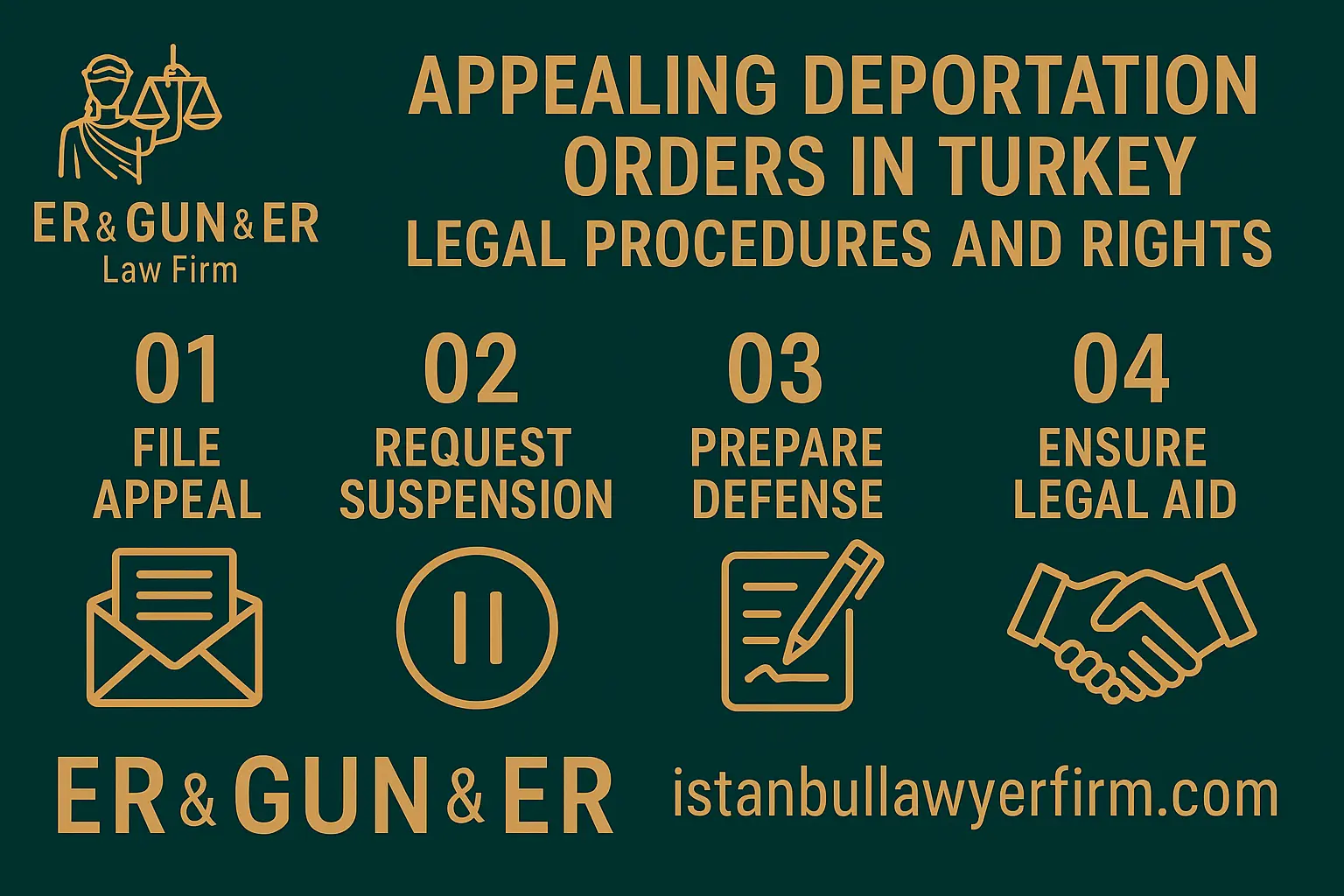
A deportation order (sınır dışı etme kararı) issued by Turkish immigration authorities under the Law on Foreigners and International Protection (Yabancılar ve Uluslararası Koruma Kanunu, YUKK, Law No. 6458) is a legally challengeable administrative decision — and the challenge must be mounted immediately, because YUKK Article 53 provides a 15-day appeal window from the date of notification to the foreign national, and the administrative court is required to decide the case within the same 15-day period. This compressed timeline means that the entire appeal — identification of the legal grounds, preparation of the evidence package, filing of the administrative court lawsuit, and the simultaneous application for stay of execution to prevent removal during the proceedings — must be executed within days, not weeks. For foreign nationals who do not speak Turkish and who are unfamiliar with the Turkish administrative court system, the practical barriers to mounting a timely and effective challenge are significant. This guide explains the deportation order framework under YUKK, the legal grounds for challenge, the administrative court process, and the parallel removal tools available to protect a foreign national's position during proceedings. Practice may vary by authority and year — verify current YUKK implementation standards and administrative court procedural requirements directly before acting on any information in this guide.
YUKK deportation grounds — what makes a deportation order legally challengeable
A lawyer in Turkey advising on deportation order challenges must explain that a YUKK deportation order is not automatically lawful simply because the Directorate General of Migration Management (GİGM) or a provincial governorship has issued it — it must be based on one of the grounds specified in YUKK Article 54, and it must be proportionate to the individual's circumstances. YUKK Article 54 specifies the grounds on which GİGM can issue a deportation decision: being subject to an entry ban; being unlawfully present in Turkey (overstay, visa violation, or illegal entry); working without a work permit; posing a public order or public security risk; carrying a communicable disease; exceeding the permitted stay period; and being linked to terrorist organizations or activity. Each of these grounds has a specific legal standard — "public order risk" is not a blanket justification for any deportation, and an administrative court will assess whether the specific facts of the case meet the legal threshold for the asserted ground. Practice may vary by authority and year — verify current YUKK Article 54 judicial interpretation and the specific threshold standards applied by administrative courts for each deportation ground before structuring any appeal argument based on insufficient legal basis.
An Istanbul Law Firm advising on procedural deportation order defects must explain that beyond the substantive grounds, deportation orders must comply with specific procedural requirements under YUKK — and procedural defects can independently support a successful administrative court challenge. YUKK Article 53 requires that the deportation decision be communicated to the foreign national or their legal representative with an explanation of the grounds for the decision, information about the appeal right and the 15-day appeal deadline, and information about the foreign national's right to request legal aid. A deportation order that does not include this required information, that was communicated without an interpreter when the foreign national does not speak Turkish, or that was not personally notified to the foreign national (but instead left at an address where they were no longer registered) has procedural defects that an administrative court will weigh in the challenge. The notification's validity determines when the 15-day appeal window begins — and a defective notification may argue that the window has not properly commenced. Practice may vary — verify current administrative court notification validity standards for YUKK deportation orders and the specific procedural defect consequences applied in current court decisions before arguing any notification-based deadline challenge.
A law firm in Istanbul advising on the proportionality principle in deportation challenges must explain that Turkish administrative courts apply a proportionality assessment to deportation orders — evaluating whether the deportation measure is proportionate to the legitimate aim pursued when weighed against the individual's personal circumstances. This proportionality assessment draws on both Turkish constitutional principles (Anayasa Article 13 on restriction of fundamental rights) and the European Convention on Human Rights (specifically ECHR Article 8 on the right to respect for private and family life, which applies through Turkey's ECHR ratification). Factors that administrative courts consider in the proportionality assessment include: the length of the foreign national's legal residence in Turkey; the strength of family ties within Turkey (Turkish citizen spouse or children); the severity of the underlying violation that triggered the deportation decision; the foreign national's conduct history in Turkey; and the consequences that deportation would have for the individual's family and private life. A deportation order that is technically grounded on a YUKK Article 54 basis but that is disproportionate to the individual's circumstances — particularly where it would separate a foreign national from their Turkish citizen children — is subject to challenge on proportionality grounds before the administrative court. Practice may vary — verify current administrative court proportionality assessment methodology for YUKK deportation cases and the specific weight given to family tie evidence in current decisions before structuring any proportionality-based challenge. The general immigration enforcement and appeal framework is analyzed in the resource on deportation defense in Turkey.
The 15-day appeal window — YUKK Article 53 and administrative court jurisdiction
An English speaking lawyer in Turkey advising on the YUKK Article 53 appeal deadline must explain that the 15-day appeal period is the most operationally critical element of any deportation order challenge — because it begins running from the date the foreign national (or their legal representative) receives notification of the deportation decision, and a lawsuit filed after the 15-day period has elapsed will be dismissed on procedural grounds regardless of the substantive merit of the challenge. YUKK Article 53(3) specifically provides that the deportation decision can be appealed before the administrative court within 15 days of notification. The administrative court is then required to decide the case within 15 days — which is an unusually compressed judicial timeline that reflects the legislature's intention to provide rapid judicial protection against removal rather than the prolonged proceedings typical of standard administrative court cases. In practice, the administrative court's compliance with this 15-day decision deadline varies, but the appeal filing deadline is strictly enforced. Practice may vary by authority and year — verify current administrative court YUKK Article 53 enforcement standards at the relevant court before planning any appeal filing timeline.
A Turkish Law Firm advising on the stay of execution application must explain that filing the administrative court lawsuit under YUKK Article 53 does not automatically suspend the execution of the deportation order — GİGM can proceed with physical removal while the lawsuit is pending unless the court grants a yürütmenin durdurulması (stay of execution) order. The stay of execution application must be filed simultaneously with the main lawsuit and must demonstrate: that the deportation order is prima facie legally defective (fumus boni juris); and that the execution of the deportation before the court's decision would cause irreparable harm (periculum in mora). For deportation cases, the irreparable harm element is almost always present — removal from Turkey is by definition an irreversible action while the case is pending — and the primary focus of the stay application is demonstrating the prima facie legal defect in the deportation decision. An administrative court that grants a stay of execution creates legal authorization for the foreign national to remain in Turkey while the main case is decided. We file stay of execution applications simultaneously with every deportation order lawsuit as a standard practice — because the physical execution of removal can occur at any point while the lawsuit is pending without a stay. Practice may vary — verify current administrative court stay of execution standards for YUKK deportation orders and the specific prima facie defect documentation that courts currently require before structuring any stay application argument.
A lawyer in Turkey advising on the administrative court's jurisdiction over YUKK deportation orders must explain that the administrative court (İdare Mahkemesi) competent to hear a YUKK deportation order challenge is the administrative court in the location where the deportation order was issued — which is typically the provincial administrative court for the province where the foreign national was detained or where the GİGM provincial directorate that issued the order operates. For foreign nationals detained at airports, the competent court may be the administrative court for the province where the airport is located. The administrative court's review in a YUKK deportation order case covers both the substantive legality of the deportation ground (whether the facts satisfy the YUKK Article 54 requirements) and the procedural validity of the deportation process (whether the required notifications were made, whether the proportionality assessment was conducted, and whether the foreign national's right to information was respected). The court's decision in a YUKK deportation order case can annul the order entirely (iptal), partially limit its effect, or dismiss the challenge — and an unfavorable first-instance decision can be appealed to the Regional Administrative Court (Bölge İdare Mahkemesi). Practice may vary — verify current administrative court jurisdiction rules for YUKK deportation orders issued at airports and border crossings and the Regional Administrative Court appeal procedure before planning any multi-level appeal strategy. The complete immigration enforcement and challenge framework is analyzed in the resource on legal remedies against entry bans for foreigners in Turkey.
Entry bans — YUKK Article 9 challenges and waiver procedures
An Istanbul Law Firm advising on entry ban challenges under YUKK must explain that a deportation order is frequently accompanied by an entry ban (giriş yasağı) under YUKK Article 9 — prohibiting the deported foreign national from re-entering Turkey for a defined period ranging from one year to five years depending on the ground for deportation and the individual's prior immigration history. The entry ban and the deportation order are related but legally separate administrative acts: the deportation order addresses the removal from Turkey, while the entry ban addresses the prohibition on return. Both can be challenged independently before the administrative court, but because they arise from the same underlying facts and legal assessment, the challenges are typically filed together as part of a single administrative court lawsuit that addresses both the deportation order and the entry ban. Practice may vary by authority and year — verify current YUKK Article 9 entry ban duration standards applicable to the specific deportation ground and the specific administrative court challenge procedure for entry bans before structuring any entry ban challenge alongside a deportation order appeal.
A law firm in Istanbul advising on the entry ban waiver procedure must explain that YUKK Article 9(4) provides a specific mechanism for waiver of entry bans in humanitarian or compelling circumstances — allowing the Turkish governorship or GİGM to grant an entry permission despite an existing entry ban where the foreign national demonstrates specific compelling grounds. The entry ban waiver application is an administrative procedure distinct from the administrative court challenge — it is filed with GİGM or the relevant governorship and involves a discretionary assessment of the individual's circumstances. Common grounds for entry ban waivers include: family unity (Turkish citizen spouse or children); medical necessity (ongoing treatment in Turkey that cannot be provided elsewhere); humanitarian need (elderly dependent relatives in Turkey); and business necessity (contractual obligations or investment management that cannot be managed remotely). The waiver procedure and the administrative court challenge can be pursued in parallel — and a waiver application does not waive the right to pursue the administrative court challenge. Practice may vary — verify current GİGM entry ban waiver application procedures and the specific compassionate grounds that produce favorable waiver decisions before planning any parallel waiver strategy alongside an administrative court entry ban challenge.
An English speaking lawyer in Turkey advising on the consequences of an unchallenged entry ban must explain that an entry ban that is not challenged within the applicable timeframes becomes final and creates a record in Turkish border control systems that will result in automatic refusal of entry at any Turkish border crossing — including airports, land borders, and sea ports — for the duration of the ban period. The existence of a finalized entry ban also affects Turkish visa applications made abroad: Turkish consulates abroad will check against the entry ban register and decline to issue visas (or will issue them knowing that the traveler will be refused at the Turkish border). For foreign nationals with Turkish citizen family members, investment assets, or ongoing business relationships in Turkey, an unchallenged entry ban creates years of practical separation from Turkey that can have severe personal and commercial consequences. We assess entry ban validity as the first step in every deportation mandate — even where the foreign national has already been removed from Turkey — because the entry ban challenge can be pursued from abroad if the deportation has already been executed. Practice may vary — verify current entry ban challenge procedures available from abroad and the specific administrative court jurisdiction for entry ban challenges filed by foreign nationals outside Turkey before planning any offshore entry ban challenge. The entry ban appeal framework is analyzed in the resource on entry ban appeals in Turkey.
Humanitarian defense — ECHR Article 8, family unity, and non-refoulement
A Turkish Law Firm advising on ECHR Article 8 family life defense in deportation cases must explain that Turkey's ratification of the European Convention on Human Rights requires Turkish administrative courts to assess deportation decisions against the ECHR Article 8 right to respect for family and private life — and the ECtHR's jurisprudence on Article 8 deportation cases provides a framework that Turkish courts have increasingly applied in deportation challenges. Under ECtHR Article 8 analysis, a deportation that separates a foreign national from their established family life in Turkey — particularly where minor children are involved — must satisfy a "necessary in a democratic society" standard: the deportation must pursue a legitimate aim, must be necessary to achieve that aim, and must be proportionate in the sense that the private and family life disruption is not excessive relative to the aim pursued. A deportation for a technical immigration violation (overstay, administrative registration failure) that would permanently separate a foreign national from their Turkish citizen children does not typically satisfy the ECHR Article 8 proportionality standard. Practice may vary by authority and year — verify current Turkish administrative court ECHR Article 8 application methodology in deportation cases and the specific family connection documentation that courts currently require before structuring any Article 8 family life defense.
An Istanbul Law Firm advising on the non-refoulement principle in Turkish immigration law must explain that YUKK Article 4 codifies the non-refoulement principle — the prohibition on returning a foreign national to a place where they face a real risk of serious harm including torture, inhuman or degrading treatment, or death. This principle derives from both Turkey's ECHR obligations (Article 3) and its Convention Relating to the Status of Refugees obligations. For foreign nationals who face persecution, torture, or other serious harm in their country of origin, the deportation order must be assessed against the YUKK Article 4 prohibition — and GİGM has an obligation to assess the non-refoulement risk before executing any deportation to a country where such risk may exist. A deportation executed to a country where the foreign national faces a real risk of serious harm — without an adequate assessment of that risk — violates both Turkish domestic law and Turkey's international treaty obligations. We prepare non-refoulement evidence packages for every deportation case involving a destination country where persecution or violence risk may exist — including expert reports on country conditions, NGO documentation, and the foreign national's personal risk narrative. Practice may vary — verify current YUKK Article 4 non-refoulement assessment standards and the specific evidence documentation that GİGM and administrative courts require for non-refoulement protection claims before structuring any non-refoulement defense.
A lawyer in Turkey advising on humanitarian residence permit applications as parallel deportation defense must explain that a foreign national facing deportation who has not previously applied for humanitarian residence protection — or who has applied but whose application has not yet been decided — can file a humanitarian residence permit application (insani ikamet izni) under YUKK Article 46 in parallel with the administrative court challenge to the deportation order. YUKK Article 46 authorizes GİGM to grant a humanitarian residence permit where deportation is not possible for practical reasons or where there are compelling humanitarian circumstances. This parallel application strategy serves two purposes: it creates an active GİGM proceeding on the alternative basis (which may produce a separate legal status before the administrative court decides the deportation challenge); and it creates an additional record of the foreign national's humanitarian circumstances that can be referenced in the administrative court proceeding. The humanitarian residence permit application and the administrative court challenge are complementary rather than alternative strategies — pursuing one does not waive the other. Practice may vary — verify current YUKK Article 46 humanitarian residence permit application procedures and the specific humanitarian circumstances that GİGM currently accepts as sufficient for humanitarian permit issuance before filing any parallel humanitarian application alongside a deportation order challenge. The residence permit framework is analyzed in the resource on residence permit in Turkey.
Administrative detention during deportation proceedings — YUKK Article 57
An English speaking lawyer in Turkey advising on administrative detention for deportation must explain that YUKK Article 57 authorizes GİGM to place foreign nationals subject to deportation decisions in administrative detention (idari gözetim) in removal centers (geri gönderme merkezleri, GGM) while the deportation is being prepared and executed. The administrative detention framework under YUKK Article 57 imposes specific legal requirements and time limits: the initial detention decision can be taken by the governorship for a period not exceeding 48 hours; continuation of detention beyond 48 hours requires an administrative court order; the maximum total administrative detention period is 6 months, extendable to 12 months for foreign nationals whose deportation is complicated by their lack of cooperation or other circumstances; and the court must review the detention at each extension stage. A foreign national in administrative detention retains the right to challenge the detention itself — independently of the deportation order challenge — before the administrative court under YUKK Article 57(6), and the administrative court must decide the detention challenge within 5 days. Practice may vary by authority and year — verify current YUKK Article 57 detention time limits and the specific challenge procedure for administrative detention before planning any detention challenge strategy.
A Turkish Law Firm advising on challenging YUKK Article 57 administrative detention must explain that a detention challenge under YUKK Article 57(6) is a separate legal proceeding from the deportation order challenge — and it has its own specific grounds, timeline, and burden. The grounds for challenging administrative detention include: the detention decision was made without the required legal basis under YUKK Article 57(1) (the foreign national does not fall within the categories subject to administrative detention); the detention is no longer necessary because the deportation has become practically impossible (for example, because the country of destination refuses to accept the deportee); the detention conditions violate YUKK or minimum humanitarian standards; or the detention has exceeded the maximum statutory period. A successful detention challenge results in the foreign national's release from the removal center — typically with judicial supervision conditions — while the underlying deportation order challenge continues. Release from detention does not eliminate the deportation order: it only addresses the lawfulness of the continued physical deprivation of liberty during the proceedings. We file detention challenges simultaneously with deportation order challenges in every case where the foreign national is in administrative detention — because the right to liberty during proceedings is a separate and independently enforceable right. Practice may vary — verify current YUKK Article 57(6) detention challenge standards and the 5-day decision deadline compliance rate at the relevant administrative court before filing any detention challenge.
A lawyer in Turkey advising on conditions in Turkish removal centers must explain that foreign nationals in Turkish removal centers have specific rights under YUKK Chapter 4 and the Regulation on Removal Centers (Geri Gönderme Merkezleri Yönetmeliği) — including the right to medical care, the right to inform family members of their detention, the right to access legal counsel, the right to consular notification, and the right to receive visitors including legal representatives. A removal center that denies access to counsel, denies required medical care, or holds foreign nationals beyond the statutory maximum detention period creates conditions that independently support legal challenge. For foreign nationals in detention with medical conditions that cannot be adequately addressed in the removal center — or for vulnerable individuals including unaccompanied minors, pregnant women, and persons with disabilities — the detention itself may be unlawful under YUKK's specific vulnerability protections. We conduct in-person consultations with detained clients at removal centers as a priority step in every detention mandate — because direct communication with the detained client is essential for understanding their specific circumstances and for gathering the factual information needed for both the detention challenge and the deportation order challenge. Practice may vary — verify current Turkish removal center legal access rights and the specific procedures for lawyer visits before planning any removal center visit consultation. The deportation enforcement framework is analyzed in the resource on deportation of foreigners from Turkey.
Criminal convictions and deportation — the Article 54(1)(b) framework
An Istanbul Law Firm advising on deportation orders following criminal proceedings must explain that YUKK Article 54(1)(b) authorizes deportation of foreign nationals who "pose a threat to public order or public security" — and this ground is frequently invoked following criminal convictions, but also sometimes following criminal allegations that have not resulted in conviction. The critical distinction under Turkish law is between a deportation based on an established criminal conviction (where a final court judgment exists) and a deportation based on an allegation or an investigation that has not yet resulted in a final conviction. The presumption of innocence principle — protected under both the Turkish Constitution (Anayasa Article 38) and ECHR Article 6 — applies to administrative deportation proceedings as well as criminal proceedings: a foreign national cannot lawfully be deported on the basis that they "pose a threat to public order" when the only evidence of such a threat is a pending criminal accusation that has not been adjudicated. Practice may vary by authority and year — verify current Turkish administrative court standards for the "public order threat" assessment in YUKK Article 54(1)(b) cases and the specific presumption of innocence protection that courts apply in pre-conviction deportation orders before structuring any challenge to a deportation based on criminal allegations.
A law firm in Istanbul advising on the proportionality of post-conviction deportation must explain that even where a foreign national has been convicted of a criminal offense, deportation is not automatic under YUKK — the authority must assess whether deportation is proportionate to the specific offense committed, the sentence imposed, the foreign national's personal circumstances (family ties, length of residence, health), and the public interest served by deportation. Turkish administrative courts have found deportation orders disproportionate in cases where the criminal offense was minor, the sentence was suspended or served, the foreign national has Turkish citizen children, or the foreign national has a long history of lawful residence. The proportionality assessment in post-conviction deportation cases also considers the rehabilitation potential of the foreign national — and a detailed rehabilitation plan presented to the administrative court, combined with expert evidence about the foreign national's integration into Turkish society, can support a successful proportionality challenge. We prepare post-conviction deportation challenges that specifically address the proportionality analysis — distinguishing between the criminal court's determination of criminal responsibility and the administrative authority's assessment of whether deportation is necessary and proportionate. Practice may vary — verify current Turkish administrative court proportionality standards in post-conviction deportation cases and the specific rehabilitation evidence categories that courts currently weigh before any post-conviction deportation challenge.
An English speaking lawyer in Turkey advising on drug conviction deportation specifically must explain that drug offenses — prosecuted under TCK Articles 188 (trafficking) and 191 (personal use/possession) — represent a significant proportion of post-conviction deportation orders against foreign nationals in Turkey, and the TCK Article 188 versus Article 191 distinction has direct implications for the deportation challenge. A deportation based on a TCK Article 191 (personal use/possession) conviction — particularly a first-time conviction with a suspended sentence or deferred prosecution — faces a stronger proportionality challenge than a deportation based on a TCK Article 188 (trafficking) conviction, because the public order threat posed by personal drug use is significantly lower than the threat posed by drug trafficking. Where the criminal conviction resulted from a plea agreement, an effective remorse cooperation arrangement, or a partially suspended sentence, these factors affect the proportionality assessment and should be presented to the administrative court as evidence of limited public order risk. Practice may vary — verify current administrative court proportionality standards for drug offense deportation cases and the specific factors that courts weigh in drug offense deportation proportionality assessments before structuring any post-conviction drug offense deportation challenge. The drug offense legal framework is analyzed in the resource on drug laws in Turkey.
Voluntary departure and legal departure management
A Turkish Law Firm advising on voluntary departure as an alternative strategy must explain that in some deportation cases — particularly where the legal basis for the deportation is factually established and the administrative court challenge has limited prospects of success — a strategically managed voluntary departure may produce better long-term outcomes for the foreign national than a contested deportation. YUKK Article 56 provides for voluntary departure (gönüllü geri dönüş) — a procedure by which a foreign national who has received a deportation order can request a defined period (typically 15 to 30 days, extensible in specific circumstances) to arrange their own departure from Turkey. Voluntary departure under YUKK Article 56 is legally distinct from forced removal: a foreign national who departs voluntarily and timely may not receive an entry ban, or may receive a shorter entry ban, compared to a forced deportation with an accompanying ban. The availability and terms of voluntary departure must be specifically confirmed with GİGM — because the voluntary departure option is not available in all deportation cases (it may be excluded for public order or security cases). Practice may vary — verify current YUKK Article 56 voluntary departure eligibility conditions and the specific entry ban implications of voluntary versus forced removal before advising on any voluntary departure strategy.
An Istanbul Law Firm advising on the legal management of a voluntary departure must explain that even where a foreign national chooses voluntary departure, legal assistance is important to ensure that the departure is properly recorded, that any entry ban is minimized or challenged, that personal property and assets in Turkey are properly managed, and that the foreign national's future re-entry options are preserved to the maximum extent possible. Specifically, a voluntary departure should be preceded by: confirmation from GİGM of the departure's recording as voluntary rather than forced; any available entry ban waiver or reduction request; satisfaction of any pending tax or financial obligations that could create future entry issues; proper power of attorney arrangements for management of Turkish assets during the period of absence; and confirmation of the documentation that will allow a future visa or residence application. A voluntary departure managed without legal oversight can inadvertently create additional complications — such as undocumented departure that GİGM records as flight from a deportation order — that make the foreign national's situation worse rather than better. Practice may vary — verify current GİGM voluntary departure recording procedures and the specific documentation package recommended for a legally clean voluntary departure before advising on any voluntary departure strategy.
A lawyer in Turkey advising on re-entry after a deportation or voluntary departure must explain that Turkish law provides specific pathways for re-entry after a removal — and these pathways must be assessed and planned before the departure rather than after, because the factual record created at departure (whether the departure was recorded as voluntary or forced, whether an entry ban was issued, whether any humanitarian circumstances were documented) significantly affects the re-entry options available. For foreign nationals with Turkish citizen family members — who are the most common category seeking re-entry after deportation — YUKK Article 9(4)'s entry ban waiver procedure provides the most direct re-entry pathway, and the humanitarian grounds documented before departure provide the foundation for the waiver application. For foreign nationals without Turkish family ties who were deported for administrative violations — particularly overstay or documentation failures — the voluntary departure route combined with a clean exit record typically allows the foreign national to apply for a new Turkish visa from their home country after a defined waiting period. Practice may vary — verify current Turkish visa application eligibility standards for foreign nationals with prior deportation or voluntary departure records and the specific waiting period that applies before new visa applications can be made. Practice may vary — check current guidance before acting on any information on this page.
International protection — asylum applications in deportation defense
An English speaking lawyer in Turkey advising on international protection as a deportation defense tool must explain that a foreign national facing deportation from Turkey who has not previously applied for international protection (asylum or subsidiary protection) has the right to file an international protection application under YUKK Articles 61–65 — and the filing of an international protection application creates a legal obligation on GİGM to process the application before executing any deportation to the country of origin. YUKK Article 4's non-refoulement principle prohibits deportation to a country where the foreign national faces risk of persecution or serious harm, and an international protection application that raises a credible persecution or serious harm claim engages this prohibition until the application is decided. For foreign nationals from countries experiencing conflict, persecution, or political repression, the international protection application is not simply a delay tactic — it is the legally appropriate vehicle for the protection claim that Turkish law provides. Practice may vary by authority and year — verify current YUKK international protection application procedures and the specific protection ground assessment standards applied by GİGM's international protection directorate before advising on any international protection application in a deportation defense context.
A Turkish Law Firm advising on the international protection application process must explain that the international protection application must be filed with the relevant GİGM provincial directorate in person — and where the foreign national is in administrative detention, the application can be filed within the removal center. The application requires a personal interview in which the foreign national presents their reasons for fearing return to their country of origin — and the quality of the personal interview narrative, the documentary evidence supporting the claim, and the legal representation of the foreign national at the interview stage significantly affect the outcome of the application. An international protection applicant who has legal representation from the time of the application — through the interview, the GİGM's decision, and any administrative court appeal of a negative decision — is significantly better positioned than one who approaches the process without legal assistance. We prepare international protection application packages that include country condition evidence, the personal narrative, and the legal framework connecting the individual's circumstances to the YUKK protection grounds. Practice may vary — verify current GİGM international protection interview procedures and the specific country condition evidence sources that GİGM currently accepts before preparing any international protection application package.
A lawyer in Turkey advising on the interaction between international protection and deportation proceedings must explain that the relationship between an international protection application and a pending deportation order creates a legally complex situation that must be managed carefully — because the two proceedings operate under different legal frameworks (YUKK's international protection provisions versus YUKK's deportation provisions) with different decision-making timelines and different appeal mechanisms. An international protection application that is pending before GİGM creates a legal impediment to the execution of a deportation to the country of origin, but it does not automatically annul the deportation order — and if the international protection application is ultimately rejected, the deportation order may be executed. A simultaneous strategy — challenging the deportation order before the administrative court while an international protection application is pending before GİGM — provides the strongest protection, because the administrative court challenge creates judicial oversight of the deportation while the international protection application creates a separate GİGM proceeding on the protection basis. Practice may vary — verify current Turkish administrative court practice on the interaction between pending international protection applications and deportation order challenges before planning any parallel strategy. The immigration law framework — covering all categories of Turkish immigration enforcement — is analyzed in the resource on immigration law in Turkey. Practice may vary — check current guidance before acting on any information on this page.
How we work in deportation order defense mandates
A best lawyer in Turkey managing a deportation order defense mandate begins with the same time-critical parallel assessment: confirming the deportation order's notification date and the 15-day appeal deadline; identifying the legal basis of the order under YUKK Article 54 and assessing whether the facts satisfy the legal threshold; assessing whether any procedural defects in the notification or the decision-making process can support a challenge; evaluating the proportionality of the order against the individual's personal circumstances; identifying whether the foreign national is in administrative detention and whether a parallel detention challenge is required; and assessing whether international protection, humanitarian residence, or voluntary departure should be pursued in parallel with the administrative court challenge. These assessments must be completed within the first 24–48 hours of engagement — because the 15-day appeal deadline is running from the moment the deportation order was received, and the quality of the initial filing determines the judicial protection available throughout the proceedings.
ER&GUN&ER represents foreign nationals in all categories of Turkish deportation order defense — YUKK Article 54 legal basis challenges, YUKK Article 53 administrative court lawsuits and simultaneous stay of execution applications, ECHR Article 8 family life and proportionality defenses, YUKK Article 4 non-refoulement challenges, YUKK Article 9 entry ban challenges and waiver applications, YUKK Article 57 administrative detention challenges, international protection applications and appeal support, humanitarian residence permit applications, voluntary departure legal management and re-entry planning, post-conviction deportation proportionality challenges, and ECHR applications before the European Court of Human Rights. We work in English throughout all international mandates. For the complete immigration enforcement framework — covering deportation defense, entry bans, and administrative court challenges — see the resource on deportation defense in Turkey. For the entry ban challenge framework specifically — see the resource on entry ban appeals in Turkey. Practice may vary — check current guidance before acting on any information on this page.
Frequently Asked Questions
- What is the deadline for appealing a deportation order in Turkey? Under YUKK Article 53(3), deportation orders can be appealed before the administrative court within 15 days of the date of notification to the foreign national or their legal representative. The 15-day period is strictly enforced — a lawsuit filed after this period will be dismissed on procedural grounds. The administrative court is then required to decide the case within 15 days of the filing. Practice may vary — verify the notification date and the applicable deadline before planning any appeal filing.
- Does filing an administrative court lawsuit stop my removal? Not automatically. Filing the lawsuit under YUKK Article 53 does not suspend the deportation's execution. You must simultaneously file a yürütmenin durdurulması (stay of execution) application that demonstrates a prima facie legal defect in the deportation order and that irreparable harm would result from execution before the court decides. An administrative court that grants the stay creates legal authorization to remain in Turkey while the case proceeds. Practice may vary — verify current stay of execution standards before structuring any stay application argument.
- What grounds can I use to challenge a deportation order? Grounds include: the deportation is not based on a YUKK Article 54 ground; the facts do not satisfy the threshold for the asserted ground (for example, the "public order threat" standard is not met); procedural defects in the notification or decision-making process; proportionality failure where the deportation is excessive relative to the underlying violation and the individual's personal circumstances; ECHR Article 8 family life violation; and YUKK Article 4 non-refoulement violation. Multiple grounds can be raised simultaneously in the administrative court lawsuit. Practice may vary — verify current administrative court challenge standards for each ground.
- What is the non-refoulement principle and does it apply to my case? YUKK Article 4 codifies the non-refoulement principle — prohibiting deportation to a country where the foreign national faces a real risk of persecution, torture, inhuman or degrading treatment, or death. This principle derives from both Turkey's ECHR Article 3 obligations and its Refugee Convention obligations. If you face serious harm in your country of origin, non-refoulement applies and GİGM must assess this risk before executing any deportation. An international protection application under YUKK Article 61–65 is the formal mechanism for asserting the non-refoulement claim.
- Can family ties prevent deportation in Turkey? Turkish courts apply ECHR Article 8 (right to respect for family and private life) in deportation cases — and deportation that would separate a foreign national from established family life in Turkey, particularly from Turkish citizen children, must satisfy a proportionality standard that weighs the public interest served by deportation against the family life disruption. A disproportionate deportation can be challenged and annulled on this basis. The strength of the family tie evidence — particularly documentation of Turkish citizen children's dependency — is critical to this challenge.
- What is administrative detention and how long can I be held? YUKK Article 57 authorizes GİGM to place foreign nationals subject to deportation in removal centers (GGM). The initial detention requires a governorship decision; continuation beyond 48 hours requires an administrative court order. The maximum total detention period is 6 months (extendable to 12 months in specific circumstances). You can challenge the detention itself before the administrative court under YUKK Article 57(6) — independently of the deportation order challenge — and the court must decide the detention challenge within 5 days. Practice may vary — verify current detention time limits and challenge procedures.
- Can I be deported for a criminal allegation that has not been proven in court? Not lawfully on that basis alone — the presumption of innocence under Turkish Constitution Article 38 and ECHR Article 6 applies to administrative deportation proceedings. A deportation based solely on criminal allegations that have not resulted in a final court judgment faces a strong challenge on presumption of innocence grounds. Where a deportation is issued pending criminal proceedings, the "public order threat" standard under YUKK Article 54(1)(b) cannot be satisfied by an allegation alone. Practice may vary — verify current administrative court standards for pre-conviction deportation challenges.
- What happens if I miss the 15-day appeal deadline? A lawsuit filed after the 15-day period under YUKK Article 53 will typically be dismissed on procedural grounds by the administrative court. However, the legal analysis of when the notification was received — and whether the 15-day period has actually elapsed — is critical: a defective notification (not served personally, not accompanied by required rights information, not in a language the foreign national understands) may not have validly started the 15-day clock. We assess notification validity in every case before accepting that the deadline has passed. Practice may vary — verify current administrative court notification validity standards.
- How can I challenge an entry ban that was issued with my deportation? The entry ban under YUKK Article 9 is a separate administrative act that can be challenged alongside the deportation order in the administrative court lawsuit. You can also file an administrative entry ban waiver application with GİGM under YUKK Article 9(4) based on compelling humanitarian, family, or medical grounds. The entry ban challenge and waiver application can be pursued simultaneously. Practice may vary — verify current entry ban challenge and waiver procedures before planning any entry ban strategy.
- What is voluntary departure and does it avoid an entry ban? YUKK Article 56 allows foreign nationals with deportation orders to request a defined departure period (typically 15–30 days) to arrange their own departure. A voluntary departure that is properly recorded may result in no entry ban or a shorter ban compared to forced removal with an accompanying ban. However, voluntary departure is not available in all deportation cases and must be specifically confirmed with GİGM. Legal management of the voluntary departure is essential to ensure it is recorded correctly and that future re-entry options are preserved. Practice may vary — verify current YUKK Article 56 eligibility before any voluntary departure strategy.
- Can I file an asylum or international protection application while facing deportation? Yes — filing an international protection application under YUKK Articles 61–65 creates a legal obligation on GİGM to process the application before executing deportation to the country of origin. The non-refoulement principle requires assessment of the protection claim before removal. The international protection application and the administrative court challenge to the deportation order can be pursued simultaneously. Practice may vary — verify current GİGM international protection application procedures available to detained foreign nationals before any international protection application strategy.
- Does a Turkish citizen spouse or child protect me from deportation? Family ties to Turkish citizens are a significant factor in the proportionality assessment — courts apply ECHR Article 8 and weigh the deportation's impact on family and private life against the public interest served by removal. Documented Turkish citizen children who are dependent on the foreign national are among the strongest factors in a proportionality challenge. However, family ties do not create an absolute bar to deportation — they are factors in the proportionality analysis, not automatic exemptions. The strength and documentation of the family relationship determine its weight in the challenge. Practice may vary — verify current administrative court proportionality standards for family tie evidence.
- Can I return to Turkey after being deported? Potentially yes, depending on whether an entry ban was issued, the duration of the ban, and the circumstances of the deportation. YUKK Article 9(4) provides for entry ban waiver applications where compelling humanitarian, family, or other grounds exist. A foreign national deported for administrative violations (overstay, permit issues) who subsequently applies for a new Turkish visa or residence permit through Turkish consulates abroad may be eligible after the entry ban period — or earlier with a waiver. The re-entry options depend significantly on how the departure was recorded and whether any entry ban was challenged. Practice may vary — verify current re-entry eligibility standards for foreign nationals with prior deportation records.
- How quickly can you respond to a deportation order emergency? We respond to deportation emergency instructions on a same-day basis — because the 15-day appeal deadline, the simultaneous stay of execution application, and the potential need for a detention challenge all require immediate action. Our first steps are confirming the notification date, reviewing the deportation order, assessing the available grounds, and filing the administrative court lawsuit with a simultaneous stay application. For clients in administrative detention, we initiate lawyer visits to removal centers as an emergency priority. Contact us immediately upon receiving a deportation order notification.
- What does the administrative court process look like from filing to decision? The administrative court lawsuit under YUKK Article 53 involves: filing the lawsuit and simultaneous stay of execution application at the competent administrative court within 15 days; the court assessing the stay application (which may be decided within days if urgent circumstances are demonstrated); GİGM submitting its defense (savunma) to the court; the foreign national having the right to reply to GİGM's defense; and the court rendering its decision — which under YUKK Article 53 should be within 15 days of filing. The court's decision can annul the deportation order entirely, dismiss the challenge, or partially limit the order's effect. An unfavorable decision can be appealed to the Regional Administrative Court. Practice may vary — verify current administrative court YUKK case processing timelines at the relevant court before planning any appeal timeline.
Author: Mirkan Topcu is an attorney registered with the Istanbul Bar Association (Istanbul 1st Bar), Bar Registration No: 67874. His practice focuses on cross-border and high-stakes matters where evidence discipline, procedural accuracy, and risk control are decisive.
He advises foreign nationals and their families across Deportation Order Defense (YUKK Article 53–54), Stay of Execution Applications, ECHR Article 8 Family Life Defense, Non-Refoulement Claims (YUKK Article 4), Entry Ban Challenges (YUKK Article 9), Administrative Detention Challenges (YUKK Article 57), International Protection Applications, Humanitarian Residence Permits (YUKK Article 46), Voluntary Departure Management, Post-Conviction Deportation Proportionality Challenges, and ECHR Applications matters where procedural timing and regulatory precision are decisive.
Education: Istanbul University Faculty of Law (2018); Galatasaray University, LL.M. (2022). LinkedIn: Profile. Istanbul Bar Association: Official website.