

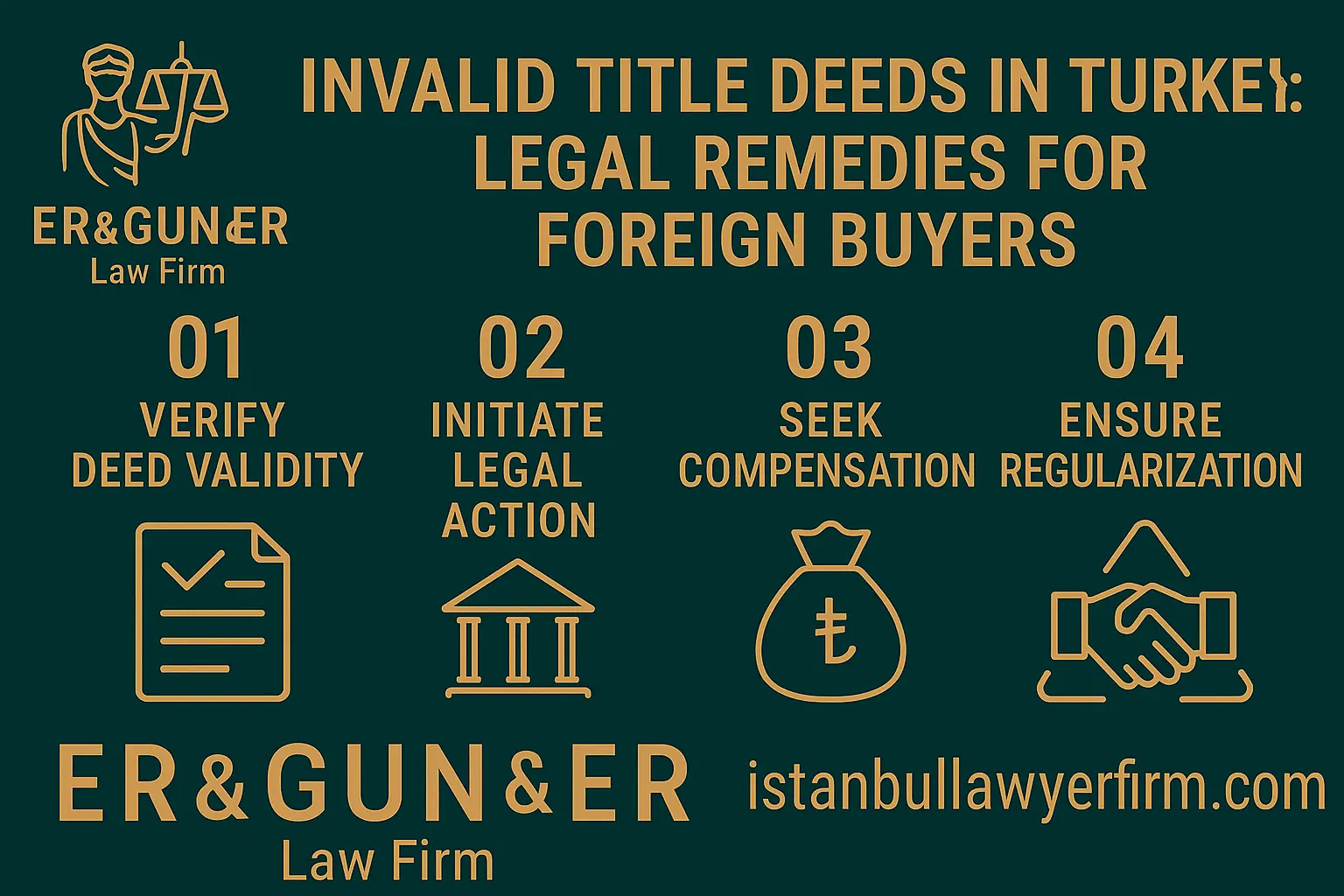
Invalid or defective title deeds — commonly referred to as "tapu sorunları" or more specifically as invalid TAPU — represent one of the most consequential legal risks facing foreign real estate buyers in Turkey. A defect can arise from clerical errors in registration, cadastral boundary mismatches, unauthorized transfers, missing construction or occupancy permits, zoning violations, prior encumbrances not properly reflected in the registry, fraudulent documentation, or identity misrepresentation by the seller. The legal consequences depend on the nature of the defect, the buyer's status as a good faith acquirer under the Turkish Civil Code, the timing of discovery, and the evidentiary record available to support correction or recovery. A lawyer in Turkey advising foreign buyers on TAPU matters operates across several parallel legal tracks — preventive due diligence before purchase, administrative correction through the Land Registry and Cadastre Directorate, civil litigation for title cancellation and re-registration under Turkish Civil Code procedure, criminal complaints where fraud or forgery is indicated under the Turkish Penal Code, state liability claims under Civil Code Article 1007 where the defect results from registry administration, and contractual remedies under the purchase agreement including rescission, damages, and restitution. Each track operates through distinct procedure, produces distinct remedies, and requires distinct evidence architecture. Practice may vary by authority and year, so every procedural step addressed below must be verified against current Turkish land registry practice, cadastral reform developments, and judicial precedent before defensive or recovery action is taken. This guide is general legal information rather than advice for any specific transaction — TAPU defense and recovery are highly fact-sensitive, and foreign buyers should seek individualized counsel before relying on any general framework. For related coverage of fraud-linked title issues, readers can also review our title deed fraud and asset recovery guide.
Types of invalid title deeds and legal consequences
A Turkish Law Firm handling TAPU defects distinguishes at the outset between administrative invalidity and substantive invalidity because the two categories follow different corrective paths. Administrative invalidity arises when registration is technically flawed — incorrect parcel identification, boundary mismatches between the TAPU record and the cadastral map, misspelled owner names that create identity ambiguity, errors in the recorded area measurement, or outdated annotations that no longer reflect the current legal position. These errors are often correctable through administrative petition to the Land Registry Directorate without requiring full civil litigation. Substantive invalidity arises when the registration records a legal situation that is itself defective — title transferred by a person without authority, construction registered without proper building permits, changes made in reliance on forged documentation, or acquisitions based on a null or voidable underlying transaction. Substantive invalidity typically requires civil litigation for title cancellation and re-registration, with the court examining the underlying transaction and the registry record to determine the correct ownership. The Turkish Civil Code No. 4721 contains the core substantive provisions governing real property ownership, registration effects, and the remedies available for registry defects. Practice may vary by authority and year, and the classification of a specific defect between administrative and substantive categories should be made by counsel reviewing the concrete registry entries and supporting documents.
Turkish lawyers who evaluate title defects also examine the interaction between registration and underlying construction compliance because a technically valid TAPU does not guarantee that the registered property is lawfully constructed or usable. Building permits issued under the Construction Zoning Law No. 3194, occupancy permits, and compliance certificates are separate from the TAPU registration itself, and a property can carry a clean TAPU while suffering from unpermitted construction, non-conforming usage, or zoning violations that affect its legal status and market value. Buyers who discover unpermitted construction after purchase face exposure to administrative demolition orders, financial penalties, and limitations on subsequent transactions. Cadastral boundary defects governed by the Cadastre Law No. 3402 present another category where the registered area differs from the physically occupied area, creating disputes with neighboring owners and exposure to boundary rectification proceedings. For broader preventive context, readers can consult our guide on legal risks of property without title verification. Practice may vary by authority and year, and the separation between title validity and construction-zoning compliance means that due diligence must address both layers rather than rely on the TAPU alone as evidence of legal standing.
An English speaking lawyer in Turkey advising foreign buyers on the consequences of different defect categories explains that remedies depend on whether the defect can be cured through correction, whether it requires cancellation and re-registration, whether it supports compensation claims against the seller or other responsible parties, or whether it triggers state liability under Turkish Civil Code Article 1007 for damages arising from registry administration. State liability is a distinctive feature of the Turkish land registry system — where the registry's administration itself produces damage to a person relying on the registry, the State can be held liable for damages under Civil Code Article 1007 even where the underlying transaction was conducted in good faith. This liability is strict rather than fault-based, meaning that proof of the administrative defect and resulting damage can support recovery without requiring proof of specific misconduct by registry personnel. Recovery against the seller typically proceeds through contract law remedies — rescission, damages for breach of warranty of title, damages for misrepresentation, or restitution — while recovery against third parties such as forgers or fraudsters proceeds through tort law remedies and parallel criminal proceedings. Each remedy has its own limitation period, evidence requirements, and procedural path, so strategy selection affects both outcome and cost. Practice may vary by authority and year, and the choice of remedy should be made based on the specific factual record rather than general preference.
Good faith third party protection and Civil Code Article 1023
A lawyer in Turkey evaluating whether a foreign buyer can retain ownership despite defects in the seller's title analyzes the good faith third-party protection under Turkish Civil Code Article 1023. That provision establishes that a person who in good faith relies on the land registry and acquires ownership or other rights in property is protected against invisible defects in the chain of title. The protection reflects a deliberate choice in Turkish property law to support the reliability of the registry as a foundation for commercial real estate transactions — if the registry did not produce reliable ownership for buyers relying on it in good faith, the registration system would fail its core function. The protection operates through specific conditions: the buyer must have acquired the property through a transaction capable of transferring ownership, the acquisition must be registered in the buyer's favor, the buyer must have relied on the registry's contents in good faith, and the buyer must not have known or been in a position to have known of the underlying defect. Good faith is presumed and must be rebutted by the party challenging the acquisition, though the presumption can be overcome by evidence that the buyer had actual or constructive knowledge of the defect. Practice may vary by authority and year, and Article 1023 analysis is fact-sensitive with significant Yargıtay precedent refining how good faith is evaluated in specific contexts including related-party transactions, bulk purchases, and acquisitions from persons under legal incapacity.
Turkish lawyers who advise on Article 1023 protection analyze the due diligence record because knowledge sufficient to defeat good faith is assessed against what a reasonable buyer would have discovered through proper inquiry. A buyer who relies solely on the TAPU printout without reviewing the construction permit status, occupancy certification, or cadastral boundaries may be treated differently from a buyer who conducts thorough due diligence and discovers no reason to question the registry. Professional real estate buyers, commercial acquirers, and buyers with legal representation are typically held to a higher standard of inquiry than individual consumers, though the specific standard depends on the nature of the transaction and the circumstances surrounding it. Red flags that should have prompted further inquiry — unusually favorable pricing, reluctance by the seller to provide standard documentation, inconsistencies between the advertised property and the registry description, identity concerns regarding the seller, or information available from public sources suggesting problems with the property — can defeat the good faith presumption if a reasonable buyer would have investigated further. Article 1023 protection is also limited by specific exclusions — acquisitions based on gratuitous transfer, acquisitions from a person whose lack of authority was evident, and acquisitions tainted by the buyer's own misconduct generally do not benefit from the protection. For additional structural context, readers can consult our due diligence guide for foreign buyers. Practice may vary by authority and year, and good faith analysis should be reviewed against specific transaction facts rather than generalized.
An Istanbul Law Firm handling litigation where Article 1023 protection is contested builds the evidentiary record through documentation of the due diligence conducted, the registry state at the time of acquisition, the timeline of the transaction, and the information available to the buyer when the purchase was completed. Title history extracts showing the sequence of registrations, communications with the seller and intermediaries, due diligence reports commissioned before purchase, and contemporaneous notes of diligence inquiries all support good faith arguments. Expert evidence on standard market practice for due diligence can establish the reasonableness of the buyer's inquiry against industry norms. Where the prior owner alleges that the buyer had knowledge defeating good faith, the evidentiary burden rests on that party to establish the specific knowledge or constructive knowledge, and a well-documented due diligence record significantly strengthens the buyer's defense. Article 1023 protection operates alongside but is distinct from state liability under Article 1007 — a buyer who loses Article 1023 protection may still have a claim against the State for registry-related damages under Article 1007, and the two claims are often pursued in parallel. The intersection of Article 1023, Article 1007, and contract-based claims against the seller creates a layered remedy framework where the buyer's position is strongest when all three potential recovery paths are preserved through prompt action. Practice may vary by authority and year, and remedy planning should identify which claims remain available within applicable limitation periods at the time issues are discovered.
Preventive due diligence before acquisition
A Turkish Law Firm structuring preventive due diligence for foreign buyers begins with the title extract and works outward to the underlying documentation that determines whether the registry entries reflect the legal reality. The title extract obtained from the Land Registry Directorate shows current ownership, registered encumbrances including mortgages and annotations, and basic property identification data including parcel, plot, and area. The title history extract shows the sequence of prior registrations and can reveal unusual transfer patterns that warrant additional inquiry. Encumbrance review addresses mortgages, foreclosure annotations, seizure notices, lease rights, usufruct rights, easements, and preliminary registration annotations that may restrict the seller's ability to transfer clean title. Cadastral documentation including the plot plan, the parcel map, and the cadastre survey confirms that the registered property matches the physically identified property and that boundaries are clear. Building permit and occupancy certificate review under Construction Zoning Law No. 3194 confirms that constructed improvements are lawfully built and usable for the intended purpose. Zoning status review addresses the permitted uses of the property under current zoning plans and any pending planning amendments that could affect future use. Practice may vary by authority and year, and due diligence scope should be tailored to the transaction size, property type, and specific risk indicators identified in preliminary review rather than applied from a generic checklist.
Turkish lawyers who verify seller authority for foreign buyers examine identity documents, title ownership, corporate authorization where the seller is an entity, and representation authority where the seller acts through agents under power of attorney. Individual sellers must be identified against government-issued documentation with verification that the person presenting the documentation is the registered owner. Corporate sellers must be reviewed through commercial registry extracts confirming the entity's existence, current shareholders and directors, the authority of the signing representative, and any restrictions on property transfers in the articles of association. Board resolutions or shareholder decisions authorizing the specific sale should be obtained where internal corporate governance requires them. Powers of attorney used in Turkish real estate transactions must meet specific legal form requirements including notarization with real estate-specific authority, and powers of attorney executed abroad require apostille or consular authentication depending on the treaty framework. Powers of attorney carry specific risks including forgery, revocation after execution, scope limitations that do not support the specific transaction, and identity mismatches between the stated grantor and the actual owner. For context on seller verification and transaction integrity, readers can consult our guide on unverified title ownership risks. Practice may vary by authority and year, and power of attorney verification should include direct confirmation with the issuing notary where any indicators raise concerns.
An English speaking lawyer in Turkey coordinating bilingual due diligence for foreign buyers ensures that the documentation gathered during verification is preserved in forms usable both for the immediate transaction and for potential later proceedings. Due diligence reports should be dated, signed, and supported by copies of the source documents reviewed, with exhibits arranged in a logical sequence that can be produced if questions arise later. Where the property has been acquired through inheritance, gift, or corporate restructuring in its recent history, the due diligence should extend to the legal validity of those prior transactions because defects in prior transfers can cascade to the current acquisition even under Article 1023 analysis. Where construction history involves multiple phases, modifications, or permit amendments, the permit documentation should be reviewed against the physical property to identify discrepancies. Cadastral reform activity in certain regions has produced periodic updates to property boundaries and legal descriptions, and due diligence should account for pending cadastral proceedings that could affect the property. Banking compliance interacts with real estate due diligence because transfers of purchase funds require banking documentation that matches the transaction structure, and inconsistencies between the purchase documentation and the banking records create complications for both the buyer and the seller. Practice may vary by authority and year, and due diligence standards should be reviewed periodically against current regulatory expectations and emerging risk patterns.
Criminal dimension: TAPU fraud, forgery, and prosecution
A lawyer in Turkey advising foreign victims of real estate fraud coordinates criminal complaints alongside civil and administrative remedies because criminal proceedings can support asset preservation, evidence gathering, and personal liability recovery that civil proceedings alone cannot achieve. The Turkish Penal Code No. 5237 contains the primary offenses relevant to TAPU fraud — Article 204 addresses forgery of official documents with enhanced penalties reflecting the trust society places in official records, Article 157 addresses fraud (dolandırıcılık) as obtaining unjust benefit through deception, and Article 158 addresses aggravated fraud with enhanced penalties where specific qualifying circumstances are present including the use of official documents or false identity. Additional relevant offenses include Article 155 regarding breach of trust, Article 159 regarding aggravated breach of trust, and Articles 207 and 208 regarding the use of forged documents. Criminal complaints are filed with the Chief Public Prosecutor's Office with jurisdiction over the place where the offense was committed or where the suspect can be located, supported by documentary evidence, witness statements where applicable, and the victim's own sworn statement describing the relevant facts. Practice may vary by authority and year, and criminal complaint strategy depends on the specific facts, the identity and location of suspects, and the strength of documentary evidence available at the initial complaint stage.
Turkish lawyers who represent foreign victims in criminal real estate proceedings coordinate participation as complaining parties (müşteki) and as intervening parties (katılan) where the criminal proceeding develops beyond the prosecutor's investigation. Complaining party status grants the victim access to the investigation file, the right to submit evidence and expert analysis, the right to appeal decisions not to prosecute, and the right to attend proceedings. Intervention status in the trial phase allows the victim to participate actively in proceedings, examine witnesses, and pursue compensation claims alongside the criminal proceedings. Asset preservation measures during criminal investigation — including seizure of specific real estate, freezing of bank accounts, and precautionary attachment of other assets — can protect the victim's potential recovery even before final judgment. These measures are obtained through motions supported by evidence of the suspect's assets and the risk of dissipation. Coordination between criminal and civil proceedings requires attention to limitation periods, evidence preservation, and the interaction between the criminal judgment's findings and the civil court's assessment of the same conduct. For related context on investor fraud defense, readers can consult our corporate fraud investigations guide. Practice may vary by authority and year, and criminal-civil coordination requires current awareness of procedural developments and precedent on the interaction between the two tracks.
An Istanbul Law Firm handling criminal investigations arising from TAPU fraud focuses on evidence preservation at the earliest stage because documentary evidence in real estate fraud cases is often time-sensitive and can be lost through subsequent transactions, document destruction, or the relocation of suspects. The evidence package typically includes the purchase documentation, communications with the seller and intermediaries, banking records showing payments made, the title registry entries before and after the disputed transaction, any powers of attorney used in the transaction, notary records of the transactions involved, and identification documents of the persons involved. Witness evidence from real estate agents, neighbors, building management personnel, and other persons with knowledge of the transaction and property can support the narrative. Expert evidence on document authenticity, signature verification, and construction compliance can address specific factual questions. Where multiple victims exist — a common pattern in cases involving systematic fraud by developers, agents, or organized groups — coordination among victims through joint counsel can strengthen the overall case, share investigation costs, and increase pressure on suspects. Double sales, where the same property is transferred to multiple buyers through sequential or parallel fraudulent transactions, require particular attention because the remedy for each victim depends on their specific position in the transaction sequence and the Article 1023 analysis applicable to their acquisition. Practice may vary by authority and year, and criminal strategy should be coordinated from the earliest indicators of fraud rather than developed reactively after civil remedies have been exhausted.
Civil litigation: title cancellation and re-registration
A Turkish Law Firm managing title cancellation and re-registration (tapu iptali ve tescil) litigation files the action before the Civil Court of First Instance (Asliye Hukuk Mahkemesi) with jurisdiction over the place where the property is located. The lawsuit seeks a judgment canceling the existing registration and ordering registration in favor of the party establishing entitlement. The competent court, the applicable procedure under the Code of Civil Procedure No. 6100, and the substantive law applied by the court are established by reference to the Turkish Civil Code and related real property statutes. Standing to sue depends on the plaintiff's claimed interest in the property — the prior owner seeking return of title, a creditor seeking enforcement of a contractual right, a party claiming acquisition through a distinct legal basis, or a party seeking correction of a registry entry. The petition must identify the specific registry entries challenged, the legal basis for the challenge, the relief sought, and the factual record supporting the claim. Evidence typically includes title history extracts, the challenged transaction documents, expert reports on land surveying and construction compliance, witness statements, and where applicable prior judgments or administrative decisions relevant to the property. Practice may vary by authority and year, and cancellation and re-registration litigation is sensitive to regional court practice, the specific expert panels available, and the evidentiary standards applied to specific categories of defects.
Turkish lawyers who represent foreign plaintiffs in title cancellation proceedings pay particular attention to the court-appointed expert (bilirkişi) process because Turkish civil procedure relies substantially on court-appointed experts for technical questions rather than on party-appointed adversarial experts common in some other jurisdictions. The expert panel for real estate cases typically includes a land surveyor, a civil engineer or architect where construction compliance is in issue, and a legal expert where the case involves specific registration or cadastral questions. The expert report addresses the technical questions framed by the court in the expertise order, and the scope and precision of the order substantially affect the resulting report. Parties can propose expert questions, object to the composition of the panel, and request supplementary reports where the initial report is incomplete or contains technical errors. Expert reports carry significant weight in the court's final determination but are not automatically binding — the court can accept, reject, or partially adopt expert findings based on its own assessment of the record. Witness testimony can address factual questions including the actual state of possession, the history of negotiations and representations leading to the disputed transaction, and the identity and authority of persons involved in the transaction. For related procedural context, readers can consult our real estate litigation guide for foreign investors. Practice may vary by authority and year, and litigation strategy should account for current expert panel practice and recent judicial decisions on similar factual patterns.
An English speaking lawyer in Turkey coordinating cross-border aspects of real estate litigation ensures that foreign documentation, foreign witnesses, and foreign banking records are presented in forms that Turkish courts can use without authenticity disputes. Documents executed abroad typically require apostille authentication under the 1961 Hague Apostille Convention where the country is a party, and consular authentication where apostille is not available. Foreign-language documents require sworn translations by translators authorized for the relevant language pair, with translations and originals presented together and identity tokens preserved consistently. Foreign witness testimony can be taken through judicial assistance procedures under applicable treaties or through video conferencing where court practice permits, and witness preparation should account for differences between Turkish court procedure and witness practice in the witness's home jurisdiction. Banking records documenting fund flows can be essential in fraud cases, and obtaining banking records often requires specific procedural steps including requests for judicial cooperation in the jurisdictions where records are held. Parallel proceedings in foreign jurisdictions — civil claims against the same defendants, criminal proceedings in the defendant's home country, or bankruptcy proceedings affecting asset availability — require coordination to preserve evidence and avoid inconsistent positions that could damage credibility in either forum. Practice may vary by authority and year, and cross-border real estate litigation should be coordinated from the earliest stage rather than approached as purely domestic proceedings supplemented by foreign elements.
Administrative correction through the Land Registry
A lawyer in Turkey pursuing administrative correction of TAPU defects works through the Land Registry Directorate rather than the courts where the defect falls within the administrative correction scope. Administrative correction is available for registry errors that do not involve disputed ownership claims — typographical errors in owner names, corrections of area measurements based on updated surveys, parcel identification corrections where the registered identification does not match the cadastral reality, and updates to outdated annotations. The petition for administrative correction identifies the specific error, provides supporting evidence demonstrating the correct information, and requests specific corrective action. Evidence can include updated identity documents, corrected survey reports, cadastral plan extracts, and documentation from prior transactions establishing the correct information. Where the correction affects the rights of third parties, the administrative procedure typically requires notice to affected parties and consideration of their objections before the correction is finalized. Where the correction involves disputed factual questions or competing ownership claims, the Land Registry Directorate typically refers the matter to the courts rather than resolving it administratively. Practice may vary by authority and year, and administrative correction practice is sensitive to the specific regional office, the nature of the error, and the availability of supporting documentation in forms the office can process.
Turkish lawyers who handle cadastral disputes work across the cadastral registry system established under the Cadastre Law No. 3402 and the Land Registry system established under the Land Registry Law No. 2644. Cadastral proceedings address the establishment of legal boundaries, the identification of parcels, the determination of rights over land in areas undergoing initial cadastral survey, and the rectification of cadastral boundaries where errors are identified. Cadastral litigation before the Cadastre Court (Kadastro Mahkemesi) handles disputes during the cadastral survey period, while post-cadastre rectifications typically proceed through the Civil Court of First Instance. Cadastral reform activities periodically update boundaries and legal descriptions across regions, and owners affected by cadastral proceedings face specific notice periods and objection windows that must be observed to preserve rights. For administrative correction context, readers can consult our title deed correction guide. Where inheritance-linked title issues arise — successions that were not properly registered, heirs whose rights are not reflected in the current registry, or disputes over succession among multiple claimants — coordination between succession law procedures and real property registration procedures is required. For inheritance and property intersection context, readers can consult our property inheritance law guide. Practice may vary by authority and year, and cadastral-registry coordination requires current awareness of reform developments and regional office practice.
An Istanbul Law Firm supporting foreign buyers with state liability claims under Civil Code Article 1007 develops the claim through documentation of the administrative defect, the causation between the defect and the damage claimed, and the quantum of damages suffered. Article 1007 establishes State liability for damages arising from the administration of the land registry, providing a distinctive remedy where the registry itself — rather than a private wrongdoer — has produced the damage. The claim is filed against the State rather than against private parties, and the competent court depends on the claim amount and the specific legal basis invoked. Evidence typically includes the defective registry entries, the correct information that should have been recorded, documentation of the buyer's reliance on the registry, the transaction documents showing the financial exposure, and evidence of the damage including the purchase price, consequential costs, and loss of use or resale value. The State can be held liable even where the underlying transaction was conducted in good faith and the administrative error was not detected at the registration stage, reflecting the strict liability nature of the Article 1007 claim. Coordination between Article 1007 claims and private-party claims is strategically important because pursuing recovery from the State while also pursuing recovery from private wrongdoers requires careful management to avoid double recovery concerns while maximizing the available recovery paths. Practice may vary by authority and year, and state liability claims require current awareness of Court of Cassation and administrative court precedent on the specific categories of defects for which recovery has been recognized.
Contract risk allocation and drafting discipline
A Turkish Law Firm drafting real estate purchase agreements for foreign buyers incorporates risk allocation clauses that address title warranty, construction compliance warranty, financial escrow arrangements, and specific remedies for defects discovered before and after closing. Title warranty clauses require the seller to represent and warrant specific facts regarding ownership, freedom from encumbrances, absence of pending litigation affecting the property, and compliance with construction and zoning requirements. Breach of these warranties can support rescission of the contract, damages, or specific performance depending on the nature and severity of the breach. Construction compliance representations address the presence of required permits, occupancy certificates, conformity with approved plans, and the absence of unpermitted additions or modifications. Financial escrow arrangements allow the purchase price to be held by a neutral third party pending satisfaction of specified conditions including title verification, permit confirmation, and transfer of registered ownership. Escrow release mechanics must be specified with precision because ambiguous release conditions create disputes even when the underlying transaction is otherwise sound. For escrow and transaction security context, readers can consult our escrow accounts guide. Practice may vary by authority and year, and contract drafting should be tailored to the specific transaction structure rather than applied from generic templates.
Turkish lawyers who draft purchase agreements for foreign buyers address the interaction between preliminary sale contracts, notarized promises to sell, and the final registration at the Land Registry. Preliminary sale contracts can be executed informally but do not transfer ownership — ownership transfer in Turkish real property law occurs only through registration at the Land Registry, and the preliminary contract creates only contractual rights subject to enforcement through specific performance or damages. Notarized promises to sell can be registered as annotations in the Land Registry, providing stronger protection against intervening transfers by the seller during the period between preliminary contract and final registration. Preliminary registration annotations (şerh) provide notice to third parties of the pending transaction and support the buyer's position if the seller attempts unauthorized transfers. The transition from preliminary contract through annotation to final registration should be planned with specific milestones, timelines, and fallback remedies if the seller delays or refuses to complete registration. Financing arrangements, whether through Turkish banks or foreign institutions, should be coordinated with the contract and registration timeline so that funding availability matches the scheduled closing. Currency selection and exchange rate risk allocation become relevant where the purchase price is denominated in a currency other than the buyer's base currency, and specific clauses can address exchange rate fluctuations, conversion timing, and payment methodology. Practice may vary by authority and year, and contract architecture should account for current banking practice and regulatory requirements affecting foreign currency real estate transactions.
An English speaking lawyer in Turkey preparing bilingual purchase agreements ensures that the binding text is clearly identified and that translations are accurate and consistent with the binding text throughout. Dual-language contracts can specify that one version controls in case of inconsistency, with the other version serving as a reference translation that supports the parties' understanding without carrying binding legal effect. The chosen binding version should typically be the Turkish version because Turkish courts will apply Turkish law to the interpretation of real estate contracts affecting Turkish property, and deviations between translation and binding text are interpreted against the party responsible for the translation. Certified translations of supporting documents — identity documents, corporate registry extracts, powers of attorney executed abroad — should be prepared by sworn translators with identity tokens preserved consistently across all documents. Notarization requirements for specific contract types require attention because the formal requirements for a legally effective contract vary by the type of transaction, the consideration involved, and the parties' status. Signature authentication, particularly for parties signing abroad, typically requires apostille or consular authentication to support the contract's use in Turkish legal proceedings. Practice may vary by authority and year, and bilingual contract drafting should account for current notary practice, banking documentation requirements, and the specific registration requirements that will apply at the final closing stage.
Public registry monitoring and post-purchase protection
A lawyer in Turkey supporting post-purchase asset protection establishes a monitoring routine that tracks the registry status of the acquired property, the legal status of related annotations, and the broader regulatory environment that could affect the property's status. Registry monitoring uses periodic title extracts to verify that ownership remains clear, that no new encumbrances have been registered without authorization, and that no unauthorized transfer attempts have been made. Electronic monitoring through the e-Government portal and specific Land Registry online services provides timely alerts for certain categories of registry changes, though the scope of available alerts varies by the nature of the registered property and the specific services subscribed. Specific annotations can be registered to strengthen the buyer's position — preliminary sale annotations where related transactions are pending, right of first refusal annotations where contractual arrangements support them, family residence annotations where the property is the marital home, and restrictive annotations limiting specific types of transactions. Annotations operate as notice to third parties that particular legal arrangements affect the property, which supports both enforcement and defense when disputes arise. Practice may vary by authority and year, and annotation strategy should be tailored to the specific legal position and risk profile rather than applied as a standard package.
Turkish lawyers who coordinate post-purchase compliance with construction and zoning requirements monitor the evolving regulatory environment affecting the property. Zoning plan amendments, urban transformation designations, new permit requirements, and enforcement actions in the immediate area can affect the property's status without direct notice to the owner. Construction compliance issues that emerge over time — including modifications made without proper permits, neighboring construction affecting the property, or discovery of prior unpermitted work — require proactive response because passive inaction can increase exposure. Tax compliance obligations including real estate tax, stamp tax on related transactions, and reporting obligations for specific property types must be tracked and satisfied on a continuing basis. Utility and services compliance — ensuring that water, electricity, and municipal services are registered in the owner's name and that payments are current — supports both the owner's practical use of the property and the legal record of continuous possession. Insurance coverage including earthquake insurance (DASK) which is mandatory for most registered properties, property insurance, and liability insurance provides financial protection against risks that legal remedies cannot fully address. Practice may vary by authority and year, and post-purchase compliance should be reviewed periodically against current regulatory developments and enforcement priorities.
An Istanbul Law Firm coordinating long-term asset protection across multiple properties, corporate ownership structures, and family succession planning develops a governance framework that supports continuity of protection even as circumstances change. Where the property is held through a Turkish or foreign corporate entity, governance documents should address the property management authority, authorization requirements for transactions affecting the property, and the succession of authority in case of management changes. Where the property is held by individuals, estate planning considerations including wills, succession arrangements, and documentation of family arrangements support an orderly transfer of the property to intended successors without avoidable disputes. Tax planning at the succession stage interacts with property ownership because transfer taxes, capital gains considerations, and estate administration costs affect the net outcome of succession. Documentation of the property's history — including the due diligence conducted at acquisition, all subsequent legal actions affecting the property, tax and compliance records, and insurance records — supports both ongoing management and future dispositions. Foreign owners who hold Turkish real estate in connection with citizenship by investment applications, residence permit programs, or long-term investment strategies require additional coordination because the property's legal status can interact directly with immigration and citizenship eligibility, and defects discovered at the immigration review stage can produce consequences beyond the real estate context itself. Regular legal review at defined intervals — annually for standard portfolios, more frequently where active disputes or regulatory changes are pending — allows emerging issues to be identified before they escalate into litigation. Dispute prevention through clear documentation, contemporaneous records of material decisions, and appropriate use of registry annotations is significantly more cost-effective than dispute resolution after problems emerge. Practice may vary by authority and year, and long-term protection frameworks should be reviewed periodically to account for changes in family circumstances, regulatory developments, and the property's own evolution over time.
Author: Mirkan Topcu is an attorney registered with the Istanbul Bar Association (Istanbul 1st Bar), Bar Registration No: 67874. His practice focuses on cross-border and high-stakes matters where evidence discipline, procedural accuracy, and risk control are decisive, with particular concentration on real estate law for foreign buyers, title deed verification and defense, tapu iptali ve tescil litigation, Turkish Civil Code Article 1023 good faith analysis, state liability claims under Article 1007, administrative correction of registry defects, cadastral disputes, and coordination of civil, administrative, and criminal tracks in real estate fraud and irregularity cases.
He advises individuals and companies across Real Estate (including acquisitions, rental disputes, and post-purchase protection), Commercial and Corporate Law, Commercial Contracts, Arbitration and Dispute Resolution, Enforcement and Insolvency, Citizenship and Immigration (including Turkish Citizenship by Investment frequently tied to real estate acquisition), International Tax, International Trade, Foreigners Law, Sports Law, Health Law, and Criminal Law. He regularly supports foreign buyers on pre-purchase due diligence, bilingual purchase agreement drafting, escrow and notary coordination, title registration, post-purchase monitoring, and the defense and recovery work that arises when title defects, fraud, or irregularities are identified at any stage of the property lifecycle.
Education: Istanbul University Faculty of Law (2018); Galatasaray University, LL.M. (2022). LinkedIn: Profile. Istanbul Bar Association: Official website.
Frequently asked questions
- What makes a title deed invalid under Turkish law? A TAPU can be invalid through administrative errors such as incorrect parcel identification or boundary mismatches, or through substantive defects such as transfer by an unauthorized person, registration based on forged documents, or registration without proper construction permits. The corrective path depends on whether the defect is administrative or substantive.
- Does Turkish Civil Code Article 1023 protect foreign buyers? Yes, Article 1023 protects buyers who in good faith rely on the land registry and acquire ownership through a qualifying transaction, regardless of nationality. The protection requires good faith at the time of acquisition, which can be defeated by evidence that the buyer had actual or constructive knowledge of the defect.
- What is Article 1007 state liability for land registry damages? Article 1007 of the Turkish Civil Code establishes strict liability of the State for damages arising from the administration of the land registry, providing recovery to persons damaged by registry errors without requiring proof of specific misconduct by registry personnel. The claim is filed against the State and is often pursued in parallel with private-party claims.
- What is a tapu iptali ve tescil davası? A title cancellation and re-registration lawsuit filed before the Civil Court of First Instance seeking a judgment canceling the existing registration and ordering registration in favor of the party establishing entitlement. It is the primary civil remedy for substantive title defects that cannot be resolved administratively.
- What criminal offenses apply to TAPU fraud? Turkish Penal Code Article 204 addresses forgery of official documents, Article 157 addresses fraud, Article 158 addresses aggravated fraud, and Articles 155 and 159 address breach of trust. Complaints are filed with the Chief Public Prosecutor's Office supported by documentary evidence and sworn statements.
- Can administrative correction resolve registry errors without court proceedings? Yes, for errors that do not involve disputed ownership claims — typographical errors, area corrections based on updated surveys, and parcel identification updates — the Land Registry Directorate can process corrections administratively based on supporting documentation. Disputed factual questions typically require court proceedings.
- What is the relationship between TAPU validity and construction permits? A valid TAPU and a valid construction permit are separate legal requirements. A property can hold a clean TAPU while suffering from unpermitted construction or zoning violations that create separate exposure to demolition orders, penalties, and transaction restrictions.
- How does due diligence protect foreign buyers? Due diligence addresses title extract review, encumbrance check, cadastral verification, building permit confirmation, seller authority verification, and power of attorney validation. Thorough due diligence both prevents problems and supports the good faith presumption under Article 1023 if issues emerge later.
- What contract clauses protect foreign buyers in real estate transactions? Title warranty clauses, construction compliance representations, escrow arrangements, preliminary registration annotations, rescission rights for defects, and specific damages provisions all contribute to protective contract architecture. Bilingual drafting with a clearly identified binding version supports enforcement.
- What is a preliminary registration annotation (şerh)? A notation registered in the Land Registry providing notice to third parties of pending transactions or legal arrangements affecting the property. Annotations strengthen the buyer's position against intervening transfers and support enforcement of preliminary contracts.
- Can foreign buyers recover funds if the title proves invalid? Recovery may be possible through civil litigation for rescission and damages against the seller, state liability claims under Article 1007, criminal proceedings with parallel compensation claims, and administrative correction where applicable. Recovery depends on specific facts, evidence, and timely action within applicable limitation periods.
- How are cadastral boundary disputes resolved? Disputes during the cadastral survey period are heard by the Cadastre Court, while post-cadastre rectifications typically proceed through the Civil Court of First Instance. Cadastral proceedings require specific notice and objection periods that must be observed to preserve rights.
- What role does the notary play in Turkish real estate transactions? Notaries authenticate signatures on preliminary contracts, powers of attorney, and related documents. The final ownership transfer occurs at the Land Registry Directorate rather than through notarization alone. Notaries do not independently verify the registry status of the property.
- How should foreign buyers monitor property status after purchase? Periodic title extract review, electronic monitoring through the e-Government portal where available, tax and insurance compliance tracking, and attention to zoning and construction regulatory developments support ongoing protection. Appropriate annotations and corporate or estate governance structures support longer-term stability.
- How does ER&GUN&ER Law Firm structure TAPU engagements for foreign buyers? Engagements begin with scope assessment — prospective purchase, post-purchase issue, or established dispute — translated into a coordinated plan covering due diligence, contract drafting, registration coordination, administrative correction, civil litigation, criminal proceedings, and state liability claims as applicable. Each track is assigned defined deliverables and synchronized timelines.