

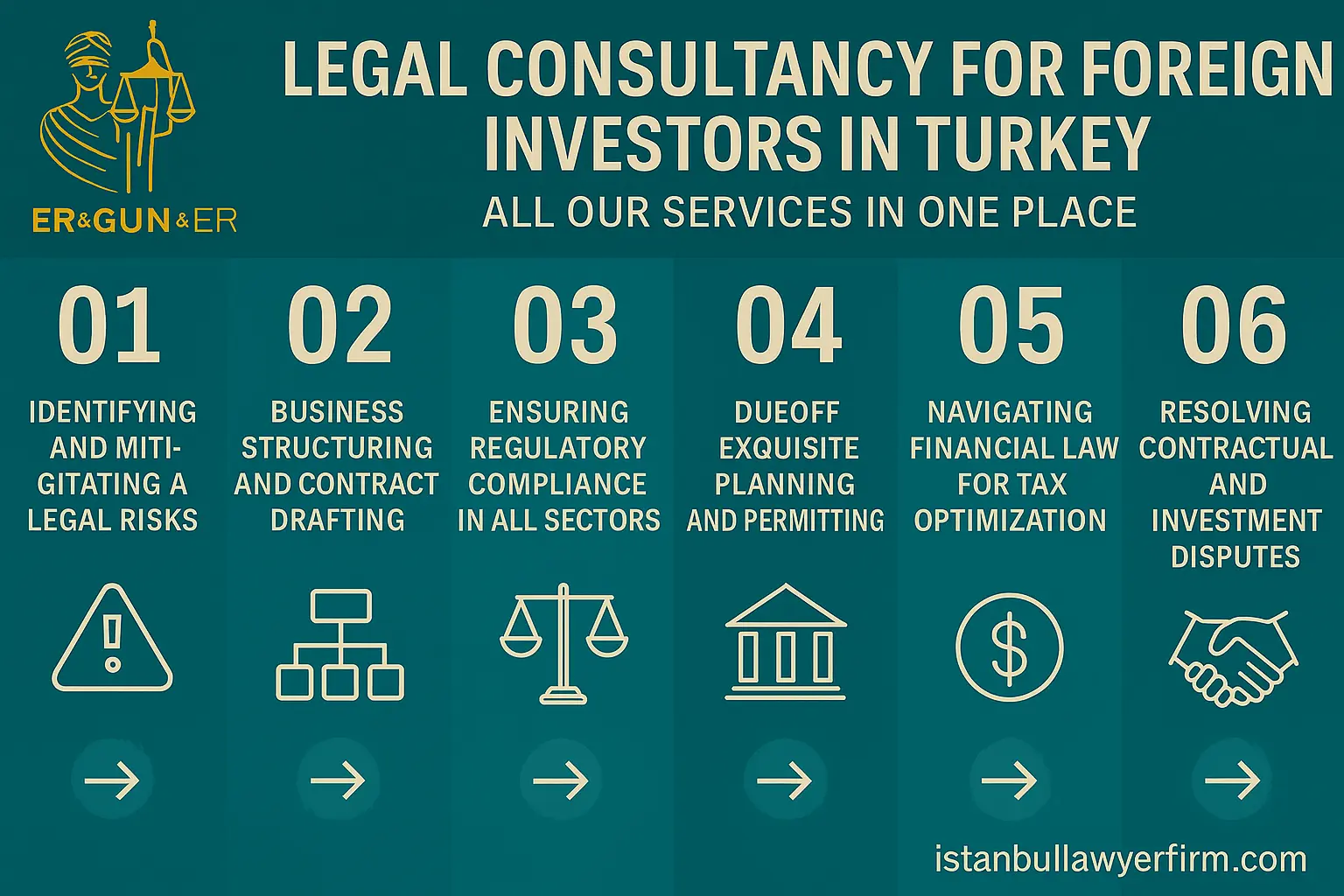
Foreign investors entering the Turkish market navigate a legal consultancy requirement that spans corporate formation, regulatory licensing, tax optimization, employment compliance, intellectual property protection, and dispute resolution pathways, each governed by specific frameworks that interact with international law considerations because cross-border elements typically characterize foreign investment. The foundational framework derives from the Turkish Commercial Code No. 6102 (TTK) operating alongside the Foreign Direct Investment Law No. 4875 of 17 June 2003 that establishes the national-treatment principle applicable to foreign investors. Minimum capital requirements effective 1 January 2024 are TRY 250,000 for joint stock companies (anonim şirket) and TRY 50,000 for limited liability companies (limited şirket), with authorized capital system for non-public A.Ş. requiring TRY 500,000. Sector-specific regulators include the Capital Markets Board (CMB — Sermaye Piyasası Kurulu) under Capital Markets Law No. 6362, the Banking Regulation and Supervision Agency (BDDK — Bankacılık Düzenleme ve Denetleme Kurumu) under Banking Law No. 5411, the Central Bank of Turkey (TCMB — Türkiye Cumhuriyet Merkez Bankası) for payment service providers and electronic money institutions under Law No. 6493, the Insurance and Private Pension Regulation and Supervision Agency (SEDDK) under Insurance Law No. 5684, the Energy Market Regulatory Authority (EPDK — Enerji Piyasası Düzenleme Kurumu) under sector-specific energy legislation, and various ministry-level authorities governing specific industries. Tax architecture combines Corporate Tax Law No. 5520 including Article 13 on related-party transfer pricing (örtülü kazanç dağıtımı), Value Added Tax Law No. 3065 (standard rate increased to 20% effective 10 July 2023), Income Tax Law No. 193, and double taxation treaties (DTTs) with over 85 countries that modify source-country taxation. The dividend withholding rate for non-resident shareholders was increased from 10% to 15% effective 22 December 2023 under Presidential Decree No. 7887, subject to DTT reductions. Employment obligations flow from Labor Law No. 4857 of 2003 (with severance pay governed by Article 14 of the repealed but maintained-in-force Labor Law No. 1475), Social Insurance Law No. 5510 governing SGK registration, and the Work Permit for Foreigners Law No. 6735 of 13 August 2016 governing foreign staff and introducing the Turquoise Card (Turkuaz Kart) system. Data protection under KVKK No. 6698 of 7 April 2016 applies where personal data processing occurs, with cross-border transfer regime reformed through Law No. 7499 of March 2024. Intellectual property protection operates through the Intellectual and Artistic Works Law No. 5846 (FSEK) and Industrial Property Law No. 6769 (SMK) effective 10 January 2017. Dispute resolution pathways include Turkish courts under Code of Civil Procedure No. 6100, international commercial arbitration under the International Arbitration Law No. 4686 (MTK), the Istanbul Arbitration Centre (ISTAC) established by Law No. 6570 of 29 November 2014 (operational 26 October 2015), mediation under Law No. 6325 with mandatory commercial mediation under Law No. 7155 effective 1 January 2019, foreign arbitral award enforcement under the New York Convention 1958 (in force for Turkey since 25 September 1991 through Law No. 3731), and investor-state dispute settlement under the ICSID Convention (in force for Turkey since 3 April 1989 through Law No. 3425). Private international law questions are governed by the Private International Law No. 5718 (MÖHUK). A lawyer in Turkey structures the consultancy relationship to span the investor's full lifecycle from market entry planning through ongoing operations to eventual exit. For framework on legal address arrangements integral to company formation, readers can consult our legal address guide for foreign companies. Practice may vary by authority and year, and effective legal consultancy for foreign investors benefits from integrated coverage across these frameworks rather than isolated advice on specific issues.
Why foreign investors need structured legal consultancy
A Turkish Law Firm advising foreign investors works from the foundational position that structured legal consultancy is not merely compliance insurance but the architectural layer determining operational agility, capital efficiency, and exit value. Unstructured approaches typically produce predictable consequences — gaps in corporate documentation that surface during investor due diligence and reduce transaction value, regulatory compliance defects generating enforcement exposure after operations are established, tax structure inefficiencies that compound across years of operations, intellectual property ownership gaps affecting M&A readiness (common issues include inadequate employee invention assignment clauses under FSEK Article 18 for copyright and SMK Article 113 for employee inventions, orphan intellectual property with undocumented ownership, and gaps in chain of title for IP acquired through asset deals), and employment law exposure creating liability as the workforce scales (particularly around severance accrual under Labor Law No. 1475 Article 14 which accrues from the first day of employment and uses a one-month-per-year formula capped at the statutory upper limit). Structured consultancy addresses these dimensions prospectively rather than reactively, producing compound returns because early-stage investment in structural correctness is substantially less expensive than retroactive remediation. The Turkish legal environment adds considerations for foreign investors including the interaction between Turkish domestic law and international treaty frameworks (over 85 double taxation treaties, over 80 bilateral investment treaties, EU Customs Union framework, WTO framework), the procedural requirements for foreign-origin documentation including apostille under the Hague Apostille Convention (to which Turkey acceded on 29 September 1985 through Law No. 3028) for documents from Convention parties and consular legalization for non-Convention countries, sworn translation (yeminli tercüman) through certified translators, and cultural and language considerations affecting practical implementation of legal arrangements. Practice may vary by authority and year, and consequences of unstructured approaches become visible typically only when specific events — regulatory inspections, due diligence, disputes — reveal accumulated gaps.
Turkish lawyers who coordinate the engagement framework for foreign investors work through elements distinguishing effective consultancy from transactional support. Engagement scope definition addresses whether consultancy covers a specific transaction only or extends to ongoing relationship support, whether coverage extends across all Turkish legal frameworks or focuses on specific dimensions, whether regulatory engagement is included or separated, and how the relationship interacts with the investor's home-country counsel and other advisors (tax advisors, operational advisors, compliance advisors). Communication architecture addresses reporting frequency, language (Turkish for regulatory interactions with Turkish authorities, English for investor-facing communications, bilingual for critical documents), contact pathways (designated relationship partner, operational contact, after-hours emergency procedures), and decision escalation frameworks. Deliverable specification including scope of routine deliverables, frequency of status reporting, and triggering events for response categories (new litigation, regulatory inquiry, material contract, specific event categories) produces predictability. Fee architecture covering hourly rates (for unpredictable workstreams), fixed fees for defined deliverables, retainer arrangements for ongoing support, and success fees or contingent arrangements where appropriate addresses the economic framework. Confidentiality and privilege arrangements including attention to cross-border considerations affecting privilege protection (Turkish attorney-client privilege under Attorney Law No. 1136 Article 36 does not map identically to common law privilege) support candid communications. Conflict management addresses the firm's existing client matters, disclosure obligations, and defined procedures for addressing conflicts as they arise. Practice may vary by authority and year, and engagement architecture for foreign investors benefits from customization because standardized approaches produce mismatches in specific engagements.
An English speaking lawyer in Turkey coordinating cross-border integration with the foreign investor's home-country advisors works through elements that support effective multi-jurisdictional coordination. Information sharing protocols addressing what information flows between Turkish and home-country counsel, how confidentiality is preserved while permitting coordination, and how conflicting advice is reconciled (typically through joint call resolution with the client as ultimate decision-maker on strategic direction) support the integrated advisory relationship. Document preparation coordination addresses requirements for dual-jurisdiction documentation including choice of law provisions, choice of forum provisions, and enforcement considerations in each relevant jurisdiction. Governance structure decisions affecting both Turkish entity operations and home-country parent governance require integrated analysis because isolated optimization in either jurisdiction produces complications. Tax planning coordination across Turkish tax law, the investor's home country tax law, and applicable DTT provisions requires systematic analysis that individual-jurisdiction tax advice cannot provide — issues including permanent establishment analysis, treaty residence, beneficial ownership, transfer pricing, controlled foreign company treatment, and repatriation efficiency require integrated perspective. Dispute resolution planning including choice of forum, applicable law, and enforcement pathway requires integrated analysis of where disputes may arise and how remedies may be pursued — a Turkish-seat arbitration decision enforceable in Turkey under MTK may face different treatment in the investor's home country under its own enforcement framework. Regulatory coordination where Turkish regulatory requirements interact with home-country regulatory requirements (particularly relevant for financial services, pharmaceuticals, defense, and technology) requires specialized coordination. Practice may vary by authority and year, and cross-border advisory coordination benefits from early establishment of the coordination framework.
Scope of services: formation, contracts, and ongoing compliance
A lawyer in Turkey defining the scope of consultancy services for foreign investors works through service categories comprising effective full-service support. Corporate formation services including corporate vehicle selection (Ltd. Şti., A.Ş., branch office, liaison office under specific legislation), articles of association drafting (esas sözleşme for A.Ş. and şirket sözleşmesi for Ltd. Şti.) that incorporate both TTK mandatory provisions and commercial preferences including reserved matters, transfer restrictions, and governance framework, founder agreement drafting where multiple founders are involved, Trade Registry (Ticaret Sicili) filings including the company founding file (kuruluş dosyası), MERSIS (Merkezi Sicil Kayıt Sistemi) registration providing the central commercial registration, tax registration (Vergi Dairesi registration with tax number and VAT registration where applicable), SGK workplace registration (işyeri tescili) within one month of first employee hiring, and bank account coordination including the capital deposit for A.Ş. formation (one quarter of subscribed capital in a dedicated bank account before registration with remainder payable within 24 months) establish the corporate foundation. Commercial contract services including drafting, review, negotiation, and coordination covering customer contracts, supplier contracts, service agreements, distribution arrangements under Turkish Commercial Code provisions with specific attention to commercial agent protections that may apply mandatorily under TTK Article 122 (portfolio compensation for commercial agents at termination), licensing contracts, and industry-specific contracts support operational activities. Regulatory engagement services including license applications, ongoing compliance reporting, regulatory correspondence, and regulator relationships where multiple regulators apply address the supervisory framework. Employment and labor services including contract templates, employment documentation, work permit applications for foreign staff through the e-İzin electronic platform under Law No. 6735, SGK compliance coordination, and labor dispute management support human resource functions. Intellectual property services covering TÜRKPATENT registration, international filings through Madrid Protocol and PCT, IP enforcement, and IP licensing support the asset protection dimension. Real estate and property services, dispute resolution services, and ongoing advisory complete the scope. For framework on engaging Turkish legal counsel, readers can consult our guide on hiring a lawyer in Turkey. Practice may vary by authority and year, and service scope definition benefits from explicit specification.
Turkish lawyers who address ongoing compliance as a structural component rather than episodic attention work through calendar-based and event-based obligations governing sustained operations. Calendar-based obligations include annual general meetings within three months after the financial year (TTK for A.Ş. requires by the end of March for calendar-year entities), board meetings with documented minutes, financial statement preparation and Trade Registry filing within statutory deadlines (typically end of May for calendar-year entities for annual financial statements), corporate income tax annual return (by the end of April following the financial year for calendar-year filers) with monthly advance tax declarations, VAT monthly returns by the 28th of the following month, withholding tax monthly declarations, stamp duty on qualifying transactions, transfer pricing documentation (annual transfer pricing form filed with corporate tax return, master file and local file where thresholds apply), SGK monthly declarations by the 23rd of the following month with annual reconciliations, KVKK VERBIS updates where applicable, and license renewals under sector-specific frameworks. Event-based obligations arise from corporate events including capital increases or decreases (Trade Registry filing with supporting documentation), share transfers (share registry update, Trade Registry filing for significant holdings), corporate officer changes (board resignation and appointment filings), registered address changes, articles of association amendments (requiring general assembly qualified majority and Trade Registry filing), mergers and acquisitions, and material corporate developments requiring specific notifications. Regulatory reporting obligations vary significantly by sector but commonly include periodic operational reports, event notifications, and compliance certifications. Financial reporting under Turkish Financial Reporting Standards (TFRS, converged with IFRS for specific categories) or sector-applicable frameworks (BOBI FRS for specific entities) produces ongoing financial disclosure. Tax compliance including routine filings, audit response under Tax Procedure Law No. 213, and transaction tax analysis operates continuously. The compound effect means systematic calendar management produces substantially better compliance outcomes than event-by-event management. Practice may vary by authority and year, and ongoing compliance architecture benefits from systematic framework.
An Istanbul Law Firm coordinating governance relationships between the foreign investor's home structure and the Turkish entity addresses elements affecting control, reporting, and strategic decision-making. Board composition and meeting mechanics where TTK requirements (board of at least one member for A.Ş., at least one manager for Ltd. Şti., quarterly meetings recommended with decisions documented in board resolutions registered in the Board of Directors Decision Book — Yönetim Kurulu Karar Defteri) interact with the foreign parent's governance preferences requires careful design. Reserved matters frameworks requiring specific approvals for enumerated categories including capital transactions (capital increases or decreases, share issuances), major contracts above defined thresholds, strategic decisions (entry into new business lines, geographic expansion, acquisition or disposal of material assets), senior management appointments and terminations, dividend declarations, related-party transactions, litigation above threshold, and articles of association amendments preserves foreign investor control while complying with Turkish corporate requirements. Information rights including monthly operational reports, quarterly financial reports with MD&A-style commentary, annual audited financial statements, access to accounting systems, and annual compliance certification support governance. Dividend and distribution frameworks including declaration mechanics (general assembly resolution following financial statement approval), statutory reserve obligations under TTK Article 519 (5% of net profit to first legal reserve until reserve reaches 20% of paid-in capital), withholding tax application (15% on dividends to non-residents modified by DTTs), and foreign exchange compliance addresses the economic return component. Strategic decision frameworks include authority matrices delineating operational, strategic, and extraordinary decision authority. Cultural integration addressing differences between Turkish and home-country business practices supports practical effectiveness — Turkish business culture emphasizes relationship-building and often prefers in-person meetings for substantial matters. Practice may vary by authority and year, and governance architecture should be established through specific documentation.
Due diligence and risk assessment
A Turkish Law Firm conducting due diligence for foreign investors works through the methodology translating target investigation into actionable risk assessment supporting investment decisions. Corporate due diligence addresses the target's corporate structure including the complete ownership chain (share registry review, TTK-required records inspection), articles of association and amendments (historical Trade Registry Gazette — Ticaret Sicili Gazetesi — publications), shareholder agreements, capital structure including preferred shares, convertible instruments, or options, board composition and governance framework, and corporate records including general assembly minutes, board minutes, and resolutions. Commercial due diligence addresses material contracts (customer, supplier, distribution, licensing, financing), key employment relationships, real estate arrangements (title deeds, lease agreements, encumbrance review), and industry-relevant agreements. Regulatory due diligence addresses licenses and authorizations, compliance history with specific regulators (any sanctions, warnings, or pending matters), pending regulatory inquiries, and sector-specific considerations. Financial due diligence addresses financial statements (with auditor reports and management letters), tax compliance status (last five years of tax returns plus payment records, any pending tax assessments or audits, transfer pricing documentation), and financial arrangements including loan agreements, guarantees, and off-balance sheet commitments. Litigation and dispute due diligence addresses pending litigation (court records review, UYAP electronic case tracking system queries where authorized), threatened claims through pre-litigation correspondence, historical dispute patterns, and dispute risk areas. Employment due diligence addresses workforce structure, employment arrangements (written contracts, SGK registrations, payroll records), employment liabilities (accrued severance under Labor Law No. 1475 Article 14, unused vacation accrual, outstanding wages or bonuses), and employment risk areas. Intellectual property due diligence addresses IP portfolio (TÜRKPATENT registrations, international registrations, unregistered IP), ownership verification (chain of title documentation), licensing arrangements, and enforcement or infringement matters. For framework on real estate due diligence, readers can consult our real estate due diligence guide for foreigners. Practice may vary by authority and year, and due diligence methodology benefits from customization to transaction characteristics.
Turkish lawyers who address the translation from due diligence findings into transaction structure work through mechanisms that transfer or mitigate identified risks. Price adjustment mechanisms include specific reductions for identified issues (purchase price reduction reflecting contingent liabilities, working capital adjustments at closing, earnout structures tying consideration to post-closing performance milestones). Holdback arrangements where a portion of purchase price is held against specific contingencies (typically 10-20% held for 12-24 months against representations breaches, indemnification claims, or specific identified risks) provide security for post-closing recovery. Representations and warranties in the definitive agreement addressing identified and unidentified risk categories allocate legal risk between seller and buyer, with survival periods (typically 12-24 months for general reps, 3-5 years or statute of limitations for tax and fundamental reps, longer periods for specific categories), caps on recovery (typically a percentage of purchase price with different caps for different rep categories), baskets or deductibles (typical threshold that losses must exceed before recovery is triggered), and qualification conventions (knowledge qualifiers, materiality qualifiers). Specific indemnification provisions addressing known issues provide targeted protection with defined financial architecture including separate caps and survival periods. Escrow arrangements where a portion of purchase price is held by a third-party escrow agent against specific contingencies provide security for recovery. Insurance coverage including representations and warranties insurance (RWI) where applicable transfers specific risk to insurance markets — RWI has become increasingly available for Turkish transactions through international insurers and can provide coverage up to transaction value with specific exclusions. Closing conditions including regulatory approvals (Competition Authority clearance under Law No. 4054 and Communiqué No. 2010/4 where applicable, sector-regulator approvals), material adverse change clauses, accuracy of representations at closing, and performance of covenants provide pre-closing protection. Post-closing obligations including transition services, non-compete and non-solicitation (subject to Turkish law limitations), and specified corrective actions address specific matters. Practice may vary by authority and year.
An English speaking lawyer in Turkey coordinating due diligence reporting for foreign investor decision-makers works through communication architecture supporting effective decision-making. Executive summary reporting providing findings most material to the investment decision with risk characterization (by severity, probability, and time horizon) and recommendation framework supports senior-level decision-making — typically 5-10 pages with traffic-light risk indicators. Detailed findings reporting providing documentation and analysis supporting the executive summary with recommendations for transaction structure response (representations, indemnification, escrow, closing conditions, post-closing covenants, or go/no-go implications) supports working-level implementation. Red flag identification highlighting issues that should affect the basic go/no-go decision supports early decision-making before full due diligence completion (deal-breaking issues including critical license gaps, material undisclosed litigation, fundamental title issues, or critical regulatory problems). Material risk reporting addresses issues for transaction structure response through representations, indemnification, escrow, or other mechanisms. Open item tracking through pending items requiring follow-up before closing supports process management. Language considerations include translation requirements for foreign stakeholder consumption and terminology nuances — some Turkish legal terms lack direct English equivalents and require explanation rather than translation (örtülü kazanç aktarımı, mukimlik belgesi, tedbir kararı, bilirkişi raporu). Cultural translation addresses how Turkish commercial practices may differ from the investor's home-country frame — the role of notary (noter) authentication in Turkish transactions, the Trade Registry Gazette publication requirement for specific corporate actions, the use of wet-ink signatures on official documents despite growing electronic signature adoption, and specific norms around negotiation, relationship-building, and deal-timing. Practice may vary by authority and year, and due diligence reporting benefits from layered architecture.
Investment vehicle structuring and commercial contracts
A lawyer in Turkey coordinating investment vehicle structuring works through corporate form selection that depends on the investor's objectives, operational model, expected capital structure, and anticipated exit strategy. Limited liability company (Ltd. Şti.) under TTK Articles 573-644 with TRY 50,000 minimum capital provides simplified governance, closely-held structure, and lower operational complexity, suitable for wholly-owned subsidiaries or simple joint ventures with few partners. Joint stock company (A.Ş.) under TTK Articles 329-572 with TRY 250,000 minimum capital provides the corporate architecture supporting multiple share classes (ordinary, preferred, founder shares), flexible capital instruments (convertible bonds, participation securities), easier equity transfers (share certificates with stock-exchange-compatible mechanics), institutional investor compatibility, and public market access — typically preferred for operations expecting external funding, complex governance, or public market access. The authorized capital system (kayıtlı sermaye sistemi) available to non-public A.Ş. meeting specific criteria (including TRY 500,000 minimum initial capital) provides flexibility for subsequent capital increases up to the authorized ceiling by board resolution rather than general assembly amendment. Branch office (şube) structure under TTK Articles 40 et seq. allows foreign parent companies to conduct Turkish operations without separate Turkish entity — the branch is not a separate legal entity but registers with the Trade Registry, has its own tax identification, and can conduct commercial operations; the parent retains legal responsibility for branch obligations. Liaison office (irtibat bürosu) under Foreign Direct Investment Law permits representation and research activities without commercial operations — liaison offices cannot generate revenue, issue invoices, or conduct commercial transactions, and are limited to representation, market research, reporting, and similar non-commercial activities; licensed through the Ministry of Industry and Technology's Incentives General Directorate for renewable three-year periods. Joint venture structures combining multiple investors require specific governance, economic rights, and exit mechanisms. Special-purpose vehicle (SPV) structures for specific projects isolate risk. The selection reflects specific circumstances. Practice may vary by authority and year, and vehicle selection benefits from integrated analysis across corporate, tax, regulatory, employment, and exit dimensions.
Turkish lawyers who address commercial contract architecture for foreign investor operations work through the framework supporting effective commercial relationships under Turkish law. Customer contract architecture addresses commercial terms, risk allocation (liability limits, indemnification, insurance), performance standards (SLAs, specifications, acceptance criteria), payment terms (including KDV application, pricing currency under Decision No. 32 requirements for TRY pricing between Turkish residents with specific exceptions), termination framework, dispute resolution, and compliance with Turkish consumer protection under Law No. 6502 for B2C relationships (mandatory 14-day withdrawal right for distance sales, specific form requirements, prohibition on unfair terms) supports revenue-generating relationships. Supplier contract architecture including supply terms, quality standards, pricing mechanisms (index-linked for long-term supply), liability allocation (TTK Article 23 commercial sales framework with eight-day notice for obvious defects and two-year notice for hidden defects under Article 23/4), and supply chain considerations supports operational inputs. Service agreement architecture addresses service delivery framework, performance standards, payment terms, and service-specific considerations. Distribution and agency agreements include considerations for commercial agents under TTK Article 122 providing mandatory portfolio compensation at termination for qualifying agents, exclusivity provisions subject to competition law analysis, territorial restrictions, and pricing structures. Licensing agreements for IP use include scope (territorial, field of use, exclusivity), royalty structures (upfront fees, running royalties, minimum guarantees), quality controls (to protect licensor's brand and IP value), and termination provisions. Financing arrangements including loans, security arrangements (rehin on movables under Law No. 6750, ipotek on immovables under TMK, guarantees under TBK), and financing structures address capital needs. Employment contracts tailored to the operational context supplement Labor Law framework — indefinite-term (belirsiz süreli) is default; definite-term (belirli süreli) requires specific objective justification; probationary period up to two months (extendable to four months by collective bargaining agreement); non-compete post-employment under TBK Articles 444-447 requires written form, legitimate interest, reasonable scope, and compensation. For framework on legal translation services supporting bilingual contract execution, readers can consult our legal translation services guide. Practice may vary by authority and year, and contract architecture benefits from industry-pattern templates adapted to Turkish law.
An Istanbul Law Firm coordinating governing law, jurisdiction, and dispute resolution provisions in foreign-investor commercial contracts addresses the framework determining how disputes will be resolved. Governing law selection under MÖHUK No. 5718 Article 24 permits parties to choose applicable law for their contract, subject to mandatory provisions of Turkish law and Turkish public order. Turkish law, foreign law, or neutral third-country law selection depends on relationship characteristics and party positions — Turkish law is typical for domestic-focused relationships and provides predictability for Turkish counterparties; foreign law may suit parent-subsidiary arrangements under the parent's home law with Turkish-asset enforcement risk; neutral third-country law (commonly English law or Swiss law) suits cross-border commercial relationships between equals. Mandatory provisions apply regardless of chosen law — Turkish competition law under Law No. 4054, Turkish employment law under Law No. 4857, Turkish consumer protection under Law No. 6502, Turkish agency protections under TTK Article 122, Turkish public order principles, and specific other provisions. Jurisdiction selection between Turkish courts, foreign courts, and arbitration affects procedural framework and enforcement pathway. Turkish court selection suits relationships where Turkish assets are primary recovery source or Turkish regulatory considerations dominate. Foreign court selection requires attention to recognition and enforcement of foreign judgments in Turkey under MÖHUK Articles 50-58 (reciprocity requirement satisfied by bilateral treaty or practical reciprocity, proper jurisdiction of rendering court, proper service on defendant, opportunity to be heard, compatibility with Turkish public order) — more restrictive than arbitral award enforcement. Arbitration selection under ICC Rules, UNCITRAL Rules, ISTAC Rules, LCIA, SIAC, HKIAC, or other institutional rules provides procedural flexibility with enforcement under the New York Convention 1958 through MTK No. 4686. Dispute escalation provisions including mandatory mediation under Law No. 6325 (commercial receivables since 1 January 2019 under Law No. 7155), negotiation periods, and notice requirements structure the pre-dispute framework. Practice may vary by authority and year, and dispute resolution provisions benefit from specific matching to relationship characteristics.
Regulatory approval and sector-specific licensing
A Turkish Law Firm coordinating regulatory approval for foreign investment works through the framework applying based on the investment sector and activities. Financial services licensing includes banking under Banking Law No. 5411 requiring BDDK authorization (with minimum capital requirements, founder and manager fit-and-proper tests, operational infrastructure requirements), capital markets activities under Capital Markets Law No. 6362 requiring CMB authorization (investment firm, portfolio management company, or specific category), payment services under Law No. 6493 requiring TCMB authorization (with specific categories including payment institution and electronic money institution), and insurance under Law No. 5684 requiring SEDDK authorization. Energy sector licensing under specific energy legislation for electricity generation, distribution, retail, wholesale, import/export activities requires EPDK authorization under the Electricity Market Law No. 6446; natural gas activities under the Natural Gas Market Law No. 4646; petroleum activities under Petroleum Market Law No. 5015; LPG activities under Law No. 5307. Communications sector activities require BTK authorization under the Electronic Communications Law No. 5809. Health sector investments require Ministry of Health authorization — hospitals under the Law on Private Hospitals, pharmaceutical manufacturing and distribution under Pharmaceutical Law No. 1262, medical devices under specific regulations. Education sector investments require Ministry of National Education authorization under the Private Education Institutions Law No. 5580. Media sector investments face specific foreign ownership limitations — foreign ownership in Turkish broadcasters is capped under RTÜK framework (foreign shareholding cannot exceed 50% of paid-in capital of any licensed broadcaster, and a foreign real or legal person cannot become direct shareholder in more than two licensed broadcasters). Aviation sector investments require Turkish Civil Aviation Authority authorization with foreign ownership limitations for Turkish-flag airlines. Defense sector investments face national security considerations. For framework on company bank account opening, readers can consult our company bank account opening guide. Practice may vary by authority and year, and sector-specific regulatory analysis should be completed before significant investment commitment.
Turkish lawyers who coordinate the procedural mechanics of regulatory licensing work through application process elements affecting approval probability and timeline. Pre-application engagement through informal consultations where permitted by the specific regulator allows clarification of applicable requirements before formal application commitment — CMB and BDDK generally engage in pre-application discussions for material applications; EPDK publishes detailed procedural frameworks. Corporate prerequisites including capital requirements (specific licensed activities have specific minimum capital beyond TTK baseline — banks require substantial minimum capital under BDDK regulations; investment firms and portfolio management companies require specific capital under CMB regulations; insurance companies require specific capital under SEDDK regulations), governance structure requirements (independent directors, audit committee, risk management committee for specific regulated entities), personnel qualification requirements (senior management and specific functional roles must meet fit-and-proper tests and qualification criteria), and operational infrastructure requirements (physical premises, IT systems, business continuity, compliance systems) often exceed baseline corporate formation. Documentation preparation covering business plan with financial projections, operational policies (underwriting, trading, investment, risk management as applicable), risk management framework, internal control systems, personnel qualifications, technology architecture, compliance program, and AML/CFT program under MASAK Law No. 5549 for qualifying entities requires substantial advance preparation. Application submission through the specific regulatory channel initiates formal review. Review period response addressing regulator questions and supplementary documentation requests continues through review. Approval or modification framework including conditions, operational limitations, and ongoing obligations sets the post-licensing framework. Ongoing compliance including reporting, operational requirements, and supervisory relationships governs continued licensed operations. Practice may vary by authority and year, and regulatory licensing benefits from specialist engagement with regulatory experience.
An English speaking lawyer in Turkey addressing the interaction between sector-specific licensing and the FDI Law No. 4875 national treatment framework works through the analysis where foreign ownership or foreign elements might trigger additional considerations. National treatment under FDI Law No. 4875 establishes that foreign investors should receive treatment no less favorable than domestic investors — sectoral restrictions applicable to foreign ownership must be anchored in specific legislation rather than administrative practice. Sectors with explicit foreign ownership restrictions include media (RTÜK framework capping foreign shareholding at 50%), aviation (Turkish-flag airlines require majority Turkish ownership under Civil Aviation Law), maritime (Turkish-flag vessels require specific ownership structure), telecommunications (specific foreign ownership considerations for specific license categories), and defense (national security considerations). Reciprocity considerations may affect specific sectors based on treatment of Turkish investors in the investor's home country. Bilateral investment treaties (BITs) where Turkey has agreements with the investor's home country (over 80 BITs in force) provide additional protections including national treatment, most-favored-nation treatment, fair and equitable treatment, full protection and security, protection against expropriation without compensation, free transfer of investments, and access to investor-state dispute settlement through ICSID Convention (Turkey party since 3 April 1989 through Law No. 3425) or UNCITRAL arbitration. Free Trade Agreements including the EU Customs Union (since 1 January 1996) affect specific aspects including customs treatment for industrial products. Foreign exchange compliance under Decision No. 32 of 1989 and subsequent amendments affects foreign-investment-related currency flows — particularly Article 4 restrictions on TRY-denominated contracts between Turkish residents with specific exceptions. E-TUYS (Electronic Incentive Application and Foreign Investment Information System) registration applies to specific foreign investment categories. Practice may vary by authority and year, and interaction between sectoral regulation and foreign investor protections benefits from integrated analysis.
Tax structuring, incentives, and double taxation treaty planning
A lawyer in Turkey coordinating tax structuring for foreign investors works within the integrated framework combining Corporate Tax Law No. 5520 for corporate entities, Income Tax Law No. 193 for individual taxpayers, Value Added Tax Law No. 3065 for consumption taxation, Tax Procedure Law No. 213 for administration, and specific tax frameworks. Corporate income tax at 25% applies to Turkish-tax-resident companies' worldwide income (with increases for specific sectors — financial institutions face 30% rate under recent legislation). Value Added Tax at 20% standard rate effective 10 July 2023 applies to most goods and services, with reduced rates of 10% and 1% for specific categories. Withholding tax applies to various payment categories including dividends (15% to non-residents effective 22 December 2023 under Presidential Decree No. 7887, subject to DTT reductions), interest (general 10% subject to DTT modifications, with specific rates for specific debt categories), royalties (20% subject to DTT modifications), service payments to non-residents (20% for specific categories), and rent. Transfer pricing under Corporate Tax Law No. 5520 Article 13 requires arm's-length pricing for related-party transactions (direct or indirect 10% ownership or management control), with documentation including annual transfer pricing form, local file (threshold-based), master file (where consolidated group revenue exceeds TRY 500 million), and Country-by-Country Reporting (where consolidated group revenue exceeds EUR 750 million). Thin capitalization rules under Article 12 limit interest deduction on related-party debt exceeding three times equity. Controlled foreign company (CFC) rules under Article 7 affect Turkish parent's taxation on specific foreign subsidiary passive income. Participation exemption for qualifying dividends from subsidiaries under Article 5 provides tax efficiency for holdings meeting specific criteria (10% minimum ownership, one-year holding, specific subject-to-tax requirement). For framework on real estate taxation, readers can consult our real estate taxation guide. Practice may vary by authority and year, and tax structuring benefits from integrated analysis across Turkish, home-country, and applicable treaty frameworks.
Turkish lawyers who address investment incentive frameworks for foreign investors work through programs that may reduce effective tax and regulatory burden. The Investment Incentive Program under Presidential Decree No. 2012/3305 (as amended) provides multiple scheme categories: general scheme applicable to qualifying projects without regional or sectoral limitation (primarily customs duty exemption and VAT exemption for machinery), regional scheme with benefits calibrated to investment location (six regions with escalating incentives for less-developed regions including reduced corporate tax rate with investment contribution rate up to 90% in Region 6, increased social security premium employer share support, income tax withholding support in specific regions), priority scheme for sectors designated as national priorities (mining, rail and sea transportation, tourism, healthcare, education, test centers, specific manufacturing), strategic scheme for investments reducing import dependence in strategic areas with high value-added, high-technology content, and minimum TRY 50 million investment (reduced corporate tax with 50% investment contribution rate, enhanced support package), and project-based scheme for large-scale investments (minimum TRY 500 million with strategic significance, tailored support package). Technology Development Zones under Law No. 4691 provide corporate income tax exemption for qualifying R&D and software earnings until 31 December 2028 and income tax withholding exemption for qualifying personnel. Free Zones under Law No. 3218 provide customs duty and VAT exemptions for qualifying activities. R&D and Design Centers under Law No. 5746 provide corporate tax deduction on qualifying R&D expenditure, income tax withholding support for R&D personnel, and SGK support, subject to minimum R&D personnel count (currently 15-30 depending on specific provisions) and dedicated R&D infrastructure. Organized Industrial Zones (OSB) under Law No. 4562 provide infrastructure advantages. Each framework has specific qualification criteria, application procedures, and ongoing compliance obligations. Incentive certificate (Yatırım Teşvik Belgesi) application through the Ministry of Industry and Technology initiates the framework. Practice may vary by authority and year, and incentive application benefits from integration with investment decision.
An Istanbul Law Firm coordinating double taxation treaty (DTT) planning for foreign investors works through the framework applying where Turkey has treaty relationships with the investor's home country. Turkey has DTTs with over 85 countries including all major economies and most emerging markets, providing modifications to domestic withholding tax rates and addressing residence, permanent establishment, business profits, dividends, interest, royalties, capital gains, employment income, pensions, and specific other income categories. Treaty residence analysis establishing whether the foreign investor qualifies as a resident of a treaty partner country for treaty application supports eligibility — treaty residence requires subject-to-tax basis, and treaty residence certificate (mukimlik belgesi) from the home tax authority is generally required for treaty benefit application. Permanent establishment (PE) analysis under Article 5 of most treaties determines whether the foreign investor's Turkish activities constitute a Turkish PE — physical PE (branch, office, factory, construction site lasting specified period), agency PE (dependent agent with authority to conclude contracts), service PE (specific duration of services in Turkey, where treaty includes service PE provisions). Treaty shopping and beneficial ownership considerations where the treaty provides benefits only to beneficial owners affect structuring through treaty jurisdictions — Turkish tax authorities increasingly scrutinize substance in treaty-residence entities, and BEPS-driven treaty amendments including the Multilateral Instrument (MLI) introduce principal purpose test (PPT) considerations. Mutual agreement procedure (MAP) mechanisms under treaties provide procedures for resolving cross-border tax disputes through competent authority interaction. Common treaty withholding rates for dividends include 5% for substantial shareholders (typically 10-25% ownership threshold), 10% or 15% for others, with specific rates varying by treaty. Treaty interest rates commonly 10% with reduced rates or exemptions for specific categories (interest paid to treaty country governments, central banks, specific financial institutions). Royalty treaty rates commonly 10%. Capital gains treatment varies substantially across treaties — some treaties permit source-country taxation of real estate gains and specific share disposals while exempting other capital gains. Specific treaty provisions require specific analysis. Practice may vary by authority and year, and DTT planning benefits from specific treaty analysis.
Employment, work permits, and labor compliance
A Turkish Law Firm structuring employment arrangements for foreign investor operations works within Labor Law No. 4857 of 22 May 2003 framework supplemented by specific frameworks. Employment contracts under Turkish Labor Law require written form for definite-term contracts exceeding one year (under Article 8), with essential terms including identity of parties, type and place of work, start date, wage and supplement, working hours, and termination framework. Contract types include indefinite-term (belirsiz süreli, default type), definite-term (belirli süreli, requiring objective justification such as specific project, temporary substitution, or specific duration-limited activity), part-time (kısmi süreli) below weekly threshold, on-call (çağrı üzerine), and remote work (uzaktan çalışma). Probationary period up to two months (extendable to four months by collective bargaining agreement) under Article 15. SGK (Sosyal Güvenlik Kurumu) registration obligations under Law No. 5510 apply to all employees — employer registration within 30 days of first hiring, individual employee registration within 30 days of each hire (or before commencement for specific categories), with contribution rates applicable to both employer and employee (combined rates approximately 37.5% of gross wage on specific base for general risk categories, with variations for specific sectors), monthly declarations by the 23rd of the following month. Minimum wage compliance with threshold periodically adjusted (net minimum wage effective 1 January 2024 approximately TRY 17,000, subject to specific updates). Working time regulations include 45-hour weekly limit (daily up to 11 hours), overtime at 1.5x pay or 1.5-hour compensatory rest per overtime hour (maximum 270 overtime hours per year), rest periods (daily minimum, weekly 24-hour minimum), and annual leave (14-20-26 days per year depending on service length). Termination framework includes notice periods tied to service duration under Article 17 (2 weeks for under 6 months, 4 weeks for 6-18 months, 6 weeks for 18-36 months, 8 weeks for over 36 months), severance pay (kıdem tazminatı) under the still-effective Article 14 of the repealed Labor Law No. 1475 calculated as one month's gross wage per year of service (capped at the statutory ceiling periodically updated), and procedural requirements. Occupational health and safety under Law No. 6331 applies with requirements varying by workplace risk class. Data protection compliance under KVKK applies to employee data processing. For framework on employment contracts, readers can consult our employment contracts guide for Turkey. Practice may vary by authority and year, and employment architecture benefits from specialized templates.
Turkish lawyers who coordinate work permit applications for foreign staff work through the Work Permit for Foreigners Law No. 6735 of 13 August 2016 framework. Standard work permit applications submitted through the e-İzin electronic platform by the employer company require documentation including business registration confirmation, employment need justification, applicant qualifications (diploma with apostille and sworn translation, CV, previous work experience documentation), employment contract, and specific sector documentation. The 5:1 Turkish-to-foreign employee ratio (each foreign employee requires five Turkish employees in the workplace) applies to most sectors with exemptions including specific qualifying categories of foreign employees (senior management at specific levels, specific qualified professionals, company shareholders), specific capital thresholds, and specific startup categories. Minimum salary thresholds under Ministry of Labor regulations require compensation at specific multiples of the minimum wage — currently 6.5x minimum wage for senior managers, 4x for engineers and architects, and specific multiples for specific qualification categories (verification against current regulations required). Sector-specific considerations include additional requirements for specific professions (medical professionals require Ministry of Health coordination, education professionals require Ministry of National Education authorization, lawyers practicing Turkish law require Turkish bar admission). Independent work permit (bağımsız çalışma izni) under Article 9 applies to qualifying foreign nationals operating their own business. Turquoise Card (Turkuaz Kart) under Article 11 of Law No. 6735 provides indefinite work authorization for qualified foreign nationals meeting criteria including educational qualifications, professional experience, investment contributions, or specific recognized expertise, with simpler renewal framework after initial three-year transition period. Foreign manager permits apply to specific senior management roles. Work permit renewal through the e-İzin platform before expiration supports continued authorization. Family dependent work authorization considerations apply for foreign employee family members — spouses and children may apply for their own work permits subject to standard framework. Practice may vary by authority and year, and work permit planning benefits from integration with overall employment strategy.
An English speaking lawyer in Turkey coordinating integration between Turkish employment compliance and the foreign investor's global HR framework works through elements requiring cross-jurisdictional coordination. Global mobility programs where employees move between Turkey and other jurisdictions require attention to the interaction between Turkish employment law, home-country employment law, and cross-border arrangements — tax residence under DTT tiebreaker rules, social security coordination under bilateral social security agreements (Turkey has agreements with numerous countries allowing avoidance of double social security contributions), and employment law application in multi-jurisdictional assignments. Compensation structure coordination where Turkish operations fit within broader global compensation requires attention to Turkish-specific elements — severance accrual from day one of employment (unlike many jurisdictions), specific benefit requirements including work-related meal subsidies or meal provision where commonly provided, specific tax treatment (wages taxed as employment income with specific social security allocation, equity compensation treatment for non-Turkish-listed securities). Benefits integration where global plans may or may not extend to Turkish operations requires analysis — Turkey has specific private pension frameworks under Law No. 4632 with employer contribution options, specific health insurance supplementary to mandatory SGK coverage. Employment documentation coordination where global templates interact with Turkish-specific requirements requires adaptation — specific mandatory provisions under Turkish Labor Law apply regardless of chosen law in employment contracts, and template provisions lawful in some jurisdictions may be void in Turkey (excessive non-compete scope without compensation, waiver of statutory severance, specific overtime waivers). Termination coordination across jurisdictions where global policies may conflict with Turkish requirements produces specific issues — Turkish termination for valid reason versus just cause has specific standards, procedural requirements (written notice, reason specification, SGK notification), and severance obligations. Cross-border employment structures including Employer of Record (EoR) arrangements, contractor arrangements, and specific cross-border employment arrangements require analysis of substance-over-form considerations — Turkish authorities may recharacterize arrangements that appear to be contractor but substantively operate as employment. Practice may vary by authority and year, and employment integration benefits from specific Turkish employment counsel coordination with global HR.
Intellectual property, dispute resolution, and enforcement
A lawyer in Turkey coordinating intellectual property protection for foreign investor operations works within the Industrial Property Law No. 6769 (SMK) effective 10 January 2017 framework for trademarks, patents, industrial designs, utility models, and geographical indications, and the Intellectual and Artistic Works Law No. 5846 (FSEK) for copyright including software. Trademark registration with TÜRKPATENT (Türk Patent ve Marka Kurumu) under SMK provides exclusive rights enforceable against infringement — priority searches before application reduce conflict risk, Nice Classification (10th edition currently) determines covered goods and services, and registration lasts ten years from application with renewable periods. Patent protection under SMK covers technical inventions meeting novelty, inventive step, and industrial applicability — national patent application to TÜRKPATENT, international filing through PCT (Patent Cooperation Treaty, Turkey party since 1996) providing international priority, or European patent validation in Turkey through European Patent Office filing. Utility model (faydalı model) protection provides faster protection for specific invention categories meeting novelty and industrial applicability (inventive step not required) with ten-year protection. Industrial design (tasarım) protection covers aesthetic features for five-year periods renewable up to 25 years. Copyright under FSEK arises automatically upon creation for covered works (literary, scientific, musical, artistic, cinematographic) with copyright life + 70 years duration for most categories; voluntary registration through Ministry of Culture and Tourism provides documentary evidence but is not required for ownership. Software is protected as literary work under FSEK Article 2/1. Employee inventions under SMK Articles 113-121 presumptively belong to employer when created within employment scope, subject to employee compensation rights. International protection includes Madrid Protocol for trademarks (Turkey party since 1999), PCT for patents, Berne Convention for copyright (Turkey party since 1951 with revisions). IP enforcement through specialized Civil and Criminal Courts of Intellectual and Industrial Rights (Fikri ve Sınaî Haklar Hukuk/Ceza Mahkemesi) handling IP cases, customs measures at borders under SMK with customs monitoring registration, and administrative procedures before TÜRKPATENT provide enforcement pathways. For comprehensive framework on intellectual property law, readers can consult our intellectual property law overview. Practice may vary by authority and year, and IP strategy benefits from integrated Turkish-and-international approach.
Turkish lawyers who address dispute resolution architecture for foreign investors work through the framework determining how disputes will be resolved. Turkish court litigation operates under the Code of Civil Procedure (Hukuk Muhakemeleri Kanunu No. 6100) of 1 October 2011 with specialized courts including Commercial Courts of First Instance (Asliye Ticaret Mahkemesi) handling commercial disputes (with compulsory three-judge panel for disputes exceeding TRY 500,000 under recent legislation), IP Courts (Fikri ve Sınaî Haklar Mahkemeleri) handling IP matters, Labor Courts (İş Mahkemesi) handling employment disputes under specific framework with mandatory mediation since 1 January 2018 under Law No. 7036, Consumer Courts (Tüketici Mahkemesi) handling consumer matters, and Administrative Courts (İdare Mahkemesi) handling administrative disputes. Court proceedings progress through first-instance trial, Regional Courts of Appeal (Bölge Adliye Mahkemeleri — İstinaf Mahkemeleri, operational from 20 July 2016 under Law No. 6545), and Court of Cassation (Yargıtay) with limits on appeal above specific thresholds. Foreign judgment enforcement under MÖHUK Articles 50-58 requires reciprocity, proper jurisdiction of rendering court, proper service, opportunity to be heard, and compatibility with Turkish public order. Domestic arbitration under HMK Articles 407-444 governs arbitration with purely Turkish elements. International commercial arbitration under MTK No. 4686 governs arbitration with international elements (parties in different countries, substantial connection to more than one state, place of performance outside parties' common country, subject matter of international commerce), with procedural framework and court support mechanisms. ISTAC (Istanbul Tahkim Merkezi) established by Law No. 6570 of 29 November 2014 and operational from 26 October 2015 provides Turkish institutional arbitration applying its 2015 Arbitration and Mediation Rules. ICC, UNCITRAL, LCIA, SIAC, HKIAC, and other institutional rules provide procedural frameworks. Foreign arbitral award enforcement under the New York Convention 1958 (Turkey party since 25 September 1991 through Law No. 3731) as implemented through MTK provides enforcement with narrow Article V refusal grounds. Mediation under Law No. 6325 of 22 June 2012 provides formal mediation framework, with mandatory commercial mediation since 1 January 2019 under Law No. 7155 for monetary claims arising from commercial disputes. Bilateral investment treaty (BIT) arbitration and ICSID Convention arbitration (Turkey party since 3 April 1989 through Law No. 3425) provide investor-state dispute settlement where applicable BITs apply. For framework on debt collection, readers can consult our foreign company debt collection guide. Practice may vary by authority and year, and dispute resolution architecture benefits from prospective planning.
An Istanbul Law Firm coordinating enforcement strategy when disputes produce judgments or awards works through the framework translating favorable outcomes into recovery. Turkish enforcement law under Execution and Bankruptcy Law No. 2004 (İcra ve İflas Kanunu) provides procedural framework for enforcing judgments against Turkish assets through Enforcement Offices (İcra Müdürlüğü) with procedures including asset investigation (banka kayıtları, tapu kayıtları, araç kayıtları queries), attachment (haciz) on specific assets, auction (satış) for real property and valuable movables through Enforcement Office-administered sales, and recovery distribution. Asset identification through mechanisms including Enforcement Office investigation authority, court-ordered disclosure, banking inquiries, and specific identification techniques supports enforcement. Provisional measures including precautionary attachment (ihtiyati haciz) under İİK Articles 257-269 to prevent asset dissipation during proceedings and injunctive relief (ihtiyati tedbir) under HMK Articles 389-399 can preserve status during dispute resolution. Foreign judgment enforcement under MÖHUK Articles 50-58 requires reciprocity, competent jurisdiction, proper service, opportunity to be heard, and public order compatibility. Foreign arbitral award enforcement under the New York Convention through MTK provides substantially simplified enforcement with Article V refusal grounds limited to specific categories (no valid arbitration agreement, procedural irregularities affecting due process, tribunal exceeding authority, composition issues, award not yet binding or set aside at seat, non-arbitrable subject matter, public order violation). Cross-border enforcement where judgment debtor's assets are in multiple jurisdictions requires coordination across legal systems — a favorable Turkish award may require enforcement proceedings in each jurisdiction where assets are located, with enforcement standards varying by jurisdiction. Bankruptcy and insolvency proceedings (iflas) where the judgment debtor becomes insolvent produce specific priority issues — secured creditors with registered security (mortgage, pledge) have priority over specific assets, employee claims have priority for specific periods and amounts, tax claims have priority, with general unsecured creditors sharing pro rata in remaining assets. Concordat (konkordato) under İİK Articles 285-309 provides reorganization pathway alternative to outright bankruptcy. Practice may vary by authority and year, and enforcement strategy benefits from integration with dispute resolution planning.
Author: Mirkan Topcu is an attorney registered with the Istanbul Bar Association (Istanbul 1st Bar), Bar Registration No: 67874. His practice focuses on cross-border and high-stakes matters where evidence discipline, procedural accuracy, and risk control are decisive, with particular concentration on foreign investor legal consultancy in Turkey including corporate formation under TTK No. 6102 with A.Ş. TRY 250,000 and Ltd. Şti. TRY 50,000 minimum capital effective 1 January 2024 and single-founder formation since 2012 reform, FDI Law No. 4875 of 17 June 2003 national treatment framework with E-TUYS coordination, due diligence methodology with representations-warranties-indemnification structuring, investment vehicle selection across A.Ş., Ltd. Şti., branch office, and liaison office structures, commercial contract architecture with TBK Articles 444-447 non-compete framework and TTK Article 122 commercial agent protections, regulatory approval coordination across CMB, BDDK, TCMB (payment services under Law No. 6493), SEDDK (insurance under Law No. 5684), EPDK (energy including Electricity Market Law No. 6446 and Natural Gas Market Law No. 4646), BTK (electronic communications under Law No. 5809), Ministry of Health, Ministry of National Education, and RTÜK (media with 50% foreign ownership cap), Competition Authority merger control under Law No. 4054 Communiqué No. 2010/4 thresholds (TRY 750 million total Turkey turnover and TRY 250 million two-party threshold), tax structuring with Corporate Tax Law No. 5520 Article 13 transfer pricing and Article 12 thin capitalization, Investment Incentive Program under Decision No. 2012/3305 with six regions and five schemes, Technology Development Zones under Law No. 4691 until 31 December 2028, Free Zones under Law No. 3218, R&D Centers under Law No. 5746, double taxation treaty planning across Turkey's over 85 DTTs with 15% default dividend withholding under Presidential Decree No. 7887 (22 December 2023), employment compliance under Labor Law No. 4857 with severance under repealed Labor Law No. 1475 Article 14 and Law No. 6735 work permits of 13 August 2016 with 5:1 Turkish-foreign ratio and Turquoise Card framework, intellectual property under SMK No. 6769 and FSEK No. 5846 with TÜRKPATENT, Madrid Protocol, PCT, and Berne Convention coordination, and dispute resolution through Turkish courts including specialized commercial, IP, labor, and consumer courts, ISTAC (Law No. 6570 of 29 November 2014, operational 26 October 2015), MTK No. 4686 international arbitration, ICC, UNCITRAL, LCIA, SIAC, HKIAC institutional rules, mediation under Law No. 6325 and mandatory commercial mediation under Law No. 7155 since 1 January 2019, foreign arbitral award enforcement under the New York Convention 1958 (Turkey 25 September 1991 through Law No. 3731), MÖHUK No. 5718 Articles 50-58 foreign judgment enforcement, and ICSID Convention (Turkey 3 April 1989 through Law No. 3425) investor-state arbitration.
He advises individuals and companies across Commercial and Corporate Law, Commercial Contracts, Foreign Investment, Data Protection and Privacy, Intellectual Property, Arbitration and Dispute Resolution, Enforcement and Insolvency, Citizenship and Immigration (including Turkish Citizenship by Investment), Real Estate (including acquisitions and rental disputes), International Tax, International Trade, Foreigners Law, Sports Law, Health Law, and Criminal Law. He regularly supports foreign investors on market entry planning with integrated corporate-regulatory-tax assessment, due diligence execution and risk-allocation transaction structuring, commercial contract development with integrated governing law and dispute resolution provisions, regulatory licensing strategy across sector-specific frameworks, tax structuring with DTT optimization and investment incentive applications, employment compliance and work permit coordination including Turquoise Card applications where qualification exists, intellectual property architecture from registration through enforcement, and dispute resolution from prevention through Turkish court litigation, international arbitration, and cross-border enforcement.
Education: Istanbul University Faculty of Law (2018); Galatasaray University, LL.M. (2022). LinkedIn: Profile. Istanbul Bar Association: Official website.
Frequently asked questions
- What is the legal basis for foreign investment protection in Turkey? The Foreign Direct Investment Law No. 4875 of 17 June 2003 establishes national treatment requiring equal treatment of foreign and domestic investors, with sectoral restrictions applicable equally to both. Over 80 bilateral investment treaties and the ICSID Convention (Turkey party since 3 April 1989) provide additional protections including investor-state dispute resolution.
- What corporate forms are available for foreign investors? Limited liability companies (Ltd. Şti., TRY 50,000 minimum capital) suit early-stage or simple operations. Joint stock companies (A.Ş., TRY 250,000 minimum capital, TRY 500,000 for authorized capital system) support multiple share classes and institutional investors. Branch offices operate without separate Turkish entity. Liaison offices (irtibat bürosu) permit non-commercial representation only. Both A.Ş. and Ltd. Şti. can be established with a single founder since 2012 TTK reform.
- Is due diligence legally mandatory before investment? Due diligence is not legally mandatory but essential for risk identification. Scope typically spans corporate, commercial, regulatory, financial, litigation, employment, and IP dimensions. Risk-allocation in transaction structure through representations (typical 12-24 months survival with caps), indemnification, holdback (10-20% held 12-24 months), and escrow addresses identified issues.
- Which regulators license specific sectors? CMB for capital markets (Law No. 6362), BDDK for banking (Law No. 5411), TCMB for payment services and e-money (Law No. 6493), SEDDK for insurance (Law No. 5684), EPDK for energy (Laws No. 6446, 4646, 5015), BTK for communications (Law No. 5809), Ministry of Health for health services, RTÜK for broadcast media (with 50% foreign ownership cap), Ministry of National Education for education (Law No. 5580).
- What tax incentives apply to foreign investment? Investment Incentive Program under Decision No. 2012/3305 with six regions and five schemes (general, regional, priority, strategic, project-based). Technology Development Zones under Law No. 4691 with tax exemption until 31 December 2028. Free Zones under Law No. 3218. R&D and Design Centers under Law No. 5746. Organized Industrial Zones under Law No. 4562.
- How do double taxation treaties affect foreign investor taxation? Turkey has DTTs with over 85 countries modifying withholding tax rates. Default dividend withholding is 15% (effective 22 December 2023 under Presidential Decree No. 7887), reduced by DTTs typically to 5-15% based on shareholding threshold. Interest default 10%, royalty default 20%, modified by DTTs. Permanent establishment, treaty residence, and beneficial ownership analysis support application.
- What employment obligations apply to foreign investor operations? Labor Law No. 4857 of 2003 governs employment. SGK registration under Law No. 5510 applies to all employees (within 30 days for employer and each employee). Work permits for foreign staff under Law No. 6735 of 13 August 2016 require e-İzin applications with 5:1 Turkish-foreign ratio. Turquoise Card (Article 11) provides indefinite work authorization for qualified individuals. Severance under Labor Law No. 1475 Article 14 accrues from day one.
- How is intellectual property protected in Turkey? Industrial Property Law No. 6769 (effective 10 January 2017) governs trademarks, patents, utility models, industrial designs, and geographical indications through TÜRKPATENT. Intellectual and Artistic Works Law No. 5846 protects copyright automatically on creation. Madrid Protocol, PCT, and Berne Convention extend protection internationally. Specialized IP Courts handle enforcement.
- What dispute resolution options are available? Turkish court litigation under HMK No. 6100 (with specialized commercial, IP, labor, and consumer courts), international arbitration under MTK No. 4686, ISTAC (Law No. 6570 of 29 November 2014, operational 26 October 2015), ICC and UNCITRAL rule-based arbitration, mediation under Law No. 6325 with mandatory commercial mediation under Law No. 7155 since 1 January 2019, and ICSID investor-state arbitration where applicable BITs apply.
- How are foreign arbitral awards enforced in Turkey? Under the New York Convention 1958 (in force for Turkey since 25 September 1991 through Law No. 3731) as implemented through MTK No. 4686, with substantially simplified enforcement compared to foreign judgments. Narrow Article V refusal grounds limited to specific categories support favorable enforceability.
- What transfer pricing obligations apply to related-party transactions? Corporate Tax Law No. 5520 Article 13 establishes arm's-length principle. Documentation requires annual transfer pricing form, local file (threshold-based), master file (consolidated group revenue exceeding TRY 500 million), and CbCR (consolidated group revenue exceeding EUR 750 million). APAs available for three to five-year periods.
- Can contracts specify governing law and jurisdiction? Under MÖHUK No. 5718 Article 24, parties can choose applicable law, subject to Turkish mandatory provisions and public order. Jurisdiction selection between Turkish courts, foreign courts (enforcement under MÖHUK Articles 50-58 with reciprocity), and arbitration (enforcement under New York Convention through MTK) affects procedural framework and enforcement pathway.
- What cross-border structuring considerations apply? Integrated analysis across Turkish and home-country tax frameworks, transfer pricing compliance, foreign exchange compliance under Decision No. 32 of 1989, treaty planning, KVKK cross-border transfer under 2024 Law No. 7499 reforms, and compliance with Turkish corporate, regulatory, employment, and IP frameworks produce integrated structures.
- How does ongoing compliance work for foreign investor operations? Calendar-based obligations include annual meetings (within three months after financial year for A.Ş.), tax filings (corporate by end of April, VAT by 28th of following month), SGK monthly declarations (by 23rd of following month), KVKK VERBIS updates, and license renewals. Event-based obligations for corporate events. Systematic calendar management produces better outcomes than event-by-event attention.
- How does ER&GUN&ER Law Firm structure foreign investor engagements? Engagements begin with integrated assessment of market entry, corporate, regulatory, tax, employment, IP, and dispute resolution dimensions, translated into formation strategy, compliance architecture, commercial contracting framework, risk management systems, and ongoing governance supporting the investor's full lifecycle in Turkey.