

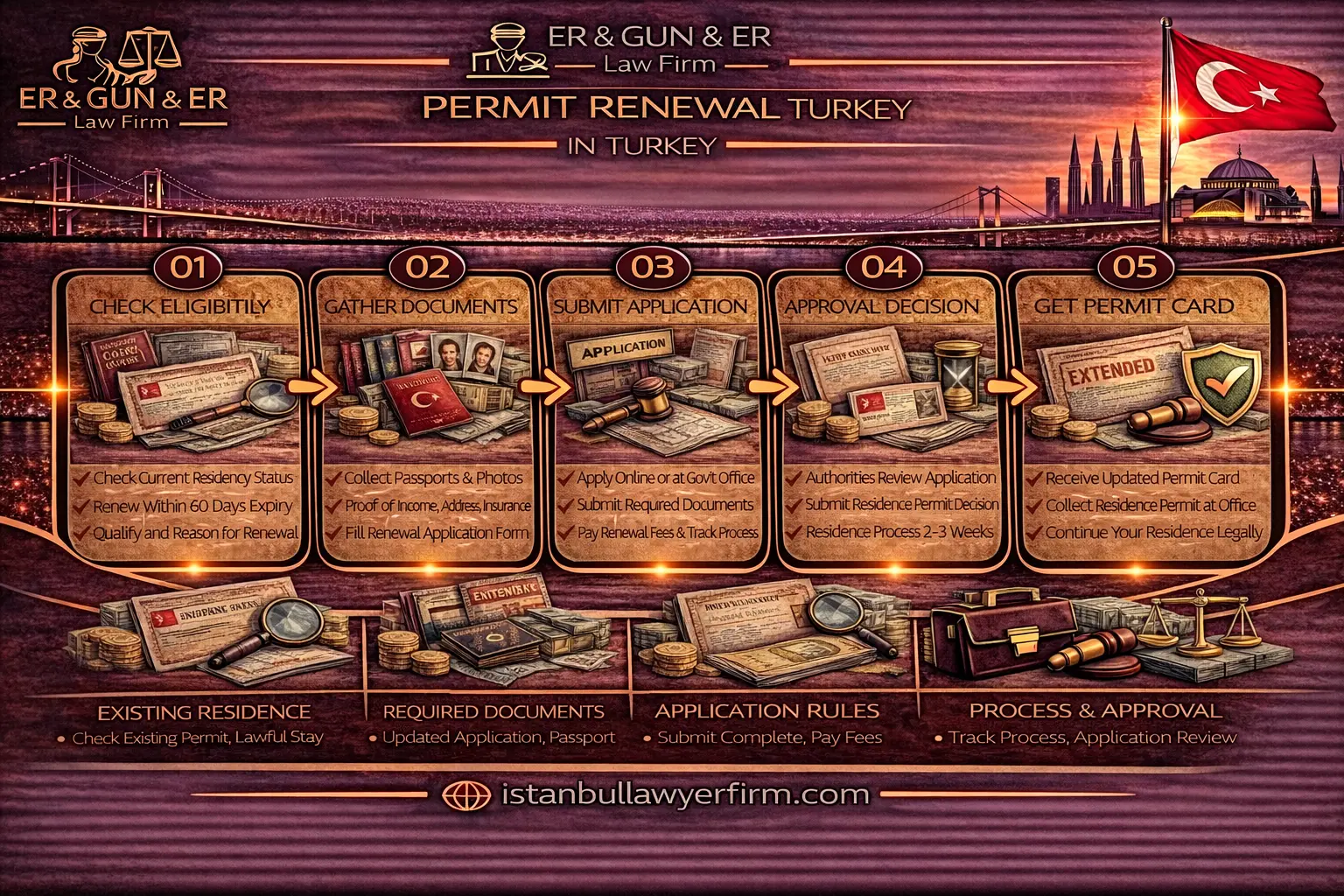
Permit renewal in Turkey is the procedural extension of an existing legal permission before it expires, and the file the authority reads is a continuous timeline of lawful presence and lawful activity rather than a fresh application. Residence renewals proceed through the migration practice administered by the Directorate of Migration Management — Göç İdaresi Müdürlüğü — under the framework of the Yabancılar ve Uluslararası Koruma Kanunu (Law No. 6458), while work permit renewals proceed through the labor practice administered by the Ministry of Labor and Social Security under the framework of the Uluslararası İşgücü Kanunu (Law No. 6735), with social security continuity tested through SGK (Sosyal Güvenlik Kurumu) records. Renewal risk increases when the address registration held at the İl Nüfus ve Vatandaşlık Müdürlüğü, the health coverage scheduled with the insurer, the SGK enrollment held by the employer, or the payroll record produced by the sponsor diverges from the declared facts. Practice may vary by authority and year, and the discussion below describes how renewal discipline is built rather than promising specific calendar windows.
An English speaking lawyer in Turkey who handles renewal files for foreign nationals will tell you that the file is judged on its evidence rather than on its narrative, and that the safest approach is clause-by-clause document control supported by an indexed evidence pack rather than last-minute portal uploads. The body of this guide walks through the institutional lanes that decide your renewal, the timing discipline that prevents avoidable gaps, the e-Ikamet workflow that defines the residence track, the sponsor and SGK compliance that defines the work track, the document architecture that proves identity and continuity, the special-profile considerations for students, families and mixed-status households, and the remedy routes — administrative objection and administrative court appeal — that are available when a renewal is rejected. Where reference material exists in adjacent areas, we link to our notes on the broader immigration law framework, the step-by-step extension workflow, the work permit framework, the foreign worker law guidance, and the immigration appeal process, so that the renewal file sits inside a coherent compliance environment rather than as an isolated submission.
1) Renewal Architecture: Two Institutional Lanes and the Continuity Standard
A lawyer in Turkey who maps the renewal landscape will start by separating the two institutional lanes that decide foreign-national status, because the most common avoidable failure is submitting the right document to the wrong lane. The residence lane is administered by the Directorate of Migration Management through provincial migration directorates, processes residence permit categories — short-term, family, student, long-term and humanitarian — under Law No. 6458, and tests address registration, identity continuity, health coverage and the continuing purpose of stay. The work lane is administered by the Ministry of Labor and Social Security through the Çalışma İzni portal, processes work permits and Turquoise Card applications under Law No. 6735, and tests sponsor identity, employment continuity, payroll alignment and SGK enrollment. The two lanes overlap in daily life because a work permit can constitute the lawful basis for stay, but they do not share processing systems, decision letters or remedy calendars, and a worker can be compliant in one lane while weak in the other. Practice may vary by authority and year, and provincial migration directorates have shown growing precision in cross-checking the e-Ikamet portal entries against İl Nüfus ve Vatandaşlık Müdürlüğü address records.
An Istanbul Law Firm that runs renewals for foreign nationals will treat the continuity standard as the dominant evidentiary test, because the authority reads each renewal as a compliance audit of the prior period. The procedure ordinarily requires the file to demonstrate that identity tokens — name spelling, passport number, date of birth — remained consistent across all systems; that the registered address held at the İl Nüfus ve Vatandaşlık Müdürlüğü matched the housing document throughout the period; that health coverage operated without unexplained gaps; that travel patterns were compatible with genuine residence under the renewed category; and, for work-based files, that payroll and SGK enrollment ran in parallel with the sponsor's stated employment relationship. Where any of these layers shifted during the period, the change must be documented as a dated event with the supporting exhibit attached, rather than left for the reviewer to reconstruct. We treat the change log as the spine of the file because it converts what would otherwise read as inconsistency into a clean chronology of recorded events.
A Turkish Law Firm advising foreign-owned employers and household principals will also distinguish between status-basis confusion and pure documentary failure, because the two require different remedies. Status-basis confusion arises when the applicant is uncertain which document grounds lawful stay on a given day — for example, where a work permit functions as stay basis but the applicant continues to file as if a separate residence permit applied — and the cure is a written status map identifying the lawful basis and the issuing authority for each month of the prior period. Documentary failure arises when the lawful basis is correctly identified but the supporting evidence is incomplete or contradictory, and the cure is a targeted exhibit pack that resolves the specific gap. Practice may vary by authority and year, and we have seen the same applicant receive a rejection for a documentary failure that, on closer review, turned out to be a status-basis confusion that no quantity of additional documents would resolve. Coordinated review by Turkish lawyers who handle both lanes is the most reliable way to classify the problem before the cure work begins. The status map ordinarily lists, for each month of the prior period, the document that grounds lawful stay (residence permit number, work permit number, or other lawful basis), the issuing authority, the validity dates, and any cross-reference to a renewal application or a category change in progress. Where a category change occurred during the prior period — for example, a transition from a short-term residence permit grounded on real estate ownership to a family residence permit grounded on marriage to a Turkish citizen — the status map records the date the prior basis closed, the date the new basis opened, and the documentary chain (notification of approval, card delivery, e-Ikamet record update) that links the two. Where a work permit functioned as the lawful basis for stay during part of the period and a separate residence permit applied during the rest, the map identifies the precise transition date so that the renewal of either document does not stray into territory the other authority controls.
2) Renewal Timing Strategy and Calendar Discipline
An English speaking lawyer in Turkey building a renewal calendar will treat timing as a legal risk control rather than as administrative housekeeping, because gaps between permits create enforcement exposure that no later filing can fully erase. The procedure ordinarily requires the renewal application to be submitted within the window prescribed by the relevant regulation — for residence categories typically opening sixty days before expiry and closing on the day of expiry under current practice, with work permit renewals expected within the closing weeks of validity through the sponsor's portal channel. Filing on the last day is structurally riskier than filing earlier in the window because portal errors, missing exhibits and authority-side technical issues that would otherwise be cured in a second pass are no longer recoverable before the underlying permit lapses. Applicants should anticipate that a missing-document rejection issued after expiry has materially different consequences from one issued during the window. Practice may vary by authority and year.
A lawyer in Turkey who has run multi-document renewal calendars will tell foreign nationals that the calendar must track every supporting exhibit's expiry date independently, because the supporting evidence does not all renew on the same schedule. The standard document set carries different validity windows: passports may be valid for years but health insurance policies typically renew annually, lease agreements may roll on annual cycles or month-to-month, address registration must be refreshed when the household moves, and SGK and payroll records produce monthly entries that must be available for retrospective inspection. We build the calendar with the renewal date as the anchor and work backwards to set internal deadlines for landlord re-engagement, insurer policy refresh, employer attestations, sworn translations and apostille processing where foreign-issued documents are involved. Where the foreign-issued document originates from a Hague Apostille Convention member state, the apostille can be obtained in the country of origin; where it originates from a non-member state, consular legalization must be sequenced into the calendar. The objective is overlap rather than back-to-back validity, because evidence that meets the renewal date with a five-day cushion is more defensible than evidence that arrives on the morning of the appointment. We also build in time for sworn translation through Turkish notary-registered translators (yeminli tercüman), because translations executed without the controlling token sheet introduce identity drift that the reviewer reads as inconsistency rather than as a translation artifact. Where the source document is in a script the Turkish notary's translator panel does not commonly handle — for example, certain Asian or Cyrillic-script civil registry documents — the calendar should reserve additional time for translator selection, terminology checks and re-execution if the first draft contains errors. Apostille and translation work that begins thirty days before submission has consistently produced cleaner files in our practice than the same work compressed into the final week.
An Istanbul Law Firm coordinating a household or a corporate portfolio of renewals will also separate residence-track and work-track timing into distinct calendars while keeping a single shared identity token sheet across both. In our practice, the common requirement is to schedule e-Ikamet portal submission, mail-package preparation and any in-person appointment for the residence lane in one stream, while keeping employer-side portal steps, corporate signatory updates and payroll-cycle alignment for the work lane in a parallel stream. Where employers sponsor multiple foreign workers, central HR ownership of validity dates is a corporate compliance obligation rather than a service to staff, because the employer is exposed to inspection consequences when a foreign worker's status lapses on the employer's watch. Practice may vary by authority and year, and the recent inspection cycle has shown growing supervisory interest in employer-level calendar discipline rather than only individual-worker compliance.
3) Residence Permit Renewal: e-Ikamet Workflow and Documentation
Turkish lawyers who file residence renewals through the e-Ikamet portal will treat the online form as a sworn statement that produces the official application reference number and freezes the declared facts, rather than as a draft that can be amended by later mail submissions. The procedure ordinarily requires the applicant to log into the e-Ikamet system maintained by the Directorate of Migration Management, select the renewal category corresponding to the existing permit, complete the form using the exact passport spelling for the name field, enter the address as it appears in the İl Nüfus ve Vatandaşlık Müdürlüğü record, upload the supporting documents in the order the portal expects, and save the generated PDF and confirmation number immediately. The standard document set ordinarily includes the passport identity pages, the existing residence card copy, biometric photographs that meet the current technical specification, the health insurance schedule covering the requested renewal period, address registration evidence, and category-specific exhibits — for example, family relationship documentation for family permits, school enrollment for student permits, or property ownership documentation for short-term permits based on real estate ownership. Practice may vary by authority and year.
A Turkish Law Firm preparing the e-Ikamet submission will also enforce identity discipline as the most cost-effective error-prevention measure, because identity drift is responsible for a disproportionate share of avoidable rejections. The standard approach is to lock a token sheet that records the controlling passport spelling — including hyphens, spaces and diacritics — together with the passport number, date of birth and nationality declaration, and to require that every translator, every employer's HR system, every insurance policy and every housing document use that same spelling. Where the passport was renewed during the prior period, the file must include a copy of the previous passport's identity page and a dated note linking the old and new passport numbers, because the e-Ikamet record otherwise risks splitting into two profiles that the system reads as different persons. Where the applicant's name carries a transliteration from a non-Latin script, the controlling spelling is the one shown on the most recently issued passport, and any divergent spelling on older documents must be reconciled with a written note rather than corrected by hand on the document itself. Photograph specifications are tested at appointment rather than at portal upload, and the standard approach is to obtain biometric photographs taken to current Directorate of Migration Management specifications by a photographer familiar with the format — typically a recent set of identical biometric images on plain background — and to bring spare copies to the appointment in case the in-person verification step requires originals rather than digital uploads. Where the applicant resides in a province whose migration directorate uses a separate appointment-scheduling channel, the appointment date and the e-Ikamet portal submission date must be coordinated so that the appointment falls within the validity window of the underlying permit and the supporting documents — particularly insurance and address registration — remain valid through the appointment date. Practice may vary by authority and year, and provincial directorates have refined their appointment-allocation systems in ways that reward applicants who book early.
An English speaking lawyer in Turkey reviewing the e-Ikamet bundle before final submission will run a four-question test on the file — identity, residence, coverage and purpose — because residence renewal decisions ultimately turn on whether each of these dimensions is independently provable. Identity is established through passport continuity and consistent spelling; residence through address registration matching the housing document; coverage through an insurance schedule whose dates fully cover the requested renewal period and whose name fields match the passport exactly; and purpose through category-specific evidence consistent with the renewal narrative. We have found that placing identity exhibits first, address proof second, insurance schedule third and purpose evidence fourth in the binder mirrors the reviewer's mental sequence and shortens the review. Where the portal generates an in-person appointment after submission, we treat the appointment as an evidence-verification step rather than as a substantive interview and bring originals plus a printed copy of the mailed index. For a refresher on the underlying renewal sequence, our step-by-step extension guide aligns with the e-Ikamet flow described here, and the residence permit documentation note can be adapted to the indexing and pagination used in renewal binders. Practice may vary by authority and year.
4) Work Permit Renewal: Sponsor Compliance, Payroll and SGK Continuity
A Turkish Law Firm handling work permit renewals will treat the sponsor relationship as the structural backbone of the file, because the Ministry of Labor evaluates the renewal as a continuation of an existing employment relationship rather than as a fresh authorization. The procedure ordinarily requires the sponsor — typically the employing legal entity — to initiate the renewal through the Çalışma İzni portal within the closing weeks of the existing permit's validity, with the foreign worker supporting through identity exhibits, updated photographs and any change documentation that the role or worksite history requires. The standard document set includes the current trade registry extract (Ticaret Sicil Gazetesi extract or e-MERSİS extract) of the sponsor entity, current signatory authorization (imza sirküleri), proof of workplace address, the employment contract reflecting the role and compensation as filed, payroll evidence covering the prior period, and the SGK enrollment record showing continuous social security registration of the worker under the sponsor's employer code. The Land Registry is not involved here, but the Ticaret Sicil Müdürlüğü and SGK records are read in parallel by the labor reviewer, and any divergence between the trade registry record, the SGK employer code and the portal entry is treated as a credibility gap.
An Istanbul Law Firm coordinating sponsor-side compliance will tell foreign-owned employers that the most common rejection trigger is not weakness in the worker's qualifications but inconsistency in the sponsor's compliance trail. In our filings before the Ministry of Labor, the common requirement is to attach a one-page chronology that lists the start of employment, any role or title change with the dated approval memo, any worksite change with the assignment letter and supervision model, any leave period with the documented reason, and any corporate change — name, address or signatory — affecting the employer entity. Where the foreign worker was assigned to client sites during the prior period, the assignment letters must show that the supervisory relationship and payroll responsibility remained with the sponsor entity rather than drifting into what an inspector would read as undeclared outsourcing. Where the sponsor reorganized — through merger, name change or address change — the renewal file must include the corporate decisions effecting the reorganization together with updated registry evidence linking the old and new identifiers. Practice may vary by authority and year, and the labor inspectorate has shown growing attention to the consistency between portal-declared role descriptions and payroll labels. Where the sponsor was the subject of a labor inspection during the prior period, the inspection report and any administrative response are part of the continuity record rather than a separate compliance file, because the renewal reviewer may consult the inspection history when evaluating the sponsor's reliability as an employer of foreign nationals. Where the sponsor's authorized signatories changed during the period, the file should include the dated board or general manager resolution effecting the change, the updated signature circular (imza sirküleri) issued by the notary, and a clear note identifying which signatory authorized the renewal submission. Where the sponsor outsourced any part of the worker's services to a related entity or to a client through a service contract, the contractual chain must be documented so that the supervisory and payroll responsibility remains visibly anchored in the sponsor entity rather than in a counterparty.
Turkish lawyers who run pre-renewal internal audits will reconcile the sponsor's records before submission, because the cost of curing a contradiction discovered during review is materially higher than the cost of curing it before filing. The standard approach is to compare, in writing, the worker's employment contract, the job description on file with HR, the title used on monthly payroll, the title declared in the portal renewal request, and the SGK occupation code — and to document any reconciliation needed before the renewal is submitted. The employer should also confirm that monthly SGK premiums were paid on time throughout the prior period, that wage payments to the worker were made by bank transfer rather than in cash where possible, and that any allowances paid alongside salary were recorded under documented internal policies rather than as undocumented payments. Where these reconciliations identify a gap that cannot be cured retroactively, the file should disclose the gap with a factual explanation rather than leave the reviewer to discover it. The compliance framing in our foreign worker law guidance is helpful as an internal audit checklist for HR and compliance teams. Practice may vary by authority and year.
5) Address Registration and Health Insurance Compliance
A lawyer in Turkey who advises on address compliance will explain that the residence renewal review compares the address declared on the e-Ikamet portal to the registered address held at the İl Nüfus ve Vatandaşlık Müdürlüğü, and that any divergence between the two is treated as an incomplete file even where the underlying housing situation is genuine. The procedure ordinarily requires the applicant to maintain the registered address throughout the period, to update the registration within the statutory window after any move, and to ensure that the housing document — typically a lease registered through the e-Devlet system or a notarized housing statement from a host — matches the registered record exactly, including building number, unit identifier and street name in the format used by the address authority. Where the building's identifying information was updated by the municipal address standardization (Adres Standardizasyon), the renewal file should include the official update note and reconcile any older documents that show the prior format. Practice may vary by authority and year, and provincial directorates have continued to refine the cross-check between e-Ikamet portal data and the central population registry (MERNİS).
An Istanbul Law Firm advising on address transitions during a renewal cycle will tell applicants that the safest approach is to update the address registration first, obtain confirmation in writing, and only then submit the renewal application with both the new housing document and the registration update record. Where the applicant moved during the prior period, the file should include the old housing document covering the period of the old address, the new housing document covering the period of the new address, the move date noted as a dated event, and the registration update confirmation. Where the applicant lives with a host — a Turkish citizen relative, a co-tenant or a homeowner providing accommodation without rent — the host's identity proof, the property ownership or tenancy document of the host, and a notarized statement of accommodation must be aligned with the registered address record. Where the applicant lives in employer-provided housing, the employer's housing confirmation must be issued under signatory authority and must match the registered address record. Address discrepancies are treated as credibility issues rather than as administrative oversights, and the cure must therefore be documentary rather than verbal. Where the lease is registered through the e-Devlet system, the registered lease itself can serve as the housing document, and the registration date provides a verifiable timeline anchor. Where the lease is unregistered or the rental relationship is informal, the standard approach is to obtain a notarized housing statement from the landlord identifying the property by registered address, the duration of occupancy and the relationship to the applicant, and to attach the landlord's identity proof and proof of ownership of the property (Tapu kaydı extract or equivalent). Where the applicant occupies a hotel or serviced apartment for extended periods, the establishment's accommodation confirmation and a bank record of payment can be used in combination with the e-İkamet residence registration, but applicants relying on hotel-based residence should be aware that prolonged hotel residence is occasionally read as inconsistent with genuine residence under certain residence permit categories and may invite category-fit questions. Where the applicant moves between provinces during the prior period, the provincial competence question arises: the renewal application is filed with the provincial migration directorate corresponding to the registered address at the time of filing, and a recent inter-provincial move should be reflected in the registration before the renewal application is submitted.
A Turkish Law Firm advising on health insurance compliance will explain that residence renewals require an insurance schedule whose validity dates fully cover the period requested in the renewal form, whose insured name matches the passport exactly, and whose scope meets the minimum standard prescribed under current Directorate of Migration Management practice. The standard document set includes the policy schedule pages showing effective and end dates, the coverage scope description, any endorsements affecting coverage limits or exclusions, and proof of premium payment where available. Where the applicant changed insurer during the prior period, the file should include both the prior policy and the current policy with overlapping or back-to-back dates, so that the timeline reads as continuous coverage rather than as a gap. Where the applicant is a dependent under a family policy, the schedule must list the dependent under the controlling identity tokens, and the principal's insurance must be archived in the same binder. Where the applicant qualifies for SGK General Health Insurance through employment, the SGK enrollment record substitutes for the private policy for renewal purposes, but the insurance lane and the employment lane must then tell the same story. Practice may vary by authority and year, and the supervisor's appetite for incomplete schedules has continued to narrow.
6) Document Architecture, Identity Tokens and Continuity Evidence
An English speaking lawyer in Turkey building the document architecture for a renewal will treat the binder as a single indexed dossier rather than as a stack of bundles delivered to multiple destinations, because the renewal review reads consistency across the file as the primary credibility signal. The standard approach is to maintain one master evidence pack divided into a residence section and a work section where applicable, with shared identity exhibits used identically across both sections, and an index page at the front that lists exhibits in the order the portal — or the labor portal — expects them. Each exhibit carries a clear caption, a date stamp where the document type allows it, and a cross-reference to the portal field it supports. The procedure ordinarily requires every scan to be complete, readable, and to show signatures, stamps and validity dates without cropping, with multi-page documents scanned as a single continuous PDF rather than as fragmented images. Where a document is renewed during the period, the new version is archived next to the older version with a "superseded" label, so that future renewals can reuse the timeline without searching old systems.
A lawyer in Turkey enforcing identity-token discipline across the binder will require that one passport spelling, one date format and one address format are used consistently across every form, every translation and every system entry. The standard document set includes a one-page identity token sheet listing the controlling passport spelling, the passport number, the date of birth in DD.MM.YYYY format, the nationality, the controlling residence card number where applicable, the controlling SGK number where applicable, and the controlling employer entity name where applicable. Translators, HR staff and family members preparing supporting exhibits work from the token sheet rather than from memory or from older documents. Where the applicant's name appears with different transliterations on older documents — for example, where a non-Latin name was historically transliterated differently into Turkish or English — the token sheet identifies the controlling passport spelling and the file includes a reconciliation note rather than handwritten corrections. Practice may vary by authority and year, and identity-token discipline is the single intervention with the highest leverage in our experience. Where the file includes documents originally issued in a foreign language, sworn translation through a notary-registered translator (yeminli tercüman) is the standard requirement, and the translation must be physically bound to a copy of the source document with the translator's notarized declaration so that authenticity is not contested. Where the source document is foreign-issued, the apostille (for Hague Apostille Convention member states) or the consular legalization (for non-member states) must be obtained on the source document before translation, so that the translation captures the apostille text or legalization stamp as part of the bound packet. Where the applicant relies on documents issued by employers, schools or religious authorities abroad, the institutional document must carry a verifiable signature, an institutional letterhead and, where applicable, the apostille from the issuing country's competent authority. Documents printed from web portals without verifiable institutional signatures are routinely treated as informal evidence and require supplementation through a sealed paper original. Where any document in the binder requires correction during the renewal cycle, the corrected version is archived with a "superseded" label and the corrected version replaces the older version in the active submission stack rather than supplementing it.
Turkish lawyers archiving renewal files for future audit will keep submission and delivery proofs as a permanent compliance asset rather than as transient artifacts. The standard approach is to capture screenshots of the e-Ikamet confirmation page after each submission, save the generated PDF of the application form, retain the mail tracking receipt and the delivery confirmation for any package mailed to the migration directorate, retain the appointment confirmation if an in-person step was required, and retain copies of any supplements delivered in response to authority requests. Where the labor portal generates messages or requests for additional documents, the messages are saved with their date and time stamps, the response is saved as a numbered supplement, and the delivery confirmation for the supplement is retained alongside the response. This archive becomes the evidentiary base for any subsequent renewal, any objection, and any administrative court filing. Many applicants ask Turkish lawyers to maintain this archive on their behalf because the discipline is more sustainable when ownership is clear, and a single archive across years is a transferable asset during background checks, citizenship assessments and family-permit applications for relatives.
7) Special Profiles: Student, Family and Mixed-Household Renewals
An Istanbul Law Firm advising international families and students will explain that family and student renewals carry their own evidentiary expectations on top of the general continuity standard, because the category itself defines the test that the reviewer applies. Family residence renewals are evaluated as the continuation of a household relationship, and the procedure ordinarily requires updated proof of the relationship — a marriage certificate or birth certificate, recently issued or apostilled where required — together with the principal's lawful basis evidence, the registered address evidence showing co-residence, and continuous health coverage for each dependent. The principal's status is the foundation of the dependent file: if the principal's permit category changes — for example, when the principal moves from a residence permit to a work permit functioning as stay basis — the dependent file must adapt accordingly, and the change must be planned so that no household member falls into a gap. Our note on the family permit framework can be used as the structural baseline for organizing the household file.
A Turkish Law Firm handling student renewals will explain that student permits are tested through enrollment continuity, and the procedure ordinarily requires a current enrollment confirmation issued by the educational institution, evidence of program continuation — completed credits, transcript or registration confirmation — and a residence pattern compatible with active study. Where the student transferred between programs or institutions during the prior period, the file should include the transfer documentation and a dated note explaining the timing of the change. Where the student took academic leave, the leave confirmation should be aligned with the travel record so that absences from Turkey are explainable. Where the student worked under permitted conditions — for example, where the relevant regulation permits limited employment — the authorization evidence should be archived to show that the employment activity did not exceed the permitted scope. The structural orientation in our student visa guide can be adapted to align the renewal narrative with the study-based status logic. Practice may vary by authority and year. Where the institution is a Turkish university recognized by the Yükseköğretim Kurulu (YÖK), the enrollment confirmation typically takes the form of a stamped letter from the registrar's office (Öğrenci İşleri) identifying the program, the enrollment year and the expected graduation date, supplemented by the e-Devlet student status query (öğrenci belgesi) where the institution participates in the e-Devlet integration. Where the institution is a private language school operating under Ministry of National Education authorization, the renewal file should include the institution's authorization document together with the enrollment letter, because student renewals under language-school enrollment have attracted particular review attention in recent cycles. Where the student is enrolled in a graduate program with research components, the supervisor's confirmation of active research can supplement the registrar's letter when attendance records are not the primary measure of enrollment continuity. Where the student took academic leave, the leave decision must be obtained from the registrar in writing rather than relying on informal communication.
An English speaking lawyer in Turkey coordinating mixed-household files — where one principal holds a work permit while a spouse holds a family permit and a child holds a student permit, for example — will impose a single token sheet, a single address narrative and a single insurance archive across all members, because mixed households are particularly vulnerable to one member's missing document undermining the entire renewal. Travel during a renewal cycle introduces additional risk: while the renewal is pending, the applicant should keep submission proof and identity documents accessible offline, avoid long absences that could be read as inconsistent with genuine residence, and refrain from changes to address or insurer where the change cannot be documented through dated exhibits. Where a household member must travel for urgent reasons, the reason should be documented through neutral evidence — medical certificates, employer assignment letters, family-event documentation — and the travel log should be archived alongside the renewal binder. Border outcomes depend on individual records, and the safest approach is to plan conservatively rather than to rely on verbal explanations at the point of entry.
8) Rejection Cures, Administrative Objection and Court Appeal
A lawyer in Turkey advising on a rejected renewal will start by reading the decision letter line by line, because the cure work must respond to the actual stated reason rather than to what the applicant assumes the problem must have been. Rejection decisions are typically framed as missing proof, inconsistent records, category mismatch or sponsor non-compliance, and each frame calls for a different cure strategy. The procedure ordinarily requires the applicant to preserve the decision notice, the proof of notification (tebligat), the original application receipts, and any supplements delivered during the review, and to build the cure file as a numbered supplement responding point by point to the stated reason. Where the rejection cites address, the cure begins by updating the address registration at the İl Nüfus ve Vatandaşlık Müdürlüğü and then attaching the matching housing document; where it cites insurance, the cure attaches the continuous schedule with a dated reconciliation; where it cites identity, the cure attaches the token sheet, the passport copies and a written reconciliation; where it cites sponsor compliance, the cure attaches reconciled trade registry, payroll and SGK exhibits as a single timeline. Practice may vary by authority and year.
An Istanbul Law Firm preparing the administrative objection (itiraz) to a rejected renewal will draft the petition as an exhibit-led document rather than as a narrative letter, because the reviewer's task is to verify proofs against the stated reason rather than to reweigh the merits in prose. The procedure ordinarily requires the objection to be filed within the statutory period from the date of notification, addressed to the issuing authority — the provincial migration directorate for residence rejections, the Ministry of Labor for work permit rejections — and supported by a structured exhibit pack with an index, a chronology and the same identity token sheet used in the original application. Where the original file was incomplete, the objection cures the gap with the now-complete exhibit set; where the original file was complete but misread, the objection re-presents the existing exhibits with a clean cross-reference to the decision's reasoning. Bilingual drafting discipline matters here, and where the source documents are in English while the objection is in Turkish, the file should preserve the source and the translation together so that authenticity is not questioned. The procedural orientation in our immigration appeal process guide can be used to structure the objection in the same evidence-first sequence. The objection text itself ordinarily comprises a procedural section identifying the contested act, the date of notification and the timeliness of the objection; a substantive section responding to each ground cited in the rejection with a cross-reference to the supporting exhibit; and a concluding section requesting reconsideration with the renewal granted on the strength of the cured record. Where the rejection cited specific regulatory provisions, the response addresses those provisions by name without inventing case numbers or registry citations the file cannot support. Where the rejection cited grounds the applicant disputes on the merits — for example, where the authority read a documented absence as evidence of non-residence when the absence was supported by neutral documentation — the objection presents the documentation, identifies the misreading, and requests reconsideration without escalating into argumentative tone, because the reviewer's task is to verify proofs rather than to engage in advocacy. Where the objection is filed by a representative, the power of attorney (vekaletname) authorizing the representative to file before the issuing authority must be attached, with apostille and translation where the power of attorney was executed abroad.
Turkish lawyers running the administrative court appeal stage will explain that court review is the next remedy when the administrative channel does not resolve the dispute, and that the petition is filed before the competent İdare Mahkemesi (Administrative Court) within the statutory period from the notification of the final administrative decision. The court reads the case primarily on the written record, and the strongest court files reuse the same indexed exhibits from the objection stage rather than introducing new narratives that could be read as inconsistent with the administrative file. The petition states the contested act precisely, identifies the procedural and substantive grounds for annulment, and attaches the decision notice, the notification proof, the objection submission, the authority's response, and the core compliance exhibits proving identity, address, insurance, lawful basis and — where applicable — sponsor and SGK continuity. Where the applicant seeks a stay (yürütmeyi durdurma), the request is supported by proof that waiting for final judgment would cause serious and irreparable harm; the court evaluates urgency and the apparent merit of the case before granting a stay, and stays are not automatic. The long-term roadmap that emerges from a disciplined court file is the clearest evidence base for any future renewal, because the same exhibits and the same chronology travel from cycle to cycle without contradiction. Practice may vary by authority and year.
9) Frequently Asked Questions for Foreign Nationals and Foreign-Owned Employers
- What is permit renewal in Turkey, and how does it differ from a fresh application? Permit renewal is the procedural extension of an existing residence or work permit before its expiry, evaluated as a continuation of an existing legal status rather than as a new application. The file is read as a compliance audit of the prior period, and identity, address, coverage and lawful-basis continuity are the dominant evidentiary tests. Practice may vary by authority and year.
- Are residence renewal and work permit renewal handled by the same authority? No. Residence renewals are administered by the Directorate of Migration Management through provincial migration directorates under Law No. 6458, while work permit renewals are administered by the Ministry of Labor and Social Security under Law No. 6735, with social security continuity tested through SGK records. The two lanes do not share processing systems or remedy calendars.
- When should a renewal application be filed? Renewal applications should be filed within the statutory window before the existing permit expires; for residence categories the window typically opens sixty days before expiry under current practice, while work permit renewals proceed through the sponsor's portal in the closing weeks of validity. Filing earlier in the window provides a cushion to cure portal errors before the underlying permit lapses.
- Can I travel while my renewal is pending? Travel while a renewal is pending is possible but should be planned conservatively. Submission proofs and identity documents should be accessible offline, long absences that could be read as inconsistent with genuine residence should be avoided, and any travel for urgent reasons should be documented through neutral evidence archived alongside the renewal binder.
- What is the e-Ikamet portal, and how is it used in renewal applications? The e-Ikamet portal is the online system maintained by the Directorate of Migration Management for residence permit applications and renewals. The applicant logs in, completes the renewal form using the controlling passport spelling and the registered address, uploads supporting documents in the order the portal expects, and saves the generated PDF together with the application reference number.
- How is the sponsor's role evaluated in a work permit renewal? The sponsor — the employing legal entity — initiates the renewal through the Çalışma İzni portal, attaches current trade registry and signatory evidence, and supports the file with payroll and SGK enrollment records demonstrating continuous lawful employment of the worker. Inconsistencies between the trade registry record, the SGK employer code and the portal entry are treated as credibility gaps.
- What address registration evidence is required for residence renewals? The renewal file must include the registered address held at the İl Nüfus ve Vatandaşlık Müdürlüğü matching the housing document — typically a lease registered through e-Devlet or a notarized housing statement from a host — together with any update record where the household moved during the prior period. The portal entry, the registration record and the housing document must align.
- What health insurance is required for residence renewal? An insurance schedule whose validity dates fully cover the requested renewal period, whose insured name matches the passport exactly, and whose scope meets the minimum standard prescribed under current practice. Where the applicant qualifies for SGK General Health Insurance through employment, the SGK enrollment record may substitute for the private policy.
- What documents prove identity continuity when the passport was renewed during the prior period? A copy of the previous passport's identity page, a copy of the new passport's identity page, and a dated note linking the old and new passport numbers, archived together as identity continuity exhibits. Without this linkage, the e-Ikamet record risks splitting into two profiles that the system reads as different persons.
- How are SGK and payroll records used in work permit renewals? SGK enrollment under the sponsor's employer code throughout the prior period and monthly payroll records consistent with the contract role and the portal-declared compensation are the primary continuity exhibits. Reviewers compare the trade registry entity, the SGK employer code, the contract, the payroll labels and the portal entry as a single chain.
- What are the most common reasons for a renewal rejection? Address registration mismatched with the housing document, insurance schedules that do not fully cover the requested period or that show a different name spelling, identity drift across systems, sponsor and SGK records that do not align with the portal-declared employment relationship, and documentation gaps from prior corporate or household changes that were not recorded as dated events.
- What is the administrative objection (itiraz), and when is it used? The administrative objection is the written remedy filed within the statutory period from the notification of a rejection, addressed to the issuing authority, and supported by an exhibit-led pack that responds to the stated reason point by point. The objection is the prerequisite reconsideration step before judicial review in many situations.
- What is the administrative court appeal route? Where the administrative channel does not resolve the dispute, the applicant may file a petition before the competent İdare Mahkemesi within the statutory period from the notification of the final administrative decision, supported by the same indexed exhibits used at the objection stage. A stay (yürütmeyi durdurma) may be requested separately on grounds of urgency and irreparable harm.
- How are mixed-household renewals coordinated? Mixed households — where members hold different permit categories — should be coordinated through a single token sheet, a shared address narrative and a unified insurance archive, with each member's exhibits stored in sub-tabs of one master binder. One member's missing document can undermine the household's overall renewal posture, and prevention is more efficient than cure.
- Does ER&GUN&ER Law Firm advise on residence permit and work permit renewals in Turkey? Yes. ER&GUN&ER Law Firm is an Istanbul-based law firm advising foreign nationals, foreign-owned employers and international families on the complete permit renewal lifecycle, including category analysis under Law No. 6458 and Law No. 6735, e-Ikamet portal preparation and submission, sponsor and SGK compliance reconciliation, address and insurance archive maintenance, family and student renewal coordination, rejection cure strategy, administrative objection drafting, administrative court appeals before the İdare Mahkemesi, and long-term compliance calendars for households and corporate portfolios — with English-language client communication and bilingual documentation throughout each engagement. Files in this area are typically led personally by the managing partner rather than delegated.
Author: Mirkan Topcu is an attorney registered with the Istanbul Bar Association (Istanbul 1st Bar), Bar Registration No: 67874. His practice focuses on cross-border and high-stakes matters where evidence discipline, procedural accuracy, and risk control are decisive.
He advises foreign nationals, international families and foreign-owned employers on residence and work permit lifecycles in Turkey — including initial applications, renewals, family and student categories, sponsor compliance, address and insurance evidence architecture, rejection cures, administrative objections and administrative court appeals — together with adjacent immigration and corporate matters where procedural accuracy and continuity discipline determine the outcome.
Education: Istanbul University Faculty of Law (2018); Galatasaray University, LL.M. (2022). LinkedIn: Profile. Istanbul Bar Association: Official website.