

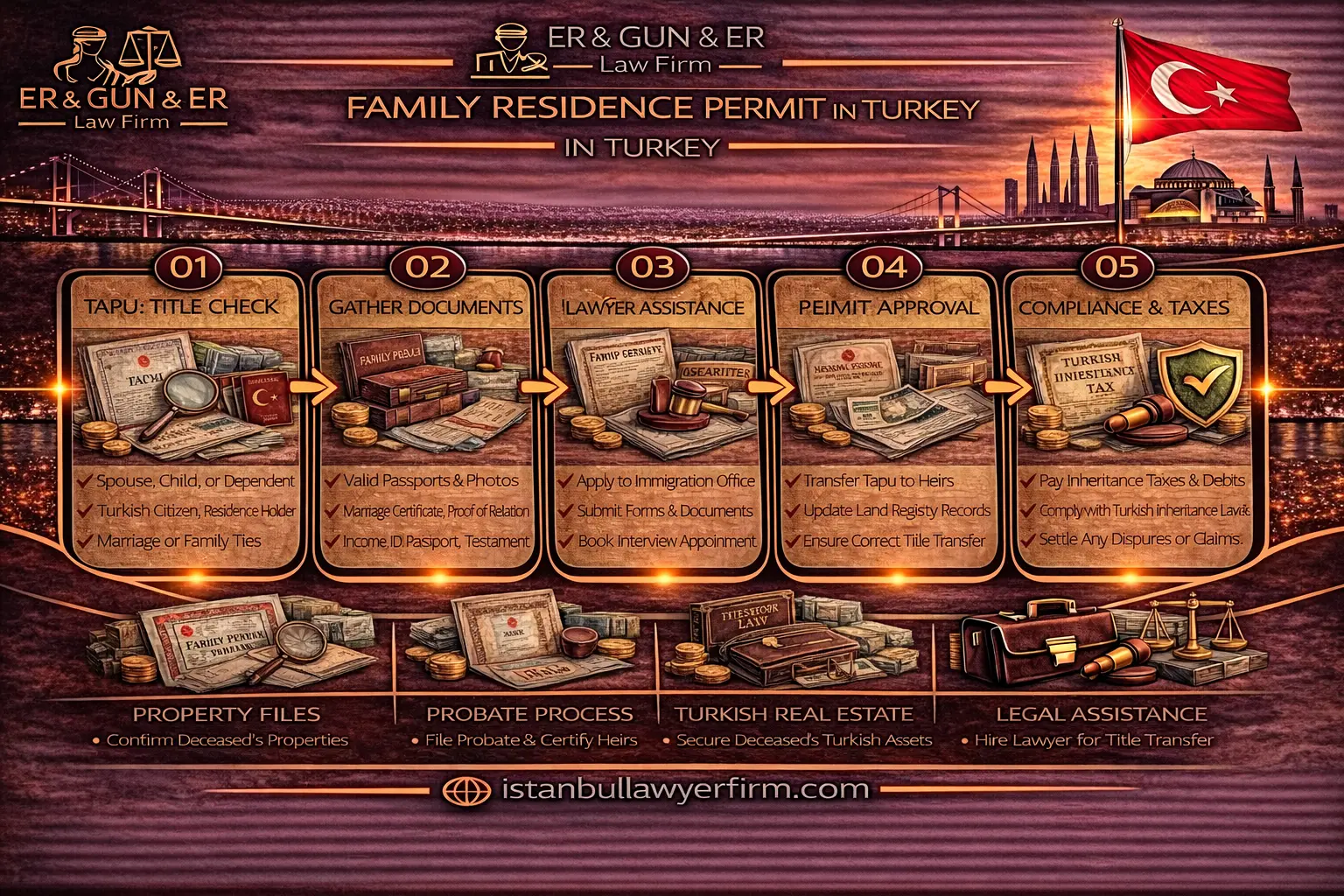
A lawyer in Turkey who advises foreign nationals on immigration matters understands that the family residence permit—the permit category that allows a spouse, child, or other qualifying family member to reside in Turkey based on a sponsor's lawful status—is evaluated primarily as a document coherence exercise rather than as a substantive eligibility assessment, because the Directorate of Migration Management's review process focuses on whether each element of the family relationship and the sponsor's status can be verified from the submitted official records without contradiction. An Istanbul Law Firm that guides families through the Turkish residence permit system explains that the family permit's central logic is derivative eligibility—the applicant's right to reside in Turkey derives from the sponsor's lawful status, meaning the application file must first establish the sponsor's status credibly and then establish the family relationship through documents that are consistent with that status—and that any inconsistency between the sponsor's records and the family relationship documents gives the reviewing officer a ground to pause or refuse the file that would not exist if document coherence had been maintained. A Turkish Law Firm that handles family residence permit matters for international clients provides structured support across the complete application workflow: verifying sponsor eligibility; identifying which family members qualify; assembling civil status documents including marriage and birth certificates; managing apostille authentication and legalization for foreign documents; commissioning certified Turkish translations; aligning address registration with the declared household; obtaining qualifying health insurance; preparing income and support evidence; completing the e-ikamet online application with consistent transliterations; managing the appointment submission with a document index; responding to deficiency notices; managing renewals; filing objections against refusals; and advising on travel compliance during pending status. An English speaking lawyer in Turkey who coordinates family permit applications for internationally located clients ensures that the file's transliterations, date formats, and document sequence are consistent across every page before the appointment rather than discovering inconsistencies at the counter. Practice may vary by authority and year — verify current family residence permit requirements, current documentation standards, and current Directorate of Migration Management practice with qualified counsel before initiating any family residence permit application.
Sponsor Eligibility and Qualifying Family Members
A lawyer in Turkey who advises on family permit sponsor requirements explains that sponsor qualification is the threshold determination for every family residence permit application—because the applicant's eligibility is derivative of the sponsor's lawful status, a sponsor whose own status is irregular, limited, or under challenge cannot provide a valid foundation for a family permit application regardless of how complete the family relationship documentation is. An Istanbul Law Firm that advises on sponsor eligibility for family residence permit applications helps clients understand the specific sponsor status requirements most relevant to each situation: Turkish citizens who wish to sponsor a foreign spouse or dependent family member must provide identity documentation establishing their citizenship and address registration reflecting the shared household; foreign nationals holding a qualifying residence permit—including work permits, long-term residence permits, and student permits in some circumstances—must provide their current permit card and establish that the permit type supports family sponsorship under current practice; and sponsors who recently changed permit category must provide transition documentation showing continuity of lawful status so officers can track the sponsor's status history without gaps. Turkish lawyers advising on sponsor file preparation help clients understand that sponsors must also demonstrate stable household address registration and sufficient lawful income to support the household—because the family permit system is designed to ensure that dependent family members will be supported rather than creating unmanaged public financial burden. Practice may vary by authority and year — verify current sponsor eligibility requirements, current qualifying permit types, and current household support standards with qualified counsel before planning any family permit application.
An Istanbul Law Firm that advises on eligible family member categories explains that the Turkish family residence permit system recognizes specific legal relationships rather than informal family arrangements—with the spouse relationship and the parent-child relationship being the most commonly processed categories—and that proving eligibility requires official civil registry documentation of the specific legal relationship rather than evidence of cohabitation or family functioning. Turkish lawyers advising on eligible family member determination help clients assess the specific documentation requirements for each relationship category: spouse applicants must prove a legally valid marriage through official civil registry records that establish both parties' identities and the marriage's legal validity under the law of the jurisdiction where it was registered—with particular attention required when one or both parties previously married, because the prior marriage's dissolution must be documented to confirm the current marriage's validity; child applicants must prove parentage through official long-form birth certificates that identify both parents, with additional custody and guardianship documentation required where custody is shared, where the sponsor is not the biological parent, or where adoption establishes the parent-child relationship; and other dependent relatives—including adult dependent children and dependent parents in some circumstances—face higher documentation burdens to establish both the legal relationship and the functional dependency that justifies residence rights based on family connection. An English speaking lawyer in Turkey who advises international families on eligible family member categories ensures that each family member's qualifying relationship is established through official documents whose legal validity in the issuing jurisdiction can be verified by Turkish authorities, rather than through informal declarations whose evidentiary weight Turkish officers treat with skepticism. Practice may vary by authority and year.
A Turkish Law Firm that advises on family structure complexity in permit applications explains that non-standard family situations—including children from prior relationships, adopted children, step-children, and families with members of multiple nationalities—create specific documentary challenges whose systematic resolution is more effective than attempting to explain non-standard family structures through cover letter narrative without supporting official documentation. An English speaking lawyer in Turkey who advises on complex family file preparation helps clients implement the specific documentation approaches most effective for each complexity: prior relationship children require divorce and custody documentation that demonstrates the sponsor's legal authority over the child and the child's legitimate residence basis separate from the other biological parent's situation; adopted children require final adoption decision documentation and proof of the adoption's legal recognition in both the adopting country and in Turkey where relevant—because Turkish authorities evaluate the adoption's legal validity under the applicable foreign law; and step-parent and blended family situations require documentation that traces the legal relationship chain from sponsor through legal marriage to step-child, because the absence of a biological relationship does not preclude eligibility but does require the legal relationship chain to be established through official records. Practice may vary by authority and year.
Required Documents and Civil Status Records
A lawyer in Turkey who advises on family residence permit document preparation explains that the family residence permit documents Turkey file is evaluated as a coherence check across four evidence pillars—sponsor status, family relationship, address linkage, and sustainable support—rather than as a simple checklist of submitted items, meaning that inconsistency across pillars is treated as more problematic than a missing supplementary document because inconsistency suggests potential misrepresentation while a missing supplement can be requested. An Istanbul Law Firm that prepares family permit document packages helps clients implement the specific document assembly approach most effective for each family's situation: building a document index that maps each submitted document to the pillar it establishes and the family member whose eligibility it supports, with the index showing each document's issuance date, apostille status, translation status, and submission date; organizing the physical submission pack in the sequence officers typically review—sponsor identity and status first, then family relationship documents, then address documents, then insurance and support—so the officer's review proceeds linearly without requiring the pack to be reordered; and maintaining consistent name spelling, passport numbers, and date formats across every page of every document in the pack, because a single inconsistency in a name transliteration or a passport number can trigger identity mismatch concerns that require supplementary clarification. Turkish lawyers advising on document consistency help clients understand that officers process family permit files under time pressure and that files which are coherent and self-explanatory receive more favorable attention than files whose inconsistencies require investigative effort. Practice may vary by authority and year — verify current document requirements and current document format expectations with the specific provincial Directorate of Migration Management office before finalizing any submission pack.
An Istanbul Law Firm that advises on civil status record requirements explains that marriage certificates and birth certificates are the evidentiary backbone of every family residence permit file—and that the format, completeness, and official character of these records significantly affect whether the officer accepts the family relationship evidence without requesting additional documentation. Turkish lawyers advising on civil status record selection help clients identify and obtain the most effective records: for marriage documentation, long-form civil registry extracts are preferred over short-form marriage certificates because they contain both spouses' full identities, the registry authority's details, and the registration date—reducing the likelihood of follow-up requests for additional marriage verification; for birth documentation, long-form birth certificates that identify both parents are preferred over hospital birth registrations because they establish the official civil registry's recognition of the parentage rather than only the medical event of birth; and for prior relationship documentation—divorces, death of prior spouses, custody orders, and adoption decisions—the records must establish the legal finality of the prior status, because unresolved prior relationships create questions about the current relationship's validity that officers may resolve by refusing the application. An English speaking lawyer in Turkey who sourced civil status records from multiple countries for international family applications ensures that each record's format is appropriate for Turkish administrative use before legalization and translation are commissioned—because discovering that a record format is inadequate after legalization and translation have been completed requires repeating those processes with the correct format. Practice may vary by authority and year.
A Turkish Law Firm that advises on document maintenance after permit issuance explains that family residence permit holders face ongoing documentation requirements—including address updates, sponsor status renewals, and civil status changes—whose systematic management prevents the administrative gaps that complicate renewals and create unnecessary enforcement scrutiny. An English speaking lawyer in Turkey who provides ongoing immigration compliance advisory for family permit holders helps clients implement the specific maintenance practices most effective for each family's situation: address registration updates that are completed promptly when the family moves, with the updated address records saved in the family's compliance folder alongside the old address evidence so the move history is traceable; sponsor permit renewal tracking that calendars the sponsor's renewal dates and ensures the sponsor's status remains continuous—because a gap in the sponsor's status creates vulnerability in the dependent family member's status that may require bridge documentation; and civil status change documentation for events that occur after permit issuance—including new children whose birth records must be added to the family's residence documentation and marriages that dissolve requiring the dependent spouse to transition to an alternative residence basis. Practice may vary by authority and year.
Apostille, Legalization and Certified Translations
A lawyer in Turkey who advises on foreign document authentication explains that foreign civil status documents cannot be used in Turkish administrative proceedings without official authentication whose specific form depends on whether the issuing country participates in the Hague Apostille Convention—with Apostille Convention member countries' documents requiring apostille certification and non-member countries' documents requiring consular legalization through the applicable diplomatic channel. An Istanbul Law Firm that manages document authentication for international family permit applications implements the specific authentication workflow most effective for each document's origin: apostille marriage certificate Turkey residence bundles that attach the apostille page physically to the marriage certificate so the chain remains intact for Turkish administrative review—because separated apostille pages and certificates create authenticity questions even when both are genuine; birth certificate apostille bundles that similarly maintain the physical attachment between the apostille and the birth document; and consular legalization chains for documents from non-Apostille Convention countries, where the document must pass through the home country's foreign ministry certification and then through the Turkish consul's authentication before it is accepted for Turkish administrative use. Turkish lawyers advising on apostille and legalization logistics help families understand that legalization planning should begin before the appointment is scheduled—because legalization typically requires several weeks between document retrieval, authority certification, and courier delivery—and that attempting to schedule an appointment before legalization is complete invariably produces either an incomplete submission or a rushed process whose quality suffers. Practice may vary by authority and year — verify current apostille and legalization requirements for documents from specific countries and current Turkish administrative acceptance standards with qualified counsel before ordering authentications.
An Istanbul Law Firm that advises on certified translation requirements for Turkish immigration files explains that translation notarization residence permit Turkey describes the standard workflow where a sworn translator produces a complete Turkish translation of the foreign document—including all seals, authority titles, registry numbers, and annexes—and the translation is then certified through Turkish notarial procedure that ties the translation to the specific legalized original. Turkish lawyers advising on translation quality help clients implement the specific translation practices that most effectively reduce rejection risk: transliteration consistency that uses a single agreed spelling for each name across the online application form, the translated documents, the sponsor's residence documents, and the appointment submission—because alternating between different transliterations of the same name, even when linguistically acceptable, creates identity mismatch concerns that officers are trained to identify; date format consistency that renders all dates in a single clear format throughout the translated document so the translated file does not introduce ambiguity about whether day-month or month-day order was intended; and seal translation completeness that renders every stamp, authority title, and registry reference in the Turkish translation so the translation is self-contained and does not require the reader to refer to the foreign-language original to understand any element of the document. An English speaking lawyer in Turkey who coordinates translations for international family permit applications ensures that the translation terminology is consistent across all documents in the family's file—using the same Turkish terms for family relationships, authority titles, and document types—preventing the terminology inconsistencies that arise when multiple translators work on different documents without coordination. Practice may vary by authority and year.
A Turkish Law Firm that advises on the practical organization of authenticated translated documents explains that the physical presentation of the legalized translation bundle—how the apostille, the original document, and the certified translation are assembled and labeled—significantly affects how efficiently the reviewing officer can verify the chain and proceed with evaluation. An English speaking lawyer in Turkey who prepares submission packs for family permit appointments helps clients implement the specific organizational practices most effective for each document: binding the legalized original, the apostille page, and the certified translation as a single bundle whose pages cannot be separated or confused—with each bundle labeled on the outside with the document type and the family member it relates to; creating a document index that lists each bundle with its original issuance authority, legalization authority, translation certification date, and the pillar it establishes in the family permit file; and performing a pre-submission consistency audit that compares each translation's name and date entries against the passport and the online application form to catch any remaining inconsistencies before the appointment rather than at the counter. Turkish lawyers advising on pre-submission audits help clients understand that the time invested in a thorough consistency check before submission consistently produces better outcomes than attempting to correct discovered inconsistencies through supplementary submissions after the appointment—because supplementary submissions require additional office visits and create a record of initial deficiency. Practice may vary by authority and year.
Address Registration, Health Insurance and Income Evidence
A lawyer in Turkey who advises on address registration for family residence permit applications explains that address linkage is one of the most frequently cited deficiency reasons in family permit files—because the family permit is evaluated as a household-based residence status whose validity depends on the sponsor and the dependent family member actually sharing a registered household address, making any inconsistency between the declared address and the official address registration records a basis for questioning the application's entire factual foundation. An Istanbul Law Firm that advises on address registration compliance for family permit applications helps clients implement the specific address documentation practices most effective for each housing situation: rental housing documentation that includes the current rental contract showing both the property address and the tenant's full legal name matching the sponsor's identity documents—with particular attention to ensuring the contract covers the application period rather than being expired; owned property documentation that includes the land registry title deed establishing the sponsor's ownership and a household occupancy statement demonstrating actual residence rather than merely legal ownership of an unused property; and employer or relative-provided housing documentation that includes a written housing allocation letter from the employer or a written consent and address declaration from the hosting relative, with sufficient official supporting evidence to establish the household's reality. Turkish lawyers advising on address compliance help clients understand that address evidence is one of the easiest elements for officers to verify against internal government systems—and that inconsistencies between the declared address and the address recorded in other Turkish administrative systems trigger suspicion that the declared address may not reflect the family's actual living situation. Practice may vary by authority and year — verify current address registration requirements and current household documentation standards with qualified counsel before declaring any address in a Turkish family permit application.
An Istanbul Law Firm that advises on health insurance requirements for family residence permits explains that health insurance coverage is assessed as a welfare safeguard in family permit files—with officers verifying that each applicant has valid coverage from an insurer recognized for Turkish administrative purposes—and that insurance documentation failures are among the most administratively straightforward reasons for permit refusal because the deficiency is immediately visible from the submitted certificate. Turkish lawyers advising on health insurance selection and documentation help clients implement the specific practices most effective for each family member's insurance situation: obtaining insurance certificates that clearly identify each applicant by name and passport number matching the application documents, confirm coverage validity through the intended residence period, and specify coverage scope—because a certificate that names the policyholder without individually identifying the insured family members, or that specifies coverage only in specific contexts not covering regular residence, may be rejected as insufficient; maintaining continuity of coverage through the application processing period so the officer cannot identify a gap between the certificate validity and the application date; and verifying that the specific insurance product selected satisfies the standards currently applied by the relevant provincial directorate—because product requirements can differ between provinces and between time periods, making a product that was accepted in one province or year not automatically acceptable in another. An English speaking lawyer in Turkey who coordinates insurance procurement for international family permit applicants helps clients obtain certificates in the correct format and verify that each family member is individually identified with the correct name spelling before the appointment. Practice may vary by authority and year.
A Turkish Law Firm that advises on income and support evidence for family permit applications explains that the sponsor requirements family residence Turkey analysis of financial support focuses on whether the sponsor's income is lawful, traceable, and sufficient to support the household—with officers evaluating the credibility of the income story across the submitted documents rather than mechanically comparing a stated figure to a published threshold. An English speaking lawyer in Turkey who prepares income evidence for family permit sponsors helps clients assemble the specific documentation most persuasive for each income source: employment income evidence that includes both the employment contract establishing the sponsor's salary terms and bank statements showing actual receipt of salary payments in amounts consistent with the contract—with the account holder's name in the statements matching the application spelling; self-employment and business income evidence that includes company registration documentation, tax registration evidence, and financial records demonstrating actual income generation—rather than statements of intent or informal attestations; and foreign-source income evidence that includes the bank receipt trail for remittances received in Turkey and the documentation establishing the income source in the sending country—because unexplained incoming bank transfers without source documentation raise questions about income legitimacy. The strongest income file is one where every income figure stated anywhere in the application is supported by an exhibit and every exhibit is indexed with a delivery proof—eliminating the discretionary element from the income assessment by making verification straightforward. Practice may vary by authority and year.
Online Application, Appointment Procedure and Post-Submission
A lawyer in Turkey who advises on the e-ikamet family residence permit Turkey online application process explains that the online application stage creates the official administrative record against which the physical submission at the appointment will be compared—making the online form's entries as legally significant as the physical documents submitted at the appointment, and making any inconsistency between the form and the physical documents a basis for questioning the application's accuracy. An Istanbul Law Firm that coordinates online applications for family permit clients implements the specific completion practices most effective for each form element: selecting the consistent name transliteration before beginning the form and applying it without variation to every name field—including sponsor name, applicant name, and other family members referenced in the form—so the form's name entries match the passport, the translated documents, and the appointment submission exactly; entering dates in the format the portal specifies and double-checking that each entered date matches the corresponding document—particularly the marriage date, birth dates, and passport expiry dates whose discrepancy creates identity questions; and completing the address section using the official address registered in Turkish systems rather than an informal description of the family's actual location—because the address in the form will be compared to the address registration records during processing. Turkish lawyers advising on online application completion help clients understand that the portal's submission creates an official record that later objections may rely on—making accuracy at the online stage as important as accuracy in the physical submission. Practice may vary by authority and year — verify current portal requirements and current online application instructions with qualified counsel before completing any e-ikamet family residence permit application.
An Istanbul Law Firm that advises on the appointment submission process explains that the appointment is the moment the Directorate of Migration Management converts the online record into a physical file and verifies originals against the submitted copies—making the organization and completeness of the physical submission pack the primary determinant of whether the appointment proceeds to substantive eligibility review or is paused at the documentary completeness stage. Turkish lawyers advising on appointment preparation help clients implement the specific submission practices most effective for each appointment: organizing the physical pack in the sequence officers typically review—beginning with the appointment confirmation page and barcode, then the sponsor's identity and status documents, then the applicant's identity documents, then the family relationship bundles, then address evidence, then insurance and support—so the officer can process the file without reordering; bringing physical originals of key documents alongside certified copies because some officers verify originals before accepting copies; obtaining and immediately archiving the submission receipt provided by the office, because this receipt establishes the filing date for lawful presence purposes and becomes essential evidence if the file is later questioned or refused; and preparing a written document index that the officer can consult to quickly locate any specific item rather than searching through an unorganized stack. An English speaking lawyer in Turkey who attends appointments or coordinates pre-appointment preparation for international clients provides the real-time document coherence management that prevents the appointment-day discoveries of missing apostilles or inconsistent name spellings that cause refusals despite otherwise complete eligibility. Practice may vary by authority and year.
A Turkish Law Firm that advises on post-submission management explains that the period between appointment submission and permit card issuance requires systematic management of deficiency notices, follow-up document requests, and office correspondence whose inadequate handling leads to refusals that could have been prevented by prompt and organized response. An English speaking lawyer in Turkey who manages post-submission correspondence for family permit applicants helps clients implement the specific follow-up practices most effective for each response situation: treating each deficiency notice as a precise document request that requires a specific organized response bundle rather than a general explanation—with the response bundle labeled with the application reference number, indexed to the specific deficiency reason, and delivered through the permitted channel with documented delivery proof; avoiding multiple partial follow-up submissions that each address one deficiency item, because multiple separate submissions create a fragmented record that is harder for the reviewing officer to reconcile; and maintaining active contact information throughout the processing period—because missed deficiency notices whose response deadlines pass while the applicant is unreachable or has changed contact details can result in refusal despite the underlying documents being available. The family permit Turkey administrative record that is built through the application, appointment, and post-submission stages becomes the foundation for renewal and, if needed, for objection—making systematic record maintenance from the first day of the application process an investment in every future interaction with the Turkish immigration system. Practice may vary by authority and year.
Renewal, Rejection Appeals and Travel Compliance
A lawyer in Turkey who advises on family residence permit renewal explains that renewal should be approached as a continuity audit rather than as a fresh application—because reviewing officers frequently compare the renewal file to the prior application file to assess whether the family's circumstances have remained consistent with the basis on which the original permit was granted—making consistency between renewal documentation and prior submissions as important as the completeness of the renewal file itself. An Istanbul Law Firm that manages family permit renewals helps clients implement the specific renewal preparation practices most effective for each family's situation: calendaring the renewal filing window far enough in advance to allow time for obtaining updated civil status records, renewing expired passports, updating address registration if the family has moved, and replacing lapsed health insurance policies—because renewals that are initiated late often involve time pressure that produces incomplete or inconsistent files; reconciling any changes in the family's circumstances—including new children, changes in the sponsor's employment or permit status, or changes in the household address—with updated official documentation so the renewal file explains all changes clearly rather than presenting unexplained inconsistencies between the original and renewal files; and preserving all prior permit cards, submission receipts, and deficiency responses in a renewal archive that the renewal officer can reference to verify the family's compliance history. Turkish lawyers advising on renewal management help clients understand that permit gaps—periods when the prior permit has expired and the renewal has not yet been processed—create administrative complications whose prevention requires filing the renewal application sufficiently before the current permit's expiry rather than waiting until the final days. Practice may vary by authority and year — verify current renewal timing requirements and current renewal documentation standards with qualified counsel before filing any family residence permit renewal application.
An Istanbul Law Firm that advises on family residence permit rejection appeals explains that the phrase family residence permit rejection appeal Turkey describes the administrative and judicial response pathway following a refusal, and that effective objection strategy requires reading the refusal decision precisely to identify the specific stated grounds before preparing any response—because objections that address the wrong deficiency are ineffective even when the family's underlying eligibility is genuine. Turkish lawyers advising on objection strategy help clients implement the specific response approaches most effective for each refusal ground: documentary deficiency refusals require targeted supplementation with the specifically missing item and delivery proof showing the supplement was filed within the applicable deadline; sponsor status refusals require specific sponsor documentation that addresses the identified concern; and relationship authenticity concerns require objective civil registry proofs rather than explanatory narrative, because officers who have expressed authenticity doubts require documentary evidence of the relationship's official recognition. An English speaking lawyer in Turkey who manages family permit objections for international clients provides the bilingual correspondence management that enables foreign clients to understand precisely what the refusal states and to participate meaningfully in the objection strategy. Practice may vary by authority and year.
A Turkish Law Firm that advises on travel compliance during pending family permit status explains that travel with family residence permit Turkey during pending applications, pending renewals, or pending objections each requires specific planning rather than a generalized travel policy—because the legal implications of travel differ depending on the family member's current administrative status, the stage of the proceeding, and the specific border authority's current practice. An English speaking lawyer in Turkey who advises on travel compliance helps clients carry the correct documentation during travel—including submission receipts, permit cards, and relationship documents—ensure that deficiency notice response deadlines are monitored during travel periods, plan re-entry carefully when permits may have changed status during the travel period, and coordinate with legal representatives to maintain response capability for official correspondence received while abroad. A lawyer in Turkey for family immigration matters combines specific knowledge of Turkish family permit procedural requirements with the English-language communication and document coherence management that enables international families to navigate Turkey's immigration system systematically rather than reactively. Practice may vary by authority and year.
A lawyer in Turkey who advises on family residence permit renewal explains that renewal should be approached as a continuity audit rather than as a fresh application—because reviewing officers frequently compare the renewal file to the prior application file to assess whether the family's circumstances have remained consistent with the basis on which the original permit was granted—making consistency between renewal documentation and prior submissions as important as the completeness of the renewal file itself. An Istanbul Law Firm that manages family permit renewals helps clients implement the specific renewal preparation practices most effective for each family's situation: calendaring the renewal filing window far enough in advance to allow time for obtaining updated civil status records, renewing expired passports, updating address registration if the family has moved, and replacing lapsed health insurance policies—because renewals that are initiated late often involve time pressure that produces incomplete or inconsistent files; reconciling any changes in the family's circumstances—including new children, changes in the sponsor's employment or permit status, or changes in the household address—with updated official documentation so the renewal file explains all changes clearly rather than presenting unexplained inconsistencies between the original and renewal files; and preserving all prior permit cards, submission receipts, and deficiency responses in a renewal archive that the renewal officer can reference to verify the family's compliance history. Turkish lawyers advising on renewal management help clients understand that permit gaps—periods when the prior permit has expired and the renewal has not yet been processed—create administrative complications whose prevention requires filing the renewal application sufficiently before the current permit's expiry rather than waiting until the final days. Practice may vary by authority and year — verify current renewal timing requirements and current renewal documentation standards with qualified counsel before filing any family residence permit renewal application.
An Istanbul Law Firm that advises on family residence permit rejection appeals explains that the phrase family residence permit rejection appeal Turkey describes the administrative and judicial response pathway following a refusal, and that effective objection strategy requires reading the refusal decision precisely to identify the specific stated grounds before preparing any response—because objections that address the wrong deficiency are ineffective even when the family's underlying eligibility is genuine. Turkish lawyers advising on objection strategy help clients implement the specific response approaches most effective for each refusal ground: documentary deficiency refusals—where the officer determined that a specific required document was missing or inadequate—require targeted supplementation with the specifically missing item and delivery proof showing the supplement was filed within the applicable deadline; sponsor status refusals—where the officer questioned the sponsor's eligibility to sponsor—require specific sponsor documentation that addresses the identified concern, which may include updated sponsor permit evidence or documentation that the sponsor's permit type supports family sponsorship; and relationship authenticity concerns—where the officer questioned whether the family relationship is genuine—require objective civil registry proofs rather than explanatory narrative, because officers who have expressed authenticity doubts require documentary evidence of the relationship's official recognition rather than additional personal statements. An English speaking lawyer in Turkey who manages family permit objections for international clients provides the bilingual correspondence management that enables foreign clients to understand precisely what the refusal states and to participate meaningfully in the objection strategy rather than depending entirely on counsel without the client comprehension needed for genuinely informed strategic decisions. Practice may vary by authority and year.
A Turkish Law Firm that advises on travel compliance during pending family permit status explains that the phrase travel with family residence permit Turkey conceals several distinct situations whose legal implications differ—including travel while a permit application is pending, travel while a renewal is pending, and travel while an objection or appeal is pending—each of which requires specific planning rather than a generalized travel policy. An English speaking lawyer in Turkey who advises on travel compliance for family permit holders helps clients implement the specific precautions most effective for each travel situation: carrying the submission receipt and the applicable permit card or prior permit card during travel so border officers can verify lawful status without the traveler needing to resolve the administrative situation at the border without documentation; verifying before travel whether the specific province has issued any instruction about travel during pending applications and preserving that instruction in writing if given; coordinating with legal representatives to ensure that deficiency notices and official correspondence that arrive during travel are responded to within the applicable deadline—because the most damaging travel complication is not the travel itself but the missed response deadline that occurs while the applicant is unreachable; and planning re-entry carefully when family members hold permits that may have lapsed during extended foreign travel, because re-entry with a lapsed or uncertain permit status can create complications at the border whose resolution requires clear supporting documentation. A lawyer in Turkey for family immigration matters combines specific knowledge of Turkish family permit procedural requirements with the English-language communication and document coherence management that enables international families to navigate Turkey's immigration system systematically rather than reactively. Practice may vary by authority and year.
Practical Roadmap and Compliance Calendar
A lawyer in Turkey who advises families on managing their Turkish family permit as an ongoing compliance project explains that the most effective approach to Turkish family immigration is treating each stage—initial application, post-submission management, renewal, and travel—as part of a continuous compliance program rather than as a series of isolated procedural events, because the administrative record built in each stage directly affects how the next stage is processed. An Istanbul Law Firm that provides structured family immigration advisory builds compliance programs around specific calendar disciplines: calendaring the sponsor's permit renewal dates and initiating sponsor renewals sufficiently in advance that sponsor status is never allowed to lapse—because a sponsor status gap that coincides with a dependent family member's renewal creates the situation where the dependent's renewal has no valid sponsor basis and cannot proceed; calendaring the dependent permit expiry dates with the renewal filing window marked to begin three to four months before expiry—providing time for document collection, legalization, translation, and appointment scheduling without the time pressure that late renewal initiation creates; and calendaring passport expiry dates for every family member and initiating passport renewals far enough in advance that no family member's passport expires during an application processing window—because a passport expiry during processing requires updated passport documentation that can delay the file. Turkish lawyers advising on compliance calendar management help families understand that immigration compliance is substantially easier to maintain than it is to restore after lapses—making proactive calendar discipline a cost-effective investment in avoiding the administrative complications that arise when status gaps appear in the family's immigration record. Practice may vary by authority and year — verify current renewal timing requirements and current permit validity periods with qualified counsel before building any compliance calendar.
An Istanbul Law Firm that advises on evidence vault maintenance for family permit holders explains that the family's accumulated immigration documentation—permit cards, submission receipts, deficiency notices, response bundles, and decision letters—forms a chronological administrative record whose organized maintenance enables efficient renewal filings, precise objection drafting, and credible representations to border officers. Turkish lawyers advising on evidence vault discipline help families implement the specific storage and organization practices most effective for long-term immigration compliance: maintaining physical and digital folders organized by permit cycle, with each cycle folder containing the online application confirmation, the appointment submission receipt, the deficiency notice and response bundle if any, and the permit card issued; archiving certified copies of every civil status document submitted—marriage certificates, birth certificates, custody orders, and divorce records—in a format that preserves apostille pages and translation certifications so these documents can be used in subsequent filings without requiring new legalization and translation; and maintaining a change log that records every significant change in the family's circumstances—address moves, sponsor employment changes, new family members, changes in child enrollment status—with the date of the change and the documentation obtained at the time. An English speaking lawyer in Turkey who maintains evidence vaults for international family permit clients provides regular vault updates and compliance status reports in English, enabling foreign clients to monitor their Turkish immigration compliance without physical presence in Turkey. Practice may vary by authority and year.
A Turkish Law Firm that advises on representing international families in complex family permit situations explains that families facing unusual circumstances—including prior refusals in their permit history, sponsor status changes, family composition changes, or pending objections or appeals—benefit from structured legal representation that coordinates all aspects of the family's immigration situation rather than addressing each issue individually without awareness of the cumulative administrative record. An English speaking lawyer in Turkey who provides coordinated immigration representation for international families implements the specific representation practices most effective for each complex situation: maintaining a single internal chronology of all official interactions between the family and the Turkish immigration system—applications, decisions, correspondence, and responses—so any new filing can be drafted with full awareness of the existing record and without inadvertently creating inconsistencies with prior submissions; coordinating translation and document terminology across all filings so the administrative record uses consistent family relationship terminology, name transliterations, and address references throughout the family's complete immigration history; and managing correspondence through a single representative channel that prevents family members in different locations from sending conflicting explanations or inconsistent documents to the same administrative file. Practice may vary by authority and year.
Complex Family Situations and Representative Coordination
A lawyer in Turkey who advises on complex family permit situations explains that families whose circumstances fall outside the standard two-parent one-nationality household pattern—including families with members of three or more nationalities, families with prior immigration enforcement history affecting any member, families where the sponsor's status has changed during the permit period, and families whose civil status records are incomplete or inconsistent across jurisdictions—face compounded documentation challenges whose resolution requires coordinated professional management rather than self-directed attempts to address each issue independently. An Istanbul Law Firm that handles complex family permit matters implements the specific coordination approach most effective for each complexity dimension: establishing a single administrative record that maps every family member's civil status, immigration history, and current status in one coherent document so inconsistencies can be identified and addressed before they appear in submitted files; coordinating document retrieval across multiple countries with consistent transliteration standards applied from the outset—so that documents obtained from different countries' registries use the same name spellings that will appear in the Turkish application; and sequencing document preparation so that foundational documents—whose information is referenced in subsequent documents—are obtained and verified first, preventing the situation where a later document must be corrected because it was prepared before an inconsistency in a foundational document was discovered. Turkish lawyers advising on complex family files help clients understand that complexity is manageable when identified and addressed systematically but becomes exponentially more difficult when it is discovered progressively during the application process under time pressure. Practice may vary by authority and year.
An Istanbul Law Firm that advises on representative coordination for international family permit applications explains that families where different members are located in different countries—with the sponsor in Turkey, one spouse abroad, and children distributed between countries—face specific coordination challenges whose management requires clear assignment of responsibilities among the family members and their representatives. Turkish lawyers advising on representative coordination help families implement the specific arrangements most effective for each dispersed family situation: executing properly scoped powers of attorney that authorize Turkish legal representatives to file applications, receive official notifications, submit supplementary documents, and receive permit cards on behalf of specific family members—with the power of attorney's scope explicitly covering each step in the process so the authority is clear; establishing a single correspondence channel through the legal representative for all official communications with the Directorate of Migration Management—preventing the situation where different family members send conflicting explanations or inconsistent documents to the same administrative file from different locations; and maintaining a shared document repository that every family member and their representative can access to ensure that documents used in different parts of the family's file are consistent versions. An English speaking lawyer in Turkey who coordinates family permit applications for geographically distributed international families provides the central coordination function that ensures each family member's file component is consistent with every other component even when different members contribute different documents from different locations. Practice may vary by authority and year.
A Turkish Law Firm that advises on family permit strategy for families with prior immigration enforcement history explains that families where any member has prior Turkish immigration violations—including overstays, prior refusals, or entry restriction records—face enhanced scrutiny whose effective management requires proactive disclosure and compliance documentation rather than hoping that prior issues will not be identified during the current application review. An English speaking lawyer in Turkey who manages family permit applications for families with prior enforcement history helps clients implement the specific disclosure and documentation approaches that most effectively present prior issues in the context of subsequent compliance: preparing a chronological compliance narrative that documents the prior issue, the circumstances that produced it, the steps taken to address it, and the subsequent period of compliant status that demonstrates the issue was not indicative of systemic disregard for Turkish immigration requirements; assembling the specific documentation that demonstrates subsequent compliance—including entry and exit records that show the family's immigration history after the prior issue was resolved, and sponsor documentation showing lawful status maintenance that demonstrates the family's commitment to compliance; and avoiding both over-disclosure that introduces issues not yet identified by the authorities and under-disclosure that creates a record inconsistency when prior issues are identified from government records. Practice may vary by authority and year.
Frequently Asked Questions
- What is a family residence permit in Turkey and who can apply? A family residence permit allows a spouse, dependent child, or other qualifying family member to reside in Turkey based on a sponsor's lawful Turkish status. The sponsor may be a Turkish citizen or a qualifying foreign resident depending on the sponsor's permit type and current practice. The application is evaluated primarily on civil status documentation establishing the family relationship and the sponsor's status documentation. Practice may vary by authority and year.
- What sponsor status is required to sponsor a family residence permit? Turkish citizens may sponsor foreign spouses and dependent family members directly. Foreign nationals must hold a qualifying permit type that supports family sponsorship under current Directorate of Migration Management practice. The sponsor must also demonstrate stable address registration and sufficient lawful income to support the household. Practice may vary by authority and year.
- What documents prove a spouse relationship for the family residence permit? A legally valid marriage must be proved through an official civil registry extract or long-form marriage certificate showing both spouses' full legal names as they appear in passports. If the marriage was registered abroad, the certificate requires apostille or consular legalization depending on the issuing country and certified Turkish translation. Prior marriage dissolutions must also be documented where applicable. Practice may vary by authority and year.
- What documents prove parentage for a child residence permit in Turkey? A long-form birth certificate identifying both parents is the primary document for establishing parentage for child residence permit Turkey applications. Where parents are divorced, custody and guardianship documentation must also be submitted. Adoption requires final adoption decision documentation. The birth certificate must match the child's passport name and the application form entries. Practice may vary by authority and year.
- What is apostille and when is it required for Turkish immigration documents? Apostille is a standardized authentication under the Hague Convention that verifies the signature and seal on a public document issued in a participating country. For family permit applications, marriage certificates and birth records issued abroad typically require apostille if the issuing country is an Apostille Convention member, or consular legalization if it is not. The apostille page must be physically attached to the document and translated. Practice may vary by authority and year.
- What are the certified translation requirements for Turkish family permit documents? Foreign language documents must be translated into Turkish by a sworn translator with the complete translation of all text, seals, registry numbers, and annexes. The translation must then be certified through Turkish notarial procedure. Name transliterations must match the online application form and the passport entries consistently throughout all translated documents. Practice may vary by authority and year.
- What address registration is required for the family residence permit? The sponsor and dependent family members must share a registered household address that is consistent between the online application form and the submitted address documentation. Address registration family residence permit Turkey documentation typically includes a rental contract or property title deed and supporting household evidence. Address inconsistencies between different Turkish government systems are a frequent deficiency reason. Practice may vary by authority and year.
- What health insurance is required for the family residence permit? Each applicant must have health insurance coverage valid in Turkey and clearly identifying the insured person by name and passport number matching the application documents. The coverage must be valid through the intended residence period. Health insurance family residence permit Turkey requirements specify that foreign policies may not satisfy local verification expectations without Turkey coverage confirmation. Practice may vary by authority and year.
- What income evidence is required for the family permit sponsor? Sponsor requirements family residence Turkey include demonstration of lawful, traceable income sufficient to support the household. Employed sponsors typically submit employment contracts and bank statements showing salary receipt. Self-employed sponsors submit company registration and tax-facing financial records. All income figures stated in the application must be supported by documentary exhibits with consistent name spellings. Practice may vary by authority and year.
- How does the e-ikamet online application work for family permits? The e-ikamet family residence permit Turkey portal requires passport identity data, sponsor linkage information, and address details whose entries must exactly match the submitted physical documents. A consistent name transliteration must be selected before beginning the form and used throughout without variation. The portal outputs—application form, appointment confirmation, and reference barcode—should be saved as part of the family's evidence file. Practice may vary by authority and year.
- What should be brought to the family permit appointment? The appointment submission requires passports, printed application forms, all legalized and translated civil status record bundles organized with a document index, address documentation, health insurance certificates, income evidence, and the appointment confirmation page. Originals should be brought alongside certified copies. The submission receipt issued by the office should be archived immediately as proof of the filing date. Practice may vary by authority and year.
- How is a family residence permit renewed in Turkey? Residence permit renewal family Turkey applications should be initiated sufficiently before the current permit expires to allow complete document preparation. The renewal file should address any changes in circumstances—new children, sponsor status changes, address moves—with updated documentation. Prior permit cards and submission receipts should be preserved for the renewal file. The renewal officer compares the renewal file to prior files for consistency. Practice may vary by authority and year.
- What happens if the family residence permit application is refused? Family residence permit rejection appeal Turkey begins with obtaining the written refusal decision and identifying the specific stated grounds. Objections should be evidence-led, targeting each stated deficiency reason with the specific corrective document and delivery proof. Administrative objection deadlines must be observed from the decision's service date. In some cases judicial review is available if administrative remedies are exhausted. Practice may vary by authority and year.
- Can a family member travel outside Turkey with a pending permit application? Travel with family residence permit Turkey during pending applications requires specific planning including carrying submission receipts, verifying that pending status does not prevent re-entry under current practice, and ensuring that deficiency notice response deadlines are monitored during travel periods. Some border situations require documentary proof of lawful filing posture. Practice may vary by authority and year.
- Does ER&GUN&ER Law Firm provide legal services for Turkish family residence permit applications? Yes. ER&GUN&ER Law Firm provides comprehensive immigration legal services for family residence permit applications in Turkey including sponsor eligibility assessment, eligible family member determination, civil status document review and sourcing guidance, apostille and legalization coordination, certified translation oversight and consistency audits, address registration alignment, health insurance procurement guidance, income evidence preparation, e-ikamet online application coordination, appointment submission preparation and document indexing, post-submission deficiency response management, renewal management, rejection appeal strategy, and travel compliance advising—with English-language client communication and bilingual documentation throughout each engagement.
Author: Mirkan Topcu is an attorney registered with the Istanbul Bar Association (Istanbul 1st Bar), Bar Registration No: 67874. His practice focuses on cross-border and high-stakes matters where evidence discipline, procedural accuracy, and risk control are decisive.
He advises individuals and companies across Immigration and Residency, Real Estate Law, Tax Law, and cross-border documentation matters where procedural accuracy and evidence discipline are decisive.
Education: Istanbul University Faculty of Law (2018); Galatasaray University, LL.M. (2022). LinkedIn: Profile. Istanbul Bar Association: Official website.