

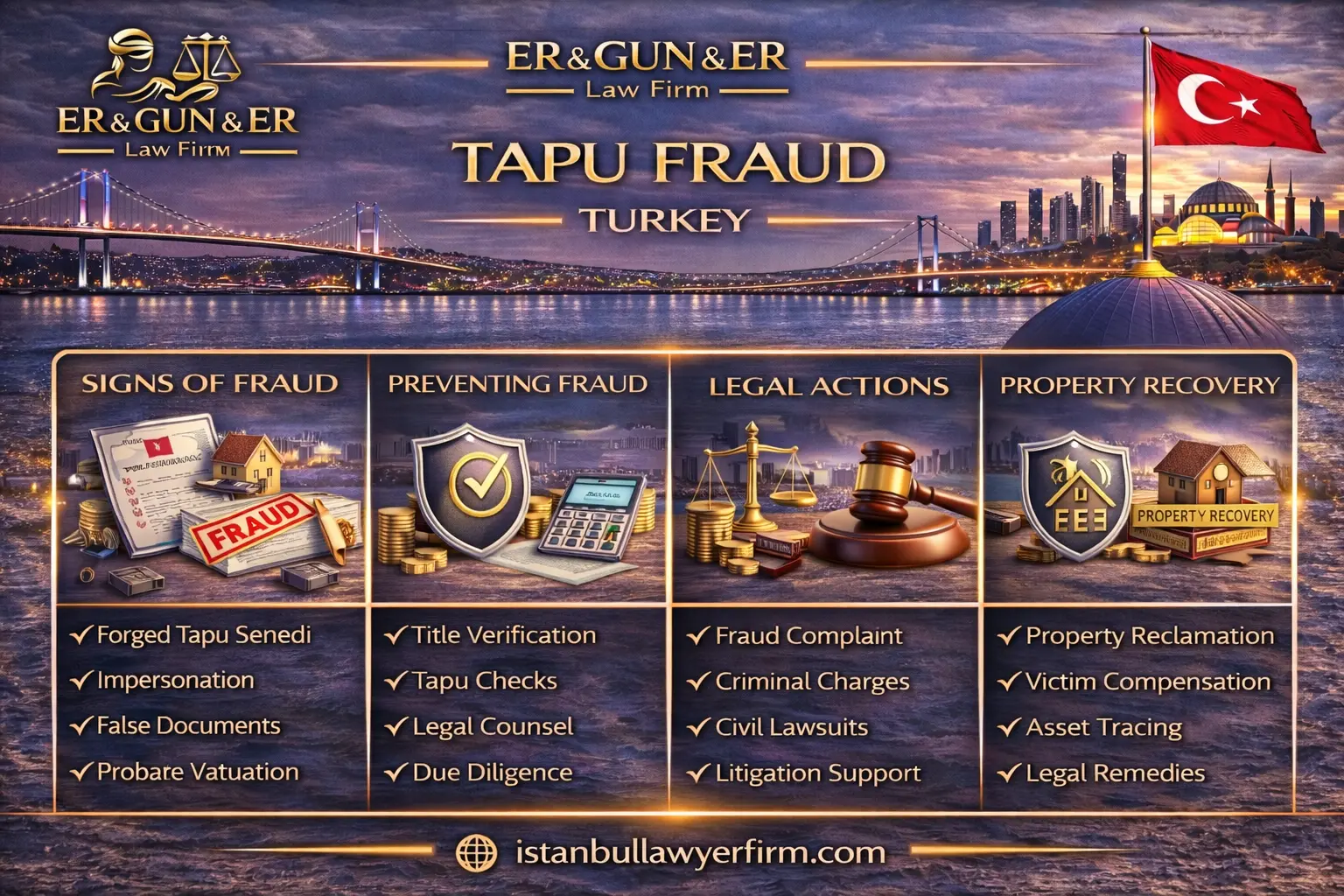
Title deed fraud is possible because real estate value is high, paperwork is complex, and many owners or buyers rely on intermediaries. In urgent cases the fraudster tries to win time, because a second transfer or a mortgage can complicate recovery. Victims often realize the issue only after a bank, a tenant, or a registry extract reveals an unexpected ownership change. The first response should focus on evidence preservation and protective measures, not on emotional negotiations with the suspected actor. The phrase tapu fraud Turkey usually appears when people search for immediate steps, but the correct steps depend on what documents were used and what the current registry record shows. A disciplined file should include certified title extracts, copies of the documents submitted to the registry, bank proofs, and the full communication trail with brokers or agents. practice may vary by authority and year — check current guidance. Early coordination with a Turkish Law Firm can help preserve proof before it disappears and can prevent avoidable procedural mistakes.
Tapu fraud overview Turkey
Tapu fraud is usually a combination of document manipulation and timing pressure. In online searches, the phrase title deed fraud Turkey often appears after an owner discovers an unexpected registration change. The key legal fact is that ownership is determined by registry records, not by private promises or possession. Fraud therefore aims to control the registry outcome, usually through fake authority documents or identity substitution. A victim should treat the situation as both a civil recovery problem and a criminal evidence problem. The first priority is to obtain an up-to-date title extract and to freeze further transfers if possible. The second priority is to preserve how the fraudster approached the victim, including calls, messages, and broker communications. Many victims lose leverage by negotiating first and collecting evidence later. A preventive foundation for understanding ownership effects is explained in the real estate law overview. For procedural service channels and public guidance, the land registry authority site at TKGM is the safest starting point. Courts and prosecutors will usually ask for official records before they accept any narrative. If the property has tenants or mortgages, those layers must be mapped because they affect urgency and risk. A clean chronology should separate what the victim saw, what the fraudster said, and what the registry shows. Any delay can increase the chance that the property is resold, mortgaged, or fragmented into shares. That is why early action often focuses on interim measures and documentary locks rather than on long letters. practice may vary by authority and year — check current guidance.
Fraud risk increases when buyers or heirs rely on verbal assurances instead of verifying the title history. People use the phrase property fraud Turkey to describe many different patterns, but most patterns share the same weakness of missing verification. A standard safe workflow starts with checking the title record, identity of the seller, and the chain of authority used for signatures. The victim should also check whether the property is subject to restrictions, seizures, or zoning limits that make the deal abnormal. If the transaction involved a foreign buyer, the due diligence burden is often higher because documents are cross-border and translators are involved. The foreigners due diligence guide shows why early verification should include both registry checks and counterpart background checks. In fraud cases, the absence of a basic verification trail is later used by fraudsters to argue that the victim was careless. A careful file therefore includes evidence of what checks were attempted and what answers were received. The legal baseline for registration effects and title system principles can be reviewed through the Land Registry Law text. A buyer should also verify whether the seller is acting personally or through a representative. If a representative is involved, the power of attorney chain becomes the main fraud surface. If an agent or broker is involved, the buyer should still treat the agent as a non-authoritative messenger unless proven otherwise. A buyer should avoid paying any money before the verification file is complete and consistent. If money was paid, the buyer should preserve bank receipts and purpose lines because they often prove intent and reliance. A practical approach is to document every step as if it will be submitted to a court later. practice may vary by authority and year — check current guidance.
Many schemes are successful because victims assume the registry record cannot change without their physical presence. In reality, land registry fraud Turkey usually operates through false authority that convinces the system that a representative is acting legitimately. The first defensive step is to confirm the current title record and to identify the exact transaction entry that caused the change. The second defensive step is to obtain the supporting documents used in the registry file, including any power of attorney and identity copies. Those documents often reveal the weak point, such as a forged signature, a manipulated identity number, or a fake notarization chain. A practical prevention workflow that is also useful in recovery is described in the title check guide. That workflow emphasizes reading annotations, liens, and transaction history rather than only the current owner line. When a dispute starts, the victim should request certified extracts and preserve them immediately. The civil law baseline for ownership and good-faith principles can be consulted through the Turkish Civil Code text. Do not quote specific provisions unless you have verified the current wording in the official source. Victims should also preserve communication with the registry office, because timing and submissions can later be disputed. If the fraud includes multiple transfers, build a timeline that shows each transfer and the supporting document set. This timeline supports both interim measure requests and criminal complaint narratives. If the property is at immediate risk of resale, the victim should prioritize freeze measures even before full merits arguments are prepared. A complete evidence pack reduces the chance that the court views the case as uncertain and refuses urgent protection. practice may vary by authority and year — check current guidance.
Common fraud schemes
Fraud schemes often begin with a believable story that explains why the seller cannot attend in person. The story is designed to push the buyer into paying a deposit before verification is complete. A common pattern is a fake owner profile combined with a forged identity document and a convincing broker narrative. Another pattern is a real owner whose documents were copied and then reused in a parallel transaction. Scammers also create fake listings that mirror legitimate listings, including copied photos and copied location descriptions. They then redirect the victim to a fake notary or a fake lawyer office to create credibility. The most effective antidote is a structured verification routine, which is why the phrase title deed check Turkey fraud prevention matters in practice discussions. A practical step-by-step explanation of title verification is given in the title deed check guide. That guide should be used as a control list, not as a substitute for case-specific review. Scammers often rely on the victim’s fear of losing the deal to another buyer. They use that fear to prevent the victim from requesting certified documents or meeting the real owner. They may also present a share transfer instead of a full transfer to make the paperwork look smaller and easier. They may propose a gift style transfer and later demand money, which creates contradictions that are hard to defend. The victim should treat every urgency message as a red flag and respond by slowing down and collecting proof. A credible transaction can survive scrutiny, but a fraudulent transaction usually collapses when asked for certified records. practice may vary by authority and year — check current guidance.
Another cluster of schemes targets owners who are absent or who live abroad and cannot monitor the property record daily. The scammer may impersonate a relative and claim that an urgent signature is needed for a family matter. The scammer may also claim that a developer is offering a special price and that paperwork must be signed immediately. In these settings, the victim often skips basic verification and signs documents without reading the annexes. This is why property due diligence Turkey fraud is not only a buyer topic but also an owner monitoring topic. A due diligence mindset means verifying the identity of every counterparty and verifying the authority behind every signature. Scammers also exploit inheritance situations by approaching heirs after a death and offering to handle paperwork. They may ask for copies of ID cards and then use those copies to prepare forged authority documents. They may also use social engineering to obtain e-government passwords and then access records to design a realistic story. In some cases, the scam involves a real notary clerk or a real agent who is corrupted, but you should not assume that without proof. The victim should focus on collecting objective records such as bank transfers, signed forms, and registry extracts. If the victim paid in cash, the victim should immediately reconstruct proof through receipts, messages, and witness notes. If the victim signed electronically, the victim should preserve the electronic signature logs and any platform confirmations. Each scheme has variations, but the control point is always the same, which is whether a provable authority existed. The safest response is to assume the scheme can evolve and to freeze assets and preserve evidence before negotiating. practice may vary by authority and year — check current guidance.
A large number of fraud files include a notary touchpoint because notaries are perceived as trust anchors. The scam can involve fake notarization stamps, fake translation seals, or a real notarization obtained through identity abuse. In such files, the phrase notary fraud Turkey real estate becomes relevant because the notary document is used as the key credibility exhibit. The victim should request the notary record number and verify that the notary act exists in the official system. Verification should be done through lawful channels and should be documented with response records. If the notary act is real but identity was abused, the defense strategy changes and focuses on signature comparison and identity proof. If the notary act is fake, the strategy focuses on proving falsity and proving that the registry relied on the fake document. Scammers also use translation documents to target foreign buyers by presenting bilingual paperwork that looks official. Foreign buyers may assume that a translated document was reviewed by a neutral authority, but translation alone is not proof. The correct approach is to verify the underlying original, verify the notary act, and verify the authority scope in the same file. Victims should not rely on a broker’s explanation of a notary document, because brokers are not authoritative in this context. Victims should also preserve the full document set, including annexes and signature pages, because fraud often hides in annexes. If the document was delivered as a photocopy, preserve the delivery chain and request the original for forensic review. If the document was delivered as a digital PDF, preserve the email headers or messaging metadata that show the sender and time. A scam can be stopped faster when the file shows exactly which document is false and exactly how it was used. practice may vary by authority and year — check current guidance.
Forged powers of attorney
Powers of attorney are a primary attack surface because they allow a person other than the owner to sign before the land registry. In many cases, forged power of attorney Turkey real estate is the exact mechanism used to create a fraudulent transfer trail. A buyer should treat any representative signature as a high-risk scenario that requires verification beyond simple visual review. Verification starts with confirming that the power of attorney is issued by a competent notary or consulate and that it is still valid. The document should clearly authorize sale or donation of the specific property, not merely general representation language. The document should identify the owner correctly and match the passport or identity card data without inconsistencies. The buyer should also verify whether the power of attorney was revoked or limited after issuance. Revocation questions are practice-sensitive and depend on how revocations are recorded and communicated to registry offices. A safe approach is to request official verification outputs and to store them in the due diligence file. Buyers and owners should use the official legislation portal to confirm the current legal framework for representation and property disposition. The land registry office will usually rely on the document presented, so the verification burden is primarily on the parties. If the owner is abroad, authentication and translation chains become critical and should be planned early. A forged document often contains small inconsistencies in names, fonts, or seals that can be detected when compared to official records. A buyer should never accept a scanned copy alone when a high-value asset is at stake. A buyer should also avoid paying any money until the authority chain is verified and recorded. practice may vary by authority and year — check current guidance.
Fraudsters often target foreign owners by producing powers of attorney that appear to be issued abroad and then used in Türkiye. These documents may include apostilles, consular stamps, or translation notes that look convincing to non-specialists. The correct control is to verify each step in the authentication chain, not only the final stamp. If a consulate is involved, confirm that the consulate is competent for the country of issuance and that the act was registered properly. If an apostille is involved, confirm that it was issued by the competent authority and that it matches the underlying document. If the document was translated, confirm that the translation is tied to the exact original and that the notary certification is real. Fraudsters sometimes mix a real apostille with a fake underlying document, which creates a misleading appearance of authenticity. They also sometimes use a genuine copy of an old power of attorney that was later revoked or that was issued for a different property. A safe file therefore includes the issuance date, the scope clause, and the property identifiers, all checked against official records. If the owner has multiple properties, confirm that the power of attorney is not a general template used for another parcel. If the owner is elderly, confirm that the owner appeared and understood the act, because later capacity challenges are common. If the representative claims urgency, treat urgency as a red flag rather than as a reason to skip checks. If the representative refuses verification, stop the process and record the refusal as part of the file. Where there is suspicion, obtain certified copies and keep them for forensic review rather than relying on screenshots. The main defense is a disciplined verification trail that shows what was checked and what was confirmed at the time. practice may vary by authority and year — check current guidance.
When a forged authority document is suspected, the first priority is to prevent further transfers and to preserve the registry file. The second priority is to obtain a copy of the power of attorney used and to compare it with the owner’s known signature and identity records. The comparison should be done on full documents, not on cropped images, because fraud often hides in small formatting details. The victim should also preserve communication with brokers, agents, and intermediaries because those communications can show the fraud chain. If the victim paid money, preserve bank receipts and any reference lines because they show reliance and intent. If the fraud involved a deposit, preserve the deposit agreement and the account ownership proof. If the fraud involved a promise of future delivery, preserve brochures and marketing messages because they show inducement. The victim should avoid negotiating with the suspected fraudster before evidence is secured, because negotiation often triggers deletion and account closure. A prudent file also includes a list of witnesses who attended meetings or who saw documents being presented. If the owner is abroad, obtain certified translations early so that evidence can be used in both criminal and civil channels. The victim should also request that the land registry record reflect a dispute status where possible, to reduce buyer reliance on a clean record. Interim measures can be considered even before the full merits lawsuit is drafted, but the request must be supported by documents. The victim should be prepared for arguments that a later buyer acted in good faith, because that defense is common. A strong early file can reduce the chance that the good faith defense succeeds because it can show obvious red flags. The most effective strategy is to treat the case as a combined evidence project and procedural sequencing project. practice may vary by authority and year — check current guidance.
Identity and signature abuse
Identity abuse in tapu files often involves a fraudster presenting themselves as the owner or as the owner’s authorized representative. The fraudster may use a copied ID card, a fake passport, or a manipulated residence document to pass superficial checks. When the fraud succeeds, the victim often learns only after seeing that the registry record changed. At that stage, cancellation of title deed Turkey becomes the central civil remedy concept for restoring the registry to the rightful owner. The success of a cancellation claim usually depends on proving that the signature or identity used was not the true owner’s. Proof may include signature comparisons, identity verification records, and witness evidence from the appointment. The victim should immediately secure certified title extracts showing the transaction history and the current owner line. The victim should also secure copies of the identity documents used in the registry file if accessible through lawful requests. If the fraudster used a translator, the translator record can become relevant because it shows who participated and what was said. If the fraudster used a broker, broker messages can show premeditation and coordination. The victim should also preserve digital evidence such as WhatsApp chats, emails, and call logs, because those records show inducement and timing. The victim should avoid altering or deleting chats, because integrity questions arise quickly in court. If the victim has a prior signature sample, preserve it in original form, not only as a scanned image. If the victim has travel records showing absence, preserve those records because they rebut claims of personal attendance. A clean identity abuse file helps both civil recovery and criminal investigation because it narrows the contested issue to verifiable facts. practice may vary by authority and year — check current guidance.
Once identity abuse is suspected, the most urgent risk is that the property will be resold or mortgaged to complicate recovery. Fraudsters often move quickly because they know that delay helps them create a good faith buyer narrative. This is why injunction in title deed disputes Turkey is discussed early in serious files. The objective is to preserve the status quo and prevent third-party reliance while the court examines the merits. A court will usually expect a prima facie showing that the transaction is suspicious and that irreparable change is likely without protection. The showing is built from certified title extracts, identity mismatch proofs, and communication records. If the victim waits until after a second transfer, the urgency narrative becomes harder because the record becomes layered. The victim should therefore request protective measures as soon as credible evidence exists, even if the full merits file is not finished. The request should be drafted narrowly enough to be implementable by the registry and clear enough to cover the relevant parcel identifiers. Overbroad requests can be resisted as disproportionate and can slow down protective action. Underbroad requests can fail to stop a mortgage or a share split, which undermines the purpose of the measure. The victim should keep the request focused on prevention of disposal and preservation of evidence. Timing and implementation depend on the court, the registry office, and the completeness of the evidence pack. The victim should not assume that a protective order will be granted automatically, because courts weigh evidence and risk. A disciplined file that shows urgency without exaggeration is usually more persuasive than a file filled with speculation. practice may vary by authority and year — check current guidance.
Identity and signature abuse can also be enabled by weak onboarding practices at brokers, developers, and intermediaries. Victims often share ID scans casually during negotiations, and those scans later become tools for fraud. A safer practice is to share ID scans only after verifying the counterparty and to watermark copies for the specific purpose. Owners should also monitor their title records periodically, especially if they live abroad or if the property is vacant. Monitoring is not paranoia, because early detection reduces the chance that the property is transferred multiple times. If an owner uses a power of attorney for legitimate reasons, the owner should limit scope and keep revocation mechanisms ready. Owners should store original signature samples and identity documents securely so they can respond quickly if abuse is suspected. Buyers should demand certified title extracts and should verify identity in person where possible. If a buyer cannot verify in person, the buyer should use independent verification channels and keep proof of verification. An owner or buyer should also verify the broker’s licensing and contact data, because fake brokers are common in digital marketing. Communication should be recorded in writing and preserved so later the timeline is provable. If a transaction involves inheritance, heirs should coordinate early because fragmented family communication increases fraud risk. If a transaction involves gifting, families should avoid secrecy because secrecy creates conditions for manipulation. Preventive discipline does not eliminate all risk, but it reduces the chance that a fraudster can create a believable paper trail. When risk is high, professional guidance can focus on evidence and sequencing rather than on fear. practice may vary by authority and year — check current guidance.
Developer and agent scams
Developer-linked fraud often starts with a glossy project story and a promise that the deed will be issued later. The victim is asked to pay quickly to lock a unit, sometimes through third-party accounts or personal IBANs. The scammer then delays by blaming municipality approvals, title parceling, or internal company issues. The practical risk is that the buyer has paid but no transferable right exists in the land registry. Another variant uses real projects but inserts a fake sales representative who diverts funds. The representative may show believable brochures, office tours, and even staged meetings. If the buyer relies on those optics, the buyer may skip verifying the developer’s corporate authority and signature power. A cautious file checks who owns the land, whether construction has lawful permits, and whether a sellable title exists for the specific unit. In many cases, the correct response is to stop payments and pivot to evidence preservation and formal notice. The civil route can overlap with broader disputes, and the commercial litigation guide is a useful map for structuring claims and annexes. Victims should treat every payment receipt, brochure, and message as a future exhibit rather than as a marketing artifact. If the case evolves into a complex dispute, a lawyer in Turkey can help separate what is provable from what is suspected. That separation matters because courts will not infer fraud solely from disappointment or delay. A strong file also records the identities of all intermediaries, including agents, consultants, and translators. The phrase real estate lawyer Turkey fraud case becomes relevant when the dispute requires coordinating corporate records, payment trails, and registry checks into one coherent story. practice may vary by authority and year — check current guidance.
Broker and agent scams often rely on the victim’s assumption that the agent is speaking with the owner’s authority. The agent may present a copy of an ID card and a partial title extract that looks correct but is outdated or unrelated. The agent then proposes a quick signing and requests a deposit, sometimes calling it a reservation fee. Foreign buyers are particularly exposed because translation gaps and time pressure reduce their ability to challenge inconsistencies. The phrase foreign buyer scammed Turkey property is usually followed by the same pattern of missing certified extracts and missing verification of who controlled the bank account. Agents may also suggest structuring the deal as a gift or as a family transfer to simplify paperwork, which can create new litigation risk. A realistic example is when a fraudster pushes a donation narrative while still collecting money, which later looks like a simulated sale. For families who are already considering donation structures, the gift transfer guide shows why consistency between declarations and bank trails is critical. A buyer should never send funds to a personal account without documenting whose account it is and why that account is authorized. If escrow language is used, the buyer should demand a written escrow mechanism and bank confirmation, not only a word in a message. If the agent refuses to provide corporate invoices or refuses to share a verifiable office address, record that refusal in writing. The buyer should also capture the listing page and the agent’s profile pages because online deletions are common after a dispute starts. When communication is bilingual, an English speaking lawyer in Turkey can help keep the record consistent and avoid accidental admissions in translated messages. The buyer should verify whether the owner has actually authorized the agent by requesting proof directly from the owner through verified channels. If the owner cannot be reached or refuses direct confirmation, the safest step is to stop and treat the deal as high risk. practice may vary by authority and year — check current guidance.
Developer and agent files often collapse because the victim did not build a due diligence pack before money moved. A due diligence pack is not a luxury because it determines whether you can later prove misrepresentation and reliance. At minimum, verify the developer’s corporate registration, authorized signatories, and the land ownership status for the exact parcel. Verify whether the project is marketed as ready title transfer or as future delivery, and record the exact marketing claim. Save the developer’s brochures and web pages as dated captures because later they are edited quietly. Demand written confirmation of what will be transferred, including independent section identifiers if applicable. If the developer proposes a promise of sale, store the signed version and confirm whether it is notarized or not, without assuming legal effect. If an agent claims they will handle the registry, request the written scope of their mandate and refuse vague assurances. Many victims later discover that they paid for a unit but the land was never owned by the seller entity. The safest prevention mindset is property due diligence Turkey fraud discipline, meaning you verify the record before you trust the story. If the file is already compromised, stop further payments and preserve evidence rather than trying to recover by paying more. Collect bank receipts, exchange slips, and any currency purchase documents that show the payment story. Collect all chat exports and email headers so you can later show timing and sender authenticity. If there are multiple victims, coordinate documentation so your facts remain consistent and your evidence is not fragmented. A Turkish Law Firm review can identify which claims are contractual, which are tort-like, and which are criminally relevant, without making unsupported promises. practice may vary by authority and year — check current guidance.
Title deed record red flags
Registry red flags are often visible in the record, but only if you know what you are looking at. A clean owner name line is not enough because fraud often hides in the transaction history and annotations. Ask for a certified extract that shows prior transfers, mortgages, liens, and court annotations. Check whether the property has recent rapid transfers between unfamiliar parties, because that pattern often signals layering. Check whether the record shows a representative transaction and whether the authority document is referenced correctly. If the record contains a sudden change soon after an owner death, treat it as high risk and verify the death timeline. The internal workflow described in the after-death tapu check guide is useful for spotting timing inconsistencies in inheritance-related cases. The phrase title deed check Turkey fraud prevention is not marketing language, because the check is what prevents you from relying on a manipulated snapshot. Another red flag is when the seller refuses to provide the full extract and offers only a cropped photo of the first page. The record should also be checked for restrictions that prevent transfer, because fraudsters sometimes sell assets that are already blocked. If a buyer sees inconsistent parcel identifiers across documents, treat it as a stop sign, not as a typo. If a seller explains inconsistencies with vague stories, record the story and then verify it through official channels. If the case is sensitive, a law firm in Istanbul can review the extract structure and identify hidden risk markers without relying on assumptions. Red flags are also created by missing attachments in the registry file, especially when a power of attorney is referenced but not shown. In many land registry fraud Turkey patterns, the fraudulent step is a single registry entry that looks normal until the supporting document is examined. practice may vary by authority and year — check current guidance.
A record may also show red flags through unusual annotations that are inconsistent with the seller’s story. For example, an annotation may indicate a dispute or a seizure that the seller claims does not exist. A buyer should request official clarification and should store the clarification with delivery proof. Another red flag is a mismatch between the property’s physical reality and the recorded usage type, which can indicate unauthorized construction or hidden subdivision. Fraudsters sometimes market units that are not recorded as independent sections, which makes later delivery impossible. When you see a pattern of rapid transfers, check whether the declared values change in a way that looks artificial. Artificial values can be used to confuse victims and to manipulate later claims about good faith. When a seller claims a clean history, insist on seeing the history and not only the current line. If the seller claims they bought recently, ask why they are selling immediately and record the explanation. If the seller refuses to show prior owners, treat the refusal as a risk indicator rather than as privacy protection. The safest mindset is property due diligence Turkey fraud discipline, meaning you verify title, identity, and authority before negotiating price. This discipline also means checking whether the seller’s bank account matches the seller identity shown in the registry. If the account belongs to a third party, ask for the legal basis and stop if it is not verified. In many fraud files, the first provable inconsistency is not the signature but the money trail. Turkish lawyers often focus on these inconsistencies because they are objective and can be presented without speculation. practice may vary by authority and year — check current guidance.
Title records should also be checked against the practical ability of the seller to attend and sign. If the seller claims to be abroad but also claims to sign in person, that contradiction should be clarified in writing. If the seller claims to sign through a representative, request the representative’s identity and the exact authority scope. If the authority is general, ask whether it includes disposition authority and whether it is limited to this parcel. If the seller uses multiple names or multiple passports, ensure the registry spelling aligns with the identity used for the transaction. Small spelling differences can later be used as a defense or as an attack, depending on who benefits. If a buyer is a foreign national, check whether additional registry restrictions apply and document the confirmation. If the property is acquired through inheritance, check whether the inheritance documentation and registry updates were completed properly. In those files, the absence of a clean inheritance update can make later transfers easier to manipulate. If the buyer relies on an agent, keep a record of every agent statement and treat it as evidence. Fraud detection also includes checking whether the same phone number appears across unrelated listings. Patterns like repeated phone numbers, repeated IBANs, and repeated intermediary names are practical red flags. A Istanbul Law Firm can coordinate registry extract review with identity and bank trail checks so red flags are evaluated coherently. That coordination is especially useful when multiple properties are involved and documents are spread across different offices. The objective is to stop the deal or stop the loss before the registry record is irreversibly complicated. practice may vary by authority and year — check current guidance.
Immediate evidence preservation
In suspected fraud, evidence preservation is a race because documents and digital traces can disappear quickly. Start by obtaining a certified title extract and a certified copy of the transaction history if available. Preserve the registry appointment records, signature pages, and any scanned identity documents used in the file. Preserve all bank receipts, SWIFT confirmations, exchange slips, and payment reference lines without editing. Export chat histories as full exports rather than as individual screenshots, because exports preserve timestamps and sender identifiers. Preserve email headers and attachments because header metadata often proves who sent a document and when it was sent. If a broker provided documents, preserve the delivery chain and record the broker’s identity details. If you suspect a forged authority document, preserve the copy you received and request the original through lawful channels. If the fraud intersects with criminal steps, the phrase criminal complaint for fraud Turkey becomes practical because prosecutors and police will ask for a clean proof pack. A lawyer in Turkey can help ensure the evidence pack is collected without contaminating it through informal edits or incomplete captures. Do not confront the suspected fraudster with your full evidence because confrontation often triggers deletion and flight. Instead, focus on freezing the record by collecting official extracts and verified copies first. If you need a neutral reference point for professional conduct and representation standards, the Istanbul Bar Association website can be used to verify institutional identity information. Preserve witness notes by writing them immediately, dating them, and storing them with the file. Preserve travel records, hospital records, and meeting logs when they are relevant to identity and presence disputes. practice may vary by authority and year — check current guidance.
Digital evidence should be preserved in a way that a court can later trust. Keep original files in a read-only folder and work only on copies for analysis. Record the device used to capture screenshots and screen recordings because device logs can later support authenticity. Capture full pages with visible URL bars and visible timestamps rather than partial frames. If the content is on a portal that changes dynamically, take multiple captures across different times and store them as separate dated files. If the fraud involved bank transfers, obtain bank statements that cover a reasonable period before and after the transaction date. Do not annotate bank statements with guesses about purpose, because annotations can be attacked as self-serving. Instead, attach the invoices or messages that explain each transfer and let the documents speak. If criminal law concepts become relevant, consult primary texts like the Turkish Penal Code and the Criminal Procedure Code to avoid relying on incorrect summaries. Do not quote specific penalty numbers from memory because those details must be verified against the current text. If you need to obtain records from institutions, write requests in a neutral factual tone and preserve submission receipts. If you need translations, keep both the original and the translation and preserve the translator’s certification record. If the victim is foreign, preserve passport pages and entry-exit records because they can prove absence at the alleged signing time. Where the file is already complex, a law firm in Istanbul can coordinate certified copies, translations, and evidence ordering so the pack is usable in both criminal and civil channels. The most common mistake is to assume you can rebuild evidence later, but rebuilding is harder once content and actors disappear. practice may vary by authority and year — check current guidance.
Evidence preservation should also anticipate the civil remedies you may seek, because civil cases require proof of loss and causation. If you paid money, preserve the payment purpose line and any written promise that induced the payment. If you delivered cash, reconstruct the event with receipts, witness notes, and bank deposit traces where possible. If you signed documents, preserve the version you saw and request the registry-submitted version because differences often reveal manipulation. If the fraud involved a developer contract, preserve the contract and the annexes and keep proof of delivery of each signed page. If the fraud involved an agent, preserve the agency agreement, commission messages, and any licensing documents the agent claimed to have. If the fraud involved inheritance context, preserve death certificates and inheritance documentation because timing can be decisive. If you suspect the property will be transferred again, collect evidence that shows imminent resale marketing such as new listings and new broker messages. If you seek compensation, the phrase damages claim fraud Turkey property becomes relevant because you must show not only wrongdoing but also the quantifiable consequences supported by documents. Quantification should be approached conservatively and supported by bank statements, valuation reports, and official extracts. Avoid writing speculative numbers into messages because speculation is easy to attack and harms credibility. If there are multiple victims, coordinate to preserve consistent facts and avoid conflicting statements in different filings. If you give a statement to authorities, keep a copy of what you submitted and the submission receipt. If you receive any notice from a registry or notary, preserve it fully and record the delivery method and date. A Istanbul Law Firm can help structure the evidence pack so the criminal file and the civil file do not contradict each other in language or annex ordering. practice may vary by authority and year — check current guidance.
Injunctions and freezes
Protective measures are usually the fastest legal tool to stop a fraudster from layering the title record through resale or mortgage. The objective is to preserve the current state while the court evaluates the merits of ownership and fraud allegations. A victim should request a measure that is tailored to the exact parcel and that can be implemented by the registry without ambiguity. Overbroad requests can be resisted as disproportionate, while narrow requests can fail to stop a mortgage registration. The phrase injunction in title deed disputes Turkey reflects that the court is asked to freeze disposal risk rather than to decide the whole case immediately. The court will typically want certified extracts, a clear fraud narrative, and proof of imminent risk such as active marketing or recent transfers. If the case includes financial claims alongside title claims, coordination with interim asset measures may be considered through tools like precautionary attachment guidance. Do not treat attachment as automatic because it depends on claim type and evidence completeness. Keep the request factual and annex-based because courts do not grant freezes based on anger or suspicion alone. If the victim is a company, corporate authorization documents should be included to show standing and internal decision. If the victim is an heir, inheritance documents should be included to show who has authority to sue and to request measures. If the victim is abroad, translations should be certified and consistent to avoid rejection of annexes. A disciplined submission is often what differentiates a quick protective step from a delayed one. The phrase real estate litigation Turkey fraud is relevant because interim protection is a litigation phase, not a platform complaint. In high-stakes scenarios, a lawyer in Turkey approach focuses on proving urgency through documents and avoiding any claim that cannot be verified. practice may vary by authority and year — check current guidance.
Freezes must be coordinated with the main case plan because a freeze without a coherent merits filing can be challenged as abusive. The victim should decide whether the primary civil aim is cancellation of title deed Turkey or a combination of cancellation and compensation. The freeze request should reference the supporting documents and show why disposal risk is immediate. Courts may look at whether the victim attempted to obtain certified registry documents and whether the victim acted promptly after discovery. Delays are often explained by victims, but the record should show objective reasons such as document retrieval time. The victim should also coordinate with execution-related systems because fraud cases often include parallel collection disputes. A structured view of how formal claims move through enforcement channels is explained in the enforcement proceedings overview. The victim should keep the freeze request consistent with any enforcement submissions to avoid contradictory statements. If the property is already mortgaged, the freeze strategy must account for the mortgage holder’s rights and the registry record sequence. If the property is already resold, the freeze request may need to cover the current holder and any pending transfers. Because local practice can differ between courts and registries, the request should be drafted in clear implementable language. practice may vary by authority and year — check current guidance. Foreign victims often need bilingual coordination to avoid misunderstandings about what the order does and does not do. In those files, an English speaking lawyer in Turkey can coordinate translations and procedural communication without adding unverifiable expectations. The victim should also plan for the possibility that a defendant will offer settlement to avoid a freeze, and any settlement should be written with registry implementation steps. The purpose of interim protection is to buy time for lawful review, not to replace proof requirements for the main case.
A freeze order is most effective when the victim monitors compliance and documents any attempt to circumvent it. If the defendant advertises the property after a freeze request is filed, capture the advertisement as evidence of risk. If the defendant tries to transfer to relatives, capture the relationship indicators and the timing indicators without speculation. If the registry adds an annotation, obtain a certified extract showing the annotation and store it with the court file. If the registry refuses implementation, obtain the refusal reason in writing and preserve submission receipts. The victim should avoid making private side deals that contradict the freeze request because contradictions harm credibility. If the victim’s objective is to restore ownership, the phrase recovery of property Turkey lawsuit describes the civil path that must be built on certified documents and coherent chronology. Interim protection supports that lawsuit by preventing the property from being irreversibly moved to third parties. If the victim also seeks compensation, the evidence pack should preserve payment trails and valuation records to support later quantification. If the defendant offers to return the property, insist on registry-safe implementation steps and do not rely on verbal promises. If the defendant offers to repay money, insist on bank transfer with clear references and written settlement scope. Courts can lift measures if the victim cannot support urgency or if the victim delays the merits filing, so planning must be realistic. practice may vary by authority and year — check current guidance. Turkish lawyers often recommend that the victim treat interim measures as part of a sequenced plan that includes criminal filings, civil filings, and registry implementation. A Istanbul Law Firm can coordinate that sequence so that filings and annexes remain consistent across different authorities. The most important rule is to keep every step provable, because a freeze is a tool that depends on trust in the record.
Criminal complaint pathway
Criminal reporting becomes relevant when the file shows intentional deception and document manipulation. The objective is to secure an official investigation record while the civil recovery work is prepared. A complaint should be drafted as a chronology that ties each act to a piece of evidence. The chronology should identify who presented which document and where it was used. Bank receipts and money flow explanations should be attached because payments often prove reliance. Certified land registry extracts should be attached because they show the transaction and the exact date. Identity documents should be attached only to the extent necessary to demonstrate mismatch. Witness names should be listed with what each witness observed and on which date. Digital messages should be exported in full so timestamps and sender identifiers are visible. The complaint should avoid claiming fixed penalties because enforcement depends on prosecutorial assessment. Instead, it should point to the official legal framework and ask for document examinations and statements. If a forged power of attorney is alleged, request that the original notary record be obtained and verified. If there is urgent resale risk, state that risk and reference the civil freeze application prepared in parallel. A well prepared criminal complaint for fraud Turkey file is usually shorter and more annex-driven than a narrative letter. Early guidance from a lawyer in Turkey helps keep the statement factual and prevents contradictions with later court pleadings.
In practice, the investigation phase often depends on whether the complaint includes verifiable annexes rather than broad accusations. Prosecutors typically look for a clear link between the suspect and the registry act, which is why intermediary identities matter. If the suspect is a broker or an agent, include their license information and all contact channels used. If the suspect used a translator, include the translator’s name and the meeting context as part of the timeline. If the suspect used a notary document, ask for official retrieval of the notary act and comparison with the submitted copy. If the suspect used registry appointment slots, ask for retrieval of appointment records and any camera logs where available. The victim should request that relevant signatures be examined by competent experts rather than relying on private assumptions. The victim should also request that bank accounts receiving funds be traced through lawful banking requests. Criminal procedure and its evidence tools can be understood through the criminal law guide and then aligned to the specific facts of the file. A complaint should not be treated as a substitute for civil recovery because prosecutors do not always resolve ownership issues directly. Civil and criminal tracks must be consistent, so avoid different descriptions of the same event in different filings. If you change your wording later, the defendant will highlight the inconsistency and weaken credibility. If there are multiple victims, coordinate one factual timeline so statements do not conflict. A coordinated approach by a law firm in Istanbul can keep the complaint, annex ordering, and translation file aligned across authorities. practice may vary by authority and year — check current guidance.
For foreign victims, the complaint file must also explain why the victim could not attend key events and how identity abuse occurred. Passport copies and entry exit records can be supportive, but they should be limited to what is necessary. If documents are in another language, certified translations should be prepared early so authorities can read annexes without delay. If the victim signs a power of attorney abroad to authorize counsel, authentication steps should be planned before filing. If the victim is abroad, a local representative can submit documents, but submission receipts must be preserved. The complaint should identify the property precisely by parcel identifiers so authorities do not mix files. The complaint should also identify the registry office involved so record retrieval requests are targeted. If the victim suspects insider participation, avoid naming individuals without proof and focus on requesting official logs. If the victim received threats, preserve the threats and consider safety planning without escalating public accusations. The criminal path can support deterrence and evidence collection, but it does not guarantee that the property will be restored. Parallel civil steps should therefore be prepared from day one and kept consistent with the complaint narrative. Communication with investigators should remain factual and annex-based to avoid later misunderstandings. Where bilingual coordination is required, an English speaking lawyer in Turkey can translate the evidence narrative while preserving original source documents. A Turkish Law Firm can also coordinate the criminal and civil files so that the record remains coherent and defensible. practice may vary by authority and year — check current guidance.
Civil lawsuit for cancellation
The core civil remedy in many fraud files is a lawsuit that targets the registry record and seeks restoration of the rightful owner line. The claim is framed around invalidity of the transaction, lack of true consent, or lack of lawful authority behind the signature. A claimant should start by obtaining certified title extracts showing the exact transaction chain and current owner. The petition should identify each transfer step and attach the supporting registry documents where available. The petition should also attach the payment trail to show reliance and to rebut arguments that the claimant consented. When the transaction is built on a fake representative act, the petition should focus on disproving the authority document and the signature link. The phrase cancellation of title deed Turkey is used for this remedy, but success depends on evidence quality and party structure. If the property has moved through multiple hands, each holder may need to be addressed so the judgment can be implemented. The claimant should also request interim protection to prevent further transfers during the lawsuit. The claimant should avoid asserting fixed timelines because civil procedure length depends on court workload and objections. A clean annex pack usually includes identity proof, signature comparison materials, registry receipts, and communication records with intermediaries. The petition should explain why the claimant did not discover the fraud earlier, using objective dates and documents. The objective is a recovery of property Turkey lawsuit that restores the registry line and neutralizes unlawful registrations. Coordinated case management by an Istanbul Law Firm helps keep annexes consistent and prevents procedural rework. practice may vary by authority and year — check current guidance.
The civil file should be treated as an evidence project because courts will test authenticity through expert review rather than through assumptions. If a signature is disputed, the claimant should request comparison with known samples and request official retrieval of original documents. If the alleged fraud used a notarized document, the petition should ask for the notary record to be produced and examined. If the alleged fraud used an online appointment system, the petition should request relevant logs and appointment confirmations. If witnesses exist, the petition should state what each witness observed and why that observation matters for consent. If the victim is abroad, the petition should include travel records and communication logs that prove absence at signing. If the victim is deceased, the petition must be structured through heirs with proper heirship documentation and authorization. The petition should avoid speculative accusations against individuals who are not proven to be involved and should focus on transaction invalidity. The court may ask for on-site inspections where identity or possession facts matter, so preserve tenant and neighbor information carefully. If the property is occupied, the claimant should preserve rental agreements and payment proofs because those records show control patterns. A claimant should coordinate civil filings with criminal filings so statements on dates, documents, and identities remain consistent. If the defendant claims the claimant approved the transaction later, the claimant should rebut with contemporaneous objections and complaints. A strategy review by a lawyer in Turkey can help prioritize the strongest evidence points and remove statements that cannot be proven. The petition should be written in short factual sentences that reference annex numbers so the judge can follow the chronology quickly. practice may vary by authority and year — check current guidance.
Civil cancellation suits also require thinking about implementation, because a favorable judgment must be registered to change the record. The judgment must identify the parcel, independent section, and share precisely so the registry can implement without ambiguity. For implementation logic, practitioners often cross-check the registration framework through official sources rather than informal guides. The claimant should keep certified copies of every court submission and every court decision because implementation can take multiple steps. If the property was used as collateral, the claimant must map how mortgages and liens were placed and whether third parties claim protection. If a defendant argues good faith purchase, the claimant should show red flags that a diligent buyer would have noticed. Red flags can include unrealistic pricing, rushed appointments, and inconsistent identity documents presented by intermediaries. If the defendant argues that the record was clean, the claimant can rebut by showing that the underlying authority document was invalid. The claimant should also plan for partial outcomes, because courts may decide differently for different transaction layers. Even if title is restored, separate disputes may remain about rents collected, damages, and occupancy during the fraud period. The claimant should document all financial consequences with bank statements and invoices so later claims are not speculative. Communication should remain disciplined because messages sent in anger are often used to mischaracterize intent and consent. If the case includes foreign parties, translations should be controlled and consistent across annexes to avoid identity confusion. A lawyer in Turkey who handles both registry-facing and courtroom-facing steps can keep the file consistent from filing through registration. practice may vary by authority and year — check current guidance.
Good faith buyer issues
Good faith buyer arguments arise when the property is transferred again after the fraudster obtains a registration entry. The later buyer will often claim they relied on the registry and had no reason to suspect manipulation. The victim will argue that the later buyer ignored obvious red flags and therefore cannot be treated as protected. Courts typically examine what a prudent buyer would have checked in that specific transaction context. If the price was unrealistically low or the signing was rushed, those facts may be treated as warning indicators. If the seller acted through a representative, the buyer’s authority checks become especially important. If the buyer refused to obtain certified extracts and relied only on photos, the refusal can weaken a good faith narrative. If the buyer paid to a third-party account, the money trail can show that the buyer accepted irregularity. If the property was under annotation or mortgage, the buyer’s awareness of those burdens may be examined. The victim should preserve evidence of market pricing and common due diligence steps to show the later buyer’s deviation. The victim should also preserve proof that the fraud was reported quickly, because delay can complicate third-party reliance arguments. The later buyer’s communications with brokers and agents can reveal whether concerns were raised and ignored. The dispute becomes fact-heavy, so broad moral statements rarely help and documents become central. In sensitive files, Turkish lawyers often build the argument by mapping red flags to specific annexes rather than debating abstract principles. practice may vary by authority and year — check current guidance.
Good faith issues become more complex when the original owner dies and heirs discover the fraud later. In those cases, the later buyer may argue that the family failed to monitor the record and that reliance was reasonable. Heirs should respond by showing the death timeline and the immediate steps taken once the suspicious transfer was discovered. If a fraudster transferred shortly after death, courts may look closely at who initiated the process and what documents were used. Heirs should preserve death records, heirship documents, and communication records with the registry office. The operational checklist for heirs often overlaps with succession planning and can be understood through the inheritance law overview. That background helps heirs explain why certain documents were not immediately available and why verification took time. The later buyer’s due diligence is still examined, especially if the seller claimed to be an heir without producing full heirship proof. If the later buyer did not request heirship documents, that omission can be treated as a red flag. If the later buyer accepted a power of attorney issued abroad without verifying the authentication chain, the omission can be treated as another red flag. Heirs should also document whether the property remained in family possession, because possession facts can influence credibility. If a tenant existed, preserve lease files because they can show who collected rent and who asserted control. If the later buyer contacted the family and was warned, preserve that warning record because it defeats reliance arguments. If the later buyer ignored a warning and proceeded, that behavior can be highly relevant to good faith analysis. practice may vary by authority and year — check current guidance.
When a later buyer exists, the case strategy should shift from a simple fraud narrative to a layered transaction analysis. The victim must identify each transfer step and show which step is invalid and why. The victim should also show what the later buyer could have checked and what the later buyer actually did. Evidence can include broker messages, bank receipts, appointment logs, and certified extracts showing rapid turnovers. If the later buyer is a company, corporate procurement records can show whether checks were skipped. If the later buyer is an individual, travel and meeting logs can show how hurried the signing process was. The victim should avoid threatening the later buyer publicly because public threats can trigger counterclaims and complicate settlement. A more effective approach is to send a structured notice with annex references and a request to preserve documents. If the later buyer is willing to negotiate, negotiation should be anchored in documented risk and implementation steps. If negotiation fails, the victim should continue with the civil cancellation track while keeping interim measures active. The victim should also coordinate with the criminal file so that statements about the later buyer remain factual and evidence-based. If the later buyer claims they relied on a notary document, request the notary record through lawful channels and preserve it. If the later buyer claims they relied on registry staff confirmation, request written confirmation rather than accepting verbal claims. The central defense against a good faith argument is a coherent record showing that warning signs were objectively visible. practice may vary by authority and year — check current guidance.
Restitution and damages
Restitution questions arise once the victim secures the record and the court identifies who benefited from the fraudulent chain. Victims often ask whether they can recover not only the property but also the money and costs lost during the fraud period. The answer depends on which party received payments, which party collected rents, and which party caused measurable loss. A civil file should therefore separate the ownership restoration request from the monetary claims and support each with documents. If a buyer paid money to a fraudster, bank receipts and purpose lines are often the primary evidence of the payment story. If a fraudster used multiple accounts, the victim should map each account to each payment in a dated table kept internally. If the property was occupied, the victim should preserve rent receipts and communication showing who demanded and received rent. If utilities or maintenance were paid by the victim while the property was controlled by others, preserve invoices and payment proofs. If the property was resold, preserve the resale contract and payment trail because those documents can show who gained value. Claims should avoid speculative numbers and should be supported by documents that a court can verify. This discipline is essential in damages claim fraud Turkey property files because overstatement harms credibility. Courts typically require a clear link between the fraud act and the alleged loss, not only general unfairness arguments. Where loss is complex, expert reports may be needed, but expert reports still depend on a clean underlying document set. Victims should also keep proof of reasonable mitigation steps, such as prompt complaints and efforts to stop resale. practice may vary by authority and year — check current guidance.
Monetary recovery can require separate procedural steps even after a favorable decision on ownership issues. A judgment awarding money is only useful if it can be executed against assets that actually exist. Victims should therefore map the defendant’s assets and bank relationships early, using lawful investigation channels. If the defendant is a company, corporate records and invoice trails can help identify receivables and business partners. If the defendant is an individual, asset tracing may require focusing on bank accounts, vehicles, and other registrable assets. Because these steps are procedure-heavy, it helps to understand the execution logic described in the debt collection guide. That guide is not a promise of outcome, but it shows why documentation and target selection matter. The victim should preserve all settlement offers because settlement offers can indicate ability to pay and can support later enforcement planning. If the defendant offers installment payments, the victim should require written terms and bank transfers with clear references. If the defendant pays through third parties, the victim should document the relationship and confirm that the payment reduces the defendant obligation. If multiple defendants exist, the victim should decide whether to pursue each jointly or sequentially, depending on provable roles. A claim against a professional intermediary may have different evidentiary needs than a claim against the direct fraudster. Victims should also preserve the full cost file, including legal expenses and certified document fees, because those costs may be relevant in litigation budgeting. Do not assume that criminal proceedings will automatically secure money, because monetary recovery usually requires civil-based execution steps. practice may vary by authority and year — check current guidance.
Damage analysis should be approached in layers so the court can see what is certain and what is contested. The first layer is direct payments made to the wrong person, which is usually provable by bank receipts. The second layer is transaction costs such as translation, notarization, brokerage fees, and registry fees, which can also be supported by invoices. The third layer is loss of use, such as rental income lost during the period the victim could not control the property, which must be supported carefully. Rental income claims should be tied to actual lease evidence or market reports, and should avoid exaggerated assumptions. The fourth layer is repair cost, where the victim can show invoices for restoring damage caused during unlawful control. If a buyer renovated the property in good faith, renovation cost can become a contentious issue and must be documented clearly. If the property value changed, valuation reports can be used to show value differences at relevant dates, but reports must be dated and coherent. Interest and currency issues can appear in cross-border payments, so victims should keep both sending and receiving bank documents. Courts may request expert review for complex calculations, so the underlying documents must be organized chronologically. If the victim made multiple payments, link each payment to the corresponding promise or invoice to show causation. If the defendant claims the victim accepted risk, rebut with proof of due diligence steps and prompt complaints. If the victim settles, ensure the settlement text states whether monetary terms include all claims or only a limited portion. After settlement, keep bank proofs and implementation correspondence, because later disputes often reopen what was paid and what was not. practice may vary by authority and year — check current guidance.
Cross-border victim challenges
Cross-border victims face higher fraud exposure because distance increases reliance on intermediaries and reduces the ability to verify documents in person. The phrase foreign buyer scammed Turkey property often reflects a pattern where the buyer relied on a broker narrative and paid before confirming the registry record. A foreign victim should immediately secure certified extracts and a complete payment trail, because later recovery depends on proving reliance and disproving consent. If the foreign victim signed documents abroad, authentication and translation chains must be preserved so the file remains usable in Turkish courts. If the fraud involved a forged authority document, preserve every version you received and request the registry-submitted copy through lawful channels. If the foreign victim is not in Türkiye, appointing counsel requires a valid power of attorney that itself must be authenticated and translated properly. The foreign victim should also preserve travel records because they can rebut claims that the victim attended appointments personally. Where a foreign victim used multiple passports or name spellings, a consistent identity mapping file should be created to prevent identity confusion arguments. If a translator or consultant was used, preserve their invoices and messages because those records show who guided the victim. Cross-border cases often involve international transfers, and those transfers have different value dates and intermediary bank references, so keep the complete SWIFT and bank confirmation set. Do not assume a platform screenshot is enough to prove payment, because courts expect bank documents. If the foreign victim needs procedural guidance in English, an English speaking lawyer in Turkey can help align submissions without changing the core facts. practice may vary by authority and year — check current guidance.
Service and communication issues can also complicate cross-border recovery because defendants may argue that the victim delayed or failed to object. The victim should therefore record discovery dates and preserve evidence of when the fraud was first detected. If the victim detected fraud through a bank, preserve the bank notification and the date of receipt. If the victim detected fraud through a tenant, preserve the tenant message and the date. If the victim detected fraud through a registry extract, preserve the extract request and the issuance date. This chronology matters because interim measures often depend on urgency and promptness. Cross-border victims should also avoid negotiating through unverified intermediaries because negotiation messages can create admissions and can be mistranslated. When communication is necessary, keep it in writing and keep the tone factual. If the victim suspects the property will be resold, capture new listings and preserve timestamped evidence of marketing. If the defendant is abroad, cross-border service can extend the timeline, so early planning is necessary. The victim should also consider whether parallel proceedings may exist in another country, such as a bank complaint or a fraud report, and keep those records consistent. Consistency is essential because defendants often attack inconsistencies across jurisdictions. Cross-border victims may also face currency disputes and exchange claims, so preserve the exchange rate applied by the bank at the time of payment. If the victim is a corporate investor, preserve board resolutions and internal approvals to show standing and decision authority. If the victim is an individual, preserve identity documents and address updates to avoid service disputes. A coordinated approach by a Turkish Law Firm can keep translations, annex ordering, and procedural steps consistent across criminal and civil channels. practice may vary by authority and year — check current guidance.
Cross-border recovery also depends on understanding that not every dispute is purely about title, because many foreign buyers suffer losses even when title cannot be restored quickly. Some files focus on recovery of payments rather than on recovery of the property, especially where the property was resold to a later buyer. In those cases, asset tracing becomes central and requires disciplined evidence of payment recipients and money paths. Foreign victims should avoid paying additional sums to fraudsters in exchange for promises to fix the record, because those payments rarely produce enforceable outcomes. The safer approach is to freeze the record through lawful interim measures and proceed through structured filings. If the victim can travel, in-person visits can help collect certified documents quickly, but they are not required if counsel can act with proper authority. If the victim cannot travel, counsel should coordinate certified documents and translations with clear delivery receipts. Foreign victims should also store all documents in a secure cloud archive with access logs, because evidence integrity matters in contested cases. If the victim wants to prevent future fraud, consider monitoring the title record periodically and using stricter verification protocols for any later transaction. Where families are involved, coordinate heirs and family members early to prevent fragmentation of facts and contradictory statements. A strong cross-border file is a file that can be understood by a judge who has no background on the parties and who will decide based on annexes. If the case is high-stakes, a lawyer in Turkey approach often narrows the case to a provable sequence, rejects speculative claims, and prioritizes interim protection. practice may vary by authority and year — check current guidance.
Notary and registry interface
Notary and registry interfaces are central because many fraud schemes rely on the appearance of official legitimacy. The registry records the transfer, but the registry often relies on documents prepared or certified elsewhere, such as powers of attorney and translations. A fraud file therefore requires mapping which office created which document and how that document entered the registry file. If a notary act is involved, request the notary record number and confirm that the act exists in the official registry. If a consular act is involved, confirm the act was issued by the correct consulate and that it was authenticated appropriately. If a translation act is involved, preserve the translator identification and the notary certification pages. The victim should also obtain the land registry file documents to see what exactly was submitted, because victims often learn that the submitted documents differ from the documents they were shown. When the fraud involves a representative, the critical question is whether the representative’s authority was real, valid, and sufficient for disposition. The legal baseline for registry transactions can be checked in the Land Registry Law and the general property principles in the Civil Code. Do not cite specific articles unless you verify them in the official source at the time of drafting. Victims should also preserve any registry communication logs and appointment records because they show timing and participation. If the registry rejected any request or asked for additional documents, preserve those requests because they show procedural context. A structured interface map often reveals the weak point and helps target the correct remedy. practice may vary by authority and year — check current guidance.
Interface problems also arise when victims assume that a notary stamp guarantees validity. A stamp can be genuine while the underlying identity is abused, and a stamp can be fake while the document looks plausible. The correct approach is to verify the notary act itself and the identity of the signer recorded by the notary. If the notary record shows a different ID number, that difference becomes a key proof point. If the notary record shows a different address or different passport data, that difference becomes another proof point. If a notary clerk handled the act, record the clerk name and request the notary’s official logs through lawful channels. If the notary act is based on a translation, confirm that the translation was presented and that the translator was officially registered. Many notary fraud Turkey real estate allegations collapse because victims cannot show which notary act existed and which act was used. The solution is to collect the official record references and preserve them with certified copies. In registry matters, the authority site TKGM provides official channels for accessing services and guidance. Use official channels for verification rather than intermediaries, because intermediaries may be part of the fraud chain. If a victim is told that a correction can be made administratively, request the legal basis in writing and verify through official guidance, because many corrections require court orders. If a victim needs to send formal letters, ensure they are drafted consistently with later filings and do not contain unverifiable legal promises. If professional standards are relevant, the Istanbul Bar Association can be used to verify institutional references without relying on marketing sources. practice may vary by authority and year — check current guidance.
Registry interface also affects how fast interim measures can be implemented because the registry must be able to annotate the record clearly. If a court order is ambiguous, the registry may delay or request clarification, which creates risk of resale in the meantime. For this reason, petitions should be drafted with implementation in mind, including parcel identifiers and the exact requested annotation type. Victims should keep certified copies of interim orders and submission receipts to prove that they requested implementation promptly. If the registry refuses implementation, the refusal should be obtained in writing and preserved because it may support renewed court requests. If a dispute is already in court, communication with registry offices should remain formal and documented to avoid misunderstandings. If a victim negotiates settlement, settlement should include a registry implementation protocol rather than a vague promise to fix the tapu. Settlement should identify which party will attend, which documents will be presented, and how costs will be handled. If a victim recovers the property, the victim should obtain a post-registration certified extract to confirm that the record truly changed. Victims should also monitor whether any mortgage or lien remains because fraud files often leave hidden burdens behind. A proactive post-recovery title audit reduces the chance of a second loss. Where complex registries are involved, coordination by a law firm in Istanbul can reduce implementation friction because the office can align court wording and registry expectations. The objective is to move from an allegation to an implementable legal outcome, and that requires precise paper, not only moral certainty. practice may vary by authority and year — check current guidance.
Settlement and negotiation
Settlement can be efficient in fraud files, but it is also risky because fraudsters use settlement discussions to buy time. The first rule is to secure evidence and seek interim protection before entering negotiation, not after. If you negotiate without protection, the counterparty may resell or encumber the property while you are talking. If a counterparty offers to reverse the transfer, demand a written protocol that identifies the registry steps and the timeline in terms of actions, not dates. Do not accept vague promises like we will fix it next week, because those promises are unenforceable. If money is demanded as a condition for reversal, treat it as a red flag and require legal review, because it often indicates extortion rather than good faith. If settlement is possible with a later buyer, the settlement should address both title and monetary adjustments, and should be implementable by the registry. A settlement should also include non-repetition commitments and cooperation obligations for documents. If the fraud is part of a wider scheme, settlement should consider whether criminal reporting is still necessary to prevent future victims. Settlement should never require the victim to withdraw legitimate complaints without clear legal advice and risk assessment. If the counterparty insists on secrecy, be cautious, because secrecy can hinder later enforcement and can hide recidivism. A good settlement is written, annex-based, and tied to registry implementation steps. A lawyer in Turkey can draft settlement terms so they do not contradict the civil claim narrative or the criminal complaint narrative.
Negotiation should be structured as an evidence exercise rather than a debate about intent. Ask the counterparty to provide the documents they rely on and preserve their responses. If the counterparty refuses to provide documents, record that refusal because it supports urgency and bad faith narratives. If the counterparty claims they acted in good faith, request their due diligence file and payment proofs, because good faith is evaluated through conduct. If the counterparty proposes returning the property, require that the return is executed through registry-safe steps and that post-transfer certified extracts are obtained. If the counterparty proposes monetary compensation, require bank transfers with clear references and avoid cash. If the counterparty proposes a repayment plan, require a written schedule in actions and amounts, and include default consequences in enforceable language. If the property is occupied, settlement should address possession and tenant communication to avoid immediate new conflict. If the settlement involves multiple parties, ensure each party signs and that their signatory authority is proven. Settlement should also address interim measures, such as whether an annotation will remain until full implementation is complete. Remove measures only after implementation is verified through certified extracts and bank receipts. In complex disputes, coordination by Turkish lawyers helps keep settlement language consistent with legal positions and avoids admissions that weaken later litigation. practice may vary by authority and year — check current guidance.
Settlement should also consider enforcement planning, because a signed settlement is only useful if it can be executed when breached. The victim should store the signed settlement and all annexes in the same folder as the registry extracts and payment proofs. If the counterparty breaches, the victim should be able to show breach quickly through bank non-payment records or registry non-appearance records. If the counterparty is a company, confirm the company signatory authority and store corporate authorization documents. If the counterparty is abroad, plan authentication and translation for settlement signatures if needed. Avoid signing settlements in haste because hasty settlements often contain ambiguous clauses that later create a second dispute. A settlement should also address whether the victim waives damages claims or preserves them, and the scope must be explicit. If the victim wants to preserve criminal reporting, settlement should not include contradictory statements that claim no wrongdoing occurred. Contradictions can later be used to attack the victim’s credibility. The victim should also be careful about public statements after settlement, because public statements can trigger defamation allegations or breach of confidentiality clauses. A disciplined approach is to settle privately, implement fully, and then close the file with a final certified extract confirming the record. If the fraud involved a network of actors, settlement with one actor may not protect against claims by another actor, so risk mapping remains necessary. A Istanbul Law Firm can coordinate settlement implementation with registry and court steps so that the settlement does not fail at the implementation stage. practice may vary by authority and year — check current guidance.
Practical roadmap
A practical roadmap starts with freezing the record and building the evidence pack before any negotiation. Obtain a certified title extract and capture the full transaction history immediately. Identify the suspicious transaction entry and request the supporting registry file documents. Preserve all payment receipts, bank confirmations, and exchange slips without editing. Export all chats and emails in full format with timestamps and sender data. Capture online listings and broker profiles because they are often deleted once the dispute begins. Decide whether to file an interim freeze request and prepare the request with parcel identifiers and annex references. Submit a structured criminal complaint if evidence shows document manipulation and request official retrieval of notary records. Prepare a civil cancellation file in parallel and keep wording consistent with the complaint. Map whether a later buyer exists and collect evidence of red flags that defeat good-faith reliance. Map whether a mortgage or lien exists and plan strategy for each burden. Preserve witness names and write dated notes of what each witness observed. Keep translations certified and consistent if any document is in another language. Maintain a single chronology that ties the fraud narrative to certified documents and bank trails. practice may vary by authority and year — check current guidance.
The roadmap should also include decision points where you stop and reassess if facts change. If the property is resold, update the case map and include the new holder as necessary. If the defendant offers settlement, do not lift interim measures until the registry record is restored and verified. If investigators request additional documents, respond promptly and keep submission receipts. If the court requests additional annexes, provide them in a structured order to avoid confusion. If you suspect forged signatures, request expert comparison and preserve known signature samples. If you suspect forged identity documents, collect official identity mismatch proofs where possible. If the victim is abroad, plan power-of-attorney steps early so filings are not delayed by authentication. If the victim is an heir, obtain heirship documents promptly and coordinate among heirs to avoid contradictory statements. If the case involves multiple properties, keep separate annex sets for each parcel to avoid mixing facts. If the case involves a developer, separate contract breach evidence from registry fraud evidence so the court can follow each claim. If the case involves an agent, preserve the agent’s authority claims and the payment path to show inducement. For strategic planning, a lawyer in Turkey approach focuses on narrowing to provable facts and removing speculative claims that undermine credibility. practice may vary by authority and year — check current guidance.
The final stage is implementation and prevention so the same victim does not face a second fraud. After any court order or settlement, obtain a post-implementation certified extract and confirm that the record is correct. Confirm that any interim measures are lifted only after the record is stable and verified. Confirm whether any mortgages, liens, or annotations remain and plan how to address them. If money is recovered, store bank proofs and settlement scope to prevent later disputes. If a criminal file exists, track its procedural steps and keep copies of submissions because they may be needed later. Implement a monitoring routine for title records and use stricter verification for any future transaction. Avoid sharing ID copies casually and watermark documents for specific purposes when sharing is necessary. Require that any power of attorney is limited in scope and that revocation controls are understood and documented. Always use certified title extracts and avoid relying on screenshots or broker claims. Keep a standard due diligence checklist and insist that every step is proven by a document stored in the file. If you buy as a foreigner, require bilingual documentation and preserve translation records. If you are an owner abroad, appoint a trusted local contact to monitor records and report changes. A disciplined prevention model is the most effective long-term defense against repeat schemes because fraudsters target predictable weaknesses. practice may vary by authority and year — check current guidance.
Author: Mirkan Topcu is an attorney registered with the Istanbul Bar Association (Istanbul 1st Bar), Bar Registration No: 67874. His practice focuses on cross-border and high-stakes matters where evidence discipline, procedural accuracy, and risk control are decisive.
He advises individuals and companies across Sports Law, Criminal Law, Arbitration and Dispute Resolution, Health Law, Enforcement and Insolvency, Citizenship and Immigration (including Turkish Citizenship by Investment), Commercial and Corporate Law, Commercial Contracts, Real Estate (including acquisitions and rental disputes), and Foreigners Law. He regularly supports corporate clients on governance and contracting, shareholder and management disputes, receivables and enforcement strategy, and risk management in Turkey-facing transactions—often in matters involving foreign shareholders, investors, or cross-border documentation.
Education: Istanbul University Faculty of Law (2018); Galatasaray University, LL.M. (2022). LinkedIn: Profile. Istanbul Bar Association: Official website.