

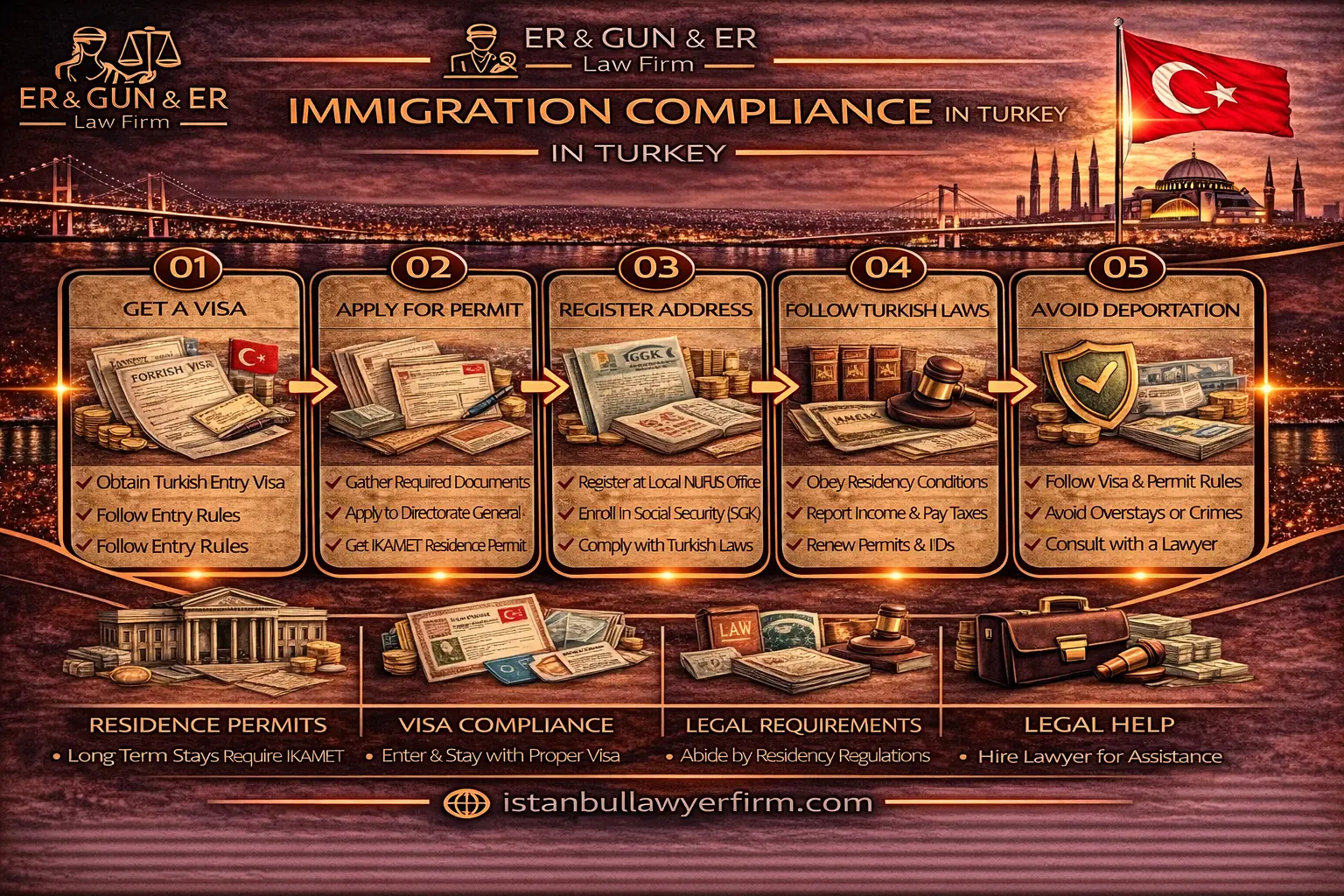
A lawyer in Turkey who advises on immigration law understands that immigration compliance is the operational discipline of keeping a person's presence and work activities aligned with Turkish migration and labor rules—and that the cost of a well-managed compliance program is consistently and substantially lower than the cost of managing enforcement consequences, permit refusals, entry ban proceedings, and administrative penalties that arise when compliance is treated as an occasional event rather than a continuous controlled process. An Istanbul Law Firm that advises on immigration compliance for individuals and employers provides the integrated framework covering every dimension of this regulatory discipline: selecting the correct status category and verifying that real activities match the declared purpose of stay; managing the evidence trail that supports each status through renewal periods and status transitions; fulfilling address registration, health insurance, and other ongoing permit conditions; tracking renewal deadlines before validity lapses create enforcement risk; managing employer sponsorship duties and the ongoing obligations that continue after a work permit is issued; maintaining audit-ready documentation that allows rapid, consistent responses to authority inspections; managing contractor classification and third-party immigration risk; planning travel and re-entry safely during permit renewals and enforcement periods; and responding to disputes and permit refusals through structured, evidence-led processes. A Turkish Law Firm that advises on immigration compliance for corporate clients understands that employer immigration compliance Turkey is not limited to filing applications—it encompasses onboarding controls, change management rules, HR and payroll consistency, and governance that prevents scope drift between a worker's documented role and actual activities. An English speaking lawyer in Turkey who advises on immigration compliance provides the bilingual guidance that enables foreign nationals and multinational employers to understand and fulfill their obligations without the language barrier creating additional compliance risk. Practice may vary by authority and year — verify current Turkish immigration law requirements, current portal procedures, current document acceptance standards, and current appointment scheduling arrangements with qualified counsel before finalizing any compliance approach, since the Directorate General of Migration Management and labor authority practice can change in ways that affect the specific requirements applicable to each status category, and since provincial office practice can differ from central guidance in ways that require locally-informed advice rather than reliance on national-level descriptions. Practice may vary by authority and year.
Immigration Compliance Framework, Status Categories and Core Legal Obligations
A lawyer in Turkey who advises on immigration compliance explains that compliance begins with correctly categorizing the person's legal status—because each category carries different ongoing obligations, different evidence requirements, and different consequences for non-compliance, and a compliance file built around the wrong category is vulnerable during authority review even when every document in the file is genuine. An Istanbul Law Firm that advises on status category analysis helps individuals and employers understand the specific categories most relevant to each situation: short-term residence permits for property owners, touristic purposes, and certain other declared purposes; long-term residence permits for individuals who have maintained lawful continuous presence for the required period; family residence permits tied to the sponsor's status; student permits tied to active university enrollment; humanitarian residence permits covering specific discretionary circumstances; and work permits issued under the International Labor Force Law Turkey compliance framework, which provide both work authorization and a stay basis for the permit holder. Turkish lawyers advising on status selection help individuals understand the critical distinction between a permit that authorizes presence only and a permit that additionally authorizes economic activity—because activities that generate income or provide services to Turkish entities require work authorization even when a valid residence permit is held, and because the consequences of acting outside a permit's authorized scope range from refusal of the next renewal application to enforcement measures whose severity depends on how the activity was characterized in official records. Practice may vary by authority and year.
An Istanbul Law Firm that advises on the Law on Foreigners and International Protection Turkey compliance framework explains that the core legal obligations for each permit holder—regardless of category—follow from the permit's issued terms, the administrative instructions implementing the Law, and the general principle that the declared purpose of stay must match the actual activities conducted. Turkish lawyers advising on ongoing compliance obligations help permit holders understand the specific requirements whose non-fulfillment most commonly triggers refusals and enforcement: maintaining continuous health insurance coverage at the required level; keeping address registration current with the relevant Provincial Directorate whenever the registered address changes; updating the permit file when the passport is renewed with a new document number; reporting material changes in circumstances—such as a change in employment, a change in family status, or a change in the financial basis supporting the permit—within the applicable reporting window; and complying with the re-entry requirements applicable to the specific permit type during travel abroad. An English speaking lawyer in Turkey who monitors ongoing compliance obligations for foreign national clients provides the systematic reminder and verification service that prevents the gradual drift from compliant status that commonly occurs when obligations are assumed to be the same as at the last renewal without verifying current requirements. Practice may vary by authority and year.
A Turkish Law Firm that advises on the corporate perspective on immigration compliance explains that for employers, immigration compliance is most effectively managed as a controlled workflow with designated owners, documented approvals, and defined escalation paths for exceptions—rather than as an informal HR favor that depends on individual memory, and that the gap between the two approaches becomes visible precisely when an inspection or a renewal refusal requires the company to demonstrate that it operates controls rather than reacting to individual circumstances. An English speaking lawyer in Turkey who advises on corporate immigration policy Turkey helps employers implement the specific governance structure most effective for each organization: a written immigration policy that defines who may authorize work for foreign nationals, what verification must be completed before any foreign national begins tasks, how role changes and location changes are managed for foreign workers, and how communications with migration and labor authorities are centralized and logged; an intake control that prevents any foreign national from beginning employment until the lawful basis is documented and archived; a tracking system that monitors permit validity dates, passport expiry dates, insurance continuity, and address registration currency for every foreign national in the workforce; and a periodic internal audit that tests whether the compliance documentation matches the worker's actual role and location. Practice may vary by authority and year.
Residence Permit Compliance, Insurance and Renewal Tracking
A lawyer in Turkey who advises on residence permit compliance explains that maintaining a valid residence permit requires managing not only the application and approval process but the ongoing conditions that the permit imposes throughout its validity period—because officers conducting renewal reviews assess the applicant's compliance record during the prior period, and a permit that was lawfully obtained but whose conditions were not maintained creates refusal risk at renewal. An Istanbul Law Firm that advises on residence permit compliance Turkey helps permit holders implement the specific ongoing compliance approach most effective for each permit type: archiving the approval documentation, the permit card, and all submission receipts in a secure controlled folder that can be produced immediately if needed; tracking the permit validity end date and the passport validity end date as separate but linked compliance events whose proximity creates specific renewal planning challenges; verifying that the address registered with the Provincial Directorate matches the address used in all submissions and supporting documents; and confirming that the real purpose of activities during the validity period remains consistent with the permit's declared purpose—because a change in activity that the permit does not cover creates a compliance gap. Turkish lawyers advising on residence permit compliance help permit holders understand that consistency across identity tokens—name spellings, date of birth, passport number—across all documents in the file is one of the most practically significant compliance requirements, because token inconsistency is a common trigger for additional scrutiny that delays straightforward renewals. Practice may vary by authority and year.
An Istanbul Law Firm that advises on health insurance residence permit Turkey compliance explains that health insurance is a recurring permit condition whose management requires ongoing attention rather than one-time policy purchase—because the insurance must remain continuous and adequate throughout the permit period and must be documented in a way that officers can verify quickly. Turkish lawyers advising on insurance compliance help permit holders implement the specific insurance management approach most effective for each situation: keeping the full policy text, not only a summary page, together with payment evidence and any endorsements or renewals in the same archive as the permit file; ensuring that the insured party's name and identity tokens match the passport spelling used in the permit application exactly; tracking insurance validity end dates separately from permit validity end dates since they often differ; replacing or renewing coverage before gaps occur rather than after, since a gap in the insurance record can require explanation and supporting evidence during renewal review; and for employers providing insurance to foreign staff, ensuring that enrollment confirmations use the employee's passport spelling rather than an anglicized or shortened version. An English speaking lawyer in Turkey who coordinates insurance compliance for foreign national clients provides the quality-control review that confirms the insurance archive satisfies current Directorate of Migration Management compliance standards before the renewal filing is assembled—preventing the common situation where an officer requests insurance documentation that the applicant believes they have but cannot locate quickly because it was not organized alongside the permit file. Practice may vary by authority and year.
A Turkish Law Firm that advises on renewal tracking for residence permits explains that renewal failures are most commonly caused by weak tracking discipline rather than by substantive ineligibility—and that a systematic renewal tracking program whose implementation requires modest ongoing effort prevents the significant disruption and expense of managing an expired permit situation. An English speaking lawyer in Turkey who designs renewal tracking residence permit Turkey systems for individual clients and corporate HR teams implements the specific tracking approach most effective for each situation: recording permit validity end dates, passport expiry dates, insurance validity end dates, and supporting document expiry dates in a single place with assigned ownership; setting renewal preparation reminders that begin sufficiently in advance to allow for appointment scheduling, document collection, translation, and notarization without pressure; recording the location of original documents and translation versions so the renewal file can be assembled without searching; triggering a file review whenever a material change occurs—new address, new passport, change in civil status, change in financial basis—rather than waiting until renewal season to reconcile the accumulated changes; and logging all submissions, receipts, and official responses with dates so the next renewal starts from a complete historical record. Practice may vary by authority and year.
Work Permit Compliance and Employer Sponsorship Obligations
A lawyer in Turkey who advises on work permit compliance explains that a work permit is a scope document rather than a general authorization—and that both the employer and the worker are obligated to ensure that the activities actually performed match the role description and employer details recorded in the work permit throughout the permit's validity period. An Istanbul Law Firm that advises on work permit compliance Turkey helps employers and workers implement the specific compliance approach most effective for each work arrangement: ensuring that the worker's actual job title, duties, primary worksite, and reporting line match what was described in the work permit application and that any material change is evaluated for whether an update or new authorization is required before the change occurs; maintaining payroll, attendance, and social security records that are consistent with the permit details so these parallel systems do not contradict the immigration file during inspections; documenting the start of authorized work and the internal approval of work assignment because retroactive corrections are difficult to make credible; and coordinating the work permit file with the residence status file so that stay authorization and work authorization remain synchronized and do not contradict each other. Turkish lawyers advising on work permit compliance help employers understand that scope drift—where operational managers assign work outside the permit's described role without a documented compliance review—is one of the most common sources of inspection findings. Practice may vary by authority and year.
An Istanbul Law Firm that advises on employer immigration compliance Turkey explains that employer sponsorship is the act of linking a foreign worker's legal authorization to a specific employer record—and that the sponsoring employer's obligations begin with verifying the role is genuine and documented and continue throughout the employment period. Turkish lawyers advising on employer sponsorship duties help companies implement the specific sponsorship compliance approach most effective for each hiring situation: verifying that the company's own registration details—name, address, trade registry number, and authorized signatory—are current and consistent across all sponsorship documents before any application is submitted; maintaining an HR intake control that prevents any sponsored foreign worker from beginning tasks until the authorization is documented and archived; keeping a role change approval process that requires compliance sign-off before any change in title, department, worksite, or reporting line for a foreign worker takes effect; and managing termination as a compliance event by documenting the end of employment promptly and assessing whether any immigration file update is required. An English speaking lawyer in Turkey who provides employer immigration compliance advisory for companies with foreign workforces ensures that HR, payroll, and immigration records are consistent across systems—preventing the common situation where payroll shows one employment structure and the immigration file describes a different one. Practice may vary by authority and year.
A Turkish Law Firm that advises on International Labor Force Law Turkey compliance explains that the work permit framework imposes specific obligations on employers throughout the permit period—including maintaining records of the sponsored worker's actual employment, avoiding assignments outside the authorized scope, and complying with any applicable labor law obligations whose consistency with the immigration file affects the employer's overall compliance posture during Ministry inspections. An English speaking lawyer in Turkey who advises on work permit compliance for international employers helps companies understand the specific interaction between Turkish labor law and immigration compliance—including how payroll documentation, employment contracts, and social security records must align with permit details to prevent the situation where one system's records are used to challenge the credibility of another, and providing the integrated advisory that ensures the HR team and the immigration file are updated simultaneously when changes occur rather than sequentially after a discrepancy has already been created. Practice may vary by authority and year.
Address Registration, Insurance Compliance and Documentation Standards
A lawyer in Turkey who advises on address registration compliance explains that address registration is a foundational immigration compliance obligation because the Directorate of Migration Management links each permit holder to a province and a local directorate through the registered address—and because inconsistencies between the declared address and the address appearing in other systems are one of the most common triggers for additional authority scrutiny during renewal review. An Istanbul Law Firm that advises on address registration foreigners Turkey compliance helps permit holders implement the specific address management approach most effective for each housing situation: keeping a current set of address documentation—lease, title deed of the hosting party, or a formal accommodation statement—that can be verified by authorities and that uses the same identity tokens as the permit file; treating every address change as a compliance event that triggers prompt action rather than a personal matter outside the immigration file; maintaining a dated address change log that records when moves occurred and what documentation was used so that address differences across systems can be explained as timing rather than concealment; and ensuring that the address used in permit submissions, in employer letters, and in insurance policies is consistently the same location. Turkish lawyers advising on address compliance help both individual applicants and corporate HR teams understand that using a corporate office address or a convenience address that does not reflect the actual residence location creates a consistency problem that can expand a routine renewal into a credibility investigation. Practice may vary by authority and year.
An Istanbul Law Firm that advises on documentation standards for immigration compliance explains that the quality and organization of the evidence file is as important as the substantive eligibility of the applicant—because authorities make decisions from the documents they can read and verify, and a disorganized or internally inconsistent file creates doubt even when the underlying facts support approval. Turkish lawyers advising on documentation compliance help individuals and employers implement the specific documentation discipline most effective for each compliance context: using a single token sheet that records the exact passport spelling of the applicant's name and applies one consistent date format across every document so identity tokens do not drift across different submissions; keeping source documents, sworn translations, and notarization pages together as complete exhibit bundles rather than in separate folders; recording when each document was produced and by which translator or notary so the chain of custody is visible; maintaining version control so outdated templates with old addresses or old corporate names are not accidentally reused in new submissions; and keeping a submission log that records what was filed, when it was filed, and the reference number or receipt that confirms receipt. An English speaking lawyer in Turkey who manages documentation compliance for foreign national clients provides the quality-control function that tests the file for token consistency, completeness, and internal coherence before it is submitted to the authority—identifying and correcting token drift, missing exhibit pages, and mismatched dates at the preparation stage rather than discovering them after a submission has created an adverse record. Practice may vary by authority and year.
A Turkish Law Firm that advises on document retention for immigration compliance explains that retention must balance audit readiness with privacy and data security—because immigration files contain highly sensitive identity information whose unauthorized disclosure creates both regulatory and reputational risk. An English speaking lawyer in Turkey who advises on document governance for corporate immigration programs helps employers implement the specific retention approach most appropriate for each organization: defining access controls that limit file access to staff who need the information for compliance tasks; maintaining submission receipts and official responses for the period needed to support potential audits or appeal proceedings; archiving superseded document versions as superseded rather than deleting them, since silent deletion can later appear like concealment if a dispute arises; and defining incident response procedures for lost permits, renewed passports, and unexpected authority notices so the first response preserves rather than disrupts the evidence trail. Practice may vary by authority and year.
Employer Audit Readiness, Inspections and Corporate Policy Framework
A lawyer in Turkey who advises on employer audit readiness explains that immigration inspections test the coherence of the employer's file against the reality of workplace operations—comparing immigration records with HR records, payroll data, and the worker's actual duties and location—and that the employer whose systems tell consistent stories across these parallel records typically resolves inspections more quickly and with less disruption than the employer whose systems contain unexplained inconsistencies. An Istanbul Law Firm that advises on inspection preparation for employers implements the specific readiness approach most effective for each corporate situation: maintaining a standardized file structure for every foreign worker with consistent exhibit tabs and naming conventions so any file can be navigated quickly during an inspection; keeping a current snapshot of each worker's authorization, role description, and worksite assignment signed and dated internally; maintaining a submission receipt and official response log in chronological order so inspectors can see when each compliance step was taken; designating a single inspection coordinator who can produce the file index within minutes and who is backed by a named deputy; and conducting periodic internal file audits using an immigration audit checklist Turkey that is tailored to the company's actual statuses and business models rather than using a generic template. Turkish lawyers advising on inspection readiness help employers understand that inspectors test systems as well as documents—and that a company that can demonstrate controlled onboarding, change management, and notification processes handles inspections more credibly than a company that produces good documents for each individual but cannot show systematic controls. Practice may vary by authority and year.
An Istanbul Law Firm that advises on corporate immigration policy frameworks explains that a policy is the foundation of a sustainable compliance program—because policies with written controls, templates, and training produce repeatable compliance behavior that does not depend on individual memory. Turkish lawyers advising on corporate immigration policy Turkey help employers design the specific policy structure most effective for each organization: a clear statement of which statuses the company will support and which arrangements—such as starting work while authorization is pending—are prohibited; onboarding gates that require documented authorization before any foreign national begins tasks; a change management rule that requires compliance sign-off before any role, worksite, or title change for a foreign worker; a communications rule that centralizes authority interactions through designated staff; a training program for managers covering what questions to ask before approving work assignments for foreign nationals; and a periodic internal review process that tests compliance through file sampling. An English speaking lawyer in Turkey who implements corporate immigration policy programs helps multinational employers ensure that policy language, template documents, and training materials are consistent and understandable across international management teams. Practice may vary by authority and year.
A Turkish Law Firm that advises on remediating inspection findings explains that when an inspection identifies compliance gaps, the employer's response should be structured as a project with document-backed corrective actions rather than as an argument about intent or industry practice. An English speaking lawyer in Turkey who advises on inspection response for employers helps companies implement the specific remediation approach most effective for each finding type: obtaining the written record of the finding with its date and stated basis; identifying precisely which document or process produced the gap; preparing the corrective action with transparent chronology—including when the gap was discovered, what was done, and by when—rather than silently replacing documents in a way that makes it look like no gap ever existed; running a follow-up internal audit to confirm the correction is implemented and that the same gap will not recur in other files; and communicating the outcome to management through a concise remediation report that records lessons learned for future hiring cycles. Practice may vary by authority and year.
Contractor Management, Third Parties and Employment Classification
A lawyer in Turkey who advises on contractor immigration compliance explains that contractor arrangements create specific compliance exposure because work authorization in Turkey is assessed against the reality of who controls the work—and a relationship that is labeled as independent contracting but operates with the practical characteristics of employment may trigger authorization requirements aligned with the actual arrangement rather than the contractual label. An Istanbul Law Firm that advises on contractor classification for immigration purposes helps employers implement the specific classification approach most effective for each arrangement: documenting the service scope, deliverables, supervision model, and work location at the beginning of each contractor relationship in a classification memo kept with the mobility file; assessing whether the contractor has independent authorization to perform the work in Turkey rather than assuming that the contractor's own employment relationship elsewhere satisfies Turkish requirements; requiring proof of the contractor's authorization before any on-site work or system access begins; and reviewing the relationship when operational arrangements change—such as the contractor being given regular desk space, system access, or line management—since changes in operational control can alter the classification analysis. Turkish lawyers advising on contractor compliance help employers understand that procurement, project management, and HR teams all touch contractor arrangements in ways that create or eliminate compliance risk—and that a single policy applied consistently across these teams is more reliable than ad hoc case-by-case decisions. Practice may vary by authority and year.
An Istanbul Law Firm that advises on third-party staffing and outsourcing arrangements explains that where a staffing vendor or outsourcing partner deploys workers at the employer's site, the client company may face compliance questions that would normally be directed to the employer—and that defining the respective compliance responsibilities in the commercial contract protects the client from being exposed by the vendor's gaps. Turkish lawyers advising on third-party immigration compliance help clients implement the specific contractual and operational approach most effective for each outsourcing model: requiring the vendor to provide proof of each worker's authorization before site access; maintaining a site roster that records the names and authorization basis of all workers and is updated with start and end dates; defining in the contract which party will respond to authority inquiries about worker status and what documentation each party will maintain; and implementing a vendor audit right so the client can verify authorization records without relying solely on verbal assurances. An English speaking lawyer in Turkey who advises on third-party immigration compliance for multinational employers helps coordinate the vendor documentation requirements with internal immigration policy so that the same token sheet, the same file structure, and the same evidence standards apply across the employer's direct hires and its contractor workforce. Practice may vary by authority and year.
A Turkish Law Firm that advises on relocation agency and payroll processor management explains that these service providers often prepare forms, upload portal submissions, and handle translations—but that the legal responsibility for compliance accuracy remains with the applicant and, in work cases, the employer—making the quality controls applied to provider outputs as important as the controls applied to internally prepared documents. An English speaking lawyer in Turkey who advises on provider governance for immigration compliance helps employers implement the specific oversight approach most effective for each provider relationship: requiring providers to use the company's token sheet so that all submissions across different handlers use consistent name spellings and date formats; defining in writing which tasks are delegated and which require internal legal approval before submission; maintaining a vendor log that records what was submitted, when it was submitted, and under whose authorization; and conducting periodic provider audits that sample completed files to verify that required receipts and confirmations were collected and archived. Practice may vary by authority and year.
Travel Risk Management, Overstay Prevention and Entry Ban Response
A lawyer in Turkey who advises on travel risk management explains that border interactions are compliance events—because border officers can see the history of entries, exits, and permit records in real time, and because a traveler whose physical documents, declarations, and system records are inconsistent can face questions even when their underlying legal status is valid. An Istanbul Law Firm that advises on travel compliance for foreign nationals helps individuals and employers implement the specific travel risk management approach most effective for each travel situation: confirming the current permit basis and validity period before every trip and keeping submission receipts for any pending renewal accessible in both printed and digital form; verifying passport validity well in advance since an expiring passport can simultaneously block renewal preparation and create travel complications; establishing a corporate travel approval process that requires HR confirmation of current immigration status before any foreign employee travels internationally; and training travelers to carry a controlled document pack—permit card or its equivalent, passport, and a letter confirming current employment and work location—that answers the questions most commonly posed at Turkish border controls. Turkish lawyers advising on travel risk help employers and individuals understand that statements made at border interactions can conflict with HR records and permit files if travelers are not prepared—and that an inconsistent border statement creates a documentation problem that is harder to correct than a missing document, since official border interaction records persist in systems that are later accessed during renewal reviews and appeal proceedings. Practice may vary by authority and year.
An Istanbul Law Firm that advises on overstay prevention explains that overstay risk arises when the gap between when a person should have acted—applying for renewal, departing, or changing status—and when they actually acted is not documented and managed as a compliance incident. Turkish lawyers advising on visa overstay penalties Turkey compliance help individuals and employers implement the specific prevention approach most effective for each risk scenario: treating the permit validity end date as a hard planning deadline rather than a soft guideline; understanding the difference between an application submission that may affect enforcement while pending and a submission that does not, since this distinction significantly affects how stay continuation is assessed; preserving every filing receipt because receipts are the primary evidence of a person's attempt to maintain lawful status; and if a potential overstay is discovered, building a complete chronology of lawful entries, filings, and status documents before seeking advice rather than acting based on assumptions. An English speaking lawyer in Turkey who advises on overstay situations for foreign nationals provides the specific analysis most useful for each individual situation—grounded in the person's actual entry history and document record rather than in general consequences that may or may not apply to the specific facts. Practice may vary by authority and year.
A Turkish Law Firm that advises on entry ban risk management Turkey explains that entry bans typically become apparent only when a person attempts re-entry—and that the combination of urgency and unfamiliar procedures at this stage makes prior preparation significantly more effective than crisis response. An English speaking lawyer in Turkey who advises on entry ban risk management helps individuals and employers implement the proactive approach most effective for each risk profile: tracking overstay history and prior border incidents in the compliance file so potential ban triggers are identified before a problem materializes; treating any written border notice or reference number as a compliance artifact to be preserved immediately; avoiding repeated unplanned border attempts that generate new adverse records without a documented strategy; and where an entry restriction is believed to be recorded, obtaining the written basis before taking any further action. Practice may vary by authority and year — verify current Turkish immigration enforcement procedures and available remedies for each decision type with qualified counsel before taking any action based on a border incident.
Disputes, Refusals, Appeals and Compliance Remediation
A lawyer in Turkey who advises on immigration dispute response explains that even well-managed compliance programs produce decisions that are refused, canceled, or questioned—and that the response must be procedural and document-led rather than emotional, because the quality of the evidence file and the consistency of communications across submissions determine whether a dispute can be effectively resolved. An Istanbul Law Firm that advises on immigration dispute management implements the specific response approach most effective for each decision type: securing the written decision notice and preserving the date and method of notification immediately as the first evidence step; building a dossier that starts with an index and a chronology addressing the authority's stated reasons with document references; ensuring that all communications—administrative objections, court submissions, and authority inquiries—are consistent with each other and with prior filings because inconsistent explanations weaken credibility even when the underlying facts are strong; and coordinating all stakeholders who might communicate with authorities so that one authorized voice produces one coherent narrative. Turkish lawyers advising on immigration dispute response help employers and individuals understand that a dispute managed through a structured dossier protects both the immediate appeal and the credibility of future filings—whereas a dispute managed through fragmented communications across multiple parties can damage a credible underlying record. Practice may vary by authority and year.
An Istanbul Law Firm that advises on immigration appeals explains that the immigration appeal process Turkey should be approached as a structured submission to the appropriate forum—administrative objection to the issuing authority, administrative court litigation, or both in sequence depending on the decision type—and that the specific procedural requirements and deadlines applicable to each decision type must be confirmed before any response is filed. Turkish lawyers advising on appeal procedures help individuals and employers understand the specific appeal approach most appropriate for each situation: identifying whether the decision was a residence permit refusal, a work permit refusal, an entry ban notation, a deportation measure, or another category—because each category has its own remedy route and deadline; building the appeal dossier around the decision's stated reasons with exhibit-backed arguments that address each reason specifically; and maintaining one approved narrative memo across all parallel submissions so the administrative objection, the court petition, and any interim stay request all tell the same story. An English speaking lawyer in Turkey who manages immigration appeal proceedings for foreign nationals provides the bilingual case management that ensures the Turkish-language submissions accurately reflect the client's instructions and maintain consistency with all prior filings. Practice may vary by authority and year.
A Turkish Law Firm that advises on post-dispute compliance remediation explains that after a dispute is resolved, the compliance program should be updated to address the root cause of the dispute—because disputes that originate from documentation gaps, token inconsistencies, or process failures will recur in future applications if the underlying process is not corrected, and because the remediation history is itself a compliance asset that demonstrates to future reviewers that the organization identifies and addresses problems systematically. An English speaking lawyer in Turkey who advises on post-dispute remediation helps individuals and employers implement the specific learning and prevention approach most effective for each dispute type: identifying whether the dispute originated from a notification failure, a translation inconsistency, an address mismatch, or a scope drift problem; designing a specific process control that prevents that failure type from recurrence; training staff on the corrected process; updating templates and checklists to reflect the corrected approach; and recording the remediation in the compliance log so future reviews can see the complete history. A lawyer in Turkey for immigration compliance matters combines knowledge of the Law on Foreigners and International Protection, Turkish Administrative Procedure Law, labor law work permit requirements, address registration obligations, insurance compliance standards, inspection response procedures, and administrative court appeal practice with the English-language communication that enables foreign nationals and multinational employers to build and maintain an immigration compliance program whose reliability does not depend on individual memory or informal practice. Practice may vary by authority and year.
Frequently Asked Questions
- What is immigration compliance in Turkey and why does it matter? Immigration compliance is the discipline of keeping a foreign national's presence and activities aligned with Turkish migration and labor rules throughout the period of stay. It covers status selection, permit condition maintenance, renewal readiness, address and insurance currency, and documentation consistency. For employers, it additionally covers onboarding controls, scope management, and audit readiness. Non-compliance creates enforcement risk, refusal risk, and disruption to employment and travel. Practice may vary by authority and year.
- What are the main ongoing obligations for Turkish residence permit holders? Ongoing obligations typically include maintaining continuous health insurance coverage, keeping address registration current with the Provincial Directorate when address changes, ensuring passport validity does not expire while a permit is held, and verifying that actual activities remain consistent with the permit's declared purpose. Material changes in circumstances should be reported through the applicable channels. Renewal preparation should begin well before the permit expiry date. Practice may vary by authority and year.
- What does work permit compliance require from Turkish employers? Employers must ensure that the sponsored worker's actual role, worksite, and duties match the work permit description; that payroll, HR, and immigration records are consistent; that no work begins before authorization is documented and archived; that material changes in role or employment are evaluated for authorization implications before they occur; and that termination is documented promptly. The employer should maintain a standardized file for each foreign worker accessible during inspections. Practice may vary by authority and year.
- How should health insurance be managed for residence permit compliance? The insurance policy must remain continuous throughout the permit period. The insured person's name and identity tokens on the policy must match the passport spelling used in the permit file. Payment evidence and endorsements should be archived with the policy text. Coverage gaps—even short ones—can complicate renewal reviews. If coverage changes, document the transition clearly and preserve both versions. Practice may vary by authority and year.
- What address documentation is required for Turkish immigration compliance? The address registered with the Migration Management Directorate should match the address used in all submission documents and supporting evidence. Address changes should be treated as compliance events, documented with official proof, and updated promptly. A dated address change log prevents inconsistencies from appearing as concealment. Corporate housing arrangements should use documentation formats that officers can verify. Practice may vary by authority and year.
- How should employers prepare for immigration inspections in Turkey? Employers should maintain standardized file structures for each foreign worker with consistent exhibit organization; keep a current snapshot of authorization, role description, and worksite assignment; designate an inspection coordinator who can produce a file index within minutes; conduct periodic internal file audits using a tailored checklist; and train managers to avoid assigning unauthorized tasks. An inspection is most manageable when documents and operational reality tell the same story. Practice may vary by authority and year.
- What are the immigration compliance risks of using independent contractors? If a contractor relationship operates with employment characteristics—such as day-to-day direction, regular on-site presence, or systems access—authorities may assess the arrangement against the work authorization requirements applicable to employment rather than to independent services. Employers should document the classification with a memo covering scope, supervision, and deliverables. Require proof of the contractor's authorization before work begins. Practice may vary by authority and year.
- What should an employer do when a work permit holder changes role or worksite? The change should trigger a compliance review before it occurs—assessing whether the change is within the permit's authorized scope or requires an update or new authorization. The change should be documented with a role change approval form signed by the compliance owner. Payroll, HR, and immigration records should be updated consistently. An undocumented scope change is one of the most common inspection findings. Practice may vary by authority and year.
- How can foreign nationals avoid overstay risk in Turkey? Track the lawful stay basis and its expiry date as a hard planning deadline. Begin renewal preparation well in advance of the expiry date. Preserve every filing receipt as proof of compliance intent. Understand whether a pending application maintains lawful stay during processing—this varies by permit type and should be verified with current guidance. If a potential overstay is discovered, build a chronology of entries and filings before taking action. Practice may vary by authority and year.
- What should be done if an entry ban or deportation risk is identified? Obtain the written decision or notice and preserve it with the date of notification as the first evidence step. Avoid repeated unplanned border attempts that generate additional adverse records. Build a complete factual chronology of entries, exits, filings, and status documents. Seek structured legal advice grounded in the specific facts rather than acting on general assumptions about consequences. Practice may vary by authority and year.
- What documentation should be retained for immigration compliance in Turkey? Retain permit approvals, submission receipts, official responses, insurance policies with payment evidence, address proofs with dates, role descriptions and employment contracts, and any translation and notarization bundles. Use a submission log with dates and reference numbers. Apply version control so outdated templates are not reused. Archive superseded documents rather than deleting them. Practice may vary by authority and year.
- How should immigration disputes and permit refusals be managed? Secure the written decision notice and its notification record immediately. Build a dossier with an index and chronology addressing the stated reasons with document-backed arguments. Confirm the applicable appeal route and deadline before filing. Keep all parallel communications consistent with one authorized narrative. Treat the dispute file as a document case rather than a credibility argument. Practice may vary by authority and year.
- What should a corporate immigration policy include? The policy should define who may authorize foreign worker engagements, what pre-onboarding verification is required, how role and location changes are managed, who communicates with authorities, how documents are archived and retained, and what the escalation path is for exceptions. It should be connected to templates, training, and periodic internal testing. Privacy controls should address how passport and identity data is handled. Practice may vary by authority and year.
- How should companies manage third-party vendors who deploy foreign workers on site? Require authorization proof before site access, maintain a roster with start and end dates, define compliance responsibilities in the contract, implement a vendor audit right, and coordinate token sheets and file structure standards with the vendor. Site managers should escalate authorization mismatches rather than resolving them informally. The client company may face inspection questions about workers present on its site regardless of the employment structure. Practice may vary by authority and year.
- Does ER&GUN&ER Law Firm provide legal services for immigration compliance in Turkey? Yes. ER&GUN&ER Law Firm provides comprehensive immigration compliance services for individuals and employers including status category analysis, residence permit compliance advisory, work permit compliance and employer sponsorship guidance, address and insurance compliance review, documentation and token consistency checks, renewal tracking system design, inspection preparation and file audit, contractor classification advisory, third-party vendor compliance coordination, travel risk assessment, overstay and entry ban response management, dispute dossier preparation, administrative objection and court appeal management, and corporate immigration policy design—with English-language client communication and bilingual documentation throughout each engagement.
Author: Mirkan Topcu is an attorney registered with the Istanbul Bar Association (Istanbul 1st Bar), Bar Registration No: 67874. His practice focuses on cross-border and high-stakes matters where evidence discipline, procedural accuracy, and risk control are decisive.
He advises individuals and companies across Immigration and Residency, Real Estate Law, Tax Law, and cross-border documentation matters where procedural accuracy and evidence discipline are decisive.
Education: Istanbul University Faculty of Law (2018); Galatasaray University, LL.M. (2022). LinkedIn: Profile. Istanbul Bar Association: Official website.