

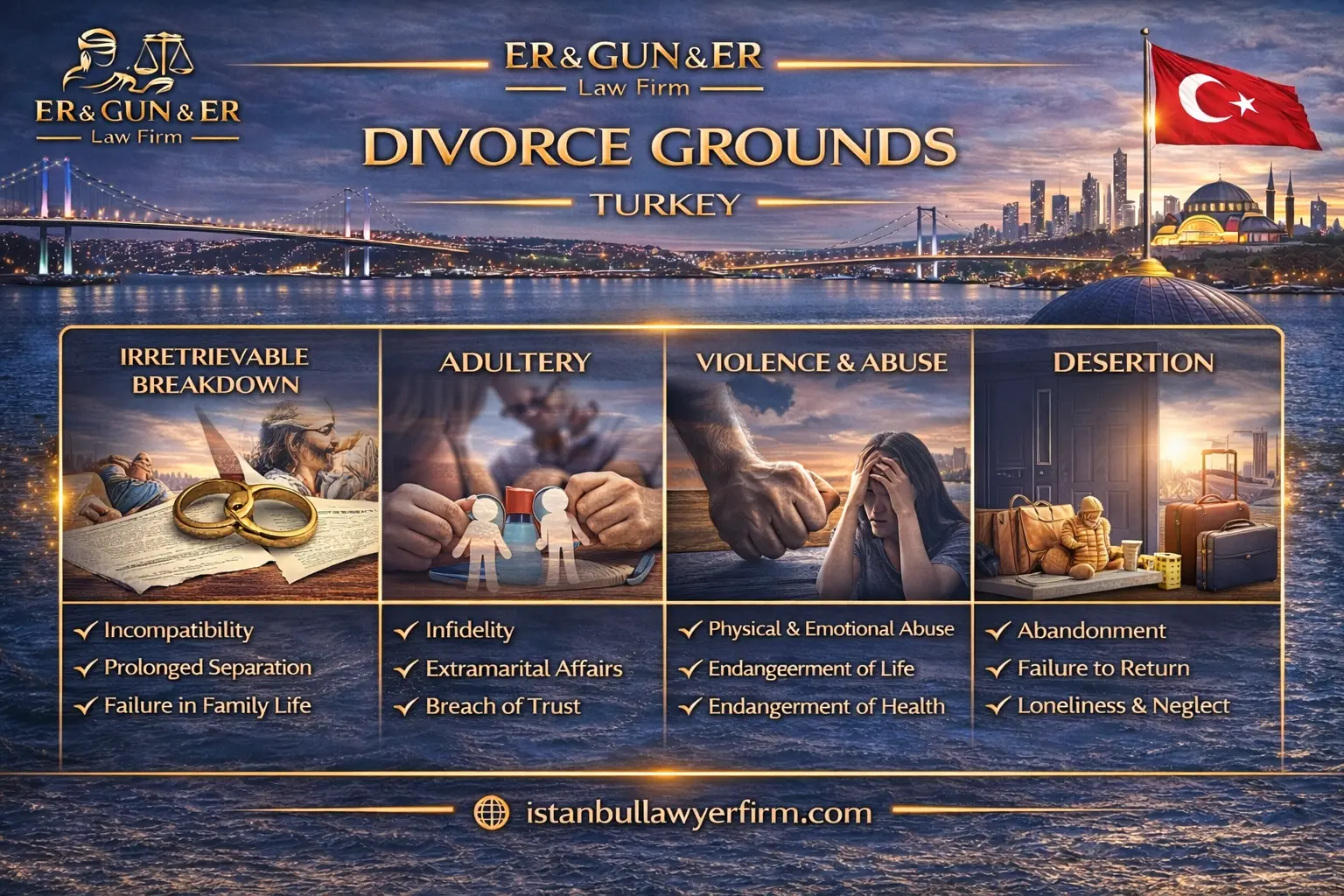
In Turkish family litigation, grounds means the legally recognized reasons the court can accept for ending a marriage. When clients search divorce grounds Turkey, they are usually asking what must be proven and what may be ordered while the case is pending. A divorce file succeeds or fails on evidence discipline, because allegations without admissible proof rarely move the court. Fault can matter for remedies, credibility, and financial consequences, so the narrative must be precise and consistent. The procedural route can be uncontested with a protocol or contested with a full evidentiary hearing, and the choice should be made early. From the first consultation with a Turkish Law Firm, the goal should be to map facts, identify lawful evidence, and control risk.
Divorce grounds overview
A divorce petition must connect concrete facts to a recognized ground under Turkish law. Courts examine the marriage history, the alleged events, and the parties’ conduct. In contested divorce Turkey, the claimant must present a coherent story that can be proved. The defence will usually challenge the chronology, the credibility, and the causation. Judges are wary of exaggerated claims, especially when the evidence is thin. A careful lawyer in Turkey will separate what is known from what is assumed. This discipline matters because one weak allegation can undermine stronger points. The court will also consider whether reconciliation attempts existed and what broke down. Witnesses, documents, and electronic records often define the outcome. However, the method of obtaining evidence can affect whether it is used. The petition should avoid inflammatory language and focus on verifiable events. Where the parties share children, the court’s immediate concern is stability. That concern influences temporary measures, interim contact, and household arrangements. Even when the ground is clear, procedure still controls pace and scope. The best practice is to prepare for proof from the first filing.
Turkish divorce law recognises both special grounds and the general breakdown ground, and the pleading choice shapes proof. In fault based divorce Turkey, parties often focus on misconduct and responsibility. Fault can influence the court’s evaluation of credibility and the fairness of certain requests. Yet the court still needs a causal link between the behaviour and the collapse of marital life. A file built only on moral judgments, without facts, tends to be fragile. It is often smarter to plead facts that can be corroborated than to plead labels. Procedure matters because evidence must be proposed and collected under the rules of the Code of Civil Procedure. If evidence is not properly requested, it may never enter the case file. Parties should also understand the broader context of family disputes explained in our family law overview. The court usually expects clear identification of witnesses and documents. Vague references to many messages or many incidents are rarely persuasive. Forensic discipline is also important for digital material, because authenticity is contested. If you plan to seek interim measures, you should align the requests with the pleaded facts. This alignment reduces procedural objections and keeps the hearing focused. A well-structured petition is often the first credibility test in court.
Many divorce files involve a foreign spouse, bilingual communication, or cross-border documentation. In those files, misunderstandings about terminology and proof are common. A court will not accept a narrative just because it sounds plausible in another system. Foreign marriage certificates, residence records, and financial documents must be presented in a usable format. Translation quality can affect meaning, especially for messages and medical reports. An English speaking lawyer in Turkey should still insist on original records and proper verification. If a party relies on foreign documents, the chain of authenticity should be checked early. The same is true for social media posts, which can be altered or taken out of context. Parties should avoid self-help tactics that create privacy or criminal exposure. When communications are sensitive, lawful preservation of evidence is essential. Cross-border travel can also affect interim parenting arrangements and contact schedules. If relocation is a risk, the case strategy must address it with precise facts. The court will focus on the child’s routine, schooling, and stability, not on slogans. A disciplined approach also protects the client from unnecessary escalation. The earlier the strategy is set, the fewer surprises emerge at hearings.
General versus special grounds
Turkish law separates divorce grounds into special grounds and a general ground based on breakdown. Special grounds describe specific events, such as adultery or desertion, and they have defined legal elements. The general ground is broader and focuses on whether common life has become untenable. This framework is anchored in the Turkish Civil Code. A practical client question is whether to plead a special ground, the general ground, or both. The answer depends on proof, risk, and the relief sought. A law firm in Istanbul will usually start by testing which facts are independently provable. If a special ground is alleged without solid evidence, it can distract from stronger claims. If only the general ground is alleged, the opponent may argue that events are isolated and manageable. Some couples choose a blended approach that keeps the legal door open. The court will still evaluate the credibility of each allegation separately. A disciplined file also anticipates defences, including counterclaims and reciprocal fault. That anticipation shapes which witnesses are called and which records are requested. The aim is to keep the case focused on the decisive facts. Strategic pleading is not about drama, but about proof and proportionality.
Special grounds can offer a clearer legal narrative, but they can also narrow the debate. If the special ground fails, the claimant may need a fallback theory to avoid starting over. This is why counsel often assesses whether the same facts also support a breakdown claim. Where misconduct is central, the case can become an evidentiary contest about intent and context. Where incompatibility is central, the case becomes a broader evaluation of marital life. Courts may weigh repeated patterns more heavily than isolated incidents. They may also consider whether the parties attempted counselling or mediation. These factors are highly fact-sensitive and should be supported with records. “practice may vary by authority and year — check current guidance.” A party should also consider the litigation cost of a long evidentiary fight, without assuming a fixed duration. When children are involved, delay can itself become a risk that needs management. The court can also scrutinise whether one spouse used the process to apply pressure. That scrutiny often appears in interim requests and objections. A coherent strategy should therefore integrate grounds, proof, and interim relief. This integration reduces surprises and keeps settlement options realistic.
Clients often begin research on the official legislation portal to understand the legal vocabulary. That is useful, but courtroom success requires translating text into provable facts. A case file should be built around documents that can be authenticated and witnesses that can be tested. This is where the working style of an Istanbul Law Firm matters, because structure prevents later procedural loss. A party should keep original records, not just screenshots or summaries. If communications are relevant, preserve them in a way that maintains context and dates. If physical violence is alleged, medical documentation and contemporaneous reports are decisive. If financial issues are alleged, bank records and expense patterns may matter more than opinions. When the opponent denies everything, the court will rely on objective material. The court will also evaluate whether the claim is proportionate to the alleged events. Overstating the case can create credibility issues that the judge will remember. Understatement can also be a problem if key facts are omitted. The safest approach is a complete chronology with supporting proof for each step. This chronology should be consistent across petition, witness statements, and hearing testimony. When the file is coherent, settlement becomes a rational option rather than a gamble.
Breakdown of marriage concept
The breakdown ground focuses on whether the marriage has irretrievably lost its function. It is often described by clients as no fault divorce Turkey, but the court still analyses conduct and context. The judge asks whether continued cohabitation can reasonably be expected. This assessment is made through concrete events, not abstract feelings. Long-term separation, persistent conflict, and loss of trust can all be relevant. The court will usually look for a pattern that shows the relationship is beyond repair. If the parties continued to live together and act as a family, the claim may be questioned. If the parties separated and formed independent lives, the claim gains weight. Witness testimony can describe daily life, but it must be specific and consistent. Written records can corroborate separation, conflict, and practical disengagement. The court can also examine whether one party blocked reconciliation attempts. However, reconciliation is not presumed simply because contact continued. Economic dependence can force contact even when the relationship is over. A breakdown claim should therefore describe both emotional and practical rupture. The goal is to show a stable picture of impossibility of joint life.
The breakdown analysis is not a checklist, but a holistic evaluation of marital life. Courts pay attention to whether conflict is chronic, escalating, and resistant to change. They also observe the parties’ courtroom behaviour, including willingness to cooperate on children. A party who uses litigation to humiliate the other may weaken their own position. Evidence of therapy, counselling, or mediation can show effort and context. Evidence of repeated deception or intimidation can show why trust cannot be restored. The court may compare the parties’ narratives against objective records. This is why dates, locations, and witnesses must align across submissions. “practice may vary by authority and year — check current guidance.” Judicial assessment can differ depending on local workload and hearing style. Some judges prefer dense documentary files, while others rely heavily on witnesses. A prudent strategy prepares for both approaches without overloading the file with noise. The breakdown ground can also interact with counterclaims, because each side may plead collapse. In that scenario, the case turns on whose narrative is more coherent and supported. The safest route is to keep the file factual, restrained, and evidence-led.
When spouses have lived abroad, served in international roles, or held assets in different countries, the breakdown ground must still be proven with Turkish-usable evidence. Courts will usually want to see how the couple’s shared life operated in practice. Travel records, residence registrations, and school information can clarify the separation history. If a spouse claims abandonment, the opposing party may argue mutual separation. A careful file therefore distinguishes voluntary distance from forced distance. Foreign documents should be prepared for court use with accurate translation and authentication steps. The procedure can be explored in more detail in our expat divorce procedure guide. Even with a strong narrative, the court will test credibility at the hearing. Hearing testimony must match what is written, because inconsistency is punished. Clients should also avoid informal settlements that contradict later claims. If property division is expected, the case strategy should preserve financial records early. A best lawyer in Turkey will usually treat document preservation as a litigation priority, not an afterthought. This approach reduces the chance that crucial records disappear during conflict. It also supports settlement, because each side can see the evidentiary reality. In high-conflict cases, disciplined preparation is often the difference between clarity and chaos.
Adultery allegations approach
Allegations of adultery are among the most sensitive claims in a divorce petition. Clients often search adultery divorce Turkey expecting a simple proof rule, but the reality is evidentiary and procedural. The court will require concrete indications that point to a marital betrayal, not mere suspicion. Witnesses who only repeat rumours are rarely persuasive. Messages, photos, travel records, and admissions may be relevant if obtained lawfully. A party should avoid hacking accounts or secretly recording private communications. Unlawful collection can create criminal or data protection exposure and can undermine the divorce case. Where the claim is serious, counsel should focus on admissible records with clear provenance. The court will also examine whether the adultery allegation is used as leverage for money or custody. If the allegation is exaggerated, the claimant’s credibility can suffer across the entire file. A restrained narrative that sticks to provable points is usually stronger. If reconciliation occurred after the alleged event, the legal effect can become complex. “practice may vary by authority and year — check current guidance.” For this reason, timing and the parties’ conduct after discovery should be analysed case by case. Even when proved, adultery claims should be pleaded with professionalism and limited scope.
A well-prepared adultery file is less about moral commentary and more about evidentiary reliability. Courts generally expect the claimant to present a clear chronology of discovery and reaction. The defence will often argue that the relationship was already over or that the evidence is fabricated. This is why metadata, original devices, and context can matter. When a spouse relies on hotel bookings or travel movements, the connection to the alleged person must be shown. When a spouse relies on intimate messages, authenticity and authorship become the battleground. Experienced Turkish lawyers often warn clients that over-collection of private material can backfire. The court may view obsessive surveillance as a sign of hostility rather than proof. A focused evidentiary set is usually stronger than a chaotic archive. If witnesses are used, they should describe direct observations, not assumptions. If family members testify, the court may scrutinise potential bias. This scrutiny does not mean such testimony is useless, but it must be detailed. A party should also consider the impact of the allegation on children and extended family. Public shaming can create reputational harm that does not help the legal outcome. A controlled litigation posture keeps the judge’s attention on the legally relevant facts.
In practice, adultery allegations often appear alongside a general breakdown claim. This combination allows the court to grant divorce even if one theory is not fully proved. It also allows the claimant to frame the collapse as rooted in a decisive breach of trust. The defence may respond with counter-allegations, including provocation or reciprocal misconduct. The court will then evaluate both parties’ behaviour and the overall stability of the marriage. Where evidence is mutual, the judge may focus on whether continuation is realistic. This shift can change settlement dynamics, because both sides may prefer privacy. Negotiations should still be evidence-based, because weak bargaining positions are exposed in court. If interim measures are sought, the court will require a credible factual basis. An unproven adultery allegation is rarely enough to justify extreme interim orders. Forensic clarity is therefore essential from the first hearing. If there is a criminal complaint related to the same facts, coordination is important. “practice may vary by authority and year — check current guidance.” Parallel proceedings can affect how parties speak and what evidence they disclose. A strategic approach protects both the divorce outcome and broader legal exposure.
Ill-treatment and violence claims
Ill-treatment in divorce files covers repeated acts that make married life unsafe or intolerable. Physical violence is the clearest form, but courts also examine threats, coercive control, and persistent humiliation. Many clients frame the issue as domestic violence divorce Turkey, and the case turns on how facts are documented. A judge usually prefers contemporaneous records over later recollections. Medical reports, emergency visits, and photographs taken close to the incident can carry significant weight. Police reports and official incident records can also support the chronology. Witnesses are useful when they describe what they personally saw or heard, not what they were told. Messages containing threats can be persuasive if the source and timing are clear. The claimant should avoid provoking confrontations to create evidence, because that can undermine credibility. The respondent often argues mutual conflict, so the file should distinguish self-defence from aggression. If there are children, the court will focus on safety and stability alongside the divorce claim. Interim protections may be sought where risk is immediate and documented. “practice may vary by authority and year — check current guidance.” A disciplined file prepared with a law firm in Istanbul should connect each allegation to a specific piece of proof. The narrative should be factual, restrained, and consistent across petitions and hearings.
Ill-treatment allegations are litigated under civil procedure rules, so the burden of proof remains central. Evidence in divorce case Turkey is not only about volume, but about reliability and lawful collection. Courts often test whether documents are original, whether messages are complete, and whether context is preserved. If a party produces selective screenshots, the opponent may challenge them as misleading. Medical documentation is stronger when it includes clinical observations rather than general statements. If a criminal complaint exists, coordination is important because inconsistent narratives can damage both files. The divorce court may look at official records, but it still decides the civil consequences independently. Parties should not assume that a criminal allegation will automatically determine fault in the divorce file. Testimony is weighed against objective material, especially when spouses give contradictory accounts. Many disputes involve alleged insults, shouting, and intimidation, and the court expects details about place and time. If violence is alleged, the safety plan should be discussed in a realistic way with counsel. “practice may vary by authority and year — check current guidance.” Experienced Turkish lawyers usually advise limiting allegations to what can be proved to the court’s standard. This approach helps prevent the case from turning into a credibility battle on speculative points. It also makes settlement discussions more rational because each side understands the evidentiary exposure.
In violence-related files, the first procedural decisions can shape the entire case trajectory. Parties should think early about what interim requests are realistic and supported by proof. Requests for exclusive use of the home, contact boundaries, and child-related safeguards must be tied to concrete events. If the petition is vague, the opponent may argue that interim relief is an attempt to gain leverage. Judges respond better to precise dates, medical notes, and consistent witness statements. Parties should preserve the original devices and records that contain relevant messages. Deleting messages or altering screenshots can be interpreted as bad faith. If a party fears retaliation, communication should be channelled through counsel and documented carefully. The court will also evaluate whether the claimant remained in contact and why. Where cohabitation continued, the file should explain practical constraints like housing and finances. This explanation reduces the risk that the judge misreads continued contact as consent. A divorce counsel review is often useful to test the proof plan before the first hearing. A careful lawyer in Turkey will also warn against unlawful surveillance that can create separate liability. “practice may vary by authority and year — check current guidance.” The safest approach is to litigate the divorce on admissible facts while protecting personal safety and the child’s routine.
Dishonorable life allegations
Allegations of a dishonorable lifestyle are often pleaded in high-conflict divorces to frame moral unfitness. Courts treat these claims cautiously because they can be vague and easily abused. The legal question is not whether a spouse is unpopular, but whether conduct makes marital life intolerable in a proven way. The claimant must identify concrete acts and a timeline rather than using broad labels. Evidence should focus on objective facts, such as repeated public incidents, documented misconduct, or verified admissions. Rumours and third-party gossip typically have limited weight unless corroborated. Judges also consider whether the claimant is using the allegation to pressure the other spouse in negotiations. When the allegation is exaggerated, credibility harm can spill over into custody and financial disputes. A restrained petition is often more persuasive than a dramatic narrative. This is especially important because the respondent may counterclaim with reciprocal accusations. In that scenario, the court may shift its focus to overall breakdown rather than moral ranking. “practice may vary by authority and year — check current guidance.” A file built with an Istanbul Law Firm should separate provable facts from value judgments. The goal is to show how the conduct affected the marital household and daily life. Clear causation is the difference between a legal ground and a rhetorical attack.
Dishonorable lifestyle claims often rely on social media posts, messages, or incidents witnessed in public spaces. Courts will ask whether the material is authentic and whether it accurately reflects the alleged conduct. A single photo without context may be meaningless, while a pattern of documented incidents may be persuasive. If the conduct occurred abroad, documents may need translation and proper verification to be usable in court. Parties should not assume that foreign online content will be self-explanatory to a Turkish judge. Screenshots can be challenged, so original links, timestamps, and corroboration matter. If a party relies on communications, completeness is important because selective extracts can mislead. The respondent may argue that posts were staged, old, or unrelated to the marriage. A client should also consider defamation and privacy risks before disseminating allegations. Counsel should keep the case in court, not on public platforms, to protect the client’s position. “practice may vary by authority and year — check current guidance.” An English speaking lawyer in Turkey can help align bilingual evidence and avoid translation distortions. This alignment is crucial when terms of insult or threat change meaning across languages. The court’s focus remains on whether common life became unbearable, not on sensational detail. A disciplined approach reduces reputational fallout while keeping the legal narrative credible.
Many parties plead dishonorable lifestyle allegations and later want to settle to avoid public hearings. Settlement becomes harder when allegations are extreme because trust is destroyed. If settlement is possible, counsel should focus on verifiable issues and avoid language that forces the other party into total denial. A protocol-driven outcome often requires both sides to save face while resolving the legal issues. Courts may still require the parties to explain the basis for divorce and confirm their requests. If allegations remain in the file, the judge may ask questions that extend the dispute. For this reason, litigation strategy and negotiation strategy should be aligned from the start. The party making the allegation should also consider the risk of counterclaims and reputational evidence. Overreach can invite deeper scrutiny into private life that neither party wants. “practice may vary by authority and year — check current guidance.” A best lawyer in Turkey will usually test whether the claim adds legal value or only increases conflict. If the claim does not materially improve the remedy position, it may be better framed under general breakdown. This does not mean hiding serious facts, but presenting them in a provable and proportional way. A judge is more likely to trust a party who speaks with precision and restraint. That trust can influence interim decisions and the tone of the proceedings.
Desertion and separation facts
Desertion claims focus on one spouse leaving the marital home and refusing to return without a justified reason. Clients searching desertion divorce Turkey often assume that physical separation alone is enough. In practice, courts usually want a clear separation story supported by objective facts. The claimant should document when the spouse left and what attempts were made to restore cohabitation. Residence registrations, rental agreements, and utility records can help prove a move and a new household. Witnesses can also confirm absence, but they should describe concrete observations. The respondent may argue that they were forced to leave due to conflict, violence, or humiliation. If that defence is credible, the desertion allegation can weaken or reverse fault arguments. This is why the file should address the reasons for departure, not only the departure itself. Courts may also examine whether the parties continued to act as a couple despite living apart. Continued shared finances or frequent overnight stays can complicate the narrative. “practice may vary by authority and year — check current guidance.” A clean chronology helps the judge see whether the separation reflects abandonment or mutual disengagement. The claimant should also avoid contradictory statements that suggest temporary arguments rather than decisive separation. When the facts are clear, desertion becomes a specific evidentiary route rather than a rhetorical claim.
Desertion as a legal ground often requires a formal step to invite return and to record the refusal. This step is designed to prevent opportunistic claims based on ordinary marital disputes. The filing party should treat the process as a procedural component that must be proved. Documentation of the invitation, delivery, and non-compliance can be central in court. If the spouse cannot be reached, address records and service efforts become important. The respondent may later claim that no proper invitation was received or that return was impossible. For this reason, service formalities and accurate addresses should be checked carefully. “practice may vary by authority and year — check current guidance.” A Turkish Law Firm will usually review whether the desertion route is realistic or whether breakdown is safer. This review includes testing whether the separation is truly unilateral and unjustified. If the claimant also alleges other misconduct, the case may be framed as multiple grounds with consistent proof. Where children are involved, the court will also scrutinise how separation affected daily care and contact. A desertion claim should therefore be drafted without undermining later custody proposals. If the parties are negotiating, invoking desertion may harden positions and reduce flexibility. Strategic pleading should serve the proof plan rather than emotion.
Separation facts also matter even when desertion is not pleaded as the formal ground. Judges consider separation length and stability as indicators of irretrievable breakdown. A party should document separate residences, separate finances, and separate daily routines where applicable. If one spouse remained in the shared home, the file should explain access, keys, and practical living arrangements. The opposing party may argue that they were excluded rather than self-excluded. This dispute can affect interim household arrangements and the court’s perception of fairness. Communications about return, reconciliation, and child contact can show intent and reasonableness. Parties should preserve such communications in a complete and contextual form. If threats or pressure exist, they may justify separation and defeat desertion framing. “practice may vary by authority and year — check current guidance.” For settlement, clarity about separation often helps because it reduces factual disagreement. A protocol can then focus on children, financial support, and property, rather than on blaming. If settlement fails, the same separation facts still support a coherent breakdown narrative. The key is to keep the record consistent across petitions, witness statements, and hearings. When the court sees consistency, it is more likely to accept that common life cannot be restored.
Mental illness ground basics
The mental illness ground is distinct from ordinary marital conflict and requires careful medical framing. Clients searching mental illness divorce Turkey often ask whether diagnosis alone is enough. Courts generally look for a medically established condition and its effect on marital life. The legal focus is whether the illness makes continuation of the marriage intolerable or impossible in practice. This analysis is different from blaming a spouse for symptoms they cannot control. The claimant should avoid stigmatizing language and stick to functional impact. Medical reports, treatment history, and professional assessments can be central evidence. If a spouse refuses treatment, the court may still require objective proof of impact. The respondent may argue that the relationship problems come from other causes. “practice may vary by authority and year — check current guidance.” The court may also consider whether supportive measures could realistically stabilize the household. If children are involved, the court will separate the divorce decision from parenting arrangements. The case should therefore present clear facts about caregiving capacity and household safety. Unverified statements by relatives are rarely enough without medical corroboration. A careful file respects privacy while still presenting necessary proof.
Mental health evidence requires careful handling because it involves sensitive personal data. Courts may require reports from authorised institutions or appointed experts depending on the case posture. Parties should not submit speculative online opinions or informal messages as medical proof. The court’s concern is reliability, not internet commentary. If an expert evaluation is requested, both parties should understand the scope and limits of the assessment. The evaluation process can be stressful, so counsel should prepare the client calmly. Records should be submitted with attention to confidentiality and relevance. Over-disclosure of irrelevant details can be seen as harassment. Under-disclosure can leave the judge without the basis needed to decide. “practice may vary by authority and year — check current guidance.” Where treatment exists, continuity and clinical observations often matter more than diagnostic labels alone. Where no treatment exists, the court may weigh other objective indicators of impairment. The respondent may also challenge the connection between episodes and marital breakdown. For this reason, the file should tie episodes to specific household events and disruptions. A precise chronology is again the safest way to present sensitive facts.
The presence of mental illness allegations changes how the court assesses interim risk and stability. The judge will often prioritise safety while avoiding unnecessary stigma. If there is any risk of self-harm or harm to others, the file should rely on professional documentation rather than fear-based statements. The court may consider supervised contact or structured routines when children are involved. These arrangements should be proposed in a way that protects the child and preserves dignity. Financial consequences may also be discussed in the context of ability to work and ongoing treatment needs. Parties should avoid assuming that illness automatically determines fault or entitlement. The court may still evaluate both spouses’ conduct in how they managed the situation. Cooperation on treatment and parenting can influence the judge’s perception of reasonableness. “practice may vary by authority and year — check current guidance.” If settlement is considered, clear medical documentation can reduce disputes about credibility. If settlement is not possible, the same documentation can support a narrow and defensible claim. The case should be framed around functional impact and household realities. This framing protects both parties from unnecessary escalation and keeps the case legally focused. A disciplined approach also supports better long-term co-parenting after divorce.
Evidence and burden of proof
Proof is the backbone of any divorce petition filed in Türkiye. The court does not decide on impressions, but on facts supported by lawful evidence. The burden of proof usually lies on the party asserting a ground and requesting a remedy. That means each key allegation should have at least one reliable supporting source. A coherent chronology helps the judge understand causation between events and marital collapse. Where the file is contested, the judge will test the internal consistency of the story at hearings. Documents, witnesses, and electronic records should be proposed in a way that matches the pleaded facts. If a document is mentioned, the petition should explain what it proves and why it matters. If a witness is named, the petition should specify the witness’s direct observations rather than general opinions. Courts also care about relevance, because unfocused evidence can dilute the strongest points. This is why a Turkish Law Firm typically builds the file around a small set of decisive facts. Clients should understand that the quality of proof matters more than the number of pages. The same discipline applies whether the case is about misconduct, separation, or breakdown. A well-prepared strategy also anticipates what the opposing side will deny and what it may admit. If you are selecting a divorce lawyer Turkey, ask how they will obtain, preserve, and present evidence.
Evidence is not automatically collected by the court, so parties must request it in time. The petition and the response should identify what will be proven and by which method. Witness lists should be realistic, because excessive witnesses can prolong hearings and weaken focus. Each witness should be capable of describing specific incidents, dates, and context. Document requests should be targeted, such as bank records, employment data, or official notifications. Where third-party records are needed, the request must be framed so the court can issue a proper writ. If the request is vague, the judge may refuse it or limit it. The same care applies to expert examinations, because experts answer defined questions. If the questions are drafted poorly, the report may not address the dispute. Procedural objections often target admissibility, authenticity, and relevance. A disciplined law firm in Istanbul will therefore plan objections and counters before the first hearing. Parties should also understand that late evidence submissions may be rejected or given less weight. Even when late material is accepted, it can create a credibility issue if it appears manufactured. Consistency across pleadings, witness statements, and hearing testimony is the practical test. When the file is built around provable facts, the court’s reasoning becomes more predictable.
The burden of proof also applies to defences, not only to claims. If a party alleges provocation, self-defence, or justification, it should be supported with facts. Negative facts, such as the absence of contact or the lack of financial support, can be proven through circumstantial evidence. Telephone logs, travel records, and residence data may show patterns even without direct admission. Courts often compare the parties’ narratives against objective documents to test credibility. Inconsistent dates and shifting explanations are common reasons why judges distrust a party. This is why clients should avoid improvising at hearings and should prepare testimony carefully. A party should also avoid submitting private material that was obtained unlawfully. Even if the material feels convincing, unlawful collection can create separate legal exposure. It can also distract the court from the main question of marital breakdown. A careful lawyer in Turkey will usually advise the client to preserve originals and avoid editing records. If messages are presented, full threads and timestamps are often more persuasive than isolated screenshots. If photographs are used, the surrounding context should be explained plainly. When both sides present competing evidence, the court tends to believe the set that is coherent and corroborated. This is why a proof plan should be treated as a core part of divorce strategy rather than an afterthought.
Digital evidence and privacy
Digital records are now central in most family cases, but they must be handled with care. Messages, emails, call logs, location data, and social media activity can all be offered as proof. The court will usually ask whether the record is authentic, complete, and attributable to a party. Screenshots are easy to manipulate, so authenticity disputes are common. A safer approach is to preserve the original device and the original application context. If a record is exported, the method and date of export should be explained. Where metadata exists, it can support credibility by showing creation time and source. If metadata is missing, the opposing side will argue fabrication or selective editing. Context matters, because a single line of text can be misread without the surrounding thread. Courts also consider whether the parties consented to the creation or disclosure of the record. An unlawful access to an account can create criminal and privacy problems beyond the divorce. For this reason, Turkish lawyers often insist on lawful collection and cautious disclosure. If a party needs third-party platform information, the request must follow procedural channels. The aim should be to prove facts without creating new legal risk during litigation. A file that respects privacy boundaries is often more credible in the judge’s eyes.
Bilingual couples often rely on mixed-language communications that can be misunderstood in translation. Small differences in tone or idiom can change how a message is interpreted. The court will expect translations that preserve meaning and context. Parties should avoid informal translations prepared by friends, especially for key messages. A consistent translation approach across the case reduces disputes about meaning. If a party relies on voice notes, the question becomes whether the content can be transcribed reliably. If a party relies on video, the question becomes whether the recording was lawful and complete. Digital evidence often raises chain-of-custody concerns, especially when devices changed hands. A party should keep the original device available in case the judge orders an examination. If a device cannot be produced, the opponent may argue that the record was curated. This is why an English speaking lawyer in Turkey should still insist on technical consistency and proper formatting. Emails should be presented with headers and dates, not only with the body text. Messaging apps should be presented with visible contact identifiers where possible. The court’s focus remains on whether the digital record can be trusted as a reflection of real events. A careful evidentiary presentation can avoid turning the case into a technical argument about screenshots.
Privacy objections often appear when one spouse submits intimate communications or personal images. The judge will consider whether the material is relevant to the pleaded facts and whether it is proportionate. If the material is humiliating but legally marginal, it may undermine the submitting party’s credibility. Parties should also consider that public sharing of private records can create separate liability. The safest approach is to keep sensitive material within the court file and disclose only what is necessary. Even within the file, counsel should avoid including redundant intimate detail. When the core issue is separation or financial support, private images often add little legal value. When the core issue is threats or coercion, a narrowly selected set of communications can be decisive. The opponent may request that the full thread be produced to test context. If the full thread contradicts the allegation, the submitting party can lose credibility quickly. Data from shared cloud accounts and family devices is especially sensitive because access rights can be disputed. If access was granted during the marriage, the scope of consent may still be contested later. Courts generally want proof that is reliable, lawfully obtained, and tied to a pleaded fact. When that standard is met, digital records can corroborate a chronology and clarify disputed events. When it is not met, the same records can become a distraction that prolongs the dispute.
Interim measures in divorce
Interim measures are temporary orders designed to stabilize life while the divorce is pending. They can address housing, financial support, child contact, and procedural protection. Clients researching interim measures divorce Turkey should understand that courts require an immediate factual basis. The judge usually wants a clear explanation of urgency and a document trail supporting the request. If a party asks for exclusive use of the home, the court will look at safety, practicality, and children’s routine. If a party asks for temporary support, the court will look at need and ability to pay. If a party asks to restrict contact, the court will look at concrete risk indicators rather than speculation. Interim orders are not meant to pre-judge the final merits, but they can shape leverage and daily life. This is why the first hearing strategy must treat interim requests as serious litigation work. An Istanbul Law Firm will usually draft interim requests with the same evidentiary discipline as the main claim. The opposing party can object and propose alternatives that appear more reasonable to the judge. Reasonableness often matters because judges prefer solutions that keep conflict manageable. practice may vary by authority and year — check current guidance. A party should therefore avoid relying on informal expectations and should prepare for strict proof demands. When interim requests are credible, the court can protect stability without escalating hostility.
Temporary financial support is often requested to cover living expenses during the case. Courts examine the household budget, income patterns, and immediate needs. Bank records and employment documents can help the judge see the real economic picture. A party who claims inability should still present objective information rather than broad statements. Where one spouse controlled the finances, document access can be a practical problem. Counsel can request records through the court to reduce asymmetry. If the spouses have assets abroad, disclosure and translation can become part of the interim debate. Interim support should be framed as a stability tool rather than a punishment. Parties can also use interim orders to regulate communication and reduce conflict escalation. If direct communication is toxic, channeling contact through counsel can reduce evidence disputes. For background on maintenance concepts, see our alimony and maintenance overview. Interim parenting routines should also be proposed with realistic schedules and practical logistics. Judges are more likely to accept a plan that reflects school times and existing caregiving patterns. If a plan is unrealistic, the court may impose a different structure that neither party expected. The safest approach is to propose interim orders that can be maintained calmly until final judgment.
Interim measures can also regulate the use of the marital home and shared movable property. Courts focus on preventing economic pressure and ensuring that basic living conditions are preserved. If the spouses continue to live under the same roof, interim orders may address boundaries and safety. If they live apart, interim orders may address access to personal belongings and children’s needs. A party should avoid self-help actions like changing locks without a legal basis. Those actions can be portrayed as bad faith and can trigger counter-requests. Interim orders may also intersect with protection mechanisms outside the divorce file. Coordination is important so that orders do not contradict each other in practice. The court often expects concrete documentation when one party claims that the other refuses support. This is why the phrase alimony divorce Turkey should be understood as an evidence-driven question, not a slogan. Payment history, bank movements, and shared expense records can show the real support pattern. Where informal cash payments are alleged, witness testimony and contemporaneous messages can help corroborate. Interim orders may be adjusted if circumstances change, such as job loss or relocation. Parties should therefore keep the court informed through proper procedural submissions rather than informal claims. A realistic interim framework can reduce conflict and make final settlement discussions more productive.
Custody and best interests
Custody decisions are guided by the child’s best interests rather than the parents’ preferences. In child custody divorce Turkey disputes, the judge looks at continuity of care and daily stability. The court will examine who has been the primary caregiver and how routines have been maintained. School attendance, healthcare coordination, and emotional stability are practical indicators judges take seriously. The court can also evaluate each parent’s ability to support the child’s relationship with the other parent. Hostile gatekeeping and manipulation often harm credibility because they threaten the child’s welfare. A parent who communicates calmly and proposes workable contact arrangements is usually seen as more reliable. Evidence should focus on caregiving facts, not on adult conflicts that do not affect the child. Parenting history can be proven through school records, medical appointments, and consistent witness testimony. If allegations of risk exist, they must be supported with objective material rather than vague suspicion. For a deeper explanation of decision factors, review our child custody rules guide. A best lawyer in Turkey will usually frame custody submissions around stability, safety, and demonstrated caregiving capacity. Courts also watch the parties’ conduct during proceedings, because it signals future co-parenting ability. Even strong parents can damage their position by using the child as a messenger in conflict. A disciplined custody file should therefore be written with the child’s routine as the central reference point.
When one parent has strong ties abroad, custody planning must consider travel and relocation risks. The court will ask where the child’s centre of life is and how it can be preserved. Relocation disputes often involve competing narratives about education, support networks, and safety. Judges generally prefer arrangements that minimise disruption to schooling and daily care. If a parent proposes travel, the court may examine passports, consent mechanisms, and return assurances. These issues are highly fact-specific and should be supported with documents rather than promises. practice may vary by authority and year — check current guidance. A party should avoid unilateral travel plans because they can trigger emergency applications and mistrust. Where international contact is already a reality, the court may want a structured and predictable schedule. If the parties have lived in different countries, residence history can become a key evidentiary issue. For cross-border risk analysis, see our international custody disputes note. The court will also evaluate how each parent supports the child’s language development and cultural continuity. However, culture should not be used as a proxy for control or exclusion. A cooperative posture that preserves contact often helps persuade the judge that stability is achievable. When the plan is realistic and evidence-led, relocation conflict can sometimes be contained without escalation.
Custody disputes often involve psychological reports or social inquiry to understand the child’s needs. Parties should treat these evaluations seriously and avoid coaching the child. Coaching can be detected through inconsistencies and can backfire in court. The judge may also listen to the child depending on age and maturity. Where the child is heard, the process should be respectful and should not pressure the child to choose sides. A parent who speaks negatively about the other parent in front of the child often harms their own position. Communication records can show patterns of cooperation or obstruction around school and health matters. If one parent regularly blocks contact without justification, the court may see that as a welfare risk. If one parent is inconsistent in attendance and care, the court may question reliability. The best custody submissions explain how the child’s routine will work on ordinary weekdays, not only on holidays. They also explain who will handle school pickups, medical appointments, and extracurricular commitments. When interim contact is ordered, compliance matters because it becomes part of the court’s factual assessment. Non-compliance can undermine credibility even if the underlying arguments are strong. A realistic parenting plan can also support settlement because it reduces uncertainty and fear. The overall objective is a stable framework that protects the child while allowing the adults to disengage safely.
Alimony consequences
Alimony requests in Turkish divorce focus on balancing need and the other spouse’s ability to pay. Courts distinguish temporary support during the case from longer-term maintenance after judgment. The label alimony divorce Turkey often covers both layers and the practical question of what the court will treat as necessity. Judges look at income sources, earning capacity, and reasonable living expenses in the household. They also consider whether one spouse supported the other’s education or career during the marriage. Fault arguments can appear, but they do not replace the need to prove financial reality with documents. A party who claims hardship should document rent, utilities, healthcare, and child-related expenses. A party who claims inability should document income volatility, unavoidable debts, and essential costs. Informal cash arrangements are harder to prove and often create credibility disputes in hearings. Courts generally prefer bank movements and payroll data to verbal statements. If one spouse works informally, the file should explain the pattern with corroboration and consistency. The court may order interim support to prevent immediate hardship while evidence is collected. practice may vary by authority and year — check current guidance. A careful strategy with a Turkish Law Firm should connect each support request to a provable budget line. This disciplined framing also protects settlement talks from unrealistic assumptions.
Alimony disputes often turn on documentation rather than moral narratives. The paying spouse may understate income, and the receiving spouse may overstate needs. The court resolves this by comparing claimed budgets against objective records. Salary slips, tax filings, and bank statements are common reference points for the judge. Where income is irregular, the court may look at long-term patterns rather than a single month. If assets exist, they may indicate capacity even when declared income is low. In this stage, evidence in divorce case Turkey becomes the decisive tool to test claims on both sides. Parties should preserve account statements and payment proofs from the moment separation begins. If interim payments were made, the method and dates should be recorded consistently. If payments were missed, the file should show requests and responses in writing. Enforcement after judgment is a separate procedural track that may require strategic planning. For an overview of enforcement mechanics, see our enforcement guidance. Cross-border collection can raise additional documentation issues and forum coordination. practice may vary by authority and year — check current guidance. Working with an Istanbul Law Firm helps keep the proof plan aligned with both the divorce file and the likely enforcement path.
Courts also consider child-related expenses when setting temporary and ongoing support. This is why budgets should distinguish personal needs from child needs in a transparent way. If the child remains primarily with one parent, the daily cost burden can be substantial. The court may require the parties to share certain expenses, depending on circumstances and proof. The paying spouse should not rely on informal arrangements that cannot be proved later. The receiving spouse should avoid accepting undocumented cash without contemporaneous acknowledgement. Negotiated payment schedules can reduce conflict if they are realistic and recorded. A protocol that ignores real income often collapses and returns the parties to court. If support is linked to property settlement, the draft should clarify which obligation replaces which. Where a spouse’s income is seasonal or commission-based, flexibility may be necessary for compliance. practice may vary by authority and year — check current guidance. The court will also look at whether either party is deliberately avoiding work or hiding earnings. Such conduct can affect credibility and may influence interim decisions on other issues. Experienced Turkish lawyers often recommend presenting a conservative, evidence-backed budget rather than an inflated claim. A disciplined stance can also help parties settle without surrendering essential protections.
Property regime consequences
Divorce often triggers a parallel financial dispute about how property is classified and valued. The governing rules depend on the applicable marital property regime Turkey and on any agreements between spouses. Courts examine whether assets were acquired before marriage, during marriage, or through inheritance or gift. They also examine whose name appears on title and who funded the acquisition. A spouse who assumes that registration alone decides ownership may be surprised in litigation. Bank transfers, loan records, and payment schedules can be more important than assumptions. Where assets were purchased with mixed funds, tracing becomes central and often contested. Valuation is another battleground, because parties may present competing expert opinions. If a business interest exists, corporate records and income data become relevant to valuation. The court may separate the divorce merits from the property dispute, depending on procedural posture. practice may vary by authority and year — check current guidance. For a focused explanation of common property issues, see our marital property overview. A careful plan with a law firm in Istanbul should map assets early and preserve proof of source of funds. This mapping also informs whether settlement is realistic or whether litigation is unavoidable. Early financial clarity reduces the risk that one spouse dissipates assets during the case.
Property settlement disputes are rarely resolved by slogans and almost always by documentation. The phrase property settlement divorce Turkey captures the practical reality that settlement requires verified numbers. Each party should compile a full asset list including real estate, vehicles, savings, investments, and significant movables. Debts should be listed with the same care, because net value depends on liabilities. Hidden debts can distort negotiation and cause later enforcement problems. If one spouse controls company accounts, disclosure becomes a procedural issue that must be pursued through the court. Transfers to relatives or rapid withdrawals can be raised as risk indicators and may need explanation. The court will usually focus on objective traces rather than speculation about motives. If an asset was sold before filing, the file should show the sale price and where the proceeds went. If an asset was gifted or inherited, the evidence should clearly identify the source and timing. practice may vary by authority and year — check current guidance. For practical settlement structures and common pitfalls, review our property settlement guide. A lawyer in Turkey will typically advise clients to avoid informal promises and to insist on documentary confirmation of values. This approach prevents later disputes about what was agreed and what was paid. A settlement that is clear on valuation and payment method is usually easier to enforce.
Property regime consequences also interact with interim measures, especially where one spouse occupies the family home. The court may need to stabilise possession while leaving final ownership and shares for later determination. This distinction is important because temporary use does not automatically determine final entitlement. Where rent is paid for a separate residence, the budget may link back to interim support disputes. Parties should also preserve title deed records and purchase contracts for real estate holdings. If properties are mortgaged, repayment history can matter for tracing contributions. If one spouse renovated a property, invoices and contractor payments may support contribution claims. Evidence should be preserved early because service providers and banks may not retain records indefinitely. practice may vary by authority and year — check current guidance. If the spouses operated a joint business, corporate governance documents can become relevant to the family dispute. The divorce court may need to coordinate with commercial proceedings if shareholder disputes arise. Parties should avoid self-help disposals of shared assets because they can be portrayed as bad faith. A realistic settlement often requires agreeing on a valuation method and a payment schedule that can actually be performed. A best lawyer in Turkey will usually insist that any settlement reflects verifiable assets and liabilities rather than optimistic assumptions. This evidence-first posture reduces litigation risk and supports a cleaner post-divorce separation.
Settlement and protocols
Settlement in divorce is typically formalised through a written protocol that addresses key issues. Clients often call this mutual divorce Turkey, but the court still reviews the protocol for clarity and voluntariness. The protocol should address custody routines, contact schedules, and decision-making responsibilities. It should address interim and ongoing support with clear payment methods and dates. It should address property division with identified assets and defined transfers or payments. It should address who will stay in the marital home during transition and how handover will occur. Ambiguous language is the most common reason protocols fail in practice. A clause that depends on an uncertain future event should be drafted with clear contingencies. Parties should avoid promises that cannot be performed, because breach can trigger new disputes. Court acceptance usually depends on whether the protocol is workable and consistent with the child’s interests. For a detailed procedural explanation, see our mutual divorce procedure. practice may vary by authority and year — check current guidance. Where one spouse is foreign, bilingual drafting may be necessary to prevent later claims of misunderstanding. An English speaking lawyer in Turkey can help align the protocol language with the client’s understanding while keeping Turkish legal meaning intact. A well-drafted protocol reduces the chance that a settled case reopens as enforcement conflict.
A settlement is stronger when both sides have exchanged core documents and understand the evidentiary position. Without that transparency, one party may later claim coercion or misinformation. Courts also consider whether the protocol is consistent with the pleadings and the hearing statements. If the parties present conflicting stories, the judge may require clarification before approving settlement. This is why negotiation should be coordinated with litigation posture rather than run in isolation. Parties should keep communications professional and avoid threats that can later become evidence of pressure. Confidentiality can be important, especially where allegations are sensitive or reputational. A protocol can include mutual non-disparagement language, but it should not obstruct lawful rights. Where assets are complex, parties may agree on an appraisal process to avoid endless disputes about value. Where payment is staged, security mechanisms may be considered depending on risk. practice may vary by authority and year — check current guidance. A protocol should also clarify who bears routine child expenses and how extraordinary expenses are approved. If parents anticipate relocation or international travel, the protocol should define consent and documentation steps. The court will usually focus on whether these provisions protect the child’s stability and contact. When settlement terms are clear, enforcement becomes a technical process rather than a renewed conflict.
Protocol drafting should also anticipate practical execution, such as title transfers, bank payments, and delivery of personal items. If a title transfer is expected, the protocol should identify the property clearly and define who pays transactional expenses. If a bank payment is expected, the protocol should specify the account and currency in an unambiguous way. If foreign payments are expected, the parties should consider documentation that will satisfy banks and auditors. The protocol should also address how disputes about interpretation will be handled, ideally by clear wording rather than later litigation. Parties should avoid incorporating informal side promises that are not reflected in the written protocol. If a spouse needs time to vacate a residence, the protocol should define a handover date and basic condition. If personal belongings are disputed, the protocol should specify a method for collection and acknowledgement. practice may vary by authority and year — check current guidance. A protocol that is too generic may leave gaps that courts cannot fill without reopening conflict. A protocol that is too detailed can also create unnecessary friction if it micromanages daily life. The drafting balance should be practical, clear, and enforceable. When children are involved, the protocol should avoid clauses that force the child into adult conflict. After approval, parties should comply strictly with the protocol because early breaches undermine trust and credibility. If compliance becomes impossible due to changed circumstances, legal advice should be taken promptly rather than through unilateral action.
Practical roadmap
A practical roadmap begins with a complete chronology written before any petition is filed. The chronology should identify each key event, the supporting proof, and any missing records. If the case is likely to be contested divorce Turkey, the proof plan should be prepared as if every allegation will be denied. That plan should include witness identification, document sources, and lawful preservation steps for digital material. Spouses should avoid deleting messages, editing screenshots, or creating staged evidence. They should secure copies of financial records, residence data, and child-related records that reflect daily life. If there is immediate safety risk, counsel should consider protective options alongside the divorce filing. If the spouses still cohabit, boundaries should be set to prevent escalation and to protect children from conflict. Communication should be kept calm and preferably in writing to reduce later disputes. A petition should be drafted with factual discipline and without unnecessary moral commentary. Requests for interim relief should be linked to concrete events and documented needs. practice may vary by authority and year — check current guidance. Parties should also think early about settlement ranges so that negotiation can be realistic. If settlement is plausible, document exchange should be structured to avoid misunderstandings. If settlement is not plausible, the file should be prepared for an evidentiary hearing without delay.
The next step is choosing the pleading approach and aligning it with the evidence that can actually be produced. Some files proceed under a fault based divorce Turkey narrative, while others rely primarily on the breakdown ground. Some files combine theories to preserve flexibility if one allegation is not fully proved. The response strategy should be drafted as carefully as the petition because admissions and denials shape proof. Witness hearings should be approached as credibility tests rather than performances. Parties should prepare witnesses to speak only to what they personally observed and to avoid speculation. Document requests should be precise so the court can obtain records from banks, employers, or institutions. If expert evaluation is expected, the questions should be defined so the report addresses the disputed point. For parenting disputes, the focus should remain on routine, stability, and cooperation. Interim orders should be complied with strictly because non-compliance becomes evidence of unreliability. If the file is essentially no fault divorce Turkey in substance, parties should still maintain a consistent factual narrative. practice may vary by authority and year — check current guidance. Negotiation can continue during litigation, but it should not undermine the pleadings with contradictory statements. If an agreement is reached, the protocol should be presented clearly and confirmed at the hearing. After judgment, parties should plan for implementation steps such as support payments, transfers, and contact routines.
Post-judgment work is often where practical problems arise, even after a clear decision. Parties should keep proof of payments and compliance from the first month after judgment. If enforcement is needed, the creditor spouse should preserve the judgment and the approval records in usable form. If the debtor spouse faces genuine hardship, legal advice should be taken before arrears accumulate. In property matters, implementation may require coordination with registries, banks, and sometimes third parties. This is why property settlement divorce Turkey should be viewed as an implementation project, not only as a courtroom result. Where children are involved, parents should follow the ordered routine consistently to rebuild stability. If circumstances change materially, the proper remedy is a lawful application, not unilateral deviation. practice may vary by authority and year — check current guidance. Cross-border lives can add translation, service, and documentation steps that require early planning. Parties should keep a single master file of key documents, translations, and contact details for institutions. A well-prepared divorce lawyer Turkey will also advise on risk control in communications and financial conduct during implementation. The goal is to end the dispute with predictable compliance rather than rolling conflict. If settlement was reached, the parties should treat the protocol as binding and document each performance step. When the process is managed with discipline, the divorce becomes a legal transition rather than an open-ended war.
Author: Mirkan Topcu is an attorney registered with the Istanbul Bar Association (Istanbul 1st Bar), Bar Registration No: 67874. His practice focuses on cross-border and high-stakes matters where evidence discipline, procedural accuracy, and risk control are decisive.
He advises individuals and companies across Sports Law, Criminal Law, Arbitration and Dispute Resolution, Health Law, Enforcement and Insolvency, Citizenship and Immigration (including Turkish Citizenship by Investment), Commercial and Corporate Law, Commercial Contracts, Real Estate (including acquisitions and rental disputes), and Foreigners Law. He regularly supports corporate clients on governance and contracting, shareholder and management disputes, receivables and enforcement strategy, and risk management in Turkey-facing transactions—often in matters involving foreign shareholders, investors, or cross-border documentation.
Education: Istanbul University Faculty of Law (2018); Galatasaray University, LL.M. (2022). LinkedIn: Profile. Istanbul Bar Association: Official website.