

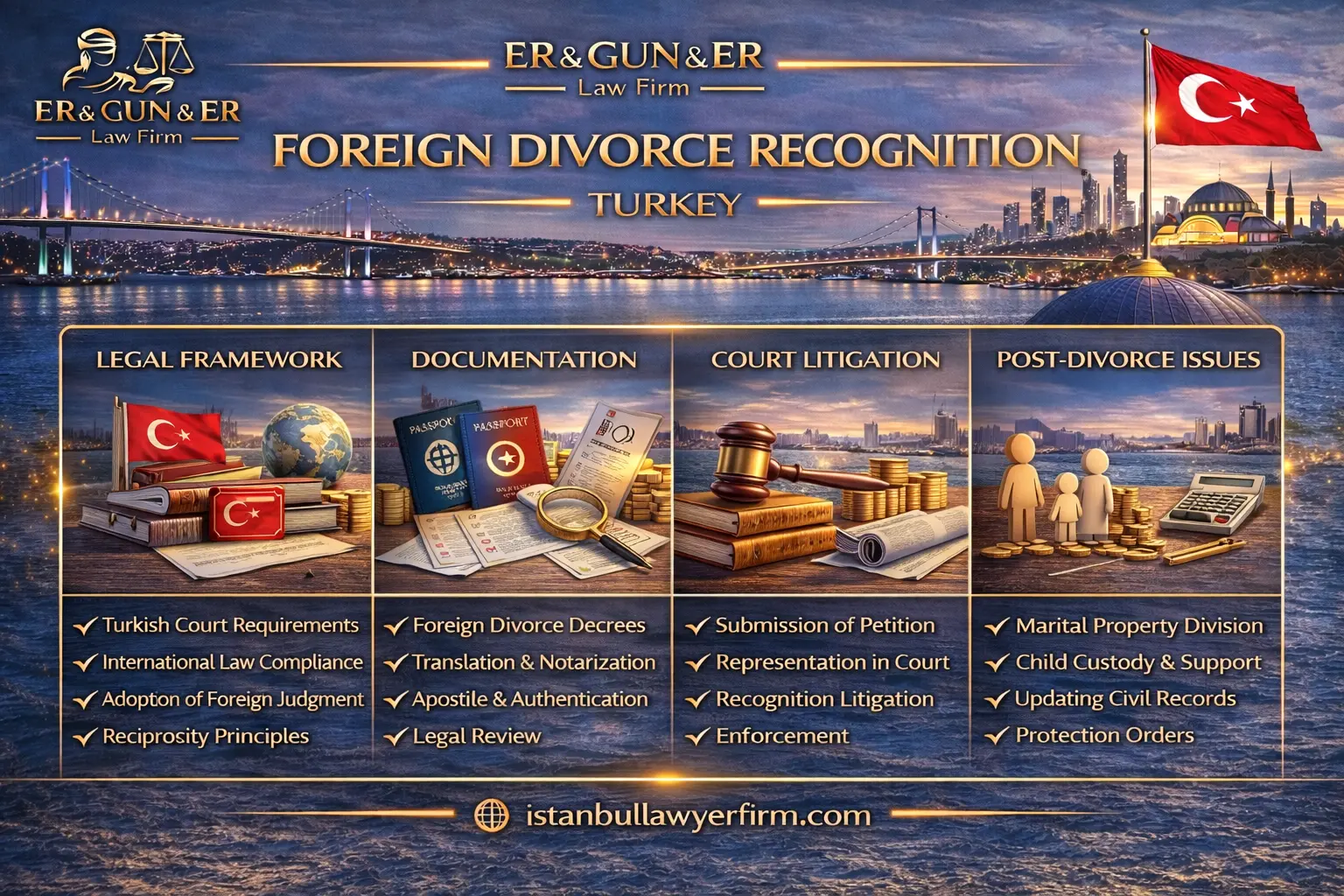
A divorce obtained abroad can be legally final in the issuing country while still creating practical barriers inside Türkiye for civil status and transaction steps. If a person’s marital status in Turkish records is not aligned with the foreign outcome, everyday procedures can become unexpectedly difficult and legally sensitive. Remarriage planning, notarial transactions, and banking compliance checks can all depend on what the Turkish civil registry shows at the time of application. Cross-border family situations also raise questions about whether related custody or support clauses can be relied on without further court action in Türkiye. The decisive factor is usually not how persuasive the story sounds, but whether the file contains authentic, complete, and properly certified documents that a Turkish court can rely on. A recognition file is therefore an evidence project that lives or dies on finality proof, identity consistency, and a clean service record. Many applicants approach the issue only after an institution refuses a step, but the better approach is to treat recognition as a preventive status control step. Coordination matters when one party is abroad, because service and due process questions are often the first point of attack in contested matters. Where the documentation chain is weak, outcomes become uncertain even if the underlying divorce is genuine and long settled. If you need a reliable procedural strategy, early review by a Turkish Law Firm can help identify gaps before filing and prevent avoidable rework. If the client needs to understand the steps in English while maintaining Turkish procedural discipline, an English speaking lawyer in Turkey can bridge the terminology gap without diluting evidentiary standards. When the goal is a status correction that institutions in Türkiye will accept, a lawyer in Turkey will focus on what the court and registry can verify rather than on what the parties assume is obvious. practice may vary by authority and year — check current guidance.
Foreign divorce recognition overview
Recognition is the mechanism that allows a foreign divorce decision to be treated as effective for Turkish legal purposes without re-litigating the underlying marital dispute. The practical objective is to make a foreign status change usable in Türkiye for civil registry records and for institutions that rely on those records. Courts approach recognition as a controlled import of a foreign legal result into the Turkish legal order based on authenticity, finality, and procedural fairness. This is why the file must show that the foreign decision is a genuine official act and that it is no longer open to ordinary appeal in its system. The court will also consider whether the respondent had a fair chance to be heard, because recognition is not meant to validate decisions produced through defective notice. Even in cooperative cases, the judge’s role is to decide on the record, so cooperation does not replace formal documentation. A foreign decree can contain many pages, annexes, or later certificates, and the Turkish court typically expects the submission to be complete and coherent. Names, dates, and identity details must match Turkish records, because status implementation depends on correct identification. Recognition is often the first step in a broader cross-border family plan, because it provides a stable legal baseline for later custody, support, or property disputes if they arise. Many clients seek a solution that is practical rather than dramatic, and that is consistent with how Turkish courts manage evidence. If you want the process handled with disciplined risk control from the start, an Istanbul Law Firm can structure the evidence set so the court can decide without unnecessary procedural detours. In complex cross-border settings, a best lawyer in Turkey approach is less about slogans and more about anticipating objections that could derail an otherwise straightforward status request. practice may vary by authority and year — check current guidance.
Recognition is also best understood as a sequencing tool, because it clarifies which actions should wait until status is confirmed in Türkiye. If the foreign divorce is not recognized, a person may still be treated as married in Turkish administrative practice even if they are divorced abroad. That gap can affect remarriage applications, inheritance planning, and the legal framing of new relationships in Türkiye. It can also affect how institutions evaluate consent and representation in certain transactions, because marital status is a frequent compliance checkpoint. Recognition does not automatically solve every cross-border consequence, but it provides a court-backed confirmation that can be used across many contexts. The recognition file should be drafted with the later user of the decision in mind, especially registry officers who will implement a change based on the dispositive wording. A common error is treating the foreign decree as self-executing in Türkiye, which can lead to failed applications and unnecessary friction. Another error is assuming that a foreign administrative certificate is equivalent to a court judgment without verifying how Turkish practice treats that document type. Courts usually require the foreign decision to be final and to come from a competent authority, and they expect those features to be proven rather than asserted. Because documents are often obtained from multiple foreign offices, the chain of authenticity must be consistent and verifiable. The decision can later be relevant even in disputes that are not purely family matters, because status can shape contractual and procedural standing. The safest strategy is to keep the petition narrow and to support every claim with an annex that can be inspected by the court. In cooperative scenarios, Turkish lawyers still prefer to build the file as if it might become contested, because a later objection can otherwise reopen preventable issues. practice may vary by authority and year — check current guidance.
Clients often ask whether recognition is mandatory, but the more accurate question is whether any planned action in Türkiye depends on Turkish recognition of the status change. If there is no planned action and no Turkish record needs to reflect the change, some people postpone recognition, but postponement can create risk if circumstances change suddenly. It is common for recognition to become urgent when a client wishes to remarry, to register a child related change, or to complete a notarial transaction that requires a single status record. Recognition is also relevant where one party wants to rely on the divorce status in a separate dispute, because status can influence standing and legal interest analysis. A careful file addresses the relationship between the foreign decree and Turkish records without importing unnecessary foreign narrative material. The petition should explain the requested effect in Turkish terms, focusing on status recognition and not on moral assessments of the marriage. Courts generally prefer clarity about what is requested and what is not requested, because that helps craft a dispositive section that can be implemented. Where the foreign decree includes additional clauses, the petition should separate status recognition from any request that might be treated as execution of obligations. That separation reduces the chance that the case becomes overloaded and delayed by disputes that are not needed for the core status goal. The file should also anticipate that the judge will examine the service trail and the respondent’s participation to ensure procedural legitimacy. If the case involves multiple jurisdictions, it is prudent to keep a controlled terminology map so that foreign terms are not mistranslated into Turkish legal categories. When clients want a coordinated approach that protects both court and registry implementation, a law firm in Istanbul can manage the evidence chain and the post-decision steps as one integrated process. practice may vary by authority and year — check current guidance.
Recognition versus enforcement
Recognition and enforcement are often mentioned together, but they serve different purposes and they trigger different practical consequences in Türkiye. Recognition focuses on accepting the foreign status result, such as the dissolution of marriage, as effective within the Turkish legal order. Enforcement focuses on making a foreign obligation executable, such as payment duties or specific performance measures, through Turkish execution mechanisms. The difference matters because a status recognition decision is often enough for registry alignment, while an enforcement path may be needed for monetary or custodial obligations that require execution steps. Mixing the two concepts in one request without clarity can confuse the court and invite avoidable objections. A disciplined petition states whether it seeks recognition only or also seeks an order that supports execution of a foreign operative clause. Courts can accept recognition while limiting or refusing enforcement aspects that are not properly documented or that require additional conditions. This is why annex planning must be aligned with the requested outcome rather than with what the foreign decree happens to contain. If the foreign decision includes multiple operative parts, the petition should identify each part’s legal character and finality status in the issuing system. In many cross-border divorces, parties primarily need status recognition, and enforcement issues can be managed later through separate strategic steps if needed. A recognition file should not create false certainty about execution outcomes, because execution depends on assets, location, and procedural prerequisites that cannot be assumed. If the matter requires both tracks, a structured approach by an Istanbul Law Firm can separate issues cleanly and reduce the risk that the entire case slows down due to one contested enforcement element. practice may vary by authority and year — check current guidance.
The practical effect of recognition is that Turkish authorities can treat the person as divorced once the registry update is completed using the court decision. The practical effect of enforcement is that a creditor-like action can be pursued through Turkish execution offices or related mechanisms based on the recognized enforceability of the foreign obligation. Because enforcement is more intrusive, Turkish courts tend to review due process and clarity of the operative clause with heightened care. A status recognition request can often be proven with finality and authenticity documents and a clear identity mapping, while enforcement requires additional proof that the obligation is enforceable and sufficiently determinate. If a foreign decree orders periodic payments, questions can arise about whether the order is modifiable and what that means for execution in Türkiye. If a foreign decree includes custody or contact language, separate questions can arise about how Turkish institutions will treat those determinations in practice. This is why many practitioners advise clients not to overload the first filing if the core need is status correction and registry alignment. A narrowly framed recognition request can often proceed more efficiently and can create a stable platform for later steps if enforcement becomes necessary. The court’s decision writing becomes easier when the petition does not blur the legal category of each requested effect. Evidence management also becomes easier because each annex can be tied to a specific recognition condition rather than to a broad concept of cross-border fairness. In contested matters, the respondent will often attack service and participation, and those issues can expand quickly if the petition includes aggressive enforcement demands. The safer approach is to match the requested relief to what the file can prove without speculation and without relying on informal narratives. When clients need a clear explanation of what each track does and does not achieve, Turkish lawyers typically emphasize that recognition is about legal status while enforcement is about execution tools. practice may vary by authority and year — check current guidance.
The distinction also shapes how clients should communicate with institutions, because institutions often need a clear document showing status rather than a complex order containing mixed obligations. A recognition decision is typically presented to registry officers and other administrative units as a basis for updating status records and related entries. An enforcement decision or an enforceability outcome is more often used in an adversarial context against a debtor-like counterparty, and it may require additional procedural steps after the court phase. Clients sometimes expect that a recognized divorce automatically resolves all financial disputes, but property and support often require separate analysis and sometimes separate proceedings. Clients also sometimes expect that a foreign settlement agreement is automatically executable in Türkiye, but enforceability depends on how the settlement was adopted and documented in the foreign system. For this reason, the petition should avoid suggesting that recognition alone will produce monetary recovery or immediate compliance by the other party. A realistic strategy treats the recognition decision as a foundational status instrument and then assesses enforcement options based on the counterparty’s location and assets. This strategy is particularly important when one party is abroad, because cross-border execution can require coordination beyond Türkiye. Overpromising on enforcement can backfire and can also complicate settlement discussions by creating unrealistic expectations. A well-built recognition file can still be valuable in settlement because it removes ambiguity about marital status and reduces leverage created by registry inconsistency. In practice, clients benefit when the file is prepared like a court document rather than like a narrative letter, because courts decide on admissible proof. If the case is sensitive, an early review by a best lawyer in Turkey style practitioner can help keep the scope disciplined and prevent avoidable procedural escalation. practice may vary by authority and year — check current guidance.
When recognition is required
Recognition is typically required when a foreign divorce needs to be treated as effective for Turkish legal processes that depend on civil status. The most common trigger is a mismatch between a foreign marital status and what Turkish records show, because Turkish authorities rely on domestic records as the first reference point. If a client intends to remarry in Türkiye, the system usually expects the prior marriage to be shown as dissolved through a recognized status change. If a client needs to register a status related change that depends on divorce, such as certain family entries, recognition can become the necessary step before any administrative update is accepted. If a client is engaged in a transaction where marital status affects documentation expectations, recognition can also become functionally required. If a dispute arises in Türkiye where a party’s standing depends on being divorced, a court may expect formal recognition evidence rather than a foreign document presented informally. Recognition can also be important for long-term planning, because status affects inheritance expectations and family governance decisions even years after divorce. Many clients only discover the need when an institution requests a Turkish court decision, but the legal logic is that Turkish institutions implement Turkish status records. Recognition is therefore the bridge that makes a foreign status outcome usable in Turkish administrative life. A careful analysis begins by identifying which Turkish process is blocked and which record must be corrected to unblock it. When clients need that analysis done with careful risk control, an Istanbul Law Firm can assess the institutional dependency chain and plan the least disruptive procedural route. practice may vary by authority and year — check current guidance.
Recognition is also commonly required where the divorce has cross-border consequences that cannot be managed through informal documentation alone. If the foreign decree includes determinations about children or support, parties may need to consider whether those determinations will be relied on in Türkiye, and if so, which legal track is appropriate. Even if the parties are cooperative, institutions may still ask for a Turkish decision that clearly references the recognized foreign outcome. If one party later challenges the divorce status, a recognition decision offers a stable court-issued confirmation that is harder to dismiss. This stability can be important where a person’s identity documents, residence records, or institutional profiles still reflect the prior marital status. Recognition can also be required for consistency when a person holds more than one citizenship and needs status alignment across different administrative systems. In practice, the need is driven by the point where a Turkish authority must take action, because the authority must rely on a legally valid basis within Turkish procedure. Where a party is abroad and service questions are likely, early planning becomes critical because service issues can determine whether recognition is granted. If the foreign court process was by default, recognition can still be possible, but it requires stronger documentation about notice and fairness. Clients should avoid assumptions such as thinking that a foreign decree stamped by a court will automatically be accepted by every Turkish institution. Instead, they should treat recognition as a formal step that produces a Turkish court output usable across institutions. If the file includes sensitive personal information, submissions should be limited to what is needed to establish recognition conditions and to support the requested relief. Because these files can be document-intensive, Turkish lawyers often advise preparing a clean annex map early so that the petition remains controlled and auditable. practice may vary by authority and year — check current guidance.
There are also scenarios where recognition may not be immediately required, but waiting can create risk that surfaces later at the worst time. If a client has no immediate plans in Türkiye, they may postpone, but future events such as remarriage plans, property transactions, or family disputes can suddenly make recognition urgent. If the client anticipates any future Turkish-facing transaction, obtaining recognition earlier can reduce stress and avoid last-minute document retrieval from foreign authorities. Another scenario is where a client needs to change a surname or align identity usage across records, because that often becomes harder if years have passed and documents are scattered. Recognition can also be a preventive step where the other party is likely to contest later, because early filing can secure a stable status record before disputes escalate. In practice, the risk analysis should include whether the respondent can be served reliably and whether the foreign case file can be obtained in certified form. If those elements are uncertain, postponing can increase difficulty because addresses change and foreign records become harder to retrieve. Clients should also consider that institutions can change their internal verification routines, which can suddenly make recognition documents more strictly required. Because clients often want a predictable path, counsel should explain that recognition is a formal court process and not a registry-only formality. If a client wants an English-language explanation of Turkish procedural steps without losing accuracy, an English speaking lawyer in Turkey can provide that clarity while maintaining strict evidence discipline. practice may vary by authority and year — check current guidance.
Civil registry update steps
The civil registry update is the practical endpoint for many clients, because it is the point where Turkish records begin to reflect the foreign divorce through a Turkish court-recognized status change. The registry does not typically decide on recognition by itself, so the first step is usually to obtain a Turkish court decision that recognizes the foreign divorce outcome. The court decision must be clear on the parties’ identities and on the recognized status change so that a registry officer can implement it without interpretation. After the decision is finalized in Turkish procedure, the client typically uses certified copies of the decision to apply for the relevant registry update. The registry’s implementation will depend on the clarity of the dispositive wording and the alignment between names in the decision and names in Turkish records. If there are spelling differences or name change issues, the registry can request clarification or additional documentation to ensure the correct person’s record is updated. This is why identity mapping in the petition is not merely a court preference but also an administrative necessity for implementation. A careful process also anticipates that clients may need the updated record for new marriage procedures, for notarial transactions, or for institutional compliance checks. Because registry steps are administrative, they should be approached with precise documents and calm communication rather than with informal explanations. When clients need a coordinated plan that covers both the court phase and the registry phase, a lawyer in Turkey can align the petition strategy with the later administrative requirements. practice may vary by authority and year — check current guidance.
Registry updates are sensitive to document form and identity consistency, so clients should plan to keep certified copies and to maintain a clean chain of documentation. If the foreign decree includes a surname change clause, the petition and the recognition decision should be structured so that the registry can understand the before-and-after identity linkage. If the client holds multiple identity documents, the file should avoid contradictions and should be consistent about which document is relied on for Turkish records. Clients should also understand that registry implementation can involve internal verification steps that are separate from the court’s decision-making process, so administrative processing should not be assumed to be instantaneous. The most reliable path is to ensure that the recognition decision contains all the key identifiers that the registry uses, because missing identifiers often create follow-up requests. If the client needs the updated record for urgent planning, the safest approach is to reduce ambiguity rather than to rely on informal assurances. Institutional requirements can also shift over time, and local practice can differ between registry offices, so counsel should prepare clients for reasonable variability. If the client is abroad, coordinating signatures, certified copies, and communication channels becomes more important, because distance can magnify minor administrative issues. If the client needs guidance that balances legal precision with practical workflow, a best lawyer in Turkey style review can identify where the file might create later registry friction and can correct it early. practice may vary by authority and year — check current guidance.
Clients often focus on the registry outcome, but a disciplined approach treats the registry update as a downstream implementation of a carefully prepared court record. If the court record is incomplete, registry implementation becomes uncertain even if the judge grants recognition, because the registry officer needs a clear basis for a specific update action. If the court record is clean, implementation is usually more straightforward, because the registry officer can treat the decision as a reliable instrument and can update the record accordingly. Clients should also consider that other institutions may request evidence of the registry update itself, not only the court decision, because institutions often verify status through Turkish record outputs. That means the process is not finished until the record reflects the change and the client can obtain an updated civil status extract where needed. If the client plans to use the divorce status for future transactions, they should keep the recognition decision and the registry update proof together as a single status package. If a dispute later arises, that package can be used to show status continuity in a way that is difficult to challenge. For clients who value a controlled evidence chain and predictable institutional acceptance, an Turkish Law Firm can treat the registry phase as part of the same legal project rather than as an afterthought. For clients who need local coordination and document handling in Istanbul, an Istanbul Law Firm can manage certified copies and registry interactions with consistent quality control. For clients who want a coordinated local process with full procedural discipline, a law firm in Istanbul can keep the court file and administrative file aligned so that the status change is not lost in translation between institutions. practice may vary by authority and year — check current guidance.
Court jurisdiction in Turkey
Jurisdiction is the first gate because a correct file can still fail if it is lodged before the wrong court. For recognition proceedings, Turkish courts look at connecting factors such as the parties’ domicile, habitual residence, or last shared residence, and at any statutory forum rules for foreign judgments. The practical starting point is to map where each party is registered and where they can actually be reached for service. If you file in a place with no meaningful connection, you increase the risk of procedural objections and delays. The law framework is mainly drawn from Turkish International Private and Procedural Law and the general civil procedure rules. The court will also examine whether the foreign decision is final and capable of recognition in the Turkish legal order. Many applicants assume that a consulate or registry office can directly accept the divorce, but the default route is judicial. The phrase court procedure recognition Turkey captures that the process is case file based and evidence driven. In recognition of foreign divorce in Turkey, the forum question should be answered before you spend time collecting documents. Counsel should verify whether the matter will be treated as recognition only or whether enforcement aspects are also requested. That choice can affect the court that is competent and the scope of the petition. It can also affect the service strategy, especially if the respondent is abroad. A careful jurisdiction analysis also reduces the chance of parallel proceedings or conflicting filings. It helps you plan the sequence between court action and civil registry update. The safest approach is to treat jurisdiction as a document backed issue, not as a guess.
In practice, the court will expect you to show why that forum is appropriate through identity records, address data, and service feasibility. If the applicant has moved frequently, the file should explain the timeline of residence in a way that matches official records. When parties have different nationalities, the court will still focus on procedural competence in Türkiye rather than on personal preferences. A frequent problem is that applicants rely on informal addresses, which later leads to failed service attempts and adjournments. You should obtain reliable address evidence, and where necessary use official channels for locating the respondent. If the respondent’s location is uncertain, the file must be prepared with realistic alternatives and clear documentation. The court can request clarifications if the petition is vague on where the respondent can be served. You should also consider whether there is any pending family case in Türkiye that could create overlap. If there is overlap, the strategy should be coordinated to avoid inconsistent statements. The phrase foreign divorce recognition Turkey is often searched by people who only want a registry correction, but courts still require a proper jurisdiction basis. If you plan to ask for enforcement elements later, it is better to anticipate that in your forum selection. If you do not, you may have to restart or expand proceedings, which increases cost and friction. Any expectation about which courthouse is faster is not a reliable criterion and should not drive jurisdiction choices. “practice may vary by authority and year — check current guidance.” A disciplined approach is to focus on legal competence and service practicality, then proceed with filing.
Jurisdiction analysis becomes more sensitive when the foreign divorce judgment includes operative parts beyond the dissolution of marriage. If the applicant wants the Turkish court to order execution measures, the file may move from recognition logic to enforcement logic. That distinction is central to recognition and enforcement Turkey family law practice, because different consequences follow. Enforcement requests can also trigger additional checks on service, due process, and the enforceability of the operative clauses. Some applicants use the word exequatur Turkey divorce to describe the overall outcome, but the court will still separate recognition from enforceable execution. In many cases, a recognition decision is sufficient to update status records, while enforcement is needed for monetary or custody related obligations. If enforcement is sought, the court may require more detailed proof of finality and of proper notification to the respondent. The petition should describe precisely which part of the foreign judgment is relied on and why. A vague request that mixes dissolution, custody, and payment orders without separation can invite procedural objections. It can also complicate the court’s ability to craft a clear dispositive section that authorities can implement. The court may refuse to treat non final or interlocutory measures as enforceable, even if they are labelled as orders abroad. Evidence of the scope of the foreign court’s jurisdiction and the parties’ participation can become more relevant in these mixed cases. Applicants should also anticipate that enforcement can require additional follow on steps once recognition is granted. “practice may vary by authority and year — check current guidance.” A coherent jurisdiction and scope narrative at the start will usually prevent the case from drifting into unnecessary disputes.
Required documents package
The documents package is the decisive element because Turkish courts rely on official proof, not on personal statements about marital status. The core item is the foreign divorce decree or judgment in its complete form, including the operative section and any pages that identify the parties. You should also obtain an official certificate or notation showing that the decision is final and no longer subject to ordinary appeal in that system. If the judgment is issued in a language other than Turkish, you will need a certified translation that matches the original page by page. Courts also expect authenticity formalities, such as apostille or consular legalization, depending on the issuing state. If service occurred abroad, supporting documents that show how notice was given and whether the respondent participated are often critical. Identity documentation should align with Turkish records, especially where names are spelled differently across systems. When the file aims at enforcement of foreign divorce judgment Turkey, additional attachments may be needed to show the enforceable nature of specific orders. This is because enforcement focuses on execution, and execution requires clarity on what is owed and to whom. A petition prepared with a foreign judgment recognition lawyer Turkey perspective will treat every document as a piece of admissible evidence rather than as background. You should keep originals and certified copies organized because courts may ask to inspect the original chain at hearings. If the foreign decision references annexes, ensure those annexes are included if they affect the meaning of the ruling. Missing pages can create doubts about completeness and can delay the court’s ability to evaluate finality. “practice may vary by authority and year — check current guidance.” A disciplined package reduces objections and helps the court issue a clear recognition decision.
Many foreign divorce files include parenting provisions or financial obligations that are drafted as part of the same judgment. If you need those effects to be usable in Türkiye, you must present the relevant parts in a way that the court can separate and understand. The file should clearly identify which clauses relate to custody, contact, relocation limits, or parental authority. If the foreign decision contains a custody order, the recognition of custody order Turkey question turns on whether the order is final and whether due process was respected. The same discipline applies to support clauses, because the recognition of alimony order Turkey outcome can depend on how the foreign court framed the obligation. You should therefore provide any supplementary certificates that confirm the operative clauses are final and not suspended. If the foreign system issues a separate certificate of enforceability or similar document, obtain it where available. Courts can be cautious if the divorce is final but the support order is modifiable, so the file should explain the nature of the order with official wording. Translation accuracy matters here because small wording differences can change whether a clause is treated as declaratory or executory. You should also provide proof of the parties’ participation or proper service for these operative parts, not only for the dissolution itself. If a respondent claims they were not heard on custody or payments, the court may scrutinize the foreign record more closely. Where the foreign judgment references later administrative steps, include documents showing whether those steps occurred. Any mismatch between the petition request and the actual judgment language can trigger a partial refusal. “practice may vary by authority and year — check current guidance.” A clean separation of dissolution, custody, and payment documents makes the court’s job easier and reduces risk.
Even when you only want status recognition, you should prepare the file with the civil registry end use in mind. Registry implementation typically depends on the recognition decision wording, the parties’ identity information, and proof that the foreign decree is final. To support Turkish civil registry update after divorce, it is helpful to include Turkish identity numbers where available and to attach civil status extracts that show the current entry. If the applicant is a foreign national without a Turkish identity number, the file should include passport copies and any residence documentation that ties the person to Turkish records. The court will not edit registry data directly, but the recognition decision will be relied on by registry officials when they update entries. Name changes can cause the most friction, so you should provide official evidence of any post divorce name usage in the issuing country. If the foreign decree includes a restoration of a maiden name, that clause should be translated with particular care. People often approach the process because they want remarriage after foreign divorce Turkey without legal uncertainty, and registry alignment is central to that goal. A new marriage application in Türkiye can be blocked if the registry still shows a person as married. That is why the recognition petition should avoid ambiguity on whether the marriage was dissolved and on the date of dissolution. If there are multiple judgments, such as a separate decree absolute, you should attach the final one and explain the sequence. You should also keep a clear record of which documents are originals and which are certified copies, because registries may ask for specific formats. If a consulate has issued any confirmation letters, treat them as supplementary, not as substitutes for judicial recognition. “practice may vary by authority and year — check current guidance.” A registry focused package is still a court focused package, and it should be prepared with the same evidentiary discipline.
Apostille and legalization rules
Authentication is a frequent failure point because courts must be confident that the foreign decree is an official act of the issuing authority. If the issuing state is a party to the Hague Apostille Convention, the usual method is an apostille attached by the competent authority in that state. The apostille does not confirm the content of the judgment, but it confirms the origin and signature capacity of the issuing official. In an apostille for divorce decree Turkey workflow, the apostille should match the specific document version that will be submitted to the Turkish court. If the judgment is multi page, make sure the apostille covers the entire document set in a way that cannot be separated or confused. Some jurisdictions issue an apostille for a certified copy rather than the original, and that can still be acceptable if the certification chain is clear. If the issuing state is not in the apostille system, consular legalization is typically required through that state’s authorities and the Turkish consulate. The legalization chain may involve multiple steps, and each step should be preserved as part of the submission packet. People searching foreign divorce recognition Turkey often underestimate this step because they assume a court seal alone will suffice. Turkish courts generally require a recognizable international authentication path, not merely a domestic stamp. You should also check whether the certificate of finality needs its own apostille or legalization, because it is often a separate document. The same applies to powers of attorney executed abroad, if used, because they need an authentication chain suitable for Turkish use. If the foreign decree is digital, you should confirm whether the issuing authority provides an apostille equivalent verification method. “practice may vary by authority and year — check current guidance.” Treat authentication as a primary requirement, because a missing apostille can stop the case before substance is discussed.
A common mistake is obtaining an apostille for a translation rather than for the underlying original foreign judgment. Courts generally want the original judgment authenticated first, and the translation is then certified within Türkiye through the notary chain. Another frequent error is presenting an apostille that belongs to a different document with a similar case number or date. Authentication certificates should be checked against the document title, issuing authority, and date to avoid that mismatch. If the judgment was re issued as a certified copy, the apostille must correspond to that certified copy, not to an earlier printout. Some apostilles are issued as separate sheets, and those sheets can be detached, so the submission should preserve the linkage clearly. If pages are missing, the apostille loses practical value because the court cannot be sure what was authenticated. In consular legalization chains, the most common gap is skipping an intermediate authority that the consulate expects to see. That gap can lead to rejection at the consulate stage or later objections in court. Applicants sometimes assume that a foreign notary stamp is enough, but the Turkish court will focus on the international authentication layer. If the foreign judgment is signed electronically, the file should include an official verification output from the issuing authority where available. It is also important to check whether the apostille authority is the correct one for courts rather than for administrative documents. When documents are issued in federal systems, the competent apostille authority can differ by region, and errors occur. “practice may vary by authority and year — check current guidance.” A careful pre filing review of the apostille and legalization chain is often the most cost effective risk control step.
Legalization requirements are not purely formal, because they determine whether the court will treat the foreign decree as reliable evidence. When legalization is required, you should plan the sequence early, because some countries need judicial copies issued for international use. Those copies can differ from the version delivered to parties in domestic proceedings. If the foreign court issues separate true copy certifications, those certifications may need to be legalized together with the judgment. You should also ensure consistency between the legalized document and the translation that will be notarized in Türkiye. If an apostille is used, confirm that it is legible and that it includes the necessary elements such as reference number and authority identification. If consular legalization is used, confirm that each stamp is dated and clearly tied to the right document. Courts can become skeptical when the chain contains unclear stamps or unofficial stickers that cannot be attributed to an authority. In recognition and enforcement Turkey family law files, authentication is often scrutinized more carefully where the foreign judgment includes monetary orders. This is because execution measures are more intrusive, so the court expects a stronger proof trail. You should preserve original envelopes, cover letters, or official confirmations if they help demonstrate the provenance of documents. Digital authentication systems are developing, but acceptance in Turkish practice depends on how verifiable the system is for the court. If a foreign authority offers a QR based verification portal, include the printed verification results in the file as supportive material. “practice may vary by authority and year — check current guidance.” A complete legalization narrative prevents the court from wasting time on authenticity questions that can be resolved before filing.
Certified translation standards
Translation is not a cosmetic step, because the Turkish judge will rely on the Turkish text to understand what the foreign court decided. For most files, the translation must be produced by a sworn translator and then notarized so that the court can treat it as a formal submission. The translator should translate every page that carries legal meaning, including stamps, endorsements, and finality notations. In certified translation divorce decree Turkey practice, omissions of stamps or endorsements are a common reason for court questions. The translation should preserve the structure of the judgment, including headings, numbered paragraphs, and the operative section. Names should be translated consistently, and where transliteration is needed, the translator should follow passport spellings. Dates should be rendered clearly and consistently to avoid confusion between day month formats used in different countries. If the foreign judgment includes references to other orders, those references should be translated accurately so the court understands the scope. If the judgment contains legal terms without direct Turkish equivalents, the translator should use standard legal Turkish and avoid informal paraphrase. A party should also review the translation for factual alignment, because the translator may not know local registry conventions. The court procedure recognition Turkey process often turns on the clarity of the operative section in Turkish. That is why the translation of the dispositive part should be checked carefully for completeness and correct party identification. If there is a separate certificate of finality, it should be translated with the same discipline and notarized as a separate instrument. “practice may vary by authority and year — check current guidance.” A precise translation reduces hearings and prevents the court from requesting re translation or supplemental explanations.
Courts typically focus on whether the translated text clearly shows that the marriage was dissolved and that the decision is final. If the translation uses ambiguous wording, a judge may ask whether the decision is provisional, conditional, or subject to further steps abroad. That risk is higher in systems that issue multiple stages of divorce decisions, such as decree nisi and decree absolute equivalents. The translator should therefore reproduce the foreign court’s finality language and any attached certificates faithfully. In recognition of foreign divorce in Turkey, a common friction point is whether the foreign decision is a judgment, an administrative act, or a religious instrument. Translation should not try to upgrade the character of a document by using Turkish court terminology that is not supported by the original. Another common friction is translating terms like order or decision without indicating the issuing authority and legal context. Courts may also check whether the translation includes the court name, case number, date, and parties, because these are basic identifiers. If any of those identifiers are missing in the Turkish text, the court can doubt whether the document corresponds to the parties in the petition. Notary practice in Türkiye can require the translator to certify that the translation matches the presented original, so the original must be available at that stage. If the original is presented as a certified copy, the notary should see the certification and the authentication chain together with the copy. If the translation is prepared from a scanned image, quality issues can lead to misread names or numbers, which later causes corrections. Corrections can be possible, but they add time and can undermine confidence in the file’s reliability. “practice may vary by authority and year — check current guidance.” The safest approach is to treat translation as an evidentiary instrument and to review it like you would review a contract.
A practical workflow is to prepare a translation matrix that matches each foreign document to its Turkish translation and notarization reference. That internal control helps prevent accidental submission of an untranslated annex or a mixed up page set. You should keep scanned copies of the authenticated originals and the notarized translations for later registry interactions. Courts may return originals after review, but you should not rely on that, so careful file management matters. If you intend to use the recognition decision for multiple purposes, such as registry update and later enforcement of financial clauses, keep a consistent document set. Where the foreign decree contains multiple operative parts, ask the translator to preserve that separation in Turkish and avoid merging clauses. If the foreign decision uses technical family terms, consider having a legal reviewer check terminology before notarization. Once notarized, editing the translation is harder, because a corrected version must be re notarized and resubmitted. Applicants who seek remarriage after foreign divorce Turkey should plan for these practical steps to avoid last minute administrative obstacles. They should also ensure that names in the translation match names in Turkish identity records, including middle names and diacritics. If the foreign judgment uses initials, the translation should explain them as shown in the original and avoid speculative expansion. If a party has dual citizenship, the file should use consistent identity references and avoid presenting conflicting passport spellings. Registry officials often rely on the court’s recognition decision, so clarity in the court file indirectly protects later administrative steps. “practice may vary by authority and year — check current guidance.” A controlled translation and certification process is one of the most effective ways to reduce recognition risks.
Service and due process checks
Turkish courts do not re-try the foreign divorce, but they do check whether the respondent had a fair opportunity to be heard. That is why the service record from the foreign proceedings often becomes the most important part of the evidence file. If a judgment was issued by default, the court will want to see how notice was delivered and whether the method complied with the foreign forum’s own rules. If the respondent lived in Türkiye while the case ran abroad, the court will pay close attention to whether the address used was credible and whether delivery was traceable. If the respondent lived abroad, you should expect a focused review of cross-border notification steps and the documentation that proves them. Searches for service abroad divorce case Turkey usually reflect this anxiety about whether a foreign notice process will be accepted. The court’s concern is not paperwork for its own sake, but the integrity of the adversarial process. A missing summons, an unclear delivery receipt, or an address that cannot be linked to the respondent can create a due process concern. Even where the respondent actually knew about the case, courts typically look for formal evidence rather than assumptions. If the foreign file shows counsel representation, it helps to show the mandate and the stages where submissions were made. If there were hearings, the record should demonstrate whether the respondent was invited and whether any objections were recorded. If the foreign court served via publication, the Turkish court may ask for proof that the statutory conditions for that exceptional route were met. Applicants should collect service documents early, because retrieving them later from a foreign court registry can be slow. When the service record is incomplete, the safest plan is to obtain an official clarification from the issuing court rather than trying to explain gaps with narrative. “practice may vary by authority and year — check current guidance.”
Turkish procedure expects the petition to show, in a structured way, how the respondent was notified and how the judgment became final. A well prepared annex set usually includes the proof of service, the respondent’s address used by the foreign court, and any return receipts or electronic tracking outputs. If the foreign court uses an online portal for service, printouts should be accompanied by an official verification where available. If the respondent signed an acknowledgment, the original format should be shown, not only a translated summary. Where the record is complex, it is sensible to align the analysis with the broader recognition principles explained in the foreign judgment recognition guide. If the divorce involved an expat couple with moving residences, the contextual issues around notice and participation are also discussed in the expat divorce procedure overview. Even when those resources are used for orientation, the court file must still stand on its own and be supported by the specific documents from the foreign case. You should avoid presenting generalized statements like the respondent was informed, because Turkish judges typically ask how and when. If there was substituted service, the petition should identify the legal basis used by the foreign court without inventing or guessing. If the respondent contested jurisdiction abroad, you should attach that objection and the foreign court’s ruling on it, because it can show that the respondent was engaged. If the respondent never appeared, the petition should still demonstrate that the foreign court’s notice steps were properly completed. In Turkish practice, due process concerns are not treated as minor defects, because they go to legitimacy of the foreign decision. If you anticipate a challenge, prepare a clean chronology that matches each notice attempt to a supporting annex. If any step is uncertain, address it directly and support it with an official record rather than leaving it implicit. “practice may vary by authority and year — check current guidance.”
Due process review is usually framed through the lens of Turkish public procedural guarantees rather than through the foreign court’s terminology. Courts look for a demonstrable path showing that the respondent could access the claim, the evidence, and the hearing opportunities. If a foreign judgment file is thin, the Turkish judge may require supplementary material that clarifies what was served and what the respondent was expected to do. In that scenario, certified copies from the foreign court registry can be more persuasive than informal explanations. The general procedural approach can be cross checked through the civil procedure code text and the conflict of laws framework can be reviewed through the international private law text. These references help structure arguments without relying on unverified article numbers. If the respondent alleges they were never served, the court may examine whether the foreign file includes a clear address determination and a verifiable delivery event. If the address was outdated, the petition should explain why it was used and whether the foreign court was informed of any updates. If the foreign system permits service by email, the file should show confirmation of delivery and access, not only that a message was sent. If the foreign court relied on a private process server, the petition should include any licensing or official capacity information that makes the service credible. If the respondent participated at some point, the petition should highlight the participation record, because it can neutralize arguments about lack of notice. If the respondent never participated, the file should demonstrate that the foreign court still provided a real chance to do so. A careful due process narrative often reduces the number of hearings needed, because the judge can decide based on documents. It also reduces the chance that recognition will be delayed by additional service efforts within Türkiye. “practice may vary by authority and year — check current guidance.”
Public policy considerations
Public policy review is the most misunderstood concept in foreign judgment recognition, because it is not a second appeal on merits. The court asks whether giving effect to the foreign decision would clearly contradict fundamental principles of the Turkish legal order. This can relate to procedural fairness, equality of arms, or basic protection of personal status rather than to disagreements about facts. The phrase public policy objection Turkey recognition often arises when a respondent argues that the foreign process was incompatible with core guarantees. A court will typically examine the recognition request in a restrained way and will not reopen the underlying marital dispute. However, if the foreign decision was issued in a manner that shocks basic fairness, the court can refuse recognition. Examples can include extreme denial of defense rights or decisions that disregard minimum notice expectations. Public policy can also be invoked if the foreign decision creates a personal status result that cannot be accommodated in Turkish civil status registers. The review is contextual, so the petition should address the point calmly and with documentation rather than with rhetoric. If the foreign court record shows that both parties participated or had counsel, the public policy risk is usually lower. If the foreign decision includes ancillary clauses, the court may evaluate those clauses separately for public policy compatibility. The applicant should avoid sweeping claims like Turkish courts always accept foreign divorces, because that invites an unnecessary debate. Instead, the applicant should show that the foreign decision is final, issued by a competent authority, and produced through a fair process. The legal basis for recognition is rooted in the Turkish conflict of laws framework accessible through official sources. “practice may vary by authority and year — check current guidance.”
When preparing arguments, it is safer to rely on official texts rather than on secondary summaries that may be outdated. For this reason, practitioners often consult the Mevzuat official portal to confirm the current wording of statutory provisions. If a regulatory change or a procedural circular is relevant, the Official Gazette is the correct starting point for verifying publication and currency. Public policy discussions sometimes drift into moral or cultural arguments, but courts usually focus on legal compatibility and basic procedural guarantees. The petition should therefore frame public policy in legal terms and connect it to the evidence on service, representation, and finality. If the respondent raises a public policy argument, the applicant should respond with precise file references and avoid personal accusations. If the foreign system uses unfamiliar institutions, the petition can explain them neutrally through official descriptions or court certificates. Where a foreign decision is based on an agreement, the court may still want to see that the agreement was accepted by the foreign court through a recognizable procedure. If the foreign judgment is based on unilateral declarations, the petition should show how the foreign law treats those declarations and whether the respondent could contest them. If there are children, public policy sensitivity can increase because the best interest standard has strong weight in Turkish family practice. If the foreign judgment uses terminology that implies a sanction, the court may ask whether that sanction is consistent with Turkish principles. In those cases, it is helpful to separate the dissolution result from any punitive language in the foreign text. If the dissolution can be recognized while a punitive clause is ignored, the petition should present that as a coherent request. Clear structuring supports the judge in issuing a decision that registry officials can implement without confusion. “practice may vary by authority and year — check current guidance.”
Public policy should be treated as a risk control topic rather than as a dramatic battlefield. A petition that anticipates the court’s concerns and addresses them with documents usually performs better than one that assumes acceptance. If the foreign decision was rendered by a court with jurisdictional connection and both parties were heard, the public policy challenge tends to be harder to sustain. If the respondent claims fraud, the court will usually ask whether the foreign forum provided a mechanism to challenge the judgment there. If such a mechanism exists and was not used, the court may consider that in evaluating fairness arguments. If the respondent claims coercion in a settlement, the court may examine whether the settlement was judicially approved and whether consent was recorded. If the judgment includes a statement about consent, the petition should support it with the hearing minutes or the signed agreement from the foreign file. If the foreign decree conflicts with a Turkish judgment on the same marital status, the court may see that conflict as a public policy problem. For that reason, the applicant should disclose any related Turkish proceedings and explain the procedural posture honestly. If there is a risk of conflicting status entries, the petition should propose a clear remedy sequence, starting with recognition and then registry update. If the foreign divorce occurred long ago, the petition should still show finality and continuity of status, because delay alone does not substitute for proof. If the foreign decision is from an authority whose nature is unclear, the petition should provide official confirmation that it is competent to decide divorces. If that confirmation cannot be obtained, the public policy risk and the recognition risk both increase. A practical approach is to focus on fairness, authenticity, and clarity of the foreign decree’s operative effects. “practice may vary by authority and year — check current guidance.”
Partial recognition issues
Foreign divorce decisions sometimes combine multiple determinations in one document, and Turkish courts may not treat every determination the same way. Recognition can be granted for the dissolution of marriage while other parts are left without effect in Türkiye. This is not a contradiction, because the court’s task is to decide which foreign outcomes can be integrated into the Turkish legal order. The key is whether each part of the foreign decision satisfies the recognition conditions, especially finality and due process. If the dissolution is final but a financial clause is provisional, the court may limit recognition to the status part. If the foreign judgment contains a consent based arrangement, the court will still look for judicial approval and clarity of consent. That is why applicants should not assume that a negotiated outcome will automatically carry over without scrutiny. Where the foreign divorce was by agreement, it can be useful to understand how consensual endings are treated in Türkiye, as discussed in the mutual divorce procedure guide. The court will typically expect the petition to separate the requests so that the dispositive section can be implemented cleanly. If the petition requests everything at once without separation, the judge may ask for clarification or may refuse parts that are not properly documented. Partial recognition also arises when the foreign decree includes findings that are irrelevant for Turkish implementation, such as narrative fault statements. Those findings might remain in the foreign text, but Turkish implementation focuses on operative outcomes. A careful petition avoids overreach and targets what is realistically recognizable and usable. This approach often reduces litigation risk because it narrows the issues the respondent can contest. “practice may vary by authority and year — check current guidance.”
Applicants frequently ask whether the Turkish court will re-evaluate the grounds for divorce stated in the foreign judgment. In a standard recognition file, the court generally does not re-litigate the factual reasons, but it may examine whether the foreign process respected basic rights. If the foreign judgment includes language that would be treated as defamatory or punitive in Turkish context, the petition should avoid asking the Turkish court to endorse that language. The better strategy is to ask for recognition of the status change and, if necessary, specific enforceable obligations. This is also why translating the narrative sections carefully matters, because an overly aggressive translation can create unnecessary controversy. If the foreign judgment is based on a legal concept that does not match Turkish categories, the petition should describe it neutrally and avoid forced equivalence. For orientation on how Turkish courts categorize divorce reasons domestically, the divorce grounds overview can be useful, but the recognition petition should remain focused on the foreign decision. Partial recognition is also relevant when the foreign decree contains protective orders, undertakings, or non-molestation style restrictions. Some of those clauses may have a public enforcement character that requires separate analysis before they can be treated as enforceable in Türkiye. If a clause is time limited abroad, the Turkish court may ask whether it is still in force or has expired, and documentary proof is needed. If a clause is designed as a sanction, the court may decline to import it and may instead limit recognition to the marital status. If the petition is precise about what is sought, the judge can write a decision that avoids importing unnecessary foreign legal effects. This precision also protects the applicant from a later allegation that they misled authorities about the scope of the foreign decision. A disciplined approach is to treat partial recognition as a planning tool, not as a failure. “practice may vary by authority and year — check current guidance.”
Partial recognition decisions must be drafted so that administrative authorities understand what changed and what did not. If the dissolution is recognized, the civil status result is that the person is no longer married in Turkish records once the registry update is completed. If financial or parenting parts are not recognized or not enforced, those parts should not be presented to banks, registries, or third parties as if they were executable in Türkiye. A common risk arises when applicants present a foreign settlement as automatically binding in Türkiye without a clear recognition or enforcement basis. If the parties want to rely on a foreign settlement in Türkiye, they may need to structure a separate agreement under Turkish law or pursue enforcement where legally possible. In some cases, the foreign judgment may be recognized but the applicant may still need separate Turkish court actions to implement property or compensation outcomes. This can happen where Turkish mandatory rules require a specific domestic procedure for certain rights. It can also happen where the foreign decision is declaratory and does not contain an enforceable operative clause. Applicants should therefore manage expectations and plan the next steps based on what the recognition decision actually grants. Where the foreign file includes multiple judgments, such as a divorce judgment and a later financial order, it may be more efficient to seek recognition for each in a coordinated way. If the applicant seeks only a status update now, they should preserve documents for any later enforcement attempt and keep translations consistent. If the respondent raises objections, the court may issue a decision that is narrower than requested, so the petition should include a fallback logic. That fallback logic should explain why status recognition alone is still valuable for registry and future transactions. Properly used, partial recognition can reduce dispute intensity while still delivering the core outcome that the applicant needs. “practice may vary by authority and year — check current guidance.”
Custody and support effects
Foreign divorce recognition can have immediate consequences for parental responsibility, because Turkish authorities need a clear status baseline before acting on related matters. If the foreign decree includes a final parenting determination, the recognition file should explain what that determination means in practical terms for Türkiye. Courts often examine whether the child was given appropriate procedural protection and whether the respondent parent was heard. If the foreign court applied a best interest analysis, the file should show that the process was substantive and not merely formal. Recognition may be sought so that schools, healthcare providers, and travel authorities can rely on a legally coherent custodial framework. At the same time, applicants should understand that Turkish child protection principles can influence how foreign parenting outcomes are received. If there is an ongoing child case in Türkiye, coordination is critical to avoid inconsistent orders and to protect the child from procedural turbulence. For background on how custody issues are framed domestically, see the child custody overview. For cross-border situations, the international custody guide provides context on common conflict patterns. Even with that context, each recognition file must be built on the specific foreign record, especially on service and participation evidence. If the foreign decree grants decision making authority to one parent, the petition should show whether it is final and whether it was contested. If the decree allows relocation, the petition should show whether that permission was conditional and whether conditions were met. If the decree contains supervised contact or protective restrictions, the petition should address how those restrictions are evidenced and whether they remain in force. Where uncertainty exists, the petition should avoid asserting outcomes as automatic and should instead present the foreign result as a documented legal fact to be recognized. “practice may vary by authority and year — check current guidance.”
Support obligations are often the practical reason people pursue recognition, because financial continuity matters after a cross-border divorce. If the foreign judgment contains spousal maintenance, child maintenance, or arrears, the petition should separate those clauses from the dissolution clause. A Turkish court may recognize the dissolution while requiring a clearer basis before treating payment clauses as enforceable. For that reason, the foreign record should include any enforceability certificate or proof that the payment order is final and not suspended. If the foreign system allows easy modification, the petition should clarify whether the order was modifiable and whether any modification proceedings are pending. Applicants should also consider whether the payment clause is framed as a judgment debt, an ongoing periodic obligation, or a contractual undertaking. These distinctions can affect how execution mechanisms operate once recognition or enforcement steps are pursued. For domestic perspective on maintenance concepts and how courts approach proof, the alimony law guide is a useful reference. For execution oriented context, the alimony enforcement article explains common procedural expectations. In cross-border practice, the petition should be careful not to overpromise that a foreign payment clause will be collected quickly. Instead, it should outline that enforceability depends on the clarity of the operative clause and on the respondent’s assets and location. If the respondent is abroad, additional steps may be needed to reach assets, and that is a strategic decision rather than a formality. If the respondent is in Türkiye, execution may still require careful service and notification to avoid later challenges. If the foreign judgment includes costs or attorney fee awards, the petition should present them separately and with clear proof of finality. “practice may vary by authority and year — check current guidance.”
Beyond court outcomes, custody and support recognition shapes how families manage day to day life across borders. Parents may need a recognized framework to obtain passports, consent for travel, or school registrations without repeated disputes. Financial orders may need recognition or enforcement to prevent one party from using jurisdictional gaps to avoid obligations. At the same time, foreign orders can interact with Turkish protective measures, so coordination with Turkish proceedings is sometimes necessary. If there is any risk of domestic violence or coercion allegations, parties should avoid informal arrangements and should rely on court documented steps. The recognition file should remain focused on evidence, because custody and support disputes often generate emotional claims that do not help in a recognition hearing. Where the foreign order is unclear, parties may prefer to seek a new determination in Türkiye rather than relying on a vague foreign text. That choice depends on the child’s connections to Türkiye, the location of each parent, and the urgency of interim measures. A realistic strategy also considers that enforcement against assets can be harder when assets are mobile or held through third parties. Because these matters combine procedural detail with high personal stakes, many applicants consult a family lawyer Turkey recognition specialist to plan the sequence and to avoid avoidable filings. Any advice should be anchored in the concrete foreign record, especially in finality certificates and service evidence. If parties try to shortcut documentation, they often end up with delays that harm children and increase conflict. If the goal is a stable post-divorce status, the sequence should be recognition first, then registry update, then any enforcement steps that remain necessary. If the parties are cooperative, they should still document cooperation formally, because future disputes can arise years later. “practice may vary by authority and year — check current guidance.”
Property regime implications
Recognition of a foreign divorce is often pursued for civil status purposes, but it also interacts with property questions that appear later in enforcement and transactional contexts. A divorce recognized in Türkiye can clarify whether spouses still have a marital bond for Turkish private law dealings. Property regime consequences depend on the facts, the time line, and which legal system governed the marriage at relevant moments. Courts and practitioners typically separate the status recognition file from the later property disputes, because those disputes can require separate claims and evidence. It is still prudent to anticipate the property angle when preparing the recognition file, because inconsistent narratives can create credibility problems later. If a party plans to sell or acquire assets in Türkiye after divorce, clarity of marital status can affect consent requirements and documentation expectations. The foreign decree may contain property settlement clauses, but recognition of those clauses and practical enforceability can be a different question than recognition of status. Where property settlement is governed by agreements, parties should be careful about how those agreements are framed and whether they were incorporated into a court judgment abroad. For Turkish located assets, Turkish mandatory rules and registration practices can still matter even if a foreign court addressed property in general terms. That is why it is common to review the foreign decree together with the Turkish property regime framework before acting. If a party needs a Turkish focused overview of marital asset logic, the marital property guide provides orientation. If the case involves a settlement or distribution after divorce, the property settlement article can help frame the later steps. A recognition file should not promise a property outcome, but it should avoid leaving room for confusion about the parties’ status and identities. practice may vary by authority and year — check current guidance.
Cross border divorces frequently involve assets in more than one country, and parties sometimes assume that a foreign decree automatically controls Turkish assets. That assumption can create unnecessary risk, because implementation for Turkish assets may require domestic steps that depend on how rights are registered and proven. The recognition decision can be an important foundation document, because it confirms the dissolution date and the parties’ status for Turkish institutions. A later property claim may require showing when the marriage ended and whether a property regime ended at a specific moment. If a foreign decree includes a detailed asset list, the Turkish side may still require proof that the assets exist, are owned by a spouse, and are located in Türkiye. A party should also be careful with assets held through companies, because corporate ownership and shareholder rights follow corporate records and can require separate disputes. When foreign spouses have different nationalities, the applicable law analysis for property can become more complex, and a recognition petition should not make sweeping claims about which system governs. If a party intends to rely on a foreign settlement, they should confirm whether the settlement is a court approved order or a private contract, because that changes how it can be used. If the foreign decree is silent on property, the absence of a property clause does not mean that no claims exist, and it also does not block claims, but it changes the litigation plan. Evidence discipline matters, because property disputes usually require bank records, title records, and transaction trails that are independent of the divorce decree. A recognition file that is clean and consistent supports that later evidence narrative. Parties should avoid using recognition proceedings as a substitute for a property settlement proceeding, because courts will focus on recognition conditions rather than on merits of asset division. In Turkish practice, it is also important to plan how registry changes will be handled after recognition, because registry clarity can affect notarized transactions. A careful approach also reduces the risk of third party challenges based on marital status uncertainty. The safest strategy is to treat recognition as the status baseline and then treat property as a separate evidence heavy phase. practice may vary by authority and year — check current guidance.
Property issues also arise when there are concurrent obligations such as debts, guarantees, or ongoing contracts entered into during the marriage. After recognition, third parties may look at Turkish records to assess whether a person is married, divorced, or still in a status that triggers consent expectations in certain transactions. Where a spouse acted as a guarantor, the timing of divorce and the scope of marital consent can become an argument, even if the divorce itself is not disputed. Foreign decrees sometimes include clauses allocating debt responsibility, but those clauses do not automatically bind Turkish creditors who were not parties to the foreign case. This is why parties should not use foreign property allocation language to assume a creditor relationship has changed in Türkiye. If the parties own immovable property in Türkiye, post divorce management often requires dealing with title records, tax documentation, and bank compliance checks, all of which can depend on status clarity. If a party remarries, the property regime of the new marriage and the evidence of prior dissolution can interact, especially if there are children and inheritance expectations later. Parties should therefore keep the recognition decision and registry update documents accessible for later transactions. If the foreign decree contains a waiver clause, it should be treated carefully, because the meaning and enforceability of waivers can be interpreted differently across systems. Courts and practitioners often advise separating waiver language from status recognition requests, to avoid importing contractual disputes into a recognition file. A well drafted recognition petition also avoids describing property rights as already resolved if they are not, because that can be used against the applicant later. In cross border cases, it is also prudent to align names and identity details across the divorce decree, passports, and Turkish records, because property registries are strict on identity. If a party has changed a surname after divorce abroad, the recognition and registry update documents should be prepared to make that change traceable for property records. A disciplined approach avoids surprises when a notary or registry officer flags inconsistencies years after the divorce. practice may vary by authority and year — check current guidance.
Timelines and practical risks
Applicants often ask how long recognition takes, but a responsible answer depends on facts that vary across courts, service complexity, and document readiness. The most controllable factor is the quality and completeness of the documents presented at filing. If the file lacks authentication, the case can stall before any substantive review occurs. If the respondent must be served abroad, the case can require additional time because cross border service is not instantaneous. If the respondent is reachable in Türkiye and does not contest, the case can still require procedural steps that cannot be skipped. If the respondent contests, the court may schedule additional hearings, request supplementary records, and examine due process more closely. The risk profile also changes depending on whether the petition asks for recognition only or includes enforcement elements. A recognition request aimed at a registry update tends to focus on finality and identity alignment, while enforcement aspects can expand the scope of review. It is also important to distinguish legal time frames from administrative implementation time frames, because a favorable recognition decision still needs to be used for registry changes. Delays often come from translation rework, missing finality certificates, or incomplete service documentation rather than from the recognition principle itself. Parties should plan for realistic variability and avoid time critical commitments like wedding dates without a risk buffer. They should also avoid promising third parties that a registry will update records by a certain date, because registry practice can depend on internal workload and verification steps. If there is any urgency, the best approach is to prioritize document completeness and service feasibility rather than to speculate about calendar outcomes. practice may vary by authority and year — check current guidance.
Practical risk control starts with anticipating objections and preparing the file as if it will be contested, even if cooperation is expected. Cooperative cases can become contested later due to unrelated disputes, and a weak file becomes expensive to fix after filing. The first risk is misidentification, because cross border divorces often involve inconsistent spelling, multiple passports, and different name formats. The second risk is incomplete finality proof, because many jurisdictions issue the judgment and the finality confirmation separately. The third risk is authentication mismatch, because apostille or legalization must attach to the right document version, not to a similar copy. The fourth risk is translation error, because a translation that blurs the operative section can force the court to request a new translation. The fifth risk is service ambiguity, because a contested respondent will often attack the notice trail, and courts take that seriously. There is also a strategic risk if parties file recognition while parallel family disputes are pending in Türkiye, because inconsistent statements can be used as admissions. Parties should also consider the downstream administrative risk, because a recognition decision must be presented to institutions in a way that matches their internal requirements. Where a respondent is abroad and difficult to locate, the service plan should be realistic and documented, not based on assumptions. A further risk is that parties try to include too many issues in one petition, which can increase objections and make the judge’s decision drafting harder. It is usually better to separate status recognition from complex financial claims unless there is a clear and mature enforcement need. Where uncertainty exists, the file should present the uncertainty honestly and provide official evidence where possible. A senior practitioner approach is to treat the case as a project with dependencies and to control the dependencies early. practice may vary by authority and year — check current guidance.
There are also reputational and compliance risks when recognition is used for immigration, banking, or corporate purposes. Institutions may require a clear demonstration of marital status for onboarding, account access, or share transfer compliance. If the Turkish civil status record still shows a person as married, institutions may refuse to process transactions until the record is updated. If the divorce is recognized but the registry update is not completed, the status gap can persist in practice. Parties should therefore coordinate the court phase with the post decision phase and keep certified copies of the recognition decision. Another practical risk arises when parties rely on informal translations or unofficial summaries for administrative applications. Such summaries can create contradictions with the court record and cause institutions to request additional proof. If a party uses the foreign decree alone without recognition, the risk is that Turkish authorities will not treat the divorce as effective for Turkish civil status purposes. That risk is especially significant when a party tries to remarry in Türkiye or tries to register a child status change. Parties should also be careful with data privacy, because foreign judgments can include personal details, and filings should be limited to what is necessary. A practical file can also include a clear explanation of what the applicant seeks and what the applicant does not seek, to prevent confusion about scope. Overpromising speed or certainty creates client management problems, so communication should be disciplined and based on what the file can support. The most useful timeline guidance is often conditional and tied to specific bottlenecks like service completion and document authentication. A court can move efficiently once those bottlenecks are resolved, but no practitioner should present a single universal timeframe. practice may vary by authority and year — check current guidance.
Common rejection reasons
Rejection or partial refusal usually stems from evidence gaps rather than from the concept of recognition itself. The first common reason is lack of proof that the foreign decision is final and binding in its own system. The second common reason is inadequate authentication, including missing apostille or incomplete legalization. The third common reason is uncertainty about service, especially where the respondent was abroad or the case proceeded by default. The fourth common reason is inconsistency between party identities in the judgment and in Turkish records. The fifth common reason is translation deficiency, such as missing stamps or an unclear rendering of the operative section. Another reason can be that the issuing authority is not clearly a competent court or competent public authority for divorce in that jurisdiction, and the Turkish court cannot verify competence. In some cases, parties submit only extracts or summaries, which can cause the court to doubt completeness. In other cases, parties ask for enforcement effects without providing the necessary supporting certificates for enforceability. Courts can also refuse parts that appear to conflict with Turkish public procedural guarantees, especially if the respondent had no effective chance to be heard. A file can also fail if it is filed in a forum without a proper jurisdiction connection or if the petition is internally inconsistent. Many avoidable rejections happen because the petition uses broad language without tying each claim to a specific annex. A disciplined annex list and narrative linkage is therefore a practical risk control tool. If a party expects cooperation, they should still treat the file as a court proof exercise, because cooperation does not cure missing evidence. practice may vary by authority and year — check current guidance.
Another frequent issue is overinclusion of materials that are not necessary and that raise side arguments. If the petition includes narrative fault findings and requests Turkish endorsement of those findings, the respondent may use that to expand the dispute. If the petition includes private agreements that were not judicially approved, the respondent may argue about consent validity, which distracts from the recognition core. If the petition is not precise about whether it seeks recognition only or also seeks execution effects, the court may require clarification and may split the case scope. If there are multiple foreign decisions, submitting the wrong one can cause rejection because the court may see it as incomplete or non final. If the foreign system has a two stage finalization, submitting the earlier stage decision without the final stage confirmation is a common mistake. Another common mistake is submitting documents with inconsistent dates, such as a finality certificate dated before the judgment date due to translation or copying error. Courts can also be cautious where the foreign record is entirely electronic and the applicant cannot show an official verification method, because authenticity must be demonstrable. If the respondent alleges that the judgment was obtained by fraud, the Turkish court may examine whether the foreign forum provided remedies and whether those remedies were used. A petitioner should not ignore such allegations, but should respond with official records that show procedural fairness. If parties insist on using informal addresses or unverified service channels, they create a predictable vulnerability that the respondent can exploit. The practical discipline is to remove ambiguity from the file, because ambiguity invites objections. A realistic approach is to assume that the judge will ask what the document proves, how it was issued, and why it can be trusted. If the file answers those questions with evidence, rejection risk drops. practice may vary by authority and year — check current guidance.
Public policy concerns are sometimes cited as a rejection reason, but they are usually a wrapper for more concrete issues like due process or incompatible effects. If the foreign decision appears to deny a party a meaningful hearing opportunity, the court may treat that as a fundamental problem. If the foreign decision has effects that cannot be translated into Turkish civil status operations, the court may narrow recognition to what can be implemented. If the foreign decision conflicts with an existing Turkish decision, the court may see that conflict as incompatible and may refuse recognition to avoid status inconsistency. If a party tries to use recognition to bypass mandatory domestic procedures for certain claims, the court may limit recognition and require a separate domestic action. If the petition is drafted in a way that implies guaranteed outcomes or automatic administrative implementation, it can undermine credibility and invite scrutiny. The best practice is to draft requests that are legally modest but evidentially strong. Another protective practice is to keep the petition free of unnecessary accusations and to focus on the documentary chain. If the petitioner needs additional documents from a foreign registry, it is better to pause and obtain them than to file with gaps and hope the court will accept. The cost of delay caused by a rejection is usually higher than the cost of a careful pre filing evidence audit. Parties should also plan for post decision administrative implementation so that they do not misinterpret a favorable ruling as immediate registry change. A clean recognition decision is only useful if it is correctly used in later administrative steps. The court will generally reward files that demonstrate seriousness and procedural respect. practice may vary by authority and year — check current guidance.
Practical roadmap
A practical roadmap starts with defining the objective and keeping the scope tight. If the objective is a status update in Türkiye, the petition should focus on recognition and on the documents that prove finality, authenticity, and identity alignment. If the objective includes execution of ancillary clauses, the petition should clearly identify which clauses are to be treated as enforceable and why. The file should then be built around the foreign decree, the finality certificate, the authentication chain, and the notarized Turkish translations. Service planning should be treated as a core workstream, because service determines whether the respondent can later challenge fairness. The file should also include a clear explanation of how the parties’ identities map to Turkish records, especially where names change. Communication with the client should be realistic and conditional on document readiness, because missing documents are the most common source of delay. The roadmap should anticipate that the court will focus on procedural integrity rather than on the reasons for divorce. It should also anticipate that the civil registry implementation will follow the recognition decision rather than precede it. A client should be advised to keep copies of all authenticated and translated documents, because the same set may be needed for later transactions. A careful roadmap also includes a review for conflicting proceedings or conflicting status entries that could create public policy friction. Where the client’s aim is remarriage in Türkiye, the roadmap should prioritize status recognition and registry update before any wedding planning commitments. The plan should also include a post decision step to obtain certified copies of the recognition ruling for institutional uses. If any stage depends on a foreign authority response, that dependency should be tracked and documented. practice may vary by authority and year — check current guidance.
In cross-border cases, counsel selection should be aligned with risk, complexity, and the client’s need for disciplined evidence management. A client may benefit from advice tailored to whether the respondent is cooperative, whether the respondent is reachable, and whether the foreign record is complete. If the foreign judgment is from a jurisdiction with complex service records, it is prudent to obtain certified case file extracts that show notice steps rather than relying on summaries. If the foreign decision includes custody and payments, it is prudent to separate status recognition from later enforcement planning and to avoid mixing contested issues in one filing without necessity. The roadmap should include a translation review stage where the dispositive section is checked for precision, because the judge will rely on that wording. It should also include a review of the authentication chain for each document, because one missing apostille can undermine an otherwise strong file. Client messaging should avoid promising a specific calendar outcome, and should instead explain how the process moves once service is complete and documents are accepted. For clients who need clarity for transactions, it is useful to produce a simple status memorandum after recognition that explains what has changed and what remains pending. That memorandum should be grounded in the court decision and should not claim effects that have not been granted. The roadmap should also include data management discipline, because filings can include sensitive personal information, and over disclosure can create avoidable privacy risks. If the respondent has raised threats or coercion allegations, the roadmap should prioritize safety and formal procedure rather than informal contact. Where the client needs ongoing support beyond recognition, a staged engagement model can be more efficient than trying to solve every issue in one case file. In that context, lawyer in Turkey can be consulted for a status first strategy that does not overreach. In that context, law firm in Istanbul can coordinate the court and registry phases with consistent documentation discipline. In that context, English speaking lawyer in Turkey can help align foreign documents and Turkish procedure in a way the client can follow. In that context, Turkish lawyers may emphasize that service and authenticity are the real determinants of outcome rather than narrative. practice may vary by authority and year — check current guidance.
The final step is implementation and record keeping, because the legal result must be usable for real life decisions. After a recognition decision is issued, the client should obtain certified copies and keep them with the authenticated foreign decree and the notarized translations. The client should then proceed with the civil registry interaction using the recognition decision, because registry update is the practical confirmation of status for most institutions. If the client intends to enforce financial clauses, the client should plan separately for execution steps and for locating assets in the relevant jurisdiction. If the client intends to rely on custody provisions, the client should plan for how Turkish institutions will read the foreign order and whether any domestic protective steps are needed. The roadmap should include a check for consistency across passports, IDs, and registry records, because even small spelling differences can create administrative blocks. Where a name change occurs, the client should ensure that the recognition decision and later registry entry reflect the correct naming sequence. It is also wise to plan for future use, such as inheritance planning, because marital status records often become relevant years later. A disciplined file also allows quicker response if a third party challenges status, for example in banking or notarial settings. In complex cases, best lawyer in Turkey style analysis is less about branding and more about anticipating procedural objections before they arise. In complex cases, Istanbul Law Firm style coordination can keep the evidence chain consistent across court and administrative steps. In complex cases, Turkish Law Firm style risk control can prioritize verification and avoid claims that cannot be proven. In complex cases, lawyer in Turkey can help ensure that the recognition decision is drafted in a way that registry officers can implement without ambiguity. In complex cases, law firm in Istanbul can support clients who need documentation packages that satisfy both Turkish institutions and foreign stakeholders. In complex cases, English speaking lawyer in Turkey can bridge the terminology gap so that the client understands what the Turkish court decided and what remains a separate step. In complex cases, Turkish lawyers can help the client avoid using informal translations or unofficial confirmations as substitutes for judicial recognition. practice may vary by authority and year — check current guidance.
Author: Mirkan Topcu is an attorney registered with the Istanbul Bar Association (Istanbul 1st Bar), Bar Registration No: 67874. His practice focuses on cross-border and high-stakes matters where evidence discipline, procedural accuracy, and risk control are decisive.
He advises individuals and companies across Sports Law, Criminal Law, Arbitration and Dispute Resolution, Health Law, Enforcement and Insolvency, Citizenship and Immigration (including Turkish Citizenship by Investment), Commercial and Corporate Law, Commercial Contracts, Real Estate (including acquisitions and rental disputes), and Foreigners Law. He regularly supports corporate clients on governance and contracting, shareholder and management disputes, receivables and enforcement strategy, and risk management in Turkey-facing transactions—often in matters involving foreign shareholders, investors, or cross-border documentation.
Education: Istanbul University Faculty of Law (2018); Galatasaray University, LL.M. (2022). LinkedIn: Profile. Istanbul Bar Association: Official website.