

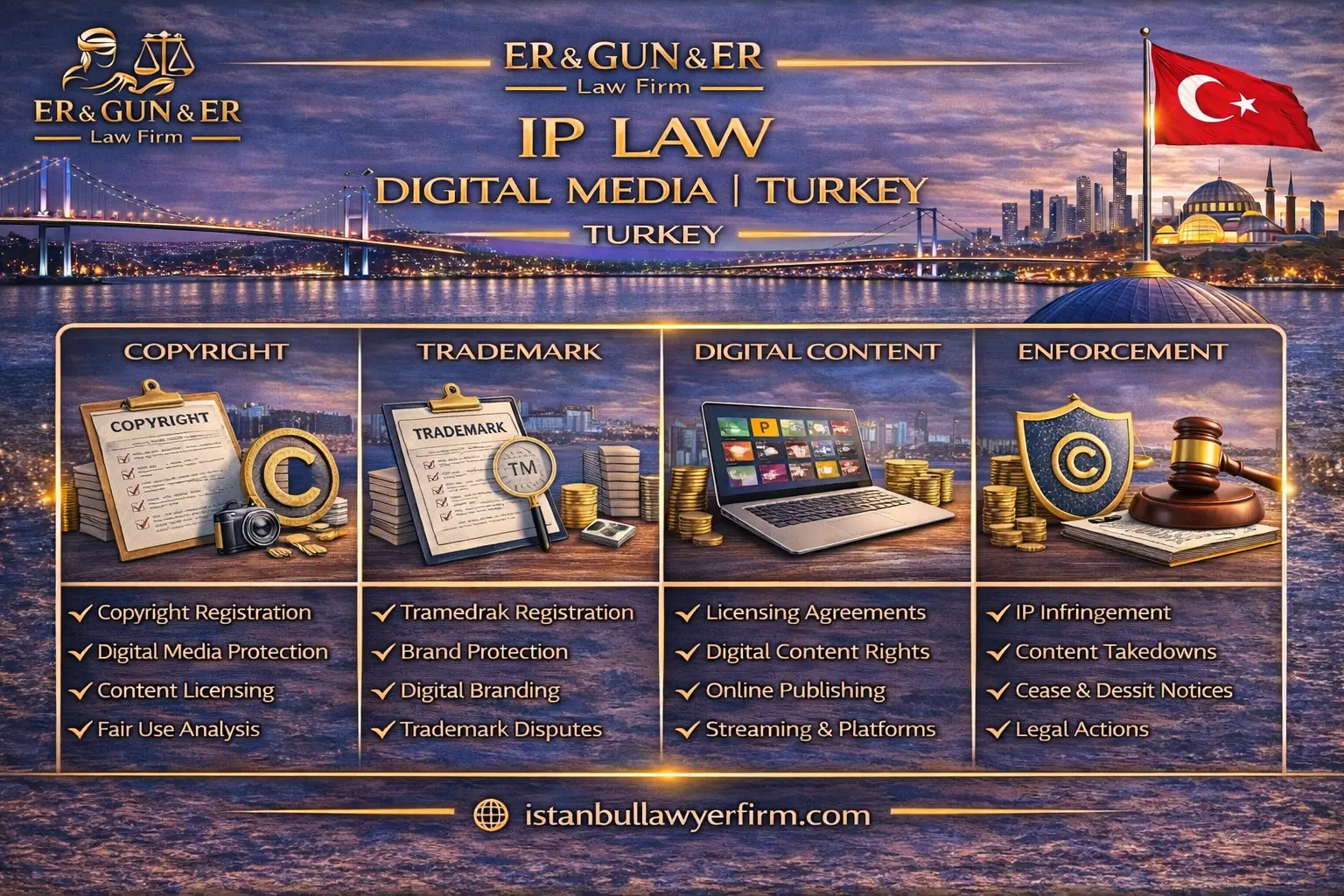
Digital media disputes in Türkiye escalate quickly because content moves faster than formal letters and because screenshots can disappear overnight. A rights holder who delays evidence collection often loses the clean proof trail needed to persuade a platform or a court. The correct approach is to treat IP law digital media Turkey as a workflow where you secure evidence first, then choose the platform and court steps that fit the right claimed. Many conflicts start as routine reposting and turn into monetization, reputation damage, and brand confusion within days. Copyright infringement Turkey internet scenarios frequently involve multiple jurisdictions, multiple accounts, and reused files where the original upload history matters. A tenant-like mindset of keeping receipts applies here, because your most persuasive tool is a chronological file of creation proof, licenses, invoices, and notices. Platforms may react to a clear record, but their internal standards are not stable and their thresholds are not published as legal rules. practice may vary by authority and year — check current guidance. If you want an enforceable outcome, you must align what you claim with what you can prove, and you must avoid statements that cannot be supported. Early file review by a Turkish Law Firm can identify missing chain-of-title documents and prevent avoidable escalation into expensive litigation.
Digital media IP overview
Digital media rights in Türkiye sit at the intersection of copyright, trademark, unfair competition, and contract law. Online disputes usually start with a post, a listing, or an advertisement that reuses a protected asset without permission. A rights holder should begin by defining what right is being asserted and what document proves ownership or authorization. IP lawyer Turkey digital media work is typically evidence-driven because a platform and a judge will ask for proof before they consider narrative. Evidence should be collected in a manner that preserves time, URL, account identifiers, and the full context of the infringement. A common mistake is saving only a cropped screenshot, which later prevents verification of the source and the scope. Another mistake is contacting the infringer first and giving them time to delete or modify posts. A disciplined file includes creation proof, publication history, licenses, and any prior permissions granted. It also includes a record of monetary harm signals such as monetization links, sponsorship mentions, or sales listings, without inventing amounts. Cross-border aspects matter because servers, advertisers, and account owners may be outside Türkiye. The safest starting point for the legal framework is the IP protection guide and the official texts on the state portal. A rights holder who relies on hearsay about platform rules often wastes time and weakens negotiation leverage. practice may vary by authority and year — check current guidance. A coherent early strategy is to secure proof, define the claim, and then decide whether platform action, civil action, or combined steps are proportionate.
Digital content disputes are rarely limited to one asset, because once an account starts copying it often copies multiple works and multiple brand signals. Licensing questions arise immediately because the other side may claim they had permission through an agency, a freelancer, or a prior campaign. The first check is whether any written permission exists and whether it covers the relevant platform, territory, duration, and monetization method. digital content licensing Turkey should be drafted and stored as if it will be shown to a platform reviewer who has limited time and to a judge who needs clarity. A rights holder should map each post to a specific licensed work or to a specific unauthorized use so the request is precise. Vague statements such as they stole my content often fail because they do not identify the protected elements. A clear request includes URLs, timestamps, and a short explanation of why the use is unauthorized. Platform steps can be useful, but they are not a substitute for preserving evidence that can survive a court file. The legal framework changes less often than platform policies, so the core rights should be checked against official sources. You can review official law texts through the Mevzuat portal without relying on unverified summaries. practice may vary by authority and year — check current guidance. When representation is needed, coordination by an Istanbul Law Firm can keep the platform communications aligned with later litigation positions. The objective is not aggressive messaging, but consistent proof presentation across every channel. This consistency matters because contradictory claims in emails, platform forms, and petitions can be used against the claimant.
Digital media IP also overlaps with commercial conduct, because online copying is often a sales strategy rather than a fan action. Unlicensed use can trigger claims under unfair competition frameworks when it confuses consumers or exploits another party’s market reputation. unfair competition online Turkey discussions typically require proof of commercial intent, comparative claims, or misrepresentation patterns rather than emotional statements. The key is to collect the full page context, including price, checkout links, and account bio claims, because context proves commercial motivation. In many cases, the rights holder must decide whether to pursue a narrow takedown or a broader action that addresses repeated conduct. A narrow action may remove one post but leave the account active, so monitoring and follow-up documentation become part of the plan. A broader action may involve court relief, and that requires a clean chain of title and a coherent explanation of harm. The commercial setting also triggers contract issues with agencies and vendors that previously accessed the content. Rights holders should therefore review their broader commercial governance and contracting structure in parallel. A useful orientation to the business interface is the business and commercial law overview. Evidence discipline remains the anchor because courts and platforms will not guess what happened. practice may vary by authority and year — check current guidance. A careful approach also reduces collateral risks such as defamation allegations arising from public accusations. The safest position is to communicate through provable steps and reserve public statements until the file is secure.
Copyright basics Turkey
Copyright protection in Türkiye is built around protected works and the exclusive rights attached to those works. In online settings, the practical question is whether the disputed asset qualifies as a protected work and whether the claimant can show authorship or chain of title. The statutory framework can be reviewed through the official copyright law text rather than through secondary posts. copyright law Turkey online content disputes typically involve photographs, videos, graphics, written posts, and software-like elements embedded in content. Protection analysis is fact-specific because originality and authorship are assessed through the content and its creation context. A rights holder should avoid asserting that every idea is protected, because protection focuses on expression rather than on abstract concepts. Online copying can be partial, such as copying a segment of a video or a portion of a graphic, so proof should show the copied segment clearly. A platform may accept a claim based on a clear match, but the claimant still needs court-grade proof if the dispute escalates. A common early mistake is relying on metadata alone, because metadata can be challenged and can be altered. Another mistake is relying on a private watermark as the sole proof, because watermarks can be added later. The stronger file combines drafts, raw files, upload history, invoices, and contemporaneous communications about creation. When the content was created by employees or freelancers, the chain of title must be documented through employment or assignment instruments. practice may vary by authority and year — check current guidance. A practical goal is to build a file that answers the same question in every forum, which is who owns what and what exactly was copied.
Enforcement choices depend on whether the dispute is about removal, compensation, or prevention of repeated use. A claimant should separate platform outcomes from legal outcomes because a platform removal does not automatically resolve contractual disputes or damages discussions. copyright infringement Turkey internet matters often involve reposting on multiple accounts, so the file must show the pattern rather than one isolated post. In many cases, the best early step is to preserve evidence through a notary-like method and then submit platform notices using the same evidence pack. The claimant should also avoid sending informal threats that can later be framed as bad faith or extortion. If the claimant intends to negotiate, negotiation should be anchored in the documented rights and not in speculative penalty claims. Where the dispute becomes adversarial, consultation with a lawyer in Turkey helps align the language of notices with the evidence actually available. A careful lawyer will remove statements that cannot be proven and will focus on the record. Courts will typically ask for authorship and chain-of-title proof before they assess scope of infringement. Platforms may ask for the same, but their forms compress issues into short fields and require disciplined summaries. practice may vary by authority and year — check current guidance. The claimant should also assess whether the infringer is a commercial actor, because commercial exploitation often supports broader claims and stronger relief requests. If the infringer is a competitor, the dispute may also overlap with commercial conduct and unfair competition arguments. The claimant should keep a clean history of prior permissions, because permission questions are common defenses. The claimant should also preserve correspondence showing whether the infringer was warned and whether they repeated the conduct after warning. Repeat conduct is often easier to prove than intent, but it still needs chronological documentation. A rights holder who builds a structured file early is usually in a better settlement position because the other side can see what will be produced in court.
Digital copying frequently occurs through social accounts that claim to be fan pages, news pages, or aggregator accounts. social media content theft Turkey files often involve rapid reuploads and edits that change the appearance but preserve the core protected expression. The claimant should preserve the full post context including captions, hashtags, and monetization cues because those elements show use and reach. If the infringer changes the post after notice, the claimant should preserve both versions to show the alteration timeline. A frequent defense is that the content was public, but public availability does not equal permission to exploit commercially. Another defense is that attribution was provided, but attribution alone is not the same as a license. A claimant should also assess whether the infringer used the content to sell goods, drive traffic, or boost sponsorship value, because that context can influence remedy strategy. Where the platform provides a reporting tool, the claimant should fill it with precise URLs and attach proof that the claimant owns the content. Platforms may ask for a signed statement, but the claimant should avoid overstating facts that cannot be proven. practice may vary by authority and year — check current guidance. If the claimant needs to proceed to court, the claimant should have a clean chain-of-title narrative that starts at creation and ends at the disputed post. The file should also include the claimant’s own publication history, because first publication timing can matter in credibility and comparison. When the claimant used collaborators, the claimant should document their contributions and the agreed ownership outcome. A well-managed copyright file is less about legal rhetoric and more about reducing ambiguity. The claimant should treat every screenshot and file export as something that may be examined under oath. This discipline is the difference between a strong claim and an expensive dispute with unclear outcome.
Works and authorship proof
Authorship proof is the core vulnerability in online disputes because many creators publish without preserving drafts or production files. The first task is to collect raw files, project files, and edit histories that show the work existed before the alleged copying. Where a team worked on the content, the file should clarify who created what and what rights were assigned or retained. A common mistake is relying only on a published post, because a published post does not show the internal creation process. Rights holders should store working files in a stable archive with timestamps and access logs where possible. When disputes escalate, notary-style preservation can be valuable, but it must be planned carefully. evidence notarization IP Turkey practices typically focus on capturing URLs, timestamps, and the visible infringement context in a formal record. The claimant should preserve the infringement page, the profile page, and any sales page that the infringement connects to. If the infringing content is embedded in a story or temporary format, rapid capture is essential because the content may expire. The claimant should also preserve the claimant’s own original post history to show continuity and ownership. If the claimant changed handles or pages, the file should include proof of control over the account history. practice may vary by authority and year — check current guidance. The objective is to build a chain that a neutral reviewer can follow without relying on trust. A clean chain-of-title and authorship proof pack usually improves platform takedown success and reduces denial risk. It also sets the stage for court relief if platform steps fail.
Proof in digital disputes is rarely a single document, so the file should combine technical indicators with human documentation. Technical indicators include upload metadata, file hashes, and EXIF-like data, but these indicators should be supported by invoices, contracts, and communications. Human documentation includes briefing emails, draft approvals, and payment records that show commissioning and delivery. When infringement occurs on visual platforms, the scope of copying must be shown with side-by-side context, not with isolated thumbnails. Instagram infringement Turkey cases often turn on whether the copied post is identical, substantially similar, or transformed, and that assessment depends on clear visual proof. The claimant should also capture engagement indicators such as view counts and comments, but without making unsupported claims about revenue. If the infringer blocks the claimant, the claimant should record the block and use alternative lawful methods to capture the content. If the infringer deletes posts after notice, the claimant should preserve the pre-deletion record and the notice timeline. Where collaboration agreements exist, the claimant should show who had authority to publish and who had authority to license. If the work was created under employment, the claimant should preserve employment documentation and job scope evidence. If the work was created by a contractor, the claimant should preserve the assignment or license documents and payment records. When the file must be explained in English for foreign stakeholders, an English speaking lawyer in Turkey can translate the evidence narrative while preserving Turkish-facing source documents. practice may vary by authority and year — check current guidance. The claimant should avoid speculative statements about intent and focus on what the record proves. A strong record is usually the fastest path to resolution because it narrows defenses to technicalities.
Creators should also plan authorship proof before disputes happen by implementing basic documentation habits. Each project should have a brief, a delivery email, and a final approved file stored with date and version information. If multiple versions are published, store the sequence and the reason for changes so later comparisons are not confusing. If the work is licensed to a brand or an agency, keep the license scope document and keep the payment record that corresponds to that scope. If a platform requires proof of ownership, a clean license and assignment pack can often satisfy the reviewer more quickly. Where a work is a compilation, the file should identify the original elements and the third-party elements to avoid overclaiming. Overclaiming harms credibility because the other side can show that some parts are not owned by the claimant. If a rights holder uses stock assets, keep the stock license and the purchase record to show lawful use. If the dispute involves a series of works, create a table in your internal file that maps each work to its proof pack, but do not present it as a public list in the petition unless instructed. When evidence is captured, preserve full-page captures rather than selective snippets to prevent allegations of manipulation. If the content is time-sensitive, record the capture method and preserve the original file outputs. If a notary record is obtained, keep the full notary text and the annexes, not only the cover page. practice may vary by authority and year — check current guidance. A disciplined evidence process is not about complexity, but about reducing ambiguity in a way decision makers can verify. It also reduces cost because counsel does not need to reconstruct the story from scattered messages. The rights holder should treat evidence as an asset that protects both enforcement and negotiation positions.
Licensing and assignment clauses
Licensing problems in digital media are usually created by unclear scope and unclear ownership language. A license should state the work, the permitted platforms, the territory, the duration, and whether monetization is allowed. A license should also state whether sublicensing is allowed, because many disputes arise when agencies pass content to third parties without clear authority. digital content licensing Turkey files often fail because the license is drafted as marketing language rather than as enforceable scope. The contract should define deliverables and versions so later edits and derivatives are not disputed. It should also define crediting terms if credit is required, because credit disputes often create reputational conflict. Where payment is tied to usage scope, the payment schedule should be aligned with the scope so the file is coherent. A license should include a termination mechanism and a post-termination takedown obligation where relevant. It should also define what happens to content already published when the license ends, because archival and reposting issues are common. A rights holder should keep signed versions and keep evidence that the counterparty received them. For general contracting discipline, the contract law overview provides a practical framework for enforceability thinking. In many disputes, the court focuses on what was agreed in writing rather than on what parties assumed. practice may vary by authority and year — check current guidance. A careful drafting review by a law firm in Istanbul can reduce ambiguity by aligning scope, payment, and termination language with evidence expectations. The best contract is the one that makes unauthorized reuse easy to prove.
Assignment clauses are especially sensitive because they determine who can sue and who can authorize enforcement steps. A contract should state whether rights are assigned fully or licensed, and it should avoid mixing terms that create confusion. influencer contract Turkey IP disputes often arise when influencers reuse brand assets beyond campaign scope or when brands reuse influencer content beyond the agreed period. An influencer contract should define whether the brand can edit, repost, and boost content through paid ads, because boosting changes distribution and may change licensing assumptions. The contract should also address whether the influencer may reuse the content on their own channels and whether the brand may reuse it on its channels. If the influencer uses third-party music or stock visuals, the contract should allocate responsibility for clearing those rights and preserving proof. A common mistake is assuming the platform license covers everything, which later fails when content is reused off-platform. Where the content includes software elements, templates, or code-like assets, contract terms should address source delivery and usage rights. For software-heavy campaigns, the software agreement guide can help align licensing language with technical reality. practice may vary by authority and year — check current guidance. A disciplined reviewer will also check that the signatory authority is clear so the counterparty cannot later deny consent. If the agreement is managed by an agency, the contract should state whether the agency acts as agent or principal because that affects who holds rights. The file should also include payment records tied to the scope, because payment history often supports interpretation. A clean contract reduces friction because both sides know what is permitted and what is not. It also reduces the need for aggressive takedown action because disputes can be resolved through documented scope reading.
Licenses for music and audiovisual content require additional precision because rights are layered and ownership is fragmented. music licensing Turkey digital issues often involve separate rights for composition, performance, and recording, and confusion about who cleared what. A digital media contract should require the party providing music to confirm clearance and to provide proof of the licenses obtained. If a brand uses a soundtrack in an advertisement, the contract should define whether the usage is organic, paid, or broadcast-like, because different channels can trigger different clearance needs. If a creator uses a popular track without clearance, the creator should not assume that a platform claim system will solve legal exposure. Contracts should allocate responsibility for infringement claims and define cooperation obligations for takedowns. They should also define preservation duties, such as storing project files, raw footage, and clearance emails. Where a dispute arises, the party with the better clearance file usually has stronger defense leverage. The contract should also address moral rights style objections, such as objections to distortion or context, because these can arise even when a license exists. It should define whether the license is exclusive or non-exclusive and whether the licensor can grant rights to others. practice may vary by authority and year — check current guidance. In high-value campaigns, consultation with Turkish lawyers can help align contract language with the actual media workflow so clauses are not purely symbolic. The practical goal is to prevent later platform removals and to prevent internal disputes about who caused a takedown. A well-drafted license also supports faster enforcement because you can show the court what rights you control. It reduces negotiation time because the counterparty cannot plausibly claim scope confusion. The best approach is to draft for clarity, store proof, and treat each license as an enforceable evidence item rather than as a marketing attachment.
Platform content takedowns
Platform takedowns are fastest when the right is identified precisely and supported by a clean file. Start by capturing the infringing URL, the account handle, the timestamp, and the full page context. Preserve the content in a way that shows the surrounding text, captions, and any monetization cues. If the platform offers a complaint form, fill it with exact links and avoid broad accusations. Attach or reference your ownership proof, such as raw files, publishing history, and license chain documents. A takedown request should state which work is copied and which part is copied, not only that copying occurred. If the post is a video, capture the frame sequence and the title field because reposts can change thumbnails. If the post is a story or temporary reel, capture immediately and store the original capture files. For YouTube takedown Turkey legal scenarios, align your claim with the platform category you select, because misclassification triggers denial. Do not state platform timelines as facts, because review speed depends on internal queues and policy changes. Use calm language and do not threaten criminal action inside the platform form. If the account is likely to delete content, secure evidence before sending any warning message. If multiple posts are involved, submit a structured set of links rather than repeating the same text for each. Keep copies of every submission confirmation so you can show what was reported and when. If the platform requests counter-notice handling, be prepared with your next step plan and evidence.
A platform notice is stronger when it mirrors the evidence pack you would later use in court. Keep a single folder that contains the original work, the alleged copy, and the comparison notes. Include a short chain-of-title explanation that names the creator and the commissioning party where relevant. If your claim relies on assignment, attach the signed assignment pages and the delivery email. If you rely on a license, attach the license scope pages that show platform permission boundaries. Avoid uploading documents that contain unnecessary personal data, because over-disclosure creates secondary risk. When personal data is involved in screenshots, consider a compliance review using the KVKK audit defense guide. Your summary should focus on what is visible and provable, not on intent or motive. If you anticipate a later formal record, preserve the same captures for evidence notarization IP Turkey so you do not rely on platform archives. Many platforms accept a signed statement, but the statement should not include facts you cannot verify. If the other side sends a counter-notice, you should answer with documents rather than with long explanations. Where the claimant is foreign, an English speaking lawyer in Turkey can align the wording with Turkish-facing evidence standards. Keep every email acknowledgment and ticket number, because it confirms the date of your report. If the platform refuses action, record the refusal text because it may later support urgency arguments. Do not treat a takedown as final, because repeated uploads may require ongoing monitoring and repeat filings.
If platform steps fail or the harm is ongoing, the file should be ready for a civil escalation path. Escalation begins with confirming jurisdiction, identifying defendants, and preserving the most current copies of the infringing pages. A well-prepared platform record helps, but courts still expect independent proof that survives deletion. This is why the capture method and storage format matter as much as the claim label. If the infringer is a business, you should also collect corporate identifiers and storefront links to show commercial context. If the infringer is anonymous, you should record every handle change and every profile link to preserve continuity. Before filing, align your narrative with commercial dispute strategy in the commercial litigation guide. Courts often ask why platform steps were insufficient, so keep a short explanation tied to documented refusals or repeated uploads. Do not assume that a platform denial proves the claim is weak, because denial can be procedural. Do not assume that a platform acceptance proves the claim is legally complete, because platforms apply internal policies. practice may vary by authority and year — check current guidance. If urgency is high, build a tight record that shows ongoing access, ongoing confusion, and inability to stop harm through platform tools. Where multiple rights are implicated, separate them and attach the evidence for each right distinctly. Coordinated handling by a Turkish Law Firm can keep platform communications consistent with later petitions. The objective is to prevent contradictions that allow the other side to exploit your earlier statements.
Social media misuse cases
Social media misuse often looks minor at first, but it can cause brand dilution and revenue loss quickly. The first step is to identify whether the misuse is copying, impersonation, unauthorized advertising, or leaked content. social media content theft Turkey is usually proven by showing the original post and the copied post with timestamps. Capture the full profile page as well, because profile claims and bios can demonstrate misrepresentation. If the infringer edits the caption, store the edited version and the original version to show the change. If the infringer blocks you, record the block event and use lawful alternative viewing methods for capture. Instagram infringement Turkey frequently involves reposted reels where audio and overlays are changed to disguise copying. In those cases, preserve the audio track and the visual sequence, not only a still image. Document whether the infringer tags sponsors or uses shopping features, because that shows commercial leverage. If the infringer runs paid ads, capture the ad library entry or the promoted tag if it is visible. Avoid public accusations before evidence is secured, because posts can be deleted and comments can escalate. If you send a warning, keep it short and attach the ownership proof rather than debating morality. If the other side claims permission, request the written license and store the response as part of the chain. Where the file is sensitive, a lawyer in Turkey can help preserve the record without overstatement. practice may vary by authority and year — check current guidance.
Impersonation cases require separating brand identity evidence from content ownership evidence. Save the account URL, the username, the profile photo, and the claims made in the bio. If the account uses your trademark or brand name, capture the full set of profile elements and highlights. If the account messages your customers, store message screenshots with full timestamps and sender identifiers. If the account solicits payments, capture the payment instructions because they show intent and harm risk. When a fake account uses your staff images, preserve the original staff photo sources to show prior control. If the misuse involves deepfakes or manipulated videos, preserve the original source file that was altered. Also preserve the alteration indicators, such as inconsistent frames or metadata, without claiming technical certainty. If you work with an agency, review whether any prior campaign granted permission to reuse assets. If permission was limited, collect the contract and the scope paragraph that proves the limit. A structured response avoids mixing privacy claims and IP claims in one statement. If personal data is present, consider how disclosure is handled so you do not create new compliance exposure. In practice, Turkish lawyers often recommend documenting both the public post and the account history. They also recommend keeping a calm communication tone to reduce counter-accusations and defamation risk. practice may vary by authority and year — check current guidance.
Social media disputes often require a staged approach because one platform action rarely ends repeated copying. Begin by securing the evidence pack, then choose whether to send a platform notice, a lawyer notice, or both. If the infringer is a small creator, a narrow notice may resolve the matter without litigation. If the infringer is a commercial reseller, a narrow notice may simply trigger migration to another account. In those repeat cases, monitoring becomes part of the enforcement plan and should be documented. Keep a spreadsheet internally for URLs and dates, but present evidence in narrative form in petitions. Avoid claiming you are entitled to specific penalties, because such numbers depend on fact and forum. If you need to communicate with foreign stakeholders or platforms, keep the terminology consistent across languages. An English speaking lawyer in Turkey can help keep the file consistent while coordinating cross-border communications. If the infringer threatens a counterclaim, preserve that threat and avoid escalation in public. If the infringer offers a settlement, demand that the settlement is written and that the scope is precise. Settlement should state whether the infringer will delete backups and refrain from reuploads. Settlement should also state what happens to already published copies and derivative edits. After resolution, keep the evidence pack, because later recurrences are easier to prove with a prior baseline. practice may vary by authority and year — check current guidance.
Trademark use online
Trademarks are frequently misused online through profile names, ads, domain redirects, and marketplace listings. The legal analysis starts by identifying the registered sign and the scope of goods or services relevant to the dispute. trademark infringement online Turkey issues often include lookalike product pages that imitate official branding and packaging. Preserve the listing page, the seller page, and the checkout flow to show commercial context and confusion risk. If the infringer uses your mark in a keyword ad, capture the ad text and the landing page together. If the infringer uses your mark in a handle, capture the handle history if the platform shows changes. The statutory framework for trademark rights can be reviewed in the Industrial Property Code text. Do not quote article numbers unless you confirm them in the official source, because summaries can be outdated. A rights holder should also check whether the use is nominative, descriptive, or misleading, because context matters. Online disputes often involve multiple sellers, so evidence should show whether the seller is the same entity. If the infringement is tied to counterfeit goods, preserve evidence of shipment and packaging where available. If the infringement is tied to services, preserve customer communications that show confusion, without revealing unnecessary personal data. When the infringer is local and commercial, consultation with a law firm in Istanbul can help structure notice and evidence. The goal is to stop misuse while keeping statements limited to what can be proven. practice may vary by authority and year — check current guidance.
Enforcement planning starts with deciding whether the immediate objective is removal, correction, or prevention of repeat use. A clean portfolio record helps because platforms and courts often ask whether the mark is registered and by whom. You can verify registration procedures and services through the TURKPATENT website. trademark enforcement Turkey typically combines a platform request with a formal notice and, if needed, court steps. A platform may remove a listing, but a repeat seller may reopen under a new account, so monitoring matters. When you send a notice, include the registration number details from official records and avoid exaggerating scope. Keep the notice short, attach the registration printout, and attach the infringement captures with timestamps. If the infringer claims authorized distribution, request documentation of supply chain and preserve the response. If the dispute overlaps with contract issues, ensure your position aligns with the underlying commercial agreements. A practical orientation for online actions is the trademark enforcement overview. Do not use the platform form to litigate complex issues, because the reviewer will not resolve contractual disputes. If the infringer uses your mark in comparative claims, preserve the comparative statements and the product context. Coordination by an Istanbul Law Firm can keep the platform and notice steps consistent with later filings. Avoid stating platform timelines as guarantees, because internal review speed is not a legal entitlement. practice may vary by authority and year — check current guidance.
Online trademark disputes often include claims beyond trademark law, such as misleading marketing and consumer confusion narratives. A claimant should decide whether to frame the case narrowly as trademark misuse or more broadly as commercial misconduct. The broader framing can be useful when the infringer uses similar trade dress, slogans, and product descriptions. The broader framing can also be risky if it relies on facts you cannot prove, so the file should stay document-based. Preserve customer confusion indicators carefully and anonymize personal data where possible. If the infringer runs a marketplace store, capture the store name, product assortment, and contact details shown publicly. If the infringer uses your mark in metadata or hidden tags, consider how you can prove that use without speculation. When a platform refuses to act, court relief may be considered, and injunction IP Turkey court is often discussed in urgent scenarios. Do not assume urgent relief is automatic, because urgency must be demonstrated through documented ongoing harm. If the other side is a repeat counterfeiter, document repeat incidents and prior removals to show pattern. Avoid aggressive public statements, because they can create defamation exposure and distract from the core claim. A careful strategy review by a best lawyer in Turkey will usually focus on narrowing the issues to provable points. The review will also check whether your own brand usage is consistent, because inconsistent usage can create defenses. It will also check whether there are any prior coexistence arrangements or authorized distributor relationships. practice may vary by authority and year — check current guidance.
Domain names and cybersquatting
Domain disputes usually start when a third party registers a name that mimics a brand and routes traffic for profit. The first step is to capture the domain resolution behavior, the landing page, and any redirect chain. domain name dispute Turkey files often require showing confusing similarity and lack of legitimate interest with clear evidence. Preserve WHOIS-like data where available and store registrar information shown on public lookup outputs. If the domain hosts a storefront, capture the product pages, contact details, and payment methods displayed. If the domain is parked with ads, capture the ad categories and the keyword signals because they show monetization intent. If the domain forwards to social accounts, capture the linked account pages to show coordinated misuse. If the domain uses your logo or copyrighted visuals, preserve those elements in the same evidence pack. Avoid claiming the registrant identity is confirmed unless you have verified data, because privacy masking is common. A rights holder should also check whether the domain was registered before the trademark filing, because chronology matters. The appropriate route can depend on the extension and registrar policies, so you should not assume a single universal process. practice may vary by authority and year — check current guidance. Keep your own trademark certificates and business identifiers ready because domain complaints often require them. If the registrant offers to sell the domain, preserve the offer because it may show intent, but do not negotiate in a way that creates admissions. Early file review by a Turkish lawyers team can help choose the route that fits the evidence and objective.
Domain conflicts often overlap with platform impersonation because the domain is used as a hub to collect credentials or payments. A tenant of the domain may change content quickly, so evidence capture should be repeated when changes occur. Capture the domain at different times and store each capture with a time marker so the change pattern is provable. If the domain hosts a phishing-like form, preserve the form fields and disclaimers without submitting personal data. If email addresses are used on the site, capture them because they can link the domain to other infringing activity. If the registrant uses privacy masking, you may still collect indirect identifiers such as payment instructions or contact channels. Avoid sending informal threats that could be used as leverage in later negotiations. If you send a cease and desist, keep it short and attach only what is needed to establish rights. A rights holder should also check whether any distributor or agency registered the domain under a legitimate prior arrangement. If such an arrangement existed, collect the contract and the termination record to show authority ended. If the domain is used for counterfeit sales, coordinate evidence with trademark and unfair competition claims carefully. A disciplined escalation plan drafted with a lawyer in Turkey helps avoid contradictory statements across parallel complaints. The plan should identify the objective, such as transfer, suspension, or stop of misleading use. It should also identify what proof will be reused across platforms, registrars, and courts. practice may vary by authority and year — check current guidance.
Domain disputes can be cross-border because registrars and hosting providers may be outside Türkiye. Cross-border complexity increases the value of clear, neutral documentation that can be shared with foreign service providers. Preserve an English summary for internal use, but keep the original Turkish documents and certificates intact. If you need bilingual coordination, keep terminology consistent across emails, platform forms, and petitions. Where a registrar asks for proof of rights, provide official trademark certificates and a short explanation of confusing similarity. Do not overstate consumer harm without supporting captures, because unsupported claims reduce credibility. If the other side offers a transfer for money, evaluate the offer carefully and preserve the negotiation record. A settlement should be written and should include commitments not to register similar domains again. Settlement should also address whether redirects and archived copies will be removed or disabled. If settlement fails, move to the chosen formal route with the evidence pack already prepared. If the matter is time-sensitive, document urgency through active redirects, active sales pages, and customer confusion captures. In complex brand disputes, coordination by a law firm in Istanbul can align domain actions with trademark and content actions. Coordination should also consider data privacy exposure if the domain collected user information. Keep your internal incident log because repeat offenders often reuse similar patterns across new domains. practice may vary by authority and year — check current guidance.
Influencer and agency contracts
Influencer deals fail most often when the contract does not match the actual distribution workflow. The core question is who owns the raw footage, the edited deliverables, and the derivative cuts made for different platforms. The agreement should define whether rights are assigned or licensed, and it should avoid mixing labels that create ambiguity later. A well drafted influencer contract Turkey IP structure specifies permitted platforms, territories, duration, and whether paid boosting is allowed. It should also address whether the brand can edit, crop, subtitle, or combine the content with other assets. If whitelisting or brand-run advertising is contemplated, the scope should be written and supported by a separate approval record. The contract should allocate responsibility for third-party assets such as music, fonts, stock footage, and brand-supplied material. It should state what proof of clearance will be delivered and where that proof will be archived. Deliverables should be defined by file type, resolution, length, and version naming so later proof is not confused. Approval mechanics should be documented because disputes often arise when a party claims content was never approved. If the influencer must remove posts after termination, the contract should define removal obligations in realistic terms. It should also define what happens to copies already reposted by third parties and whether cooperation will be provided for platform notices. Payment milestones should be tied to delivery and approval so the payment record aligns with the content record. Moral and reputational constraints should be written narrowly so they are enforceable and not purely subjective. Dispute clauses should focus on evidence and written communications rather than on threats. practice may vary by authority and year — check current guidance.
Agency involvement adds a second chain-of-title layer that must be controlled in writing. The contract should state whether the agency signs as principal or as agent, because that determines who can grant rights and who can be sued. If subcontractors shoot or edit the content, the file should include their assignments or work-for-hire style acknowledgments so the ownership story is coherent. A frequent problem is that an agency can approve content verbally, then later deny approval when the campaign underperforms. The safest approach is to require written approvals and to store them with the final delivered files. Brands should also control access to drafts because leaks are common in fast-moving campaigns. If the campaign involves consumer data, tracking links, or audience lists, the contract should include data handling and confidentiality duties. If a dispute arises, a platform may request proof that the brand is authorized to act, so signatory authority should be preserved. If the influencer plans to reuse the content as portfolio material, the reuse scope should be written and limited. If the brand wants perpetual use, the brand should state it clearly and align it with compensation and termination language. It is safer to separate broad usage rights into a separate schedule so it is not lost inside marketing language. If the brand expects exclusivity, the exclusivity definition should be precise and tied to product categories and time periods. A brand should avoid requiring impossible content guarantees because the evidence will not support them. Coordination by an Istanbul Law Firm can help align contract language, approval records, and enforcement posture so later takedown steps do not contradict earlier permissions. practice may vary by authority and year — check current guidance.
Termination clauses should be drafted as operational steps rather than as moral judgments. The contract should define what happens to published posts, archived copies, and planned reposts once the relationship ends. If the brand wants removal, the contract should state the removal request method and require written confirmation of completion. If the influencer wants to keep posts live, the contract should define whether that is permitted and whether monetization can continue. The contract should also define whether dispute escalation requires a notice period, and whether notice must be sent to a specific address. If notices are sent only by messaging apps, service disputes arise later and weaken both sides. The safer route is to require email delivery and to keep delivery confirmations. The contract should also define the dispute evidence pack, including the final files, approval emails, payment receipts, and clearance documents. If a party alleges breach, the first review should be the record, not assumptions about intent. If settlement occurs, settlement terms should be written with clear scope so the parties know what claims are released. If the campaign involved multiple jurisdictions, the governing law and forum should be stated clearly to prevent parallel filings. If the parties plan to use a platform complaint as a remedy, the contract should define cooperation obligations for platform submissions. Any claim about performance metrics should be treated carefully because metrics can be manipulated and can vary by platform reporting methods. Avoid contract language that treats impressions or conversions as guaranteed outcomes, because it becomes a credibility problem in later disputes. A practical contract aims to reduce ambiguity so enforcement is based on documents, not on memory. practice may vary by authority and year — check current guidance.
Music and audiovisual rights
Music and audiovisual rights issues escalate because a single clip can contain multiple layers of rights owned by different parties. A rights holder should identify whether the dispute is about composition rights, recording rights, performance rights, or audiovisual fixation rights. A common mistake is treating a platform library selection as a universal clearance for every use and every distribution channel. For advertising, synchronization-style usage is often the sensitive point because it connects music to commercial messaging. In music licensing Turkey digital practice, the file should show which track was used, what license was obtained, and what the permitted use scope was. If the content is re-edited or republished, confirm whether the license permits re-edits and derivative cuts. If the content is boosted through paid advertising, confirm whether the license covers paid distribution or only organic posting. If the music is supplied by a producer, preserve the producer agreement and the proof that the producer had rights to license the recording. If the music is user-generated, preserve the raw project files that show creation and first fixation. If the dispute involves a sample, preserve proof of sample clearance or proof that the sample is original. If the content includes multiple tracks, map each track to its clearance proof so later comparisons do not confuse reviewers. If a platform claim arises, capture the claim notice text and store it with the publishing URL and timestamp. If the other side threatens a takedown, request their claimed rights basis in writing and preserve the response. Avoid stating that a claim is false without checking your clearance file first. practice may vary by authority and year — check current guidance.
Platform rights management systems can be useful signals but they are not court findings and they do not settle ownership disputes. A platform may block, mute, or monetize content based on internal rules that change without warning. If a dispute becomes formal, the strongest defense is a documented clearance pack rather than a screenshot of a platform claim dashboard. Preserve licenses, purchase receipts, email clearances, and any scope confirmations that explain where the track can be used. If the content is part of a larger series, keep consistent clearance naming so files are retrievable and comparable. If the same track is used across multiple campaigns, keep a master license record and link each campaign to that record with a written reference. When a counterparty claims you had permission only for one platform, check whether your license is platform-specific. If your license is silent on platforms, do not assume breadth, and seek clarification in writing. If the dispute involves a commissioned soundtrack, preserve the assignment or exclusive license that confirms ownership of the final master. If the dispute involves a collaboration, preserve split agreements and delivery confirmations so authorship is not later contested. If the opposing party is a commercial actor, document monetization and commercial use context without guessing revenue figures. If you intend to pursue enforcement steps, align your narrative with the official law texts and keep claims limited to provable points. A Turkish Law Firm can help audit a clearance pack and remove weak assertions before a platform dispute becomes a court dispute. practice may vary by authority and year — check current guidance.
Audiovisual disputes also require careful chain-of-title work because footage often contains people, locations, and branded objects that create separate permissions. If a production used location releases, keep the signed releases and keep proof of the location authority. If the production used talent, keep talent agreements and consent records that define usage scope. If the production used stock footage, keep the stock licenses and the purchase receipts that tie to the exact clip ID. If the production used an agency editor, keep the editor agreement so the editor cannot later claim ownership of the final cut. If the dispute involves a short clip used in news-like commentary, the context and purpose can matter, and the file should preserve the full post context. If the dispute involves compilation videos, preserve the editing timeline that shows how the clip was used. If the dispute involves reuploads, preserve multiple captures at different times to show repetition and refusal to stop. If a counterparty claims consent, request the consent record and do not accept informal screenshots as proof. If a rights holder plans to negotiate, negotiation should be anchored in the documented chain of rights rather than in threats about penalties. If multiple stakeholders are foreign, keep the file ready for bilingual explanations while preserving original Turkish-facing documents. If the content is used by multiple distributors, keep a distribution map so you can identify which party exceeded scope. If the dispute is time-sensitive, secure proof first, then decide whether platform steps or court steps are proportionate. Avoid overclaiming rights in music or footage that you did not actually clear, because the counterparty will exploit overclaiming. practice may vary by authority and year — check current guidance.
Unfair competition online
Unfair competition claims often succeed where pure IP claims struggle, because online misconduct is sometimes about confusion and misrepresentation rather than about exact copying. The analysis focuses on whether a competitor’s conduct is designed to divert customers through misleading presentation or deceptive comparisons. Preserve the full customer journey, including the advertisement, the landing page, and any checkout prompts, because context proves commercial intent. Document whether the competitor uses similar trade dress, similar slogans, or similar product descriptions that create confusion. Document whether the competitor claims affiliation, authorized dealer status, or official partnership without proof. Capture reviews, endorsements, and influencer tags that create trust signals, because those signals often drive conversion. If the conduct includes comparative statements, preserve the exact statements and the product context and avoid paraphrase. A structured orientation to comparative statements is available in the comparative advertising guide. Do not assume that every aggressive marketing claim is unlawful, because legality depends on the specific wording and provable facts. Unfair competition online Turkey disputes often turn on whether the conduct is systematic and whether it targets a competitor’s market position. Preserve multiple incidents over time so you can show pattern rather than a single screenshot. Keep captures that show the competitor’s identity markers, such as business name, tax identifiers displayed publicly, and contact details. Do not make accusations about criminality unless you have verified facts, because misstatements create defamation exposure. practice may vary by authority and year — check current guidance.
Remedy strategy should be aligned with what the record can prove and with what will stop the conduct efficiently. A narrow approach may target a specific misleading page, while a broader approach may target the marketing model that repeats across channels. Evidence should be collected with timestamps and URLs so the other side cannot deny what was published. If the other side deletes content after notice, preserve both the pre-deletion and post-deletion record to show evasive behavior. If the other side uses multiple accounts, preserve cross-links that show common control without making unsupported identity claims. Capture pricing and discount claims carefully, because misrepresentation is often embedded in price anchoring and limited-time offers. If the conduct targets your brand name indirectly, capture the search results context that shows diversion, but avoid speculative statements about algorithms. Preserve customer complaints and confusion messages with personal data minimized, because privacy errors can weaken a strong competition claim. If the competitor uses your content as a wrapper for their own goods, consider whether combined IP and competition claims are proportionate. In high-stakes matters, a best lawyer in Turkey approach usually narrows the case to provable misrepresentations and provable diversion indicators. Do not state that a court will automatically stop the conduct, because relief depends on urgency proof and forum practice. Use notices as evidence tools, not as emotional messages, and keep a record of delivery and response. If the competitor refuses to respond, preserve the silence record and proceed with the evidence pack intact. If settlement is offered, require written terms that include non-repetition and correction steps rather than vague apologies. practice may vary by authority and year — check current guidance.
Online competition disputes often overlap with contracts, because the misconduct may be enabled by former distributors, former employees, or former agencies. Preserve the contractual history and termination notices, because they explain why access existed and when authority ended. If the dispute is about marketing materials created under a prior relationship, preserve the scope clauses that show what reuse was permitted. If the dispute is about client lists or confidential data, preserve confidentiality clauses and access logs where possible. Do not claim that data theft occurred unless you have concrete proof, because such claims are easily attacked. Focus on what is visible and verifiable, such as misleading public claims and copied public materials. If the competitor uses similar domain patterns and social handles, preserve the linkage to show a coordinated strategy. If the competitor uses fake endorsements, preserve the endorsement pages and the lack of verification indicators, without asserting certainty about identity. If the competitor claims compliance certifications, request the proof and preserve the refusal if proof is not provided. For online disputes, timing matters because misleading campaigns can run short and disappear, so evidence capture should be repeated while the campaign is active. When disputes become cross-border, keep an English summary for stakeholders while preserving original captures and Turkish-facing documents. Avoid turning the dispute into a public argument, because public argument often creates collateral legal risk. Keep communications private, documented, and consistent across platforms and letters. A disciplined approach is to secure proof, send a structured notice, and escalate through court only when the file supports urgency. practice may vary by authority and year — check current guidance.
Evidence and notarization
Evidence in digital media disputes must be collected as if the content will disappear, because deletion and edits are routine. Begin by capturing the full URL, the account handle, the timestamp, and the full page view, including comments and monetization cues where visible. Save the capture files in an unedited format and store them with a short note describing what was captured and when. If you later need formal use, consider a capture method that produces a verifiable record with annexes that show the content precisely. evidence notarization IP Turkey practices typically aim to preserve the state of a page at a specific time so later denials are less credible. Do not rely only on screen recordings that lack visible URL and date cues, because later reviewers may question authenticity. Capture both the infringing content and your original content, because comparison requires both sides. If the infringement appears in an ad, capture the ad and the landing page together, because the landing page proves commercial context. If the infringement is in a story, capture immediately and store the raw output because the story may expire. Preserve the profile page because it can show identity claims and business contact channels. Keep copies of your own licenses and assignments so the chain-of-title story is ready. Avoid adding legal conclusions to captures, because the capture should remain factual and neutral. If you collect evidence through third parties, record who collected it and how, because chain integrity can be challenged. If the case will proceed to court, store the evidence chronologically so the judge can follow the story without guessing. practice may vary by authority and year — check current guidance.
Notarization-style steps are most useful when the infringer is likely to delete content or when you need urgent court relief later. Before formal capture, verify that the URLs open consistently and that the content is visible without requiring private login. If the content requires login, document the access method and preserve a lawful access record, because access disputes can arise later. Preserve the HTML context where possible, but do not claim technical conclusions unless you have expert support. If you capture comments, keep them in full context and avoid selective copying that can be framed as manipulation. If you use a translator for foreign stakeholders, keep the translation separate from the source and do not edit the source text. Where bilingual coordination is needed, an English speaking lawyer in Turkey can help produce an accurate narrative summary while preserving Turkish-facing source documents unchanged. If the evidence includes personal data, minimize disclosure and store the full version securely, because data mistakes can create separate liabilities. If you plan to submit to platforms, keep the same evidence pack so platform statements remain consistent with court statements. If you send a cease and desist, attach only what is needed to establish the claim and preserve proof of delivery. Do not assert platform response windows as if they are legal deadlines, because those processes change and are not stable. Keep a record of any platform refusal or non-response because it can later support urgency explanations. If the infringer alters content, capture the altered version and store it with a timestamp to show change behavior. practice may vary by authority and year — check current guidance.
A pre-litigation evidence pack should be built to answer three questions without ambiguity. The first question is what right you own and what document proves ownership or authorization. The second question is what exactly was used without permission, and where it was published, and when it was captured. The third question is why the use is unlawful under the chosen claim frame, with proof that matches each element. Do not build the pack around broad narratives, because broad narratives are easy to attack and hard to verify. Build the pack around documents, captures, and a short chronology that ties them together. If you rely on contracts, include signed signature pages and the relevant scope clauses and preserve proof of delivery. If you rely on invoices, include the invoices and the proof of payment that aligns with the invoices. If you rely on publication history, include the original upload URLs and archival captures that show continuity. If you rely on patterns, include multiple captures over time and label them with dates so repetition is provable. Avoid claiming damages amounts unless you have a documentary basis, because overstatement damages credibility. Keep your communications consistent across platform forms, letters, and petitions because inconsistency is a common defense tool. If you intend to seek urgent court relief later, keep the evidence pack ready so you can demonstrate urgency without scrambling. If the file is complex, align your strategy with what you can prove, not with what you wish you could prove. practice may vary by authority and year — check current guidance.
Injunctions and court relief
Injunctions are the primary court tool when the goal is to stop ongoing digital exploitation before the main case is decided. They are used when a post, listing, or campaign continues to cause harm while ordinary litigation would be too slow. The court will usually look for a clear right, a clear infringement record, and a credible urgency narrative. Urgency is proven through dated captures, repeated uploads, and documented platform refusals or evasive edits. A claimant should avoid presenting the dispute as a personal insult and should present it as a provable rights violation. Evidence should include the original work file, the infringement capture, and the chain-of-title document that ties the right to the claimant. If you request broad measures, you must explain why narrow measures cannot protect the right adequately. An injunction request is stronger when it identifies the specific URLs, accounts, and files that should be blocked or removed. If the infringement is commercial, capture the sales funnel and checkout prompts to show the practical harm. The phrase injunction IP Turkey court reflects that the remedy is procedural and depends on the court’s view of urgency and proof. Because courts assess file discipline, early review by a law firm in Istanbul can prevent avoidable evidentiary gaps. A strategic review by a best lawyer in Turkey can also narrow the request to measures that are enforceable and provable. The claimant should keep platform submissions consistent with the court request so the narrative does not change across forums. The claimant should also preserve service and identity proof for defendants because anonymous accounts often conceal control. practice may vary by authority and year — check current guidance.
Court relief can be designed to preserve the status quo, to prevent further distribution, and to secure evidence for the main case. A claimant should distinguish between a request to stop use and a request to compel disclosure, because proof requirements differ. Where the defendant is a business, identification can be supported by registry data, storefront details, and payment channel captures. Where the defendant is anonymous, the file should show account identifiers, linked domains, and repeated conduct that indicates common control. If the dispute is fundamentally contractual, the petition should not pretend it is purely a copyright fight. Instead, the petition should explain the license scope and show how the defendant exceeded it with specific posts. This is why copyright law Turkey online content cases often turn on what was licensed and what was not licensed. If the claimant seeks broad blocking, the claimant should explain proportionality and avoid asking for measures that impact unrelated content. If the claimant seeks removal of caches and mirrors, the claimant should support the request with proof of those mirrors. If the claimant seeks seizure of revenues, the claimant should avoid stating numbers and should focus on traceable monetization indicators. A well-structured petition uses short factual sentences and annex references, because judges decide on documents and not on long narratives. A claimant should also plan for compliance steps, because an order that cannot be implemented creates delay and frustration. When a platform is involved, the claimant should document the platform steps already attempted, including ticket numbers and refusal texts. If the case involves multiple jurisdictions, the claimant should avoid making forum statements that cannot be justified by the record. practice may vary by authority and year — check current guidance.
Injunctions do not replace the main case, because the court still needs to decide ownership, infringement, and remedies on full review. A claimant should therefore treat urgent relief as a bridge that protects the market position while the merits are litigated. If the court grants relief, the claimant should monitor compliance and capture any continuing violations as new evidence. If the defendant circumvents an order through new accounts, the claimant should document linkage and return to court with the updated record. The claimant should avoid declaring victory after one takedown, because repeat behavior is common in digital markets. A careful compliance log supports later requests for broader measures if the initial order is evaded. If the relief request includes removal of content that is already shared widely, the claimant should set expectations realistically. The court can order steps, but practical removal from all mirrors may not be fully controllable by any single defendant. This is why copyright infringement Turkey internet files often combine platform actions with court actions and monitoring. If a settlement is reached, it should include non-repetition commitments and cooperation for future reuploads. A settlement should also define what happens to archived copies and whether the defendant must disable backups. If the dispute concerns trademarks, settlement should also cover future handle names and domain registrations. If the dispute concerns licensing, settlement should state the precise scope that remains permitted, if any. The claimant should keep settlement texts and compliance proofs because later disputes often reopen what was agreed. practice may vary by authority and year — check current guidance.
Customs and border measures
Customs measures become relevant when online infringement is tied to physical goods moving across borders. A digital campaign can drive counterfeit sales that are fulfilled through shipments into or out of Türkiye. In those cases, the rights holder should treat border strategy as part of online enforcement rather than as a separate silo. The practical aim is to identify the goods, the marks, and the supply chain indicators that customs officers can recognize. A rights holder should keep trademark certificates and product identification materials ready for submission. If the infringement involves packaging and trade dress, capture those visuals and store them with the online listing evidence. If the infringer uses multiple storefronts, map the storefront names and shipping origins in a consistent record. Customs steps usually require accurate identification of rights and clear descriptions of suspected goods. Requests that are vague or overly broad can be ineffective because officers need concrete indicators. A rights holder should also preserve invoices and purchase records from test buys where lawful, because those records can show origin. If a shipment is seized or held, the rights holder should respond with documents and not with assumptions about the sender. Where counterfeit risk is high, proactive planning is more effective than reacting after products reach customers. Border measures can also support litigation by showing commercial scale and organized distribution patterns. Because border practice involves multiple agencies and technical criteria, preparation should be document-led. practice may vary by authority and year — check current guidance.
A border strategy usually starts with confirming that the relevant marks and designs are properly documented and current. Where the issue is trademark-driven, keep the registration extracts and any renewal records that prove continuing protection. If you are coordinating multiple brands, keep separate files so customs submissions remain clear and do not overlap. When planning a submission, use a structured workflow and avoid relying on informal emails that may be lost later. A practical overview of documentation and coordination steps is explained in the customs enforcement guide. That guide is useful as a process map, but each case must still be aligned with the specific goods and the specific right. If the infringement involves a registered sign, the rights holder can cross-check the statutory framework through the industrial property code text. Do not quote article numbers unless you have verified them in the official source at the time of drafting. Because border measures require precise identification materials, prepare product images, packaging comparisons, and known exporter indicators. If the infringer changes packaging, update the identification pack quickly and store versions with dates. If the rights holder is foreign, appointing a local coordinator can reduce delay and keep communications consistent. In high-volume files, an Istanbul Law Firm can coordinate evidence, translations, and agency-facing submissions without contradicting platform notices. This coordination is also useful when you need to align civil court steps with administrative border steps. Avoid promising that customs will stop every shipment because traffickers adapt routes and tactics. practice may vary by authority and year — check current guidance.
Border actions should be integrated into the overall enforcement record so the case story remains coherent across forums. If a customs hold occurs, preserve the hold notice, the correspondence, and the identification materials submitted. These documents can later support claims about scale and intent without requiring speculative assertions about profit. Where the right is copyright-based rather than trademark-based, border measures may be less direct, so the plan should be realistic. In mixed cases, it can be useful to separate the trademark recordation stream from the copyright evidence stream. If the infringer is a distributor, border documents can also help identify corporate entities and logistics partners. If the infringer is anonymous online, shipment data may be one of the few ways to connect an account to a real actor. Confidentiality should be managed carefully because shipment documents can contain personal data and business secrets. Only disclose what is necessary to the agency or to the court, and store the full versions securely. If the case proceeds to civil court, the border file can be attached as supporting evidence of commercial use. If the case proceeds to settlement, border pressure can create leverage, but leverage should still be used with restraint. A disciplined approach avoids public accusations and keeps the dispute inside documented channels. In practice, Turkish lawyers emphasize that border measures work best when the identification pack is updated and the evidence chain is clean. They also emphasize that the rights holder should keep a single chronology that ties online listings to physical shipments. practice may vary by authority and year — check current guidance.
Criminal complaint interface
Criminal complaints in IP disputes are sometimes considered when the conduct appears organized, commercial, and deliberate. The key is to separate emotional frustration from legally relevant elements that can be proven with documents. A complainant should not assume that every online copying act is handled through criminal channels. The first step is to secure the evidence pack so that deletion does not erase the core facts. Where the conduct involves mass distribution or counterfeit sales, the complainant should capture the full sales context. If the dispute is about a single repost, a civil or platform route may be more proportionate than a criminal route. A criminal interface can also affect settlement dynamics, so it should be used carefully and consistently. If a complaint is filed, the complainant should keep the complaint text consistent with prior platform notices. Contradictory statements across channels are a common weakness that the other side can exploit. A complainant should avoid stating fixed outcome expectations because prosecutorial discretion and evidentiary thresholds vary. This is particularly relevant in copyright infringement Turkey internet cases where identification of the real uploader is difficult. Identification difficulties should be addressed through documented account captures, payment channels, and shipment links where relevant. If the alleged infringer is a business, corporate identifiers should be preserved to avoid misdirected filings. If the alleged infringer is anonymous, the complainant should document the linkage points without claiming certainty beyond the record. practice may vary by authority and year — check current guidance.
A complaint file should be drafted as a chronology that ties each piece of evidence to a specific allegation. The file should include the original right documents, the infringement captures, and any platform refusal records. If the complaint involves trademarks, include the registration extract and the specific online use that creates confusion. This structure is important in trademark infringement online Turkey disputes because the mark use context drives interpretation. If the complaint involves authorship, include raw files and assignment pages that show chain of title. If the complaint involves counterfeit sales, include listing pages, payment prompts, and delivery proofs where available. The complainant should also include any cease and desist letter and the delivery record to show notice and repetition. Where legal framing is needed, the complainant should avoid unverifiable legal labels and focus on provable facts. A practical orientation on criminal procedure themes is available in the criminal law overview. That orientation helps align expectations with procedure, but it does not replace a case-specific evidence audit. Early review by a lawyer in Turkey can help remove unsupported claims and keep the complaint focused on what the record proves. This review should also check whether any civil action is pending so filings remain consistent and do not create contradictions. If the case is cross-border, translations should be prepared carefully and should reflect the source text without embellishment. If the case involves personal data captured in screenshots, disclosure should be minimized to what is necessary for the allegation. practice may vary by authority and year — check current guidance.
Criminal and civil tracks should be coordinated because inconsistent claims can undermine both paths. A complainant should decide whether the immediate goal is removal, compensation, or deterrence and align filings accordingly. If the priority is to stop ongoing publication, civil urgent relief may still be needed even if a complaint is filed. If the priority is to secure identity information, the strategy should consider what information can be obtained through lawful channels. If the dispute involves multiple infringing accounts, the file should show the pattern and the linkage indicators clearly. The complainant should also document good-faith efforts to resolve through platform tools when those tools were attempted. This documentation can support an explanation of why formal state action was considered necessary. At the same time, the complainant should avoid using the criminal route as a negotiation threat in public communications. Threat messaging can create collateral risk and can weaken the credibility of the substantive complaint. A disciplined approach is to keep communications private, factual, and anchored in the evidence pack. If the other side proposes settlement, settlement terms should be written and should include non-repetition and deletion commitments. Settlement should also address backups, mirrors, and agency copies if those exist, because recurrence is common in digital media. In complex disputes, a Turkish Law Firm can coordinate the record across platform notices, civil petitions, and complaint filings so the narrative remains consistent. Coordination should focus on document integrity, chain of title, and provable publication history rather than on speculative outcomes. practice may vary by authority and year — check current guidance.
Practical roadmap
A practical roadmap begins with scoping the right and locking the evidence before you contact anyone. Capture the infringing page in full view with URL, timestamp, profile details, and monetization cues. Capture your own original work in the same pack, including raw files, drafts, and publication history. Store the captures in an unedited format and keep a short note explaining what each file shows. If the infringement is likely to disappear, consider a formal preservation method so later denials are less credible. Then identify whether the primary claim is copyright, trademark, contract breach, or unfair competition, and keep the labels consistent. This identification step is central in IP law digital media Turkey because different rights require different proof packages. If a license exists, pull the signed scope clauses and confirm whether sublicensing or paid boosting was permitted. If an agency was involved, confirm whether the agency had authority to grant rights and whether authority was terminated. If a platform tool is available, submit the complaint only after evidence is secured and only with precise URLs. Keep a record of every submission confirmation and every platform response so the timeline is provable. If the infringer responds, request written proof of permission and preserve the response even if it is incorrect. Do not negotiate in public comments because public negotiation creates reputational risk and evidence confusion. If the infringement is commercial, capture checkout pages and customer confusion indicators with personal data minimized. practice may vary by authority and year — check current guidance.
After the first response cycle, decide whether you need only removal or also a binding settlement that prevents recurrence. If the case is a licensing dispute, map each use to the contract scope and keep the mapping in a dated internal note. This mapping is essential in digital content licensing Turkey disputes because scope arguments are the first defense raised. Draft any settlement as a written instrument that lists the URLs, the works, and the accounts covered by the commitments. Include a deletion obligation for archived copies and a non-reupload obligation for future campaigns. If you accept a license fee after infringement, document the fee as a settlement fee and clarify that it is not an admission of broad permission. If you reject a fee, state the rejection calmly and keep the written record so later claims of acceptance cannot be invented. If repeated uploads occur, escalate proportionately and use the prior record to show repetition and bad faith. If urgent harm continues, prepare a court-ready pack with annexes and a short chronology that matches your platform submissions. If counterfeit goods are involved, integrate border strategy and keep shipping evidence aligned with online captures. If personal data appears in the evidence, minimize disclosure and store full versions securely to avoid compliance exposure. Where communication becomes sensitive, a review by a best lawyer in Turkey can help keep statements strictly within what the record supports. That review can also prevent overbroad demands that are difficult to enforce and easy to attack. Keep internal governance disciplined by storing contracts, licenses, and approvals in one archive rather than in scattered chats. practice may vary by authority and year — check current guidance.
Long-term prevention requires creating a repeatable evidence and contracting system rather than treating each dispute as unique. Use standardized license templates that define platform scope, duration, territory, and monetization permissions clearly. Store assignment pages and delivery emails for every commissioned work so chain of title is always available. Implement a monthly scan of key platforms and marketplaces so unauthorized reuse is detected early. When you detect reuse, capture first, then report, and keep the same file structure for every incident. A consistent file structure reduces decision time because you do not rebuild the story from scratch each time. If your brand has multiple marks, keep a master portfolio folder with registration extracts and usage examples. If your content includes third-party assets, keep clearance proof to avoid counterclaims and credibility attacks. If you work with agencies, require that agencies provide subcontractor assignments and keep them in the same project folder. If you work with influencers, require written approvals and define post-removal obligations in operational terms. If a dispute escalates, present the file as a chronology with annex references and avoid long moral arguments. This approach is usually what an IP lawyer Turkey digital media team will expect because it aligns with both platform and court review habits. Keep communications calm and factual so your own messages do not become weak evidence against you. Review your process after each incident and adjust templates so the same ambiguity does not recur. practice may vary by authority and year — check current guidance.
Author: Mirkan Topcu is an attorney registered with the Istanbul Bar Association (Istanbul 1st Bar), Bar Registration No: 67874. His practice focuses on cross-border and high-stakes matters where evidence discipline, procedural accuracy, and risk control are decisive.
He advises individuals and companies across Sports Law, Criminal Law, Arbitration and Dispute Resolution, Health Law, Enforcement and Insolvency, Citizenship and Immigration (including Turkish Citizenship by Investment), Commercial and Corporate Law, Commercial Contracts, Real Estate (including acquisitions and rental disputes), and Foreigners Law. He regularly supports corporate clients on governance and contracting, shareholder and management disputes, receivables and enforcement strategy, and risk management in Turkey-facing transactions—often in matters involving foreign shareholders, investors, or cross-border documentation.
Education: Istanbul University Faculty of Law (2018); Galatasaray University, LL.M. (2022). LinkedIn: Profile. Istanbul Bar Association: Official website.