

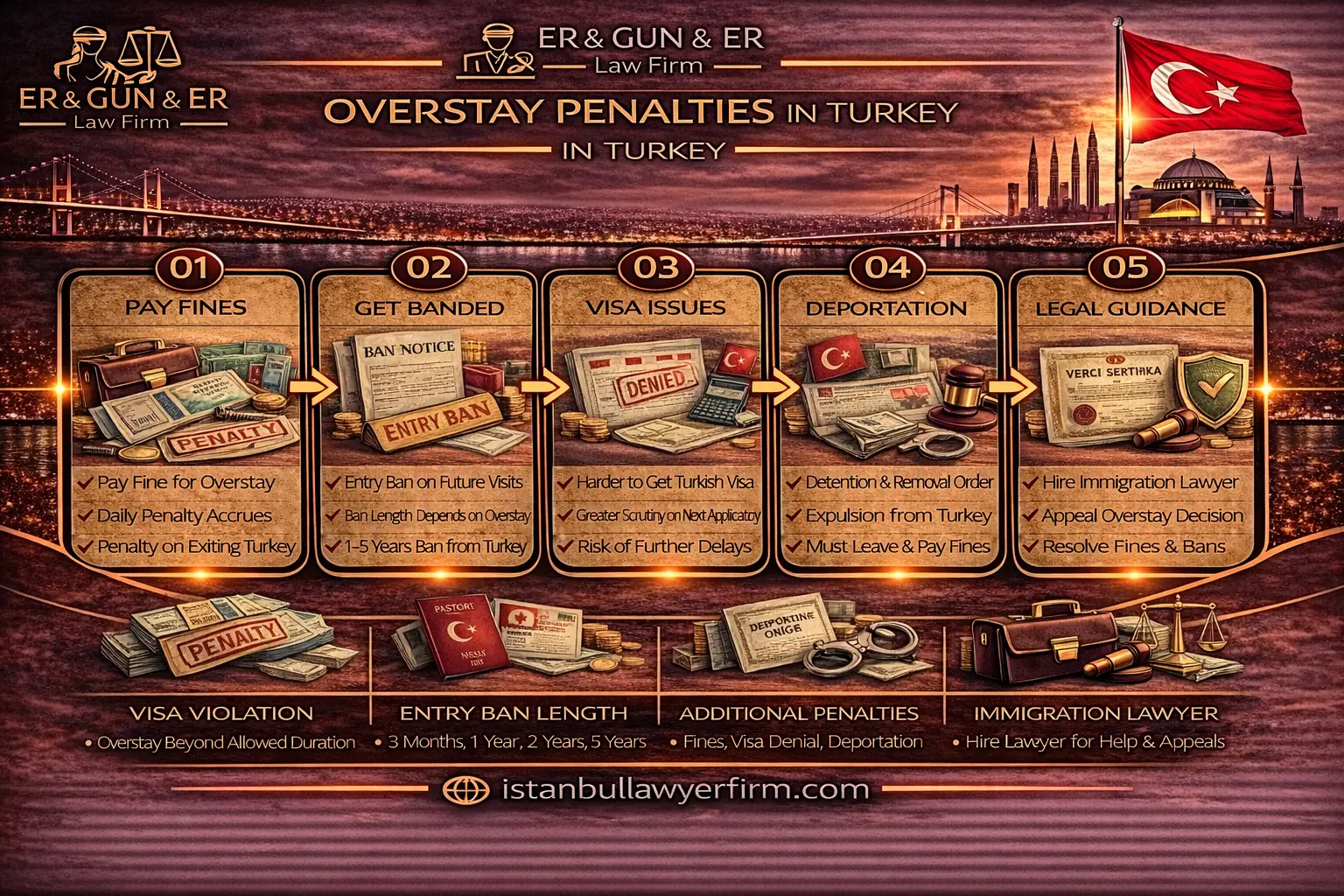
An overstay in Turkey means remaining in the country beyond the lawful stay period granted by a visa, a visa exemption, or a valid residence document under the Law on Foreigners and International Protection No. 6458 (Yabancılar ve Uluslararası Koruma Kanunu, YUKK, 2013) and its Implementing Regulation. Once the authorized period ends, the foreign national becomes subject to administrative action at the border and, in some files, additional measures recorded by the Directorate of Migration Management (Göç İdaresi Genel Müdürlüğü, PMM). The immediate consequences typically involve an administrative fine under the Law of Fees No. 492 framework and a risk assessment for future entry under YUKK Article 9, but the exact outcome depends on the individual's documentary status and the timing of the exit. A single day can be treated differently from a long gap when the person had a pending application, a cancellation decision, or an unrecorded status change. Because officers rely on electronic entry-exit records and the travel document history, the solution is usually evidence-driven rather than argument-driven. Before taking any step, the person should collect the passport biodata page, entry stamp pages, visa or e-visa proof if any, and any residence or work related papers. This framework focuses on overstay penalties and explains how the process is applied under YUKK and the related border practice. If the file is sensitive, early review by a lawyer in Turkey can prevent procedural mistakes that are difficult to reverse after a border decision is issued. For background on the wider legal landscape, the immigration law framework is a useful context document for non-specialists and corporate travel teams.
What counts as overstay under YUKK
Overstay is counted from the first day after the lawful stay period ends, and it continues until the foreign national exits Turkey or obtains a valid status that stops unlawful presence under the YUKK framework. The lawful stay period may come from a visa sticker, an e-visa, a visa exemption period under bilateral or multilateral arrangements, or the validity of a residence card issued under YUKK Articles 30-48. If the passport has multiple entries, the relevant period is the most recent entry that created the current stay, not an earlier trip. Border systems record entry and exit electronically through the PMM infrastructure, and officers rely on those records even when a stamp is unclear or missing. A person can fall into overstay simply by miscalculating the last lawful day, especially when counting rules differ between calendar days and nights in the country or when the 90-day-in-180-day rolling window under visa exemption regimes is misread. The risk is higher when travelers cross through multiple airports or land borders because they may assume a new period begins automatically with each internal movement. In reality, the controlling record is the international entry recorded in the passport and the electronic system, not hotel bookings or domestic tickets. Overstay can also be triggered when a visa condition is breached, such as using a short-stay authorization for activities that require a separate work permit under Law No. 6735. When a residence card expires, the day after expiry is treated as unlawful stay unless a legally recognized pending renewal protects the person, and the protective effect of a pending file depends on whether the renewal was filed before expiry under YUKK Article 25 framework. When a residence document is cancelled, the cancellation decision date and the notice service date can matter for calculating when unlawful stay begins. Practice may vary by authority and year, and a conservative calculation with an early file review reduces the risk of unexpected findings at exit.
Not every gap is treated the same, because the legal file may include a pending application, a refusal decision, or a granted document that was not yet collected. Some applicants believe that filing a residence application automatically freezes unlawful stay, but the effect depends on whether the filing occurred while lawful stay still existed and whether the system recorded the filing before expiry. If the applicant received a rejection notice and remained in Turkey, the overstay period may be counted differently than if the application is still under review. If the person changed passports, the overstay analysis must connect the old passport entry record to the new passport identity record through consular documentation. If the person lost a residence card, the loss itself is not a lawful stay basis, so replacement steps and police reports should be kept in the file. If the person left Turkey and re-entered, earlier overstays can remain relevant for future entry assessments even when the current stay appears lawful. A Turkish Law Firm advising on overstay situations typically builds a chronology of status events tied to documentary evidence, because border officers focus on what the electronic record shows rather than on explanations offered under departure stress. Border practice and migration office practice sometimes treat pending processes differently, and the same facts may be evaluated with different emphasis. Practice may vary by authority and year, and verbal assurances from third parties should never be relied on because the exit officer will apply what is recorded in the system. A disciplined file explaining status events chronologically is the strongest tool when the overstay classification is questioned, and a short review with an English speaking lawyer in Turkey keeps instructions aligned with what border officers actually ask for.
A frequent point of confusion is that the physical stamp in the passport may be faint, incomplete, or missing, but the electronic record can still show an exact entry date. If a stamp is missing due to an automated gate, request a printout or confirmation when possible, because later disputes depend on date proof. If the passport has an older stamp that appears to overlap, officers follow the most recent entry that created the current stay. If the person stayed in Turkey under a residence card and then left, the exit will be recorded even if the person forgot to carry the residence card at the gate, though presentation of the card can change the immediate calculation because it shifts the applicable expiry anchor. If the person holds an e-visa printout, that printout should be kept because the system may not display full details to the traveler in a way that can be checked in advance. If the person overstayed for a short period, the file should still be documented because short overstays can still trigger a fine and can affect future entries. If the overstay resulted from force majeure such as flight cancellation, medical emergency, or border closure, collect objective evidence including airline cancellation notices, hospital admission records, and emergency medical documentation before the border moment. If the person is asked to sign a document at the border, read the dates and descriptions carefully and request clarification before signing, and if the person disagrees with the stated number of days, ask for the calculation basis and keep a copy of any printed calculation screen or receipt. Officers apply a standardized method, but small input errors can cause large differences when a long stay is involved. Practice may vary by authority and year, and a careful document set reduces the risk that a correctable record issue becomes an irreversible administrative outcome.
Common overstay scenarios and risk patterns
Many overstays arise from missed renewal planning for short-term residence cards, where the person assumes an application is still valid after an expiry date. In a residence permit overstay file, the first question is whether a renewal was filed properly under YUKK Article 25 framework and whether the filing produced a recognizable receipt or system record. If the person filed but did not complete biometrics or did not attend the appointment, the pending status may not protect the stay in the way the person expects. If the person received a rejection and did not exit, the overstay period may be treated as running from the decision date or from the notice service date depending on how the record is created under the Notification Law No. 7201 framework. If the person changed address without updating records through the Address Registration System (Adres Kayıt Sistemi), notices can be served to the old address and the person may miss critical information. If the person relied on a third-party intermediary, the file should confirm what was actually filed and when, because verbal assurances do not change system records. Student transitions between enrollment periods can create gaps when school documentation is delayed or not updated under YUKK Article 38 short-term residence for students. Family dependants can become unlawful without realizing it when the principal applicant's status changes under YUKK Article 34 family residence framework. Tourists who extend travel for personal reasons usually face simpler files but still require careful calculation and payment planning. Multiple-entry travelers commonly miscount how much visa-free time remains because prior days in the rolling window are forgotten. An Istanbul Law Firm typically approaches these scenarios by building a chronology of status events and matching each event to a document rather than relying on verbal narratives. Practice may vary by authority and year, and the earlier this chronology is prepared, the easier it is to decide whether to exit immediately, to pursue a correction, or to plan a controlled re-entry. For residence permit procedural framework supporting overstay analysis, readers can consult our residence permit framework.
Work-related overstays often arise when an employer assumes that a pending work authorization step automatically legalizes continued stay. In a work permit overstay situation, the authority examines whether the person had a lawful residence basis while the employer process was pending under the Work Permit Law No. 6735 framework, which replaced the earlier Law No. 4817 in 2016. If the employer changed entity or workplace, the mismatch can delay approvals and create a gap that later appears as overstay. If the employment relationship ended but the person remained in Turkey without updating status, the overstay period can begin while the person still believes employment documents are sufficient. If an employer stops payroll or social security reporting, that may trigger a status review that exposes the overstay during subsequent checks. If the worker travels abroad during a pending process, re-entry may be refused because the pending record may not be recognized at the border. If the person holds a work authorization in one city and starts working in another city, the file can be treated as non-compliant even when the person believed the permit was flexible. If the person is a shareholder or director, additional documentation may be requested under YUKK Article 31(j) framework for investors. Turkish lawyers coordinating these files emphasize that exit planning and future applications should not be undermined by inconsistent documents between the employer file and the individual file. Practice may vary by authority and year, and work-related overstays are best managed by aligning immigration status, employer compliance, and travel planning in a single written roadmap. For the work permit procedural framework, readers can consult our work permit framework.
Another common scenario involves travelers who entered visa-free and later assumed that a simple extension at the border or online was possible under a general grace period, which does not exist under current Turkish practice. When the person learns otherwise, the overstay may already have accrued and the exit becomes the point where the issue is formalized. A related scenario is a person who filed for a residence permit but then traveled and returned, believing that the pending file would operate as a multi-entry authorization — which it does not, because pending applications do not generally substitute for valid entry documents. If the person re-enters under a new visa exemption, the prior overstay remains recorded and affects the officer's assessment. Administrative confusion after a passport change commonly creates overstays when the new passport number is not linked to the old entry record through proper consular channels. Medical and family emergencies create files that must be built around objective emergency evidence including hospital admission records, death certificates of family members, and flight disruption notices. Address notification failures under the Address Registration System cause unintended overstays when residence renewal notices fail to reach the applicant. Border closures during pandemic-era restrictions, natural disasters, or diplomatic incidents create force majeure files requiring airline correspondence and rebooking attempts as supporting evidence. Working informally while holding a short-stay authorization creates overstays compounded by unauthorized work allegations that substantially increase the risk profile beyond simple late departure. Practice may vary by authority and year, and a coherent chronology often prevents misunderstandings that otherwise escalate into entry bans or escalated administrative measures.
Fine calculation and payment at exit points
Overstay fines are administrative charges assessed based on the period of unlawful stay and the legal basis of entry, and they are determined at the moment the overstay is identified under the Law of Fees No. 492 framework with YUKK Article 10 coordination. Travelers often search for a single table, but in practice a visa overstay fine calculation varies with nationality, reciprocal arrangements reflected in bilateral agreements, and the way the border record classifies the status. Authorities calculate the number of unlawful days by referencing the electronic entry date and the last lawful day under the relevant visa or exemption regime. If the person held a residence card that expired, the calculation may be anchored to the expiry record rather than to the entry date, depending on how the file is coded. If the person had a pending application, officers may evaluate whether the filing created a lawful stay bridge under YUKK Article 25 framework, and that evaluation can change the count. Because these variables exist, it is unsafe to promise a fixed amount before the border officer produces the calculation output. Practice may vary by authority and year, and the practical task is therefore to verify the input dates, to verify the status category used, and to request a printed calculation or receipt that shows the basis. If the officer's output is inconsistent with the passport record, politely ask for a re-check rather than arguing in general terms. If the person believes a pending application should have protected the stay, present the receipt and appointment records immediately because late presentation may not be considered. If the person exited and re-entered during the period, ensure the system is reading the correct entry record and not an older trip. For a procedural overview of how the administration frames this issue, readers can consult the visa overstay penalties framework. Experienced Turkish lawyers often focus on date inputs first because correcting a date can reduce the entire liability without debating discretion.
In most overstay cases the fine is collected or recorded at the exit point, because departure is the moment when the unlawful stay period becomes final. Travelers who expect to resolve the issue later often discover that paying the overstay fine at the airport is the default practical step to close the overstay record. The payment channel varies between airports and land borders, and it may involve a cashier desk, an indicated bank counter, or an electronic payment instruction through specific banking partners. Before payment, the traveler should ask for the printed assessment output that shows the calculated days and the stated basis. After payment, the traveler should verify that the receipt shows the correct identity data and that it is an official receipt rather than a private invoice. If the traveler pays in a different currency, confirm how the amount was converted and keep the exchange evidence if available. If the traveler pays by card, keep the card slip and the official receipt because either document alone may be insufficient later. If the traveler cannot pay due to banking issues, ask what alternative payment route is acceptable and document the instruction. If the traveler is leaving during a busy period, arrive early because the payment step can require additional queues and administrative review. If the traveler is transiting, ensure that the officer processes the exit properly so the payment and exit are linked in the system. If the traveler has a pending residence or work file, keep proof of filing because payment does not automatically resolve status issues for future applications. Practice may vary by authority and year, and a careful payment record is the single most important artifact for future re-entry planning because it proves that the traveler did not evade the administrative process. A law firm in Istanbul can guide document presentation and communication sequence even when the traveler is under time pressure at the gate.
When a traveler disputes the calculation, the dispute should be framed as a factual correction request rather than as a complaint about policy. Factual corrections focus on entry date, exit date, expiry date, or proof of a pending lawful application that bridges the stay. If the traveler can show a clear official receipt for an application or an appointment record, present it immediately. If the traveler cannot show the evidence at the gate, the practical option may be to pay and then preserve the right to challenge through administrative channels later under the İdari Yargılama Usulü Kanunu No. 2577 framework. If the traveler refuses to pay, the officer may still record the liability, and the traveler may face difficulties on the next entry or on a future permit filing. Payment does not automatically prevent an entry ban but often reduces uncertainty by creating a clean record of the exit event. Paying is typically the safer operational choice when the traveler has limited time, because missing a flight can create additional consequences. After payment, store the receipt and related documents in both paper and secure digital form. The receipt may be requested for new visa applications, residence permit applications, employer sponsorship files, and consular interviews. Do not rely on photographs of the receipt alone because originals can be requested later. Practice may vary by authority and year, and the practical aim is to leave the exit point with documents that can be shown to the consulate, the migration office, or a court without ambiguity.
Entry ban risk and voluntary departure framework
An overstay does not automatically mean a ban will be recorded, but the border officer may assess entry risk when the unlawful stay is confirmed under YUKK Article 9 framework. The assessment is entered in the system at the time of departure, and it can affect later admissions even when the fine is paid. The first driver is the length and pattern of the overstay, because repeated or extended unlawful presence is treated more seriously than an isolated miscalculation. Another driver is whether the traveler complied at exit by presenting documents, cooperating with the calculation, and completing payment in the official channel. If the officer believes the traveler tried to avoid detection, used inconsistent identity documents, or provided misleading statements, the risk evaluation escalates. Prior immigration violations, prior unpaid fines, or prior removal records weigh against the traveler. Border teams also consider whether the person has a pending residence or work pathway, because that context can affect how future compliance is viewed. A person who can show a pending employer-sponsored file may be assessed differently from a tourist with no lawful pathway planned, but presenting a planned pathway is not a guarantee because the decision ultimately rests on the facts visible to the officer and the electronic record. If the file indicates that the person continued working or residing long after expiry, the authority may view the case as deliberate rather than accidental. Practice may vary by authority and year, and entry ban for overstay is therefore not a single rule but a risk outcome shaped by the record and the officer's discretionary assessment under YUKK Article 9. A short pre-exit review by a lawyer in Turkey helps identify which documents are worth presenting. For the entry ban appeal framework specifically, readers can consult our entry ban appeal framework.
Voluntary departure is the concept of leaving Turkey by one's own initiative through an authorized exit channel before the case escalates into forced measures, and it is addressed under YUKK Articles 55 and 56 framework. For overstays, voluntary departure often means cooperating at the border, paying the assessed fine, and exiting without attempting to hide the unlawful period. This approach matters because the system record may reflect whether the person complied or resisted, and that record influences future risk review. In a voluntary departure situation, the practical task is to choose the exit point, prepare payment capability, and carry the document pack. The document pack should include the passport, any visa or residence records, any pending application receipts, and any evidence that explains unavoidable delay. The traveler should plan extra time at the airport or land border because administrative processing may take longer than ordinary exit control. Under YUKK Article 56, individuals who are subject to a removal decision may be granted a voluntary departure period ranging typically from fifteen to thirty days depending on the circumstances, during which they are expected to depart at their own initiative. When a voluntary departure period is granted, compliance within the stated window is important because failure to depart within the period can trigger administrative detention under YUKK Article 57 framework. If the traveler is traveling with dependants, ensure that each dependant's status is checked separately because a child's expiry date may differ from the parent's. Voluntary departure does not guarantee that no entry restriction will be recorded, but it improves the credibility of later applications. Practice may vary by authority and year, and a pre-exit review by an English speaking lawyer in Turkey helps travelers present only the necessary documents and avoid explanations that create new questions.
Voluntary departure should be distinguished from situations where the administration issues a formal removal measure (sınır dışı etme kararı) under YUKK Article 54, because the legal consequences and future risk profile can differ substantially. If the file includes an allegation beyond overstay, such as unauthorized work under Law No. 6735 or public order concerns under YUKK Article 54/1-d, the administration may treat departure as part of a broader enforcement record. In those cases, paying the fine alone does not resolve the problem because a separate Article 54 decision may exist in the record. The traveler should ask whether any written decision was issued and request copies where possible. If the traveler receives a document that appears to be a removal decision, the traveler should keep it and avoid losing it because it is central to any later objection under the İdari Yargılama Usulü Kanunu No. 2577 framework with its 60-day application window. The traveler should document the exact exit date and the exit point because later reviews test whether the person complied with the departure instruction. If the traveler was granted time to depart voluntarily under YUKK Article 56, comply within that timeframe rather than waiting until the last hour. If the traveler needs to cancel flights, keep cancellation receipts and new bookings to show continuous effort to depart. An Istanbul Law Firm can structure the file so that voluntary compliance is documented and any contested record is preserved for later administrative review. Practice may vary by authority and year, and a clean voluntary departure record improves future visa and permit outcomes because it shows cooperation rather than evasion.
Residence permit and work permit implications
Overstay history influences residence permit decisions because the migration authority evaluates compliance behavior and document consistency under YUKK Articles 21-48 framework. The first question is whether the applicant left Turkey and cleared the overstay record before applying again. If the applicant applies from abroad through a Turkish consular mission, the Foreign Ministry and PMM systems may still show the prior overstay and request additional explanations. If the applicant applies in Turkey, the authority evaluates whether the application was filed while the person still had lawful stay, which affects admissibility. Applicants should not assume that filing automatically cures an overstay, because the authority may reject filings made after unlawful stay began. Previous residence card expiry with the card copy and renewal receipts documents the compliance attempt; previous application rejection notices with proof of service establish decisive dates; address notification problems with Address Registration System records and returned-notice records explain correspondence failures. When an applicant wants to restart lawful stay, it is often necessary to plan the application route based on the person's travel flexibility and purpose. Migration offices assess whether an applicant has an unresolved overstay record or an unresolved entry restriction record before granting a new residence card, and unpaid fines or incomplete exit processing prompts requests for proof of payment and proof of departure before proceeding. For general planning on application routes and documentation standards supporting residence permit re-entry, readers can consult the residence permit applications framework. Practice may vary by authority and year, and if the applicant has family ties or long-term integration factors those facts can be documented and presented but do not replace status compliance.
Overstay history also affects renewal outcomes because renewal reviews re-check compliance history even when the current card is valid. The renewal file should include a short explanation and the supporting receipts, even if the authority does not ask immediately, because readiness prevents delays caused by last-minute searches. Frequent travelers should plan trips around renewal appointments and avoid leaving Turkey in a way that breaks the continuity of the application file, because travel during pending processes can create new entry records that confuse overstay calculations if the pending file is not visible at the border. Stable address registration under the Address Registration System and prompt updates after any move prevent missed notices that commonly cause unintended overstays. Landlord contract retention with signed lease and payment records supports housing evidence requests during renewals. Family tie renewals require current civil registry documents; income-based renewals require bank statements consistent with prior files to avoid credibility issues; work-based renewals require employer documents matching the permit record. If the applicant's overstay was linked to a prior rejection, the renewal file should include proof that the applicant complied with the exit instruction and paid any assessed amounts. A Turkish Law Firm coordinating renewal files typically treats overstay history as a managed risk factor rather than as an embarrassing detail to be hidden, because transparent handling allows administrative reviewers to focus on current eligibility criteria. Practice may vary by authority and year, and the practical objective is to keep the residence record clean so future residence cards and long-term plans are not repeatedly disrupted by the same documentary gaps.
Overstay history complicates employer-sponsored work authorization because authorities assess whether the foreign national has maintained lawful stay during key steps under the Work Permit Law No. 6735 framework. In a work permit overstay file, the first question is whether the person is currently inside Turkey unlawfully or whether the person already exited and cleared the record. Employers often assume that a pending work permit automatically legalizes stay, but the effect depends on the individual's recorded status and the sequencing of filings between Ministry of Labour and Social Security (Çalışma ve Sosyal Güvenlik Bakanlığı) and PMM. For that reason, the employer and the employee should align on a single timeline identifying when employment can begin and when travel can occur. If the employee worked informally during the overstay, the risk profile escalates because the file can include allegations beyond simple late departure. Work authorization connects to payroll and social security compliance under Law No. 5510 SGK framework, so employers should avoid paying wages in a way that contradicts the employee's authorization status. When a work authorization is already in place and the employee overstays, the risk is not only at exit but also in how the existing record is evaluated during renewal, because renewal files prompt compliance review including whether the employee maintained lawful stay and complied with exit and re-entry conditions. Role changes during pending processes require matching job descriptions and payroll files. Dependant family members of the employee require separate status monitoring because dependant overstays create separate files. Practice may vary by authority and year, and a law firm in Istanbul coordinating work permit and overstay files ensures that exit planning and future applications are not undermined by inconsistent documents.
Evidence documentation and administrative objection framework
Evidence begins with identity and travel documents because the system record is tied to the passport. Copy the biodata page, all entry stamps, and all exit stamps in one PDF. Save any e-visa or visa sticker proof showing the authorized stay period, any residence card copy and work card copy even when expired, any appointment notices and filing receipts and payment receipts related to permits, the overstay fine receipt and any printout showing the day calculation, boarding passes and flight tickets proving actual departure date, flight disruption correspondence, medical emergency records, and address registration proof when notice service is contested. Keep screenshots of online application portals only as backups because originals and official receipts carry more weight in administrative review. Documentation should cover the status narrative, not only travel dates, including full submission sets for any filed applications, intermediary authorization records, passport change linkage, consistent transliteration notes for name spelling differences, written decisions with certified copies where possible, service records with delivery location and date proof, certified civil registry documents for family files, employer letters matching the permit record for employment files, and reliable translations with translator certification. A Turkish Law Firm typically builds this folder before departure so the record is ready for objections, organized chronologically so an officer can read it in minutes. Practice may vary by authority and year, and evidence should be prepared with the future forum in mind because border officers, migration offices, and courts read different parts of the file.
Administrative objections start by identifying which authority created the record that is being contested under the YUKK framework. A fine assessment and an entry restriction may be recorded by border officers, while status decisions may be recorded by the PMM through its provincial directorates (İl Göç İdaresi Müdürlüğü). The objection route depends on the type of record and the document received at exit. If only a payment receipt was received, the first step is to request the underlying assessment printout and any restriction record through the PMM information request channels. If a written restriction decision was received, keep the decision and the service proof because objections are date-sensitive under the İYUK 2577 framework with its 60-day application window starting from the notification date. Verbal statements that a restriction exists or does not exist should not be relied on without written confirmation. An administrative objection file should attach the passport copy, entry and exit record, and the fine receipt. Pending application disputes attach filing receipts and appointment notices showing the timeline; force majeure disputes attach airline and medical records showing unavoidable delay; identity disputes attach passport linkage evidence. The objection should be factual and should correct specific dates or status categories rather than arguing fairness, and it should request that the authority disclose the record basis used for the decision. For the immigration appeal procedural framework, readers can consult our immigration appeal framework. Practice may vary by authority and year, and a structured objection can sometimes resolve simple record errors without a full court case.
When the dispute concerns an entry restriction, first obtain a copy of the restriction record and confirm the stated ground under YUKK Article 9 framework. Do not assume the restriction is only about overstay because system records may include other risk flags including Article 9/1-b public order concerns, Article 9/1-c public health concerns, or Article 9/1-ç involvement with terrorism organizations. If the ground is unclear, request clarification in writing and keep proof of the request. The objection chronology should show lawful intentions, including timely appointments and attempts to depart. If the fine was paid and the exit was voluntary, emphasize that compliance in the objection narrative. Pending residence or work process objections attach complete application receipts and correspondence; wrong entry date objections show passport stamps and electronic entry confirmations; incorrect expiry date objections show visa or residence validity proof; wrong passport number objections show old and new passport linkage. This approach supports an overstay entry ban appeal strategy because it targets the recorded error rather than arguing general fairness. Avoid accusatory language and focus on record correction and proportionality. If the authority rejects the objection, keep the rejection response because it frames the later court case under İYUK 2577. Objection planning should also consider future applications, because inconsistent objections harm later residence filings. The objection should not deny the overstay if the overstay is provable because denial damages credibility. Instead, the objection should explain why the overstay occurred and why the recorded measure is unlawful or disproportionate. Practice may vary by authority and year, and a coordinated file prevents contradictory submissions from family members, employers, or agents.
Court appeal framework and deportation overlap
When administrative remedies do not resolve the issue, the next step is an application to the Administrative Courts (İdare Mahkemesi) under the Administrative Procedure Law No. 2577 framework. A court petition is required when the traveler challenges an entry restriction under YUKK Article 9, a removal decision under YUKK Article 54, or a refusal that has legal effect. The court reviews whether the authority acted lawfully under YUKK and whether the record supports the stated reasons. The İYUK 2577 framework sets a 60-day application window starting from the notification date for most administrative actions, and this deadline is strict with limited extension possibilities. For a court appeal entry ban file, the petition should attach the restriction decision, the service proof, the passport copy, and the fine receipt. The petition should include a chronology explaining why the overstay occurred and what steps were taken to comply. If immediate harm is expected, the petition may include a request for stay of execution (yürütmeyi durdurma) under İYUK Article 27 to suspend the practical effect of the decision, and the court will look for urgency (telafisi güç veya imkansız zarar) and a plausible illegality argument (hukuka aykırılık) supported by documents. Stay is not automatic because courts evaluate stay requests on the facts presented. A well-prepared petition avoids emotional language and targets the decision's factual and legal defects. Calculation disputes identify incorrect dates and attach proof; pending status disputes attach filing receipts showing the authority overlooked them; proportionality disputes show the person's compliance history and the absence of concealment. Practice may vary by authority and year, and court work should be coordinated with future visa or permit filings so submissions remain consistent.
Court preparation starts by confirming what documents exist and what documents are missing. If the traveler did not receive a written decision, the first task is to request the record through the proper channel because a court cannot review a measure that is not identified. Once the record is obtained, check the stated ground and the stated dates for accuracy. Many errors are clerical, such as wrong passport numbers or wrong entry dates, and courts can correct those when proven. Courts evaluate whether the authority considered the traveler's evidence or ignored it without explanation, so proof of what was submitted during the administrative stage is important. Late submissions require explanation with retrieval trail attached. Medical evidence requires legible documents with dates matching the overstay period; airline records require complete cancellation notice and rebooking confirmation; foreign-language documents require consistent translations. Court petitions should be organized so each annex proves one specific fact and is referenced clearly, allowing the judge to verify the narrative quickly. While a court case is pending, avoid actions that create a new violation because a second incident undermines the case. Parallel appeals in different forums without counsel coordination create inconsistent requests that harm credibility. If stay is granted, keep the court decision copy ready to show border officers and consulates. If stay is denied, consider whether administrative compliance steps are still available to reduce harm while the case proceeds. Practice may vary by authority and year, and a coherent court record improves future discretionary decisions because it shows the traveler used lawful remedies.
Overstay is usually treated as an administrative violation managed at exit, but deportation exposure arises when the file is coded as a broader compliance concern under YUKK Article 54 framework. The phrase deportation risk for overstay describes the situation where unlawful stay is assessed together with other risk indicators including repeated violations, identity inconsistencies, or suspected unlawful work. Officers consider whether the person ignored prior notices or failed to cooperate at earlier checks. Internal police controls can surface unlawful stay before the person reaches an airport, and in that situation the person may be directed to a provincial migration unit rather than being allowed to leave immediately. Overstay files intersect with removal measures when the authority believes the person will not depart voluntarily, which happens if the person is found during an internal check without any valid document, or if prior violations are treated as repeat non-compliance. The first priority is to understand what decision has actually been issued and which unit issued it. A fine receipt is not the only record because separate Article 54 decisions can exist in the migration database. For the deportation procedural framework, readers can consult our deportation framework. Travelers often conflate an entry ban with a removal file, but the two can coexist and should be analyzed separately because a removal measure focuses on leaving Turkey while an entry restriction focuses on coming back. When both appear in the record, the dispute file becomes procedural through first obtaining copies of every document issued, then mapping contested versus accepted facts, and finally selecting the primary legal argument. Practice may vary by authority and year, and guidance from experienced Turkish lawyers is most useful when it is evidence-led and realistic about discretion.
Employer duties and re-entry planning strategy
Employers and sponsors can reduce overstay exposure by treating travel authorization as a compliance workflow rather than as a personal responsibility under the Work Permit Law No. 6735 framework. The first control is a calendar that tracks visa expiry, residence expiry, and appointment dates for every foreign national connected to the organization. The second control is a pre-travel checklist confirming the traveler has the correct document for the purpose of stay. Frequent travelers require HR recording of entry and exit dates so rolling-window miscalculations are detected early. Organization-provided accommodation requires updated address notifications under the Address Registration System. Family sponsors should still keep copies of receipts and notices because the traveler may be separated from documents at the airport. Employers should instruct employees not to start work or client-facing activity on a short-stay authorization that does not permit employment, and when a work authorization route is planned the employer should align the filing timeline with the employee's lawful stay timeline. Casual advice about grace periods should be avoided because such advice is often wrong for the specific record. When a traveler becomes unlawful, the sponsor's role is to help gather documents and plan a lawful exit, not to conceal the issue. Employers should keep internal communications disciplined because those communications can later be requested and can show whether management encouraged non-compliance. Practice may vary by authority and year, and a coordinated review with a Turkish Law Firm is typically efficient when the sponsor must balance travel timing, corporate needs, and documentary corrections. For the compliance framework across immigration matters, readers can consult our immigration compliance framework.
Employers should understand what must not be done because well-intended shortcuts worsen the file. Paying money through unofficial intermediaries does not correct the official record and creates fraud exposure under the Turkish Criminal Code No. 5237. Asking employees to travel through alternative border points to avoid detection is particularly risky because electronic records follow the passport through PMM integration. Instructing employees to provide misleading statements at the border creates a misrepresentation note that is harder to challenge than the original overstay. Backdating contracts, letters, or travel instructions can be treated as a separate compliance issue under both labor law and criminal law frameworks. If documents were missing, the correct approach is to request replacements through official channels and to document the retrieval steps. Assignment emails and project plans should be preserved to show why travel was necessary. Employee termination requires documented exit timeline so unlawful presence does not continue silently after payroll ends. Agent-mediated filings require reporting of filing events with submission confirmations rather than verbal status updates. Contesting a record requires one spokesperson and one document set to prevent inconsistent submissions. Dependent spouse files should be managed as one unit with the primary employee so dependants do not become unlawful separately. Reputational risk requires calm internal communication to avoid panic-driven errors. Practice may vary by authority and year, and a structured sponsor approach reduces disruption because decisions are made based on documents rather than assumptions, valuable also for audits because it shows the employer promotes lawful compliance as a policy.
Re-entry planning starts by confirming what happened at exit in writing. Keep the fine receipt, the calculation printout, and the passport exit stamp together. Request a clear statement on whether an entry restriction was recorded. Do not rely on informal comments from airline staff or other passengers. Check the travel document to be used for the next entry and keep identity linkage evidence if passports changed. Prepare a short chronology listing entry date, expiry date, application events, and exit date. Build a document pack supporting each event, including e-visa proofs and appointment receipts. This pack is the core tool for re-entry after overstay because officers work from records. Plan the return route based on whether a visa, a residence permit, or a work permit application will be pursued, and choose one strategy avoiding parallel attempts that create contradictory submissions. Urgent returns require legal advice before buying non-refundable tickets. Many travelers learn about restrictions only at airline check-in because airlines rely on system cues and may deny boarding without detailed explanation. Sponsorship-dependent returns require aligning the employer file and personal file before exit because corporate templates may not reflect the border record. Practice may vary by authority and year, and coordinated planning with a law firm reduces repeat violations and produces consistent submissions to border authorities, migration offices, and courts.
Author: Mirkan Topcu is an attorney registered with the Istanbul Bar Association (Istanbul 1st Bar), Bar Registration No: 67874. His practice focuses on cross-border and high-stakes matters where evidence discipline, procedural accuracy, and risk control are decisive, with particular concentration on Turkish immigration and foreigners law including overstay situations, entry ban disputes, residence permit applications, work permit coordination, deportation proceedings, and administrative court appeals. Core statutory frameworks include the Law on Foreigners and International Protection No. 6458 (Yabancılar ve Uluslararası Koruma Kanunu, YUKK, 2013) with Articles 9 (entry ban authority), 10 (visa and overstay framework), 21-48 (residence permit categories including short-term, family, student, long-term, humanitarian), 54 (deportation decision), 55 (persons exempted), 56 (voluntary departure period typically fifteen to thirty days), and 57 (administrative detention), Work Permit Law No. 6735 (Uluslararası İşgücü Kanunu, 2016) replacing Law No. 4817 with Turquoise Card framework for qualifying highly skilled professionals, Law of Fees No. 492 (Harçlar Kanunu) for overstay fine calculation, Notification Law No. 7201 (Tebligat Kanunu) for proper service affecting deadline calculations, Address Registration System Law No. 5490 (Nüfus Hizmetleri Kanunu), Administrative Procedure Law No. 2577 (İdari Yargılama Usulü Kanunu, İYUK) for administrative court appeals with 60-day application window from notification date and İYUK Article 27 stay of execution (yürütmeyi durdurma) framework requiring irreparable harm (telafisi güç veya imkansız zarar) and illegality (hukuka aykırılık) demonstration, Social Security Law No. 5510 (Sosyal Sigortalar ve Genel Sağlık Sigortası Kanunu), Turkish Criminal Code No. 5237 for document fraud and misrepresentation allegations, Personal Data Protection Law No. 6698 (KVKK) for cross-border data transfer, Hague Apostille Convention 1961 (Turkey acceded 29 September 1985, Law No. 3028), sworn translation requirement by yeminli tercüman for foreign-language documents, bilateral visa exemption agreements with over seventy countries establishing 90-day-in-180-day rolling window, electronic entry-exit record system through PMM infrastructure, Directorate of Migration Management provincial organization with İl Göç İdaresi Müdürlüğü handling residence permit applications, Ministry of Labour and Social Security coordination with Ministry of Interior for work permit and residence permit filings, border police framework at airport and land border exit points, specialized administrative courts (İdare Mahkemesi) framework for first-instance appeals with regional administrative courts (Bölge İdare Mahkemesi) for appellate review and Council of State (Danıştay) for cassation review.
He advises foreign nationals and employers on comprehensive immigration strategy including pre-travel compliance planning through systematic calendar management with expiry date tracking, pending application monitoring, and travel coordination, document pack preparation including passport biodata page copies, entry and exit stamp compilation, visa and residence permit documentation, payment receipt preservation, and chronological record maintenance, overstay incident response including fine calculation review with input date verification, payment procedure coordination at exit points with receipt preservation, voluntary departure framework utilization under YUKK Articles 55-56 with period compliance monitoring, entry ban response framework including written decision request through formal PMM channels, service proof preservation, ground clarification with Article 9 sub-paragraph analysis, administrative objection preparation with exhibit-based chronology, and court appeal preparation under İYUK 2577 within 60-day application window with stay of execution request where irreparable harm exists, deportation response framework under YUKK Article 54 including decision copy request, service proof preservation, and administrative court petition with chronological narrative, residence permit re-application strategy including appropriate application route selection, documentation addressing overstay history transparently, family dependant coordination, and renewal planning with compliance history documentation, work permit coordination framework under Work Permit Law No. 6735 including employer file alignment, Ministry of Labour and Social Security filing coordination with PMM residence framework, Turquoise Card eligibility assessment, payroll and social security compliance verification, and employer duty framework, administrative objection drafting including proper authority identification, factual correction framing, exhibit selection with decisive document prioritization, and service proof preservation, court appeal preparation including Administrative Court venue selection, 60-day deadline monitoring, petition drafting with chronological narrative and numbered exhibits, stay of execution request under İYUK Article 27, and coordination with regional Administrative Court of Appeals and Council of State where applicable, re-entry planning including exit documentation confirmation, identity linkage evidence preparation, visa or permit route selection, airline check-in preparation, and border presentation with chronology and exhibit readiness, employer compliance infrastructure design including systematic calendar management, pre-travel checklists, document vault maintenance, internal communication discipline, intermediary supervision with written confirmations, and emergency response protocols, and strategic compliance roadmap development including status inventory maintenance, expiry alert systems, standardized border packs, and long-term resident monthly compliance review. His practice spans Commercial and Corporate Law, Commercial Contracts, Foreign Investment, Data Protection and Privacy, Intellectual Property, Arbitration and Dispute Resolution, Enforcement and Insolvency, Citizenship and Immigration, Real Estate, International Tax, International Trade, Foreigners Law, Sports Law, Health Law, and Criminal Law.
Education: Istanbul University Faculty of Law (2018); Galatasaray University, LL.M. (2022). LinkedIn: Profile. Istanbul Bar Association: Official website.
Frequently asked questions
- What law governs overstay penalties in Turkey? The Law on Foreigners and International Protection No. 6458 (YUKK, 2013) establishes the primary framework with Article 9 on entry bans, Article 10 on visa and overstay framework, and Articles 54-57 on deportation, voluntary departure, and administrative detention. The Law of Fees No. 492 provides the fine calculation framework. The Directorate of Migration Management (Göç İdaresi Genel Müdürlüğü, PMM) administers the framework with provincial directorates and border police coordination.
- How is overstay calculated? Overstay is calculated by comparing the recorded entry date in the electronic PMM system with the last lawful day granted by the visa, visa exemption, or residence document. The rolling 90-day-in-180-day window applies to visa exemption regimes. Passport stamps support the calculation but the electronic record is controlling. Fine amounts depend on nationality, length of overstay, and applicable reciprocal arrangements. Practice may vary by authority and year.
- Is payment at exit required? Payment at exit is the default practical step to close the administrative process and obtain an official receipt. Payment channels include cashier desks at major airports, designated bank counters, and electronic payment instructions. Payment does not automatically erase all future risk but creates a clear compliance record. Always keep the official receipt and verify identity details on it.
- Does overstay automatically trigger an entry ban? No. Entry ban is a separate discretionary assessment under YUKK Article 9 framework based on length and pattern of overstay, exit cooperation, prior violations, and file consistency. Short isolated miscalculations typically do not trigger bans, but repeated or extended unlawful presence combined with uncooperative behavior escalates risk. Request written confirmation of any recorded restriction because verbal statements are unreliable.
- What is voluntary departure under YUKK? Voluntary departure (kendi isteğiyle çıkış) under YUKK Articles 55-56 framework allows foreign nationals subject to removal decisions to depart at their own initiative within a granted period typically ranging from fifteen to thirty days. Compliance within the stated period is important because failure triggers administrative detention under Article 57. Voluntary departure does not guarantee no entry restriction but improves credibility of later applications.
- How do pending applications affect overstay calculation? Pending applications may create a lawful stay bridge under YUKK Article 25 framework, but the protective effect depends on whether the renewal was filed before expiry and whether the filing is properly recorded in the PMM system. Keep filing receipts and appointment records for immediate presentation at exit. Not all pending applications provide protection, and verbal assurances should not be relied on.
- What is the administrative objection deadline? Administrative objections to PMM decisions generally follow the İdari Yargılama Usulü Kanunu No. 2577 framework with a 60-day application window starting from the notification date under the Notification Law No. 7201. Objections may proceed through PMM internal review before or in parallel with administrative court petitions. Missing the 60-day deadline substantially limits subsequent remedies.
- Can I request stay of execution for an entry ban? Yes. Stay of execution (yürütmeyi durdurma) under İYUK Article 27 framework is available when the decision is likely unlawful (hukuka aykırılık) and creates irreparable harm (telafisi güç veya imkansız zarar). The request is made within the court petition and is not automatic. Courts evaluate based on the evidence record, and stay requires strong documentation beyond emotional arguments.
- What deportation risk arises from overstay? Deportation risk arises when overstay is combined with other Article 54 grounds including unauthorized work, public order concerns, public health concerns, or involvement with designated organizations. Simple overstay without aggravating factors typically does not lead to deportation. Internal police controls finding undocumented foreign nationals may direct them to provincial migration units with deportation consideration.
- How does overstay affect future residence permit applications? Prior overstay is reviewed in new residence permit applications under YUKK Articles 21-48 framework. The critical question is whether the applicant cleared the overstay record through payment and exit. In-country applications face admissibility questions if filed after unlawful stay began. Abroad applications face additional explanation requirements. Family ties and long-term integration factors support but do not replace status compliance.
- How does overstay affect work permit eligibility? Work permit applications under Law No. 6735 framework review the foreign national's compliance history including prior overstay. Pending work permit does not automatically legalize stay, and employment before final authorization creates unauthorized work risk. Ministry of Labour and Social Security and PMM coordination requires aligned filings. Employer diligence records affect discretionary review for repeat foreign hires.
- What documents should I carry for re-entry after overstay? Carry fine receipt, calculation printout, exit stamp evidence, passport biodata page, any visa or residence documentation, any pending application receipts, identity linkage evidence if passports changed, and a short written chronology. Keep documents in hand luggage rather than checked baggage. Airlines may deny boarding based on system cues without detailed explanation, so pre-travel confirmation is valuable.
- Can employers pay overstay fines for employees? Payment can be made through the employee with employer reimbursement following internal policy, but the receipt must identify the employee and the payment must occur through official channels. Unofficial intermediary payments do not correct the record and create potential fraud exposure under Criminal Code No. 5237. Employer documentation of the compliance incident supports future discretionary review.
- What happens if I signed a document I did not understand at the border? Documents signed under time pressure may be challenged later if they contain factual errors, but the challenge requires strong evidence of the actual facts versus the recorded facts. Request clarification and a copy before signing. If signed with errors, immediately document the circumstances and preserve supporting evidence. The subsequent objection focuses on factual correction with exhibit-based evidence.
- How does ER&GUN&ER Law Firm structure overstay engagements? Engagements begin with comprehensive document review and chronology preparation, proceed through exit strategy coordination where voluntary departure is available, continue with payment procedure guidance and receipt verification, extend through administrative objection preparation within statutory deadlines, include court appeal preparation under İYUK 2577 framework with stay of execution requests where appropriate, coordinate with future residence permit or work permit applications, and conclude with compliance roadmap development preventing recurrence. Throughout, emphasis remains on evidence-led rather than argument-based advocacy.