

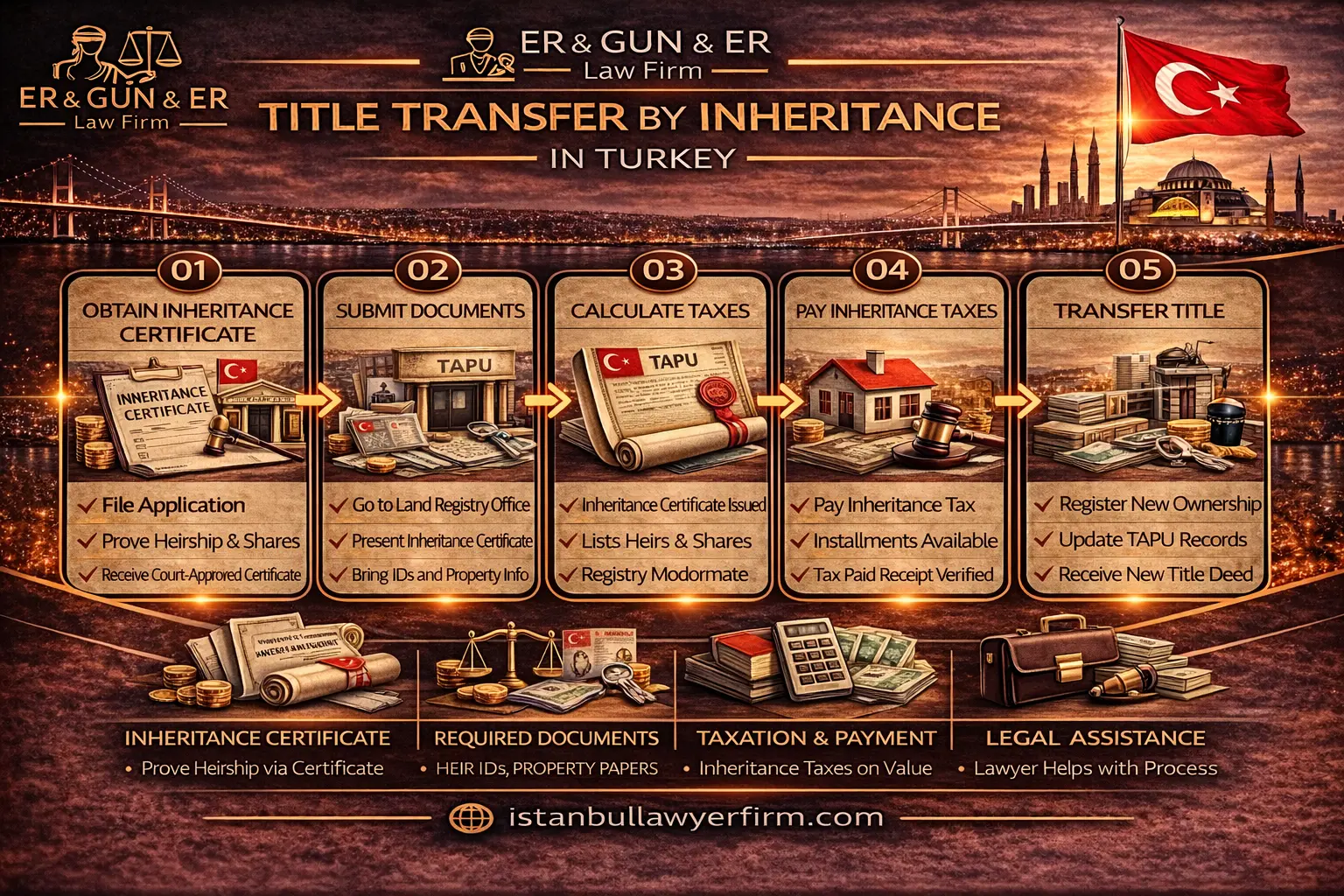
Title transfer by inheritance is the process of registering real estate from the deceased to the heirs in the land registry, and it is not a step that heirs can improvise. The practical reason is that land registry inheritance transfer Turkey depends on standing documents and a share table that offices can verify, not on family consensus. Heirs often think they can sell or donate a property immediately after death, but tapu transfer to heirs Turkey must be completed first to create a registered ownership basis. The sequence typically starts with the inheritance certificate and continues through estate tax reporting Turkey and then a land registry appointment, with each lane producing documents used by the next lane. Many steps depend on local land registry and tax office practice, so any operational detail should be treated as variable unless confirmed for the relevant office and year. “practice may vary by authority and year — check current guidance.” When multiple heirs and foreign documents are involved, disciplined coordination with English speaking lawyer in Turkey helps keep identity tokens, parcel identifiers, and evidence packs aligned without creating contradictory submissions.
What transfer by inheritance means
Title transfer inheritance Turkey is the registration act that updates the land registry from the deceased to the heirs. It is a registry change, not a private arrangement. It relies on official proofs, not on statements. It starts by proving who the heirs are. It continues by proving what shares each heir has. It requires matching identity tokens across records. It requires matching parcel identifiers across records. It requires checking whether the property is encumbered. It requires checking whether the property has annotations. It requires treating the registry as the source of truth. It requires keeping a dated record of what was submitted. It requires preserving receipts and confirmations. It requires a single custodian for documents. It requires neutral communication with the office. “practice may vary by authority and year — check current guidance.”
The transfer is often described as inheritance title deed transfer Turkey in practice. It does not decide family disputes by itself. It does not erase mortgages by itself. It does not remove liens by itself. It registers heirs as co-owners by default. It creates joint ownership after inheritance Turkey unless a separate allocation path exists. It requires that heirs coordinate signatures. It requires that heirs coordinate representation if someone is abroad. It requires that heirs coordinate a document custody plan. It requires that heirs coordinate tax and reporting steps separately. It requires separating administration from litigation lanes. It requires consistent use of the inheritance certificate share table. It requires avoiding different narratives in different offices. It requires a clean evidence index. “practice may vary by authority and year — check current guidance.”
Heirs should also understand what the transfer is not. It is not an immediate sale authorization. It is not a bank release procedure. It is not a probate judgment on will validity. It is not a substitute for estate inventory work. It is not a substitute for checking title history. It is not a substitute for checking suspicious transfers. It is not a substitute for clearing municipal records. It is not a substitute for utilities coordination. It is not a substitute for family settlement agreements. It is not a substitute for partition planning. It is not a substitute for tax filing evidence. It is a registry step that depends on a full evidence pack. It is a step that should be recorded in a chronology. It is a step that should be verified by an updated title extract. “practice may vary by authority and year — check current guidance.”
Inheritance certificate first
The inheritance certificate for title transfer Turkey is the standing proof that land registries rely on before they register heirs. It is the master share table in the file. It identifies heirs and fractions. It must match civil registry evidence. It must match identity tokens on passports and IDs. It must be readable and current in format. It must be stored as a certified copy set. It must be used consistently in every downstream pack. It is usually obtained before meaningful bank and registry disclosures. It is often needed before title history requests are processed. It is often needed before tax reporting allocation can be done. It is reused across bank, tax, and tapu lanes. It must be version-controlled if corrected. It must be protected for privacy. “practice may vary by authority and year — check current guidance.”
The practical path is to obtain the certificate, then build a property tab per parcel, then allocate shares, then proceed to tax reporting. This is why the inheritance certificate guide at inheritance certificate overview is useful as a workflow map. The certificate should be cross-checked against the newer standalone page at inheritance certificate in Turkey for consistent terminology across files. The certificate lane should be handled by a single custodian to avoid parallel versions. The certificate lane should use a token sheet to prevent spelling drift. The certificate lane should store issuance details as a dated event. The certificate lane should store who can act and how representation is handled. The certificate lane should record whether a will exists and keep that lane separate. The certificate lane should not mix valuation arguments into standing proof. The certificate lane should be prepared for foreign heirs with legalized documents. The certificate lane should be reused and not retranslated ad hoc. The certificate lane is the start of a disciplined chain. “practice may vary by authority and year — check current guidance.”
The certificate lane also supports risk control. It reduces bank and registry refusals caused by unclear standing. It reduces internal family conflict by creating an objective share table. It reduces the chance of unilateral action because co-heirs are visible. It reduces fraud risk because heirs can act with standing. It reduces repeated office visits because the same certified copy set can be reused. It reduces contradictions because one master share table is enforced. It reduces downstream errors because allocation is anchored. It reduces tax file confusion because shares are stable. It reduces registry confusion because names are stable. It reduces translation drift when foreign heirs exist. It reduces post-transfer disputes because the starting proof is clear. It supports later partition discussions by clarifying ownership. It supports later sale planning by clarifying who must sign. It supports later litigation by clarifying standing. “practice may vary by authority and year — check current guidance.”
Identifying heirs and shares
Identifying heirs and shares begins with statutory proof, not negotiation. The file should start from civil registry evidence and the inheritance certificate. The file should confirm spouse status at death. The file should confirm children and descendant branches. The file should confirm predeceased heirs and substitution chains. The file should confirm minors and representation needs. The file should confirm identity tokens for each heir. The file should confirm addresses for service and notices. The file should confirm who will act as spokesperson. The file should confirm who will hold originals and certified copies. The file should compute a share table that totals one whole. The file should cross-check that the certificate matches this table. The file should record any uncertainty as a verification ticket. The file should keep disputes in a separate lane. The file should keep a chronology of each proof obtained. “practice may vary by authority and year — check current guidance.”
Share mapping also affects later joint ownership after inheritance Turkey because registration usually creates co-ownership shares first. That co-ownership then drives whether partition or sale is possible. That co-ownership drives who must attend the registry appointment. That co-ownership drives how power of attorney is structured. That co-ownership drives how taxes and expenses are allocated informally among heirs. That co-ownership drives how rent is collected and shared. That co-ownership drives how repairs are approved and paid. That co-ownership drives how utility accounts are managed. That co-ownership drives how disputes are escalated. That co-ownership drives whether a partition lawsuit inheritance property Turkey becomes necessary. That co-ownership drives whether a settlement lane is feasible. That co-ownership also drives who can object to suspicious transfers. That co-ownership drives how banks interpret authorization requests. That co-ownership should be documented as a governance memo separate from the registry pack. “practice may vary by authority and year — check current guidance.”
Heir mapping must also be consistent with the broader rights framework. The heir rights overview at heir rights in Turkey can help explain why standing and shares matter for enforcement without changing the registry workflow. The property inheritance overview at property inheritance laws can help explain how shares translate to title records and co-ownership. The file should keep these as background references, not as substitutes for documents. The file should avoid assuming that family agreements change statutory shares automatically. The file should avoid presenting private allocations as if they replace the certificate. The file should avoid creating multiple share spreadsheets with different fractions. The file should keep one master share table and one allocator for all lanes. The file should keep a change log if a correction occurs. The file should keep foreign heir name tokens stable across translations. The file should maintain privacy because heir data is sensitive. The file should store identity documents securely and share minimally. The file should keep a single narrative memo so heirs do not contradict each other in offices. “practice may vary by authority and year — check current guidance.”
Estate tax reporting steps
The estate tax reporting steps are a distinct lane that follows standing and inventory, and it must not be confused with the tapu appointment itself. The estate tax reporting Turkey lane starts with the inheritance certificate share table and a documented asset inventory. It continues with valuation evidence per asset class. It then leads to filing proofs and office communications. It must not include guessed tax rates or deadlines. It must be built from recognized documents and dated exhibits. It must allocate values by share table consistently. It must preserve bank letters and title extracts as exhibits. It must preserve filing receipts as exhibits. It must preserve any office requests and responses as exhibits. It must maintain a change log for any corrections. It must keep the reporting lane separate from the transfer lane so the file stays readable. It must keep confidentiality controls because it contains sensitive values. It must coordinate with banks because banks often ask for reporting proof. It must coordinate with registries because registries may ask for tax-related proof in certain workflows. “practice may vary by authority and year — check current guidance.”
The most practical way to keep the lane coherent is to use a structured reporting guide. The site’s reporting overview at estate tax reporting can be used to design an index and chronology without inserting numbers. For conceptual background on inheritance tax structure without rates, the reference at inheritance tax overview can help separate concepts from numbers. The reporting file should not attempt to compute “final tax” as a marketing claim. The reporting file should instead create a method memo and attach exhibits. The reporting file should keep real estate values tied to property identifiers. The reporting file should keep bank balances tied to bank letter dates. The reporting file should keep foreign documents in a separate legalized bundle tab. The reporting file should keep the filed version locked and drafts marked superseded. The reporting file should keep a communications log with the office. The reporting file should keep a privacy memo for internal sharing. “practice may vary by authority and year — check current guidance.”
Reporting steps also affect transfer readiness because missing reporting proofs can block later office interactions depending on local practice. That is why the sequence is often described as certificate → reporting → appointment, but each office may ask for different evidence at different moments. The file should therefore treat transfer readiness as a checklist memo with evidence references, not as a promise. The file should ensure that the inheritance certificate is current and consistent. The file should ensure that property tabs are complete with parcel identifiers. The file should ensure that bank tabs are complete with balance letters if needed. The file should ensure that foreign bundles are legalized and translated if relevant. The file should ensure that any municipal records needed for utilities are in progress, without guessing what every municipality requires. The file should ensure that encumbrances are documented and clearance planning exists. The file should ensure that any disputes are kept in a separate lane so administration can proceed for undisputed items. The file should keep one spokesperson and one custodian rule. “practice may vary by authority and year — check current guidance.” For a disciplined, evidence-led process in complex estates, many heirs consult best lawyer in Turkey and law firm in Istanbul to keep the chain consistent across offices.
Tax clearance documents
Tax clearance documents are the bridge between the reporting lane and the land registry lane, and they must be treated as case-specific evidence rather than as a universal checklist. Heirs often search for a single “clearance paper,” but what the land registry requests can depend on office practice, asset profile, and the state of the declaration file. “practice may vary by authority and year — check current guidance.” The safest approach is to build a tax evidence pack that contains the declaration submission proof, any official correspondence received, and any official receipts for payments made. The pack should be indexed and dated so the land registry reviewer can understand what is being shown without reconstructing history from emails. The pack should also be consistent with the inheritance certificate share table, because land registry staff will compare names and shares across the file. The pack should not include guessed tax figures or alleged deadlines, because those are prohibited in this brief and can undermine credibility. The pack should identify each property by parcel identifiers so there is no doubt about what asset the evidence relates to. The pack should also include a short cover memo that describes, in factual terms, what has been filed and what remains pending, without promising outcomes. The pack should preserve any written request list from the tax office or the registry office as an exhibit, because this shows why certain documents exist. The pack should use a secure custody rule because it contains sensitive identity and financial data. The pack should avoid mixing unrelated taxes into the inheritance lane, because that confuses the registry discussion. The pack should also avoid presenting private family reimbursement arrangements as if they were tax evidence, because those are internal matters. The pack should be updated only through version control, and prior versions should be marked superseded rather than deleted. The topic label inheritance tax clearance for tapu transfer Turkey should be treated as “evidence of handling,” not as a promise of a particular certificate in every case.
Clearance planning also depends on the asset mix, because a purely real-estate estate can have different document dynamics than an estate with substantial bank balances. Some heirs need bank releases to fund payments, while banks may ask for proof that reporting is underway, so the file must coordinate lanes carefully. “practice may vary by authority and year — check current guidance.” A practical control is to keep a coordination memo that states which office asked for what, and when, with exhibit references, and then to follow that memo rather than hearsay. The coordination memo should not include numeric timelines, but it should include dates of requests and dates of responses, because those dates anchor diligence. The file should also preserve any tax office acknowledgments as exhibits, because acknowledgments often explain why a registry accepts a certain stage of the tax file. The file should keep a reconciliation note that shows that the names and shares used in the tax lane match the names and shares used in the registry lane. The file should also preserve any parcel-based valuation references used in the reporting lane, because registry officers may ask how a value entry was supported, even if they do not evaluate it substantively. The file should avoid a “one-page miracle” expectation and instead treat clearance as an evidence narrative backed by receipts, submissions, and official communications. The file should be careful not to disclose full bank statements in the registry lane unless required, and should use redacted summaries when possible, because privacy matters. The file should also be careful not to create contradictory statements about whether tax steps are complete; instead, state what is complete and what is pending, using documents. The file should store copies of what was shown to the registry so later disputes about “what we presented” have a factual answer. The file should keep a single custodian to prevent multiple heirs presenting different document versions. The file should also maintain a dispute-separation rule so contested issues do not contaminate the administrative discussion. The file should be written so a third party can audit it without guessing what happened.
Tax clearance documents also function as risk controls because they reduce the chance that heirs rely on informal intermediaries or rushed submissions that later create inconsistencies. If the registry office requires a specific output, the file should document the request and then obtain that output from the correct channel, rather than substituting a similar-looking paper. “practice may vary by authority and year — check current guidance.” If an office rejects a document because it is outdated or unreadable, the file should obtain a clearer certified copy and record the change as a dated event. If a new asset is discovered during clearance planning, the file should treat it as a discovery event and update the reporting lane through a controlled supplement, rather than silently editing the pack. The file should preserve all receipts and confirmations with reference numbers because these proofs are the only reliable way to settle later family disagreements about what was paid. The file should also preserve the payment approval trail separately as family governance, because the office does not need internal reimbursement arrangements but the family may. The file should keep an “office-facing pack” and a “family-facing pack” distinct, so the office pack stays lean and the family pack stays complete. The file should also ensure that foreign heirs’ identity and address proofs are consistent across packs, because token drift can cause registry refusal even when the tax evidence is solid. The file should maintain a secure archive and avoid uncontrolled sharing, because sensitive documents can be misused. The file should also plan for follow-up questions by keeping a supplement protocol with an index and a short memo per request. The file should avoid asserting any fixed time limit or penalty statement, because those must be verified for the specific case and are outside this brief. The file should remain calm, factual, and exhibit-led, because that is what makes administrative processing possible.
Land registry appointment
A land registry appointment is the practical moment where the file turns into a registry transaction, and it requires readiness across identity, shares, parcel identifiers, and supporting packs. The appointment should be treated as the “execution event” for land registry inheritance transfer Turkey, not as a casual visit. The first readiness control is to confirm that the inheritance certificate is current and matches all heirs’ identity tokens. The second readiness control is to confirm that each property tab contains correct parcel identifiers copied from official extracts, not from memory. The third readiness control is to confirm that any annotations and encumbrances are documented so the registry is not surprised at the counter. The fourth readiness control is to confirm that tax reporting evidence is ready in the format the office expects, without guessing what every office expects. “practice may vary by authority and year — check current guidance.” The fifth readiness control is to confirm that every heir who must sign will attend, or that a valid representative will attend with a properly scoped authority document. The sixth readiness control is to confirm that foreign heirs’ documents are fully legalized and translated, because partial bundles often cause rejection. The seventh readiness control is to confirm that the office has been identified correctly based on parcel location, because wrong office visits waste time and create confusion. The eighth readiness control is to preserve proof of the appointment request and any confirmation as an exhibit, because later the family may ask what was scheduled and why. The ninth readiness control is to prepare a short, factual cover memo that explains what is being requested, using parcel identifiers and exhibit references. The tenth readiness control is to keep communications neutral and avoid bringing family dispute accusations into the appointment, because registry staff process documents rather than conflict narratives. The eleventh readiness control is to keep a custody plan for originals and certified copies, because offices may need to see originals and retain copies. The twelfth readiness control is to prepare for a post-appointment verification step, meaning obtaining an updated title extract and storing it as the “after” exhibit. The thirteenth readiness control is to maintain a change log if the office requests additional documents so the family can cure systematically. The fourteenth readiness control is to treat the appointment as one event in a larger chronology and record it accordingly.
The appointment also requires coordination because co-heir attendance and representation often determine whether the process moves smoothly. If multiple heirs attend, use one spokesperson and avoid conflicting explanations at the counter. If a representative attends, ensure the authority bundle is complete and consistent with the token sheet, and ensure that the authority scope covers tapu transfer to heirs Turkey actions. “practice may vary by authority and year — check current guidance.” If the estate includes multiple properties, consider whether one appointment covers one parcel or multiple parcels, but do not assume; document the office’s instruction and follow it. The file should also ensure that any supporting documents for a parcel are kept in that parcel tab, because mixing tabs is a common source of errors. The file should also coordinate with the estate inventory lane so the appointment does not overlook a parcel that later needs a second appointment. The file should also coordinate with the tapu check lane so the “before” state is preserved in case later disputes arise. The procedural reference at tapu check after death can help keep the “before” archive consistent, without implying how quickly the registry will process a change. The file should also coordinate with the certificate lane so that any correction to the inheritance certificate is resolved before the appointment, because using an old share table can cause rejection. The file should also coordinate with the tax evidence lane so that the appointment pack includes the correct stage proof, without exaggerating completion. The file should also maintain privacy, because registry appointments require sensitive identity data and it should not be shared beyond those who need it. The file should document what was presented and what was requested by the office as a dated event so follow-up is organized.
A disciplined appointment plan reduces the risk of repeat visits and reduces the risk of inconsistent narratives across offices. The file should include a “counter checklist memo” written in sentences that describes what will be shown and why, using exhibit references, and that memo should be reviewed by the custodian before the appointment. “practice may vary by authority and year — check current guidance.” If the office rejects a document for formatting, do not argue; record the rejection reason, obtain the required document in the required format, and return with the corrected pack. If the office requests additional identity reconciliation, treat it as a token correction lane and update the token sheet and translations accordingly. If the office requests additional tax proof, obtain the official communication rather than presenting informal statements. If a dispute is pending among heirs, keep the dispute lane separate and do not attempt to use the appointment to resolve it; instead, proceed with what is administratively possible and document what is blocked. After the appointment, obtain the updated title extract, store it with the date, and retire older extracts in the “before” folder, marking them as historical. The file should also update the estate inventory to reflect the new registry state, because future steps like sale or mortgage depend on current title. The file should also notify banks and tax files only as needed, using redacted summaries, because updated ownership may affect their checklists. A disciplined appointment plan is not about speed; it is about preventing preventable failure points and keeping the estate process coherent.
Required land registry documents
Documents for tapu transfer by inheritance Turkey should be treated as an evidence map that proves standing, identifies the parcel, and supports the office’s procedural checks. The first concept is standing, usually anchored by the inheritance certificate for title transfer Turkey and identity proofs that match it. The second concept is parcel identification, anchored by current title extracts and correct parcel identifiers. The third concept is representation, anchored by authority documents when heirs do not attend personally. The fourth concept is tax reporting evidence, anchored by official submission proofs and communications rather than by estimates. “practice may vary by authority and year — check current guidance.” The fifth concept is conflict management, meaning the file should indicate whether all heirs are participating or whether the transaction is limited, without turning it into a dispute narrative. The file should avoid treating any internet “document list” as universal, because registries can request different combinations based on profile. The file should instead build a registry pack with a cover memo that describes the exhibits and their purposes. The cover memo should use the same identity tokens as the certificate and should avoid free-typing names. The pack should be organized into tabs per parcel so the office can find the right extract quickly. The pack should include a custody plan for originals and certified copies, because some offices want to see originals. The pack should include a service address plan if notices are issued, because notice management prevents later confusion. The pack should be kept lean and avoid irrelevant annexes, because clutter increases review time and mistake risk. The pack should be stored as a “registry pack version” so it can be reproduced later if disputes arise. The pack should be updated only through a change log and version control. The pack should remain neutral and factual because registry staff process documents, not arguments.
The most common document failure is token mismatch rather than missing paper, so token control is a document requirement in itself. A name mismatch between the inheritance certificate and the title record is a predictable rejection reason. A birth date mismatch across identity proofs is a predictable clarification trigger. A passport spelling mismatch across translations is a predictable foreign-heir failure point. “practice may vary by authority and year — check current guidance.” The file should therefore include a token sheet and enforce it across every translated bundle and every memo. Another common failure is parcel identifier mismatch, where a parcel is typed incorrectly in a request form, so the file should copy identifiers from official extracts rather than retyping. Another failure is mixing parcel tabs, so the file should enforce one tab per parcel and one extract per tab as the anchor. Another failure is using an outdated inheritance certificate after a correction, so the file should enforce a “current version only” rule and retire older versions. Another failure is presenting an authority document that does not clearly cover registry actions, so the file should ensure scope clarity without overbreadth. Another failure is oversharing bank statements or unrelated documents that create privacy risk and confuse the registry review; keep the pack minimal and relevant. The file should also preserve any registry office request list received for this case as an exhibit so the pack can be justified later. A disciplined document map reduces repeated appointments because it makes the file coherent and predictable to the reviewer.
Required documents also include “proof of what happened,” meaning after the registry processes the transfer, the file must obtain and store an updated title extract as the completion proof. That completion proof becomes the base for all later actions, such as sale, mortgage, partition, or utility updates. “practice may vary by authority and year — check current guidance.” The file should also store proof of submission of the pack, such as a receipt or reference, so later disputes can confirm what was presented. The file should update the estate inventory with the new registry state so the estate file remains current. The file should also update co-ownership governance notes because registration creates formal co-ownership shares that will govern decisions. The file should coordinate with bank and tax lanes only as needed, using redacted summaries, because updated title may affect their checklists. The file should also coordinate with the fraud-prevention lane by preserving pre-transfer and post-transfer extracts so a later “what changed” question can be answered. The file should keep a privacy discipline because title extracts contain location data and identity data. A disciplined approach treats the registry pack as a reusable template and logs what was used, so future heirs and future transactions are not forced to reconstruct the past from memory.
Foreign heirs documentation
Foreign heirs title transfer Turkey cases add a foreign-document pipeline that must be completed before the land registry can accept standing and representation proofs. The first control is to ensure that foreign heirs are correctly reflected on the inheritance certificate share table with consistent identity tokens. The second control is to ensure that foreign passports and address proofs are usable and token-matched to the Turkish file. The third control is to prepare authority documents when foreign heirs cannot attend, and to ensure the scope covers registry actions clearly. “practice may vary by authority and year — check current guidance.” The fourth control is to legalize foreign documents through the correct method, such as apostille or consular legalization, depending on the issuing country. The fifth control is to translate foreign documents into Turkish using a sworn translator and a single token sheet to prevent spelling drift. The sixth control is to keep source, legalization, translation, and notary pages together as a single bundle per document to prevent missing-page rejections. The seventh control is to plan custodianship for originals because foreign originals can be difficult to replace and may be needed again for banks and tax lanes. The eighth control is to maintain a pipeline memo that shows which documents are pending and which are ready, because cross-border logistics can cause delays without any misconduct. The ninth control is to avoid creating multiple translation versions for different offices, because different versions create contradictions and rejections. The tenth control is to store the foreign bundles in a secure archive and share only what the office requires, because privacy matters. The eleventh control is to keep foreign communication bilingual but fact-consistent, so English explanations do not introduce different facts. The twelfth control is to record uncertainties as verification tasks rather than as assumptions. The foreign lane is successful when the registry sees one coherent set of Turkish-readable, properly authenticated documents that match the inheritance certificate tokens.
Foreign documentation also intersects with estate tax reporting Turkey because foreign heirs often need to participate in reporting allocations and payment coordination. Keep the reporting lane separate, but ensure identity tokens and shares match across lanes. “practice may vary by authority and year — check current guidance.” Foreign documentation also intersects with property inventory because foreign heirs often cannot independently verify parcels, so the file should provide a controlled parcel tab archive that includes pre-transfer extracts. If heirs need a conceptual map of how inheritance rights apply to foreigners, the background at heir rights overview and property inheritance overview can help align expectations without changing registry requirements. The file should also coordinate with the tapu inquiry lane to prevent “missing property” disputes that are actually about incomplete inventory. If a foreign heir alleges concealment, the best cure is a shared index and chronology with exhibit references, not uncontrolled sharing of sensitive bank statements. The file should also record which documents were shown to the registry and which were retained, because foreign heirs often ask “what was used.” The file should also maintain a revocation and change protocol if authority documents are updated, because stale authorities can cause registry refusal. The file should also avoid claiming that every registry accepts the same foreign bundle format, because practice differs by office. A disciplined foreign lane reduces both procedural risk and family conflict because everyone can see the same evidence map.
Foreign heirs documentation also supports fraud prevention because delays and confusion are exploited by opportunistic actors. The best safeguard is early standing proof, early token reconciliation, and early authority planning, all documented as dated events. “practice may vary by authority and year — check current guidance.” The file should maintain periodic checks of title records while the transfer is pending and preserve snapshots, because foreign heirs cannot always monitor locally. The file should also centralize communications through one spokesperson so third parties cannot exploit mixed messages. The file should also keep a secure custody plan for originals and certified copies, because cross-border couriering creates loss risk. If a document is lost, record it as an incident and obtain a replacement through proper channels rather than patching the file. The file should also maintain a secure digital archive with access logs so the family can answer questions about who accessed what. The file should avoid using informal intermediaries who claim to “handle everything,” because that creates legal and privacy risk and often results in unusable documents. A disciplined foreign lane is not about speed; it is about producing a Turkish-usable proof chain that the registry can accept without doubts about authenticity, identity, or scope.
Apostille and translations
Cross-border files often stall at the land registry stage because foreign documents are not yet usable, and this is where apostille documents for inheritance Turkey becomes a core workflow rather than a formality. The first step is to list every foreign document that will be relied on for standing and representation, such as death records, birth records, marriage records, and powers of attorney. The second step is to confirm whether each issuing country is in the apostille system or whether consular legalization applies, because the path differs by country and document type. The third step is to obtain the correct format of each document from the issuing authority, because short extracts can omit identifiers that later cause mismatch. The fourth step is to treat legalization as a chain-of-custody event and keep the source document and legalization pages together as a single bundle. The fifth step is to create a token sheet for names and dates and to enforce it across every translation so identity drift does not appear in the Turkish file. The sixth step is to arrange sworn Turkish translations that reflect the legalized source and include all annexes that contain identifiers. The seventh step is to check translations line by line before notarization to avoid creating multiple “official” versions with different spellings. The eighth step is to keep a version-control rule so only one translation bundle is current and prior versions are marked superseded. The ninth step is to scan finalized bundles in high resolution because stamp and seal clarity matters in acceptance. The tenth step is to store all bundles in a secure archive and limit access because these are sensitive identity documents. The eleventh step is to maintain a pipeline memo showing which bundles are pending and which are complete, because cross-border logistics can otherwise be misunderstood as concealment. The twelfth step is to avoid making timeline promises, because international issuance and legalization depend on many actors. “practice may vary by authority and year — check current guidance.” The thirteenth step is to reuse the same finalized bundles across tax, registry, and bank lanes so the file stays consistent.
Translations also affect legal clarity because land registry officers compare identity tokens across the inheritance certificate and the presented foreign documents. If a foreign surname convention produces different spellings, the file should include a reconciliation memo supported by passport proofs and official records, not by explanation alone. The reconciliation memo should be factual and should point to exhibit bundles, because registry staff need objective links. The file should also ensure that relationship terms such as spouse, child, and parent are translated consistently across different documents, because inconsistent kinship terms can create doubt about the heir map. The file should not assume that one office will accept a translation format that another office accepted in a different year, because practice varies. “practice may vary by authority and year — check current guidance.” The file should therefore preserve any office instruction about translation format as an exhibit and follow it for that case. If an office rejects a bundle, record the rejection reason, cure through retranslation or re-legalization as needed, and document the cure as a change event. The file should avoid patching a rejected bundle with handwritten notes because that undermines reliability. The file should also avoid mixing pages from different bundles because missing-page suspicion triggers follow-up. The file should maintain one bundle per foreign document and a single index that shows how each bundle supports standing or representation. The file should also coordinate translations with appointment planning so the appointment is not scheduled before bundles are ready. The file should keep confidentiality controls because translations contain personal and family data. The file should use secure channels for sharing and avoid uncontrolled messaging apps for sensitive documents. “practice may vary by authority and year — check current guidance.” A disciplined translation lane reduces friction because it eliminates the most common cause of rejection, which is inconsistent tokens.
The apostille and translation lane also supports dispute prevention because clean foreign bundles reduce internal suspicion among heirs. When foreign heirs cannot attend, the representative’s authority bundle must be fully legalized and translated, and that bundle must be consistent with the inheritance certificate share table. The file should treat this as part of the foreign heirs title transfer Turkey lane even when the estate is otherwise domestic. The file should record who requested each bundle, who received it, and where originals are stored, because originals may be needed again. The file should also record whether any document was reissued or corrected and why, because unexplained changes can be misread as manipulation. The file should keep a single custodian for originals and certified copies to reduce loss risk during couriering. The file should also be clear that legalization authenticates origin, not content truth, so content disputes should be handled in the correct forum. “practice may vary by authority and year — check current guidance.” The file should not treat foreign bundles as “done” once used at the registry; the same bundles may be needed for bank and tax lanes, so reuse must be consistent. The file should also plan for future use if the property is later sold, because the chain of documents may be requested in due diligence. The file should therefore archive bundles in a way a third party can navigate, with an index and a chronology. The file should also document the token sheet used so later translations match earlier ones. A disciplined apostille and translation program is the most practical safeguard against cross-border file drift.
Joint ownership after transfer
Most inherited properties are registered to multiple heirs in shares, so joint ownership after inheritance Turkey is the default outcome unless a separate allocation is formalized later. The first practical consequence is that no single heir can act as if they own the whole property, because the title record will show fractional shares. The second consequence is that co-owners must coordinate decisions about use, rent, maintenance, and sale, and weak coordination becomes a dispute driver. The third consequence is that the property becomes part of a co-ownership governance problem, not only a registry file. The file should therefore create a co-ownership memo that records what the heirs agreed about use and cost sharing, while keeping that memo separate from the registry pack. The file should also maintain a cost ledger and revenue ledger so later disputes about rent or repairs can be answered with receipts. The file should also define a spokesperson and a decision protocol, because multiple heirs giving conflicting instructions to banks, tenants, or agencies creates chaos. The file should preserve the updated title extract after transfer as the official “after” record and store it with the date. The file should also preserve the “before” title extract and mark it as historical, because comparisons may be needed later. The file should avoid informal promises like “you can live there forever,” because such promises can create conflict without legal structure. The file should also avoid unilateral leasing without co-owner approval, because that is a common source of disputes. The file should also document any temporary arrangements, such as one heir managing the property for a period, with written acknowledgements. “practice may vary by authority and year — check current guidance.” A disciplined joint ownership file reduces litigation risk because it shows cooperation attempts and factual management records.
Joint ownership also shapes transfer planning because one heir cannot usually sell the entire property without the others, and that becomes a practical barrier when heirs want liquidity. The file should therefore evaluate early whether heirs intend to hold, rent, allocate, or sell, and record that intention in a dated memo. The memo should not be treated as binding on offices, but it helps coordinate actions and prevents contradictory messaging. The file should also document how decisions are approved, such as requiring written consent for major acts, because oral agreements are contested later. The file should also document how co-owners will handle taxes, utilities, and municipal interactions, because those are recurring issues. The file should also document who will communicate with tenants or property managers, because unclear authority invites conflict. The file should also consider whether a representative will handle routine steps, and if so, ensure the authority is properly documented and limited. “practice may vary by authority and year — check current guidance.” The file should also note that co-ownership can be affected by disputes about the will or reserved shares, and those disputes should be kept in their own lane so co-ownership administration does not stall unnecessarily. If one heir refuses to cooperate, the file should preserve written proposals and refusals, because later partition planning relies on proof that agreement failed. The file should maintain privacy discipline because co-ownership files include identity and financial data. The file should also keep an access log for sensitive documents so later accusations about leakage can be addressed. A structured co-ownership plan reduces friction because it replaces assumptions with records.
Joint ownership after transfer also creates risk when heirs are in different countries or cities, because distance magnifies communication failures. The file should therefore use a shared index and chronology so every heir can see what documents exist and what actions were taken, without circulating full sensitive extracts. The file should adopt a “single narrative memo” rule so external communications to banks, tenants, or municipal offices are consistent and factual. “practice may vary by authority and year — check current guidance.” The file should also plan how to handle emergencies such as repairs or urgent payments, and record how approvals are obtained. The file should also plan how to handle disagreements, such as appointing a mediator or moving to a formal partition lane, without threatening each other informally. The file should preserve evidence of co-ownership use, such as who lived in the property and who paid costs, because these facts become central in later disputes. The file should also preserve the property’s encumbrance status, because mortgages and liens affect co-owner options and can create new conflicts if not understood. The file should also coordinate with bank lanes if rent is collected into accounts, because allocation should match shares and be receipted. The file should avoid creating a shadow “manager” without written authority, because that invites disputes and third-party confusion. A disciplined co-ownership archive is therefore an enforcement safeguard because it makes later claims provable rather than emotional.
Partition and sale options
When heirs cannot agree on how to use or sell property, the partition lawsuit inheritance property Turkey lane becomes a practical option, but it is a separate legal remedy lane that should not be confused with the registry transfer step. The first control is to document that co-ownership exists by storing the updated title extract showing shares. The second control is to document that agreement failed by preserving written proposals, meeting minutes, and refusals in a neutral tone. The third control is to separate “emotional conflict” from “decision deadlock,” because courts evaluate deadlock through evidence of failed coordination. The fourth control is to document whether any interim arrangements existed, such as rent collection or occupancy, because those facts affect fairness arguments. The fifth control is to document expenses and revenues with receipts because these records often become accounting issues. The sixth control is to avoid promising timelines or sale results, because judicial process and sale mechanisms vary and depend on the case. “practice may vary by authority and year — check current guidance.” The seventh control is to maintain a clean asset tab and avoid mixing other estate disputes into the partition file unless they directly affect ownership. The eighth control is to maintain a settlement lane in parallel, because many partition cases settle when evidence is clear and costs are understood. The ninth control is to ensure foreign heirs can participate through properly legalized authorities if they cannot attend. The tenth control is to keep communications factual because aggressive messaging can create defamation risk and harden positions. The partition option is most effective when it is approached as a structured remedy for deadlock, not as a threat.
Sale options also include voluntary sale by agreement, which is often preferable when heirs can coordinate because it reduces procedural complexity. The file should record sale intent and the required signatures in a dated memo. The file should also record how a sale price will be determined, such as through appraisal or market offers, but it should keep those discussions separate from tax reporting valuation bases. “practice may vary by authority and year — check current guidance.” The file should document who negotiates with buyers, and whether a broker is used, because unclear negotiation authority creates conflict. The file should document how proceeds will be distributed and ensure distributions match shares unless an enforceable agreement changes allocation. The file should document bank accounts used for proceeds and maintain receipts and transfer proofs to prevent later disputes. If one heir occupies the property, document occupancy and any agreed compensation, because occupancy is a common dispute driver. The file should also document whether any encumbrances must be cleared before sale, because encumbrances can block sale or reduce buyer interest. The file should preserve buyer due diligence questions and answers as exhibits, because those exhibits can later show what was disclosed and what was not. The file should maintain privacy discipline because sales discussions can expose sensitive family data. A disciplined sale lane reduces the chance that sale becomes a new conflict after the inheritance transfer is complete.
Partition and sale planning also interacts with estate tax reporting Turkey because proceeds and allocations often need to be consistent with reported ownership and documented transfers. The file should keep these lanes consistent without inventing tax figures or deadlines. “practice may vary by authority and year — check current guidance.” If heirs plan to sell soon after transfer, they should ensure that title is correctly registered and that any pending issues are resolved, because buyers will ask for clean title extracts. The file should also ensure that municipal and utility records are updated sufficiently for practical use, because buyers and tenants often request proof. The file should also plan for foreign heir signatures and logistics early, because signing delays can kill transactions. The file should preserve all sale-related decisions in a governance log so later accusations of “secret sale” can be answered with dated records. The file should also consider that sale disputes can be resolved through settlement terms, and settlement terms should be implementable through banks and registries. The file should keep settlement drafts separate from the administrative file, with version control and a clear signed final version. A disciplined partition-and-sale plan reduces litigation risk because it documents the deadlock, documents attempts to agree, and documents the chosen route with evidence.
Mortgages and encumbrances
Mortgages and encumbrances must be checked early because they can block or complicate both inheritance transfer and later sale, and the title deed annotation inheritance Turkey lane is the practical evidence set for this. The first control is to obtain a current title extract that shows all annotations and encumbrances, and to store it as a dated exhibit. The second control is to classify each annotation in operational terms, such as mortgage, lien, caution, or restriction, and to document what office or creditor is associated with it. The third control is to preserve any bank or creditor communications that explain the encumbrance, because registry notes alone may not explain the commercial context. The fourth control is to avoid guessing clearance timelines or costs, because those are case-specific and office-specific. “practice may vary by authority and year — check current guidance.” The fifth control is to document whether the encumbrance attaches to the whole property or to a share, because share-level encumbrances affect co-owner options. The sixth control is to document whether the encumbrance predated death or arose later, because timing can be relevant in disputes. The seventh control is to coordinate with the bank lane if the mortgage is held by a bank, because bank evidence and registry evidence must align. The eighth control is to include an encumbrance summary memo per property tab that cites the title extract and notes what is known and what must be confirmed. The ninth control is to keep a clearance plan memo that lists what needs to be confirmed and which office must be contacted, without promising outcomes. The tenth control is to keep the encumbrance lane separate from the will dispute lane unless the encumbrance is part of a suspicious transfer pattern. The eleventh control is to maintain confidentiality because creditor data is sensitive. The twelfth control is to update the property tab after any clearance action and store the updated extract as a new exhibit. Encumbrance discipline is a practical safeguard because it prevents last-minute surprises at registry or sale stages.
Encumbrances also affect co-ownership governance because co-owners may disagree about paying debts, maintaining mortgages, or clearing liens. The file should therefore include a co-owner decision log for encumbrance-related decisions, such as whether the property will be kept and the mortgage serviced, or sold to discharge debts. “practice may vary by authority and year — check current guidance.” The file should document who paid what and when, supported by receipts, because reimbursement disputes are common. The file should also document whether any encumbrance is disputed, because disputed encumbrances may require separate legal action and should not be mixed into routine registry transfer submissions. If the encumbrance relates to a suspicious transfer, preserve title history and bank trails as part of a separate dispute lane, because that is an enforcement matter. The file should also understand that clearing an encumbrance often requires interaction with a creditor and may involve conditions, so do not assume a simple one-step removal. The file should keep a communication log for creditor interactions and store written responses as exhibits. The file should also plan how encumbrances will be disclosed to buyers if sale is pursued, because nondisclosure creates later liability and dispute risk. Encumbrance handling is therefore both a technical and a governance task, and it works best when the file stays evidence-led and neutral.
Encumbrance control also supports fraud prevention because sudden new annotations or sudden removals can be red flags requiring verification. The file should maintain periodic title checks while the estate is unsettled and store snapshots as dated exhibits. “practice may vary by authority and year — check current guidance.” If a new encumbrance appears without a known basis, treat it as a ticket: obtain an official extract, identify the basis, and preserve the transaction history request and response. Avoid informal accusations until the basis is verified, because misunderstandings can occur through clerical updates. The file should also coordinate encumbrance data with the tax lane because some tax offices ask about property status during reporting, but do not guess tax outcomes from encumbrance status. The file should coordinate with the municipal lane because some municipal issues are tied to property status, but keep those lanes distinct to avoid confusion. A disciplined encumbrance lane prevents repeated office visits because it allows the registry appointment pack to include a clear statement of the current title status supported by an extract. It also prevents sale failures because buyers will not proceed without understanding encumbrances. It also prevents internal conflict because co-owners can see the same extract and the same status memo. In inheritance processes, the most effective risk control is a dated extract and an indexed file that everyone uses.
Municipality and utility issues
Municipality and utility issues are the practical “post-registry” lane that many heirs underestimate, but they can create real delays in use, rental, and sale if ignored. After inheritance title deed transfer Turkey is completed, heirs may still need to update municipal property tax records, address-related files, and service subscriptions. The first control is to treat municipal steps as a separate lane with its own evidence pack, because municipalities have their own document preferences. The second control is to preserve the updated title extract as the anchor exhibit, because municipalities and utilities often need proof of current ownership. The third control is to preserve identity proofs for the heir or the representative handling updates, because the ownership proof alone may not be enough. The fourth control is to coordinate co-owners on who will manage utilities and municipal interaction, because multiple co-owners contacting different offices creates confusion. The fifth control is to keep a communications log and store receipts and confirmations as exhibits, because later disputes often involve “who paid what” questions. The sixth control is to keep the municipal lane separate from the tax reporting lane, because inheritance tax and municipal property tax are not the same lane. The seventh control is to avoid stating tax rates or municipal fee figures, because those vary and are prohibited to guess. “practice may vary by authority and year — check current guidance.” The eighth control is to consider whether the property is vacant or occupied, because occupancy affects utility management and risk. The ninth control is to document any arrears disclosed by utilities as a factual record and to plan internal allocation among heirs, without assuming legal allocation rules. The tenth control is to preserve any service termination or transfer forms as exhibits. The eleventh control is to ensure that foreign heirs are represented properly if they are not in Turkey, because municipal steps often require local action. The twelfth control is to maintain privacy discipline because utility records can reveal address details and should not be shared widely. A disciplined municipal and utility lane prevents practical problems from undermining the success of the registry transfer.
Municipalities and utilities also become relevant in sale planning because buyers and tenants often ask whether subscriptions and municipal records are up to date. If the municipal lane is ignored, the sale may be delayed by last-minute corrections and document gathering. The file should therefore create a “property operations memo” after the registry transfer that lists what operational records exist and what still needs updating. “practice may vary by authority and year — check current guidance.” The memo should not be a bullet list; it should be a dated paragraph memo stored in the property tab. The memo should state who will handle municipal updates, who will handle utility subscriptions, and how receipts will be stored. The memo should also record whether the property has a management plan or building administration that requires owner updates, because building administrators often request proof of ownership. The file should coordinate with co-ownership governance because co-owners may disagree about who pays monthly building fees, and lack of documentation creates conflict. The file should also coordinate with tenancy documents if the property is rented, because tenants may need updated owner instructions and bank account details, and those must be consistent with co-owner agreements. The file should preserve all owner change communications to building administration as exhibits because later disputes about fees and arrears can arise. The file should also keep the municipal lane neutral and factual, because it is administrative and not a dispute forum. A disciplined operational lane also reduces fraud risk because updated owner records reduce the chance of third parties exploiting outdated information.
Utility issues can also intersect with inheritance disputes land registry Turkey when co-owners disagree about possession or use. If one heir occupies the property, the file should document occupancy and any agreed compensation or cost-sharing, because utility bills become proxy evidence of occupation. “practice may vary by authority and year — check current guidance.” The file should preserve utility bill records and payment proofs in the property tab, because later co-ownership disputes may reference them. The file should also coordinate with the partition and sale lane because utility and municipal status affects readiness for sale. If the heirs plan a voluntary sale, keep the property operations memo updated so the buyer diligence pack is clean. If the heirs plan partition, keep the operational records separate but accessible so the partition lane can understand the property’s status. The file should avoid converting municipal and utility issues into moral accusations, because they are better handled through documented payment logs and written proposals. A disciplined property operations record reduces conflict because it provides traceable facts rather than arguments. In estates, small operational omissions can become large friction points, so treating this as a formal lane is a practical safeguard.
Power of attorney execution
Power of attorney is often the only workable method for foreign heirs or distant heirs to complete tapu transfer to heirs Turkey, but it must be executed and evidenced carefully. The topic phrase notary power of attorney for tapu transfer Turkey reflects the need for a properly scoped authority instrument. The first control is to define scope precisely: the authority should cover the land registry inheritance transfer Turkey transaction steps, the ability to sign forms, and the ability to receive notices. The second control is to ensure the authority matches the inheritance certificate share table tokens, including exact name spelling, because token mismatch is a common rejection reason. The third control is to ensure that the authority is prepared in the correct form and, if issued abroad, is legalized and translated into Turkish with a consistent token sheet. “practice may vary by authority and year — check current guidance.” The fourth control is to keep the authority bundle as one exhibit set with source, legalization, translation, and notary pages together, because missing pages trigger refusal. The fifth control is to maintain custody control for the original authority and certified copies, because the registry may require original presentation. The sixth control is to avoid broad, indefinite powers that create internal family risk; scope should be sufficient but proportionate. The seventh control is to record internal approvals for using a representative, because co-owners often later dispute what the representative was allowed to do. The eighth control is to keep an authority log that records when the authority was issued, when it was presented, and what transactions were performed. The ninth control is to keep the registry pack consistent with the authority scope so the officer can see that the representative is authorized for the exact action. The tenth control is to avoid using multiple representatives with overlapping authorities unless clearly coordinated, because that creates contradictory submissions. The eleventh control is to coordinate authority use with the tax lane because the same representative may also file or coordinate tax steps, but numeric tax rules must not be guessed. The twelfth control is to keep authority documents confidential because misuse creates significant risk. A disciplined authority lane reduces rejection and reduces internal conflict because it makes representative actions traceable.
Authority execution also requires careful handling of foreign documents because foreign notarization standards differ, and the Turkish file must be built in a Turkish-usable format. The file should treat foreign-issued authority as a pipeline event: issued, legalized, translated, notarized, archived. “practice may vary by authority and year — check current guidance.” The file should avoid scheduling registry appointments before the authority bundle is complete, because incomplete authority is one of the most common appointment failures. The file should also maintain a fallback plan: if one authority is rejected, the file should know what correction is needed and how it will be obtained, without improvisation. The file should also coordinate with co-heirs so that authority scope matches co-heir decisions about sale, partition, or maintenance. If co-heirs disagree, avoid giving an overly broad authority that allows one side to act unilaterally beyond agreed scope. Instead, document agreed limits and incorporate them into internal governance. The file should preserve evidence of representative communications with the registry and any forms signed, because later disputes about what was signed are common. The file should also preserve the updated title extract after transfer to confirm the representative’s actions produced the intended result. The file should also coordinate with the bank lane because representatives often manage bank releases to pay tax or costs, and bank evidence must align with registry evidence. A disciplined representative lane reduces the chance that an estate becomes chaotic because of uncontrolled authority use.
Authority execution also intersects with dispute risk, so safeguards are essential. Use a single custodian for original authority documents and do not circulate originals among multiple people. Keep a scanned high-resolution copy in the secure archive as backup, but do not rely on scans where originals are required. “practice may vary by authority and year — check current guidance.” Keep an access log for authority documents so later claims of misuse can be answered with facts. Keep a transaction log that lists what the representative did, what documents were submitted, and what was received in response. Keep internal approvals in writing so family governance is documented. If an authority is revoked or changed, record the change immediately and notify relevant offices where appropriate, and store proof of notification. Keep the authority lane separate from the merits dispute lane, because accusations should not be embedded into authority submissions. A disciplined authority lane is a practical safeguard because it reduces the chance of unauthorized transfer allegations and reduces the chance that a registry appointment fails due to scope uncertainty. In cross-border estates, authority discipline is often the main difference between completion and prolonged stalemate.
Disputes and litigation risks
Inheritance disputes land registry Turkey arise when heirs disagree about shares, when suspicious transfers are alleged, or when the title record contains inconsistencies that block transfer. The first control is lane separation: keep the administrative transfer lane neutral and keep disputes in a separate evidence-and-litigation lane. The second control is to preserve official extracts, title history, and bank trails as exhibits, because disputes are record disputes. The third control is to preserve standing proof and identity tokens, because courts and offices test standing first. The fourth control is to document the chronology of discovery, because disputes often hinge on when an heir learned of a transfer or a will. The fifth control is to avoid public accusations and to avoid emotional communications to offices, because offices act on documents and accusations can trigger freezes. “practice may vary by authority and year — check current guidance.” The sixth control is to detect and document unauthorized transfer red flags using official extracts and to request transaction history through proper channels. The seventh control is to coordinate with the evidence guidance in tapu check after death so “before and after” records are preserved. The eighth control is to coordinate with the heir rights framework in heir rights overview so standing and reserved share issues are understood as separate lanes. The ninth control is to avoid mixing tax estimates into disputes because tax figures must not be guessed and disputes focus on title and entitlement. The tenth control is to document attempts to agree, because later partition or settlement lanes rely on proof of failed cooperation. The eleventh control is to preserve all office communications and refusals as exhibits. The twelfth control is to use a single spokesperson and a single custodian rule to prevent contradictory submissions. A disciplined dispute lane reduces the chance that transfer stalls for years due to preventable file chaos.
Litigation risks also include procedural missteps such as filing in the wrong forum or failing to preserve evidence early. That is why evidence preservation should start at the first red flag, not after the family conflict escalates. “practice may vary by authority and year — check current guidance.” If the dispute involves a will, keep the will lane separate and handle it through proper probate and civil procedures, because registries will not adjudicate will validity. If the dispute involves alleged fraud, keep the fraud lane evidence-led and avoid informal “fixers,” because that creates new legal risk. If the dispute involves share errors, pursue correcting standing documents first and then propagate corrections across all packs. If the dispute involves co-ownership deadlock, document refusal patterns and then consider partition lanes with counsel guidance, without promising outcomes. The file should also maintain confidentiality because disputes increase the likelihood of document leakage and misuse. Keep sensitive identity and financial documents under custody control and share only what is necessary. The file should maintain a stable index and chronology so pleadings and administrative steps use the same facts and identifiers. The file should also coordinate with banks because banks often freeze when disputes are reported, and freezing can affect tax payments and maintenance costs. A disciplined approach is to keep the administrative lane moving for undisputed parcels while disputed parcels are litigated in their own lane. That reduces harm because the estate does not become completely paralyzed.
Disputes also create practical risks for sale planning because buyers will not proceed when title is contested or unclear. If heirs intend to sell, they must resolve title clarity first or document risk clearly, and most buyers will demand clean title. “practice may vary by authority and year — check current guidance.” This is another reason to run title checks early and preserve official extracts. Disputes also create risks for municipal and utility lanes, because co-owners may stop paying bills or fees as leverage, and that creates arrears and practical deterioration. A disciplined co-ownership governance memo and a payment log can reduce this risk by making obligations traceable. Disputes also create risks for foreign heirs because foreign heirs may lose trust if they cannot see documents, so a shared index and redacted summaries can reduce suspicion while protecting privacy. A disciplined dispute posture is one where every claim is tied to an exhibit and every administrative step is documented with receipts and confirmations. For families seeking to avoid escalatory conflict, structured counsel can keep communications factual and prevent administrative offices from becoming collateral damage in a family fight.
Compliance roadmap
A compliance roadmap for inheritance title deed transfer Turkey is a lane-based plan that keeps the sequence predictable and evidence-led. Lane one is standing, meaning the inheritance certificate for title transfer Turkey and identity token sheet. Lane two is inventory, meaning a property tab per parcel with current extracts and “before” snapshots, supported by the method in title deed check guidance. Lane three is tax reporting, meaning estate tax reporting Turkey evidence packs, supported conceptually by estate tax reporting overview and inheritance tax overview without using numbers. Lane four is tax evidence, meaning submission proofs, communications, and receipts, assembled as the registry-facing pack. Lane five is appointment planning, meaning office jurisdiction confirmation, attendee planning, and a counter memo with exhibit references. Lane six is foreign document pipeline where applicable, meaning legalized and translated bundles with a token sheet and a pipeline log. Lane seven is execution, meaning the appointment event and the post-transfer updated title extract stored as the “after” exhibit. Lane eight is operations, meaning municipal and utility updates documented with receipts and logs. Lane nine is governance, meaning co-ownership decision protocols, cost and revenue logs, and a single spokesperson rule. Lane ten is dispute separation, meaning contested issues are placed in a litigation tab while administrative lanes proceed for undisputed items. “practice may vary by authority and year — check current guidance.” This roadmap is a risk-control system because it prevents common failures such as token drift, mixed parcel tabs, and inconsistent share tables.
The roadmap should also include version control and custody control, because estates fail when documents circulate uncontrolled. Use one custodian for originals and certified copies. Use one index that lists each exhibit and its date. Use one chronology that logs each request, response, and appointment. Use one token sheet for names and dates and enforce it across translations. Use one “current certificate” rule and retire older versions with superseded labels. Use one “current authority” rule and log authority use as transactions. “practice may vary by authority and year — check current guidance.” Use a supplement protocol: when an office requests more documents, respond with an indexed supplement pack and store proof of submission. Use a post-event verification step: after each major step, obtain the updated official record and store it. Use a privacy rule: share redacted summaries among heirs where possible and keep full extracts in the secure archive. Use a communication rule: do not send accusatory messages to offices; keep office communications factual. Use a dispute rule: do not let disputes contaminate administrative packs; keep them separate. This governance model is the most practical way to execute title transfer by inheritance without guessing timelines or fees.
The roadmap should end with a close-out memo that confirms what was completed and what remains pending, because estates often continue with sale, partition, or tax follow-up steps. The close-out memo should cite exhibits, such as updated title extracts and submission receipts, and should be dated and version-controlled. “practice may vary by authority and year — check current guidance.” The close-out memo should also record who is responsible for ongoing operations such as utilities and municipal records, because ongoing obligations remain even after transfer. The close-out memo should also record co-ownership governance rules, because co-ownership continues unless allocation or partition occurs. The close-out memo should also record any pending disputes and their next procedural step, because unresolved disputes can resurface if not tracked. The close-out memo should also record where the archive is stored and who can access it, because future transactions will require these proofs. A disciplined close-out reduces future conflict because it prevents “we lost the document” problems and prevents “we never did that step” misunderstandings. For families who want an evidence-led execution from start to finish, structured counsel can keep the roadmap consistent across offices and prevent avoidable rework.
FAQ
Q1: title transfer inheritance Turkey means registering the deceased’s property to heirs in the land registry using official standing and parcel evidence. Heirs cannot reliably sell or transfer until ownership is registered. “practice may vary by authority and year — check current guidance.”
Q2: tapu transfer to heirs Turkey usually follows a sequence of inheritance certificate, tax reporting evidence, and a land registry appointment. The exact documents requested can vary by office. Keep a lane-based evidence pack rather than relying on generic checklists.
Q3: inheritance title deed transfer Turkey requires correct parcel identifiers and updated title extracts, not only the inheritance certificate. Use one property tab per parcel and store pre-transfer and post-transfer extracts. “practice may vary by authority and year — check current guidance.”
Q4: land registry inheritance transfer Turkey will not proceed without standing proof, typically the inheritance certificate share table and identity proofs. Keep tokens consistent across all documents. Avoid presenting different versions from different heirs.
Q5: inheritance certificate for title transfer Turkey is the master share table used across registry, bank, and tax lanes. If it is corrected, propagate the correction to every downstream pack. “practice may vary by authority and year — check current guidance.”
Q6: estate tax reporting Turkey is a separate lane that produces submission proofs and evidence packs used in registry planning. Do not guess tax rates or deadlines; rely on official instructions for the case. Keep the reporting lane separate but consistent with the share table.
Q7: inheritance tax clearance for tapu transfer Turkey should be treated as evidence that tax steps are being handled, such as filing proofs and official correspondence, not as a single universal paper. What the registry accepts can vary. “practice may vary by authority and year — check current guidance.”
Q8: documents for tapu transfer by inheritance Turkey should be organized into a registry pack with an index, parcel tabs, and a custody plan for originals. Avoid clutter and avoid unrelated attachments. Use version control for updates.
Q9: foreign heirs title transfer Turkey requires legalized and translated identity and authority bundles and consistent token mapping. apostille documents for inheritance Turkey may apply depending on the issuing country. “practice may vary by authority and year — check current guidance.”
Q10: notary power of attorney for tapu transfer Turkey must be properly scoped and token-consistent with the inheritance certificate, and foreign-issued POAs must be legalized and translated. Keep an authority log and custody control. Avoid uncontrolled sharing of POA documents.
Q11: joint ownership after inheritance Turkey is the default because heirs are registered in shares, and co-ownership governance prevents disputes. Document costs, revenues, and decisions with receipts and memos. “practice may vary by authority and year — check current guidance.”
Q12: inheritance disputes land registry Turkey should be handled in a separate dispute lane with official extracts and evidence preservation, while administrative lanes proceed for undisputed items. For structured execution, families often coordinate with inheritance lawyer Turkey title transfer.

