

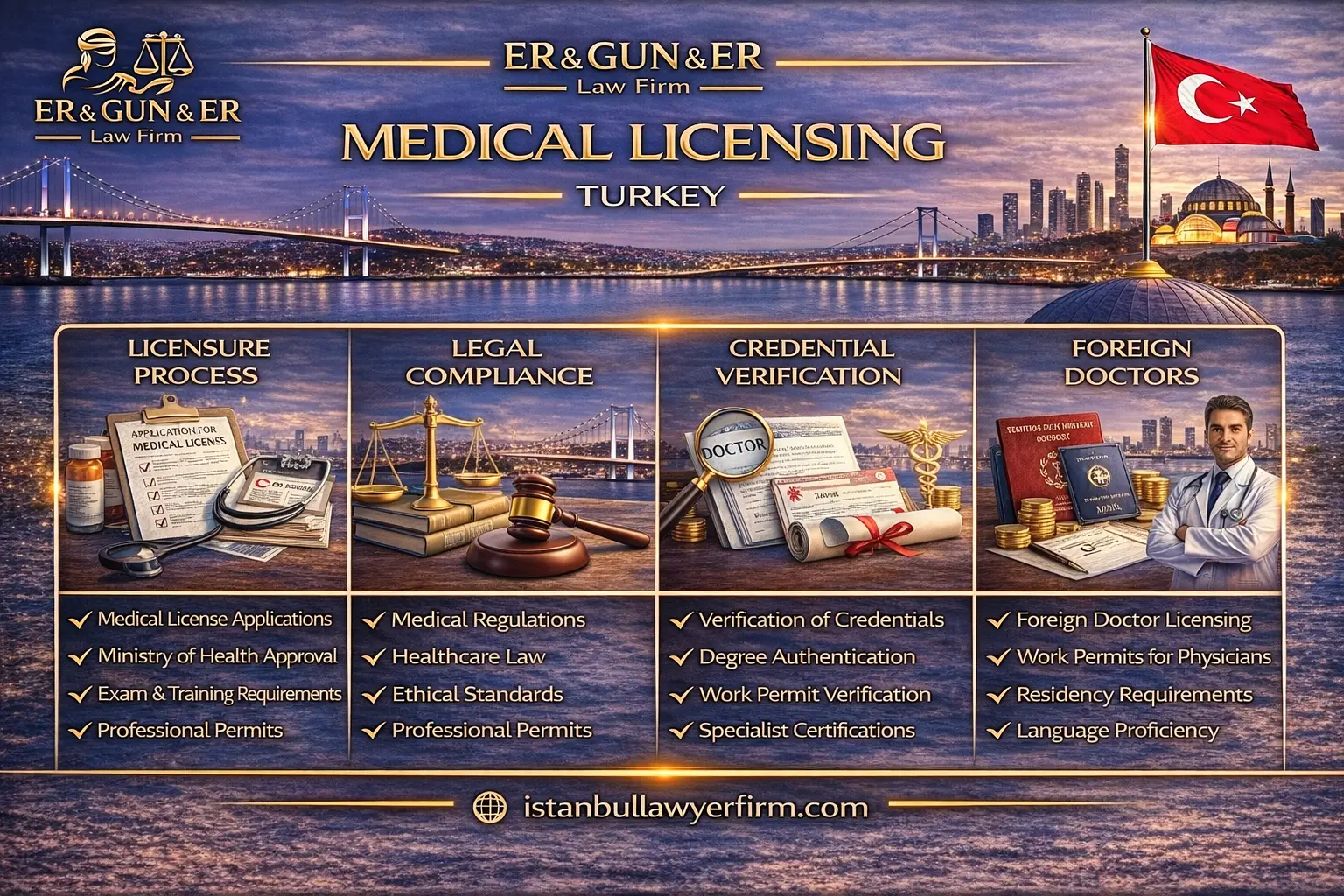
Medical licensing is rarely a single application in Turkey because it sits at the intersection of professional regulation, institutional onboarding, and immigration controls. A candidate who ignores the multi-authority structure often loses time not on the merits, but on missing evidence and inconsistent documents. In medical professional licensing Turkey matters, the decisive point is usually whether the file can be verified across institutions with clean translations and consistent identity data. Professional steps are also linked to immigration status, because a lawful work basis and a lawful scope of activity must align with the professional pathway. A clinic or hospital may apply its own credentialing checks, and those checks can become a practical barrier even when the professional side is progressing. Disciplinary exposure is another layer, because professional status can be challenged by complaints, documentation errors, or conduct allegations that create parallel proceedings. Evidence discipline is therefore not optional, because the process depends on certified records, clear provenance, and consistent submissions. A careful file built with a Turkish Law Firm mindset treats licensing as a compliance project that must survive institutional scrutiny, not as a single form submission.
Licensing overview Turkey
Licensing in healthcare is best understood as a chain of decisions rather than a single gate. The chain begins with determining which authority or institution controls the professional activity in question. It also requires separating professional authorization from the right to work and the right to practice in a specific setting. Many applicants focus only on diplomas and overlook institutional registration expectations and employment documentation. The concept of Ministry of Health licensing Turkey matters because the regulatory environment is shaped by ministry level rules and institutional implementations. Official information and public announcements should be checked on the Turkish Ministry of Health website before relying on informal summaries. When a candidate is a foreign national, the case also becomes an interface file that must align immigration status with professional steps. Institutions often ask for the same information in different formats, which is why standardizing the file early is valuable. A licensing plan should define the target role, the target institution type, and the expected documentation pathway. The plan should also define who will issue certified copies and who will provide sworn translations. Where signatures are required, the plan should ensure the correct signatory has authority and consistent name spelling. The file should also anticipate that authorities may request additional documents to verify authenticity. A conservative approach avoids assumptions about what a specific office will accept without proof. practice may vary by authority and year — check current guidance. A good lawyer in Turkey approach is to map risks and evidence needs before the first submission.
A licensing overview must also clarify what outcomes the process can realistically produce at each stage. Some steps result in recognition of a qualification, while other steps result in the right to register or the right to be employed in a regulated setting. The phrase medical license Turkey for foreigners is often used loosely, but it usually refers to the combined outcome of recognition, registration, and lawful work status. Applicants should therefore avoid treating any one certificate as the final solution. The safest strategy is to treat each step as a deliverable that must be verified and later reused by another authority. This is why copies, translations, and identity documents must match precisely across the file. If an authority requests a document update, the update should be captured with version control to avoid mixed submissions. Publicly published changes can be monitored through the Official Gazette so the file is not built on outdated expectations. When candidates rely on employer guidance alone, they may miss professional verification steps that the employer cannot shortcut. When employers rely on candidate statements alone, they may accept incomplete evidence that later fails institutional review. A robust overview therefore includes a timeline logic without promising exact durations. It also includes a document logic that ties each document to a specific authority expectation. The overview should identify which documents need original certification and which can be submitted as verified copies. It should also identify which items commonly require notarization or legalization for cross-border origin. Applicants should be warned not to submit altered or incomplete records, because credibility loss can be permanent. A clean file reduces the chance of repeated submissions and contradictory explanations. practice may vary by authority and year — check current guidance. A disciplined overview is the best prevention tool against avoidable rejection.
Licensing planning must explicitly address the immigration interface, because professional steps do not replace the need for lawful residence and lawful work. A candidate may be academically eligible yet still unable to work without the correct immigration pathway. The phrase physician work permit Turkey reflects this practical reality because employment in healthcare typically requires lawful authorization beyond professional recognition. Applicants should read the immigration dimension as part of the licensing file, not as a separate problem solved later. A reliable starting point for institutional and documentary context is an immigration law overview that explains how status and documentation interact. Work authorization concepts can be framed through a work permit guide so the candidate understands employer roles and compliance duties. Employers in hospitals and clinics often require the immigration pathway to be credible before they invest in credentialing steps. Conversely, some immigration steps may require evidence that the role is regulated and that the candidate can satisfy professional requirements. This circular dependency is why sequencing matters and why a plan should be written before actions are taken. The plan should also define the candidate’s permitted scope of activity during each stage to avoid inadvertent unauthorized practice risk. If a candidate is invited to observe or train, the plan should still clarify boundaries and documentation. Contracts and onboarding materials should not describe a scope broader than what the candidate is legally able to do at that time. Evidence of identity, residence address, and prior qualifications should be kept consistent and current. If an authority requests an update, the update should be applied across the file, not only in one place. The safest approach is to maintain a controlled file set and to submit the same core pack to each authority when possible. A controlled sequence reduces confusion and protects the candidate and employer from compliance exposure.
Regulated medical professions
Healthcare regulation covers multiple professional roles, and the legal pathway depends on the role’s statutory and regulatory classification. Candidates should not assume that a pathway for one profession applies to another profession with a similar title abroad. Some roles are treated as independent professions, while others are treated as auxiliary roles with narrower permitted activities. The professional perimeter affects what tasks can be performed, what supervision is required, and what institutional approvals are expected. The phrase medical board registration Turkey signals that professional status often requires registration or recording under a recognized professional framework. Applicants should therefore confirm which registration or recording concept is relevant for their role before submitting documents. When the role is unclear, the file should begin with role mapping using official institutional descriptions and public rules. Public rules and published texts should be verified on Mevzuat rather than relying on secondary summaries. Regulation also differs between public institutions and private institutions, because onboarding practices can apply additional filters. Even where the law is stable, institutional implementation can be strict because hospitals manage clinical risk and insurance exposure. This is why a role analysis should include the intended workplace setting and its internal policies. A candidate should also check whether the role requires a separate professional association registration or an institutional license. The employer’s credentialing team may require background checks, references, and verified training records. Those requirements are not always legal requirements, but they can function as gatekeepers. practice may vary by authority and year — check current guidance. A well advised candidate working with a law firm in Istanbul mindset treats role classification as the first compliance decision.
Because healthcare touches patient safety, regulated professions carry documentation duties that are more intense than in many other sectors. Licensing work often overlaps with health law practice because it involves consent, recordkeeping, and professional discipline expectations. The phrase health law lawyer Turkey reflects the reality that licensing issues often become risk management issues in clinical settings. For a broader framework on institutional duties and regulated conduct, candidates and employers can review health law in Turkey to understand how compliance and professional standards interact. A role is not only a title, but a permitted activity set that affects employment contracts, insurance, and patient documentation. Many disputes arise when a professional is asked to perform tasks outside the approved scope. Institutions may also apply ethical rules and internal policies that constrain behavior beyond baseline legal rules. Candidates should understand that compliance is evaluated in real time, not only at onboarding. This means that training, supervision, and documentation habits become evidence if a later complaint occurs. A candidate should also understand that credentialing is not the same as licensing, but credentialing can stop employment even when the license side is progressing. In cross-border cases, translation quality affects how training is understood, which can affect role classification decisions. A cautious Istanbul Law Firm approach is to align role mapping, documentation, and employment scope language before any clinical activity begins. This prevents a later claim that the institution misrepresented the candidate’s authorized role. The objective is to keep clinical operations and paper records consistent from day one. Clear scope protects both the professional and the institution when a regulator or insurer examines the file.
Regulated professions also differ in how they interact with private practice settings such as clinics and outpatient centers. Some roles may be practiced only under certain institutional structures, while others allow broader private practice under specific conditions. When an individual intends to practice in a private setting, the regulatory question becomes both personal authorization and facility compliance. The phrase private clinic licensing Turkey captures this facility layer because a clinic may require separate permissions, staffing ratios, and documentation systems. Facility compliance can also influence whether a foreign professional is employable, because the facility may need to show compliant staffing and oversight. Candidates should therefore ask early whether the target clinic can legally employ the role and whether the clinic’s compliance status is current. If the clinic is undergoing inspections or license renewal, hiring may pause irrespective of the candidate’s personal readiness. Private practice plans should also consider that advertising and patient acquisition rules can be strict in healthcare contexts. Contracts with clinics should define scope, supervision, and documentation responsibilities in enforceable language. If a dispute arises, a court or regulator will compare the contract scope to the actual activity performed. This is why job descriptions and clinic marketing materials must be aligned with authorized scope. Candidates should also avoid informal arrangements where they provide services without being properly onboarded. Informal practice can create both administrative and criminal exposure in certain scenarios. practice may vary by authority and year — check current guidance. A controlled approach is to treat the facility and personal pathways as one coordinated compliance project. Coordination reduces surprises and supports a clean audit trail.
Foreign qualification recognition
Foreign qualification recognition is the bridge between an overseas education record and a Turkish institutional decision. The process begins by defining which authority evaluates the qualification and what evidence that authority expects. The phrase foreign doctor licensing Turkey often covers multiple steps, including recognition, professional registration, and employment readiness. Candidates should separate the recognition question from the employment and work authorization questions so each step can be managed cleanly. Recognition is evidence driven, and authorities usually focus on authenticity, curriculum equivalence, and identity matching. Candidates should therefore obtain official transcripts and degree certificates in a form that can be verified. They should also ensure that names, dates of birth, and passport numbers are consistent across documents. Where documents come from multiple institutions, the file should include a clear explanatory narrative supported by certified records. Official institutional information about higher education coordination can be checked on the Council of Higher Education website before relying on informal sources. Candidates should avoid claiming that a foreign license automatically transfers, because recognition is based on local criteria and institutional review. The same caution applies to claims about automatic acceptance of specialization or residency training. practice may vary by authority and year — check current guidance. In cross-border situations, an English speaking lawyer in Turkey can help ensure that translations reflect the operative meaning of foreign records without overstatement. The objective is to present a file that an authority can verify without guesswork. Verification readiness is the real currency of recognition work.
Recognition decisions can be delayed or complicated by gaps in documentation rather than by substantive ineligibility. Candidates should anticipate requests for additional records that explain course content, clinical hours, or institutional accreditation status. The phrase recognition of foreign medical diploma Turkey is best understood as a structured evidence review rather than as a one time submission. Where the authority requests curriculum descriptions, the candidate should obtain them from official sources and ensure they are properly authenticated. Where the authority requests proof of internship or clinical training, the candidate should provide official confirmations rather than personal declarations. If the candidate’s education occurred across multiple countries, each segment should be documented and logically connected. Translation should be consistent, and key terms should not shift across documents because shifting terms create credibility problems. If a document is updated, the candidate should update all copies across the file to avoid mismatched versions. Candidates should also be careful about submitting screenshots or unofficial printouts as primary evidence. Such documents may be useful for context, but they are rarely sufficient for formal decisions when authenticity is questioned. A prudent approach is to maintain originals or certified copies and to keep a clear chain of custody for each record. The file should also include a structured table of contents within the submission pack, even if the authority does not require it. This improves readability and reduces the risk that a key document is missed during review. If the candidate has professional practice history abroad, confirmations of good standing may be relevant, but they should be presented cautiously and with clear provenance. The goal is not to overwhelm the authority, but to make verification straightforward. When the file is coherent, the authority’s questions become narrower and more manageable.
Foreign recognition also interacts with hospital onboarding, because hospitals may require verified credentials beyond what an authority recognizes. Credentialing teams often want a clean set of documents to satisfy internal compliance and insurance expectations. This is why hospital staff credentialing Turkey considerations should be anticipated even while recognition is pending. A hospital may request references, malpractice history disclosures, and training verifications that do not appear in the authority’s recognition checklist. Those materials should be prepared truthfully and supported by documentation to avoid later contradiction claims. Where a candidate cannot obtain a record, the candidate should explain why with evidence, rather than leaving the gap unaddressed. Incomplete files invite suspicion, and suspicion creates repeated queries that waste time. Candidates should also avoid providing inconsistent explanations across authorities and employers. Consistency matters because employers and authorities may compare submissions, especially when issues arise later. Where a candidate’s documents require legalization or consular confirmation, the chain should be completed before submission to avoid mid-process rework. Candidates should also keep proof of submission and receipt, because administrative disputes sometimes arise about what was filed. If the candidate changes address or contact information, updates should be communicated promptly and consistently. Recognition work should also be aligned with professional registration steps so that recognized documents can be reused without duplication. This reduces cost, reduces confusion, and increases control over the evidentiary record. A conservative approach treats every submission as a document that may later be reviewed in a disciplinary context. The safest posture is factual, consistent, and verifiable at all times. A file built with this discipline is resilient even when unexpected questions arise.
Diploma equivalency process
Equivalency is the structured assessment of whether a foreign diploma corresponds to the Turkish framework for the relevant profession. The phrase diploma equivalency Turkey healthcare is often used by candidates who need a clear map of which documents are decisive and how they are evaluated. Equivalency work typically requires certified diploma records, transcripts, and evidence of institutional status. Authorities often focus on authenticity first because a forged or altered record can end the process immediately. This is why candidates should obtain records directly from issuing institutions or through official verification channels. Where a diploma is issued in a language that is not Turkish, a sworn translation becomes central evidence. Translations should reflect the original text precisely and should preserve the structure of the document. If the diploma name or program title is unusual, supporting program descriptions can help avoid misclassification. The file should also include consistent identity documentation linking the candidate to the diploma record. Where there are name changes, formal proof must be provided to connect identities without speculation. Candidates should also preserve a clean chronology of education and training to reduce questions about gaps. If the authority requires additional evidence of training content, the candidate should provide it as an official document rather than as a personal narrative. practice may vary by authority and year — check current guidance. A cautious best lawyer in Turkey approach is to treat equivalency as an evidence engineering exercise that must stand alone without oral explanation. The goal is a pack that a reviewer can verify quickly and confidently.
Equivalency files often fail on small inconsistencies that appear harmless to the candidate but serious to an administrative reviewer. Differences in spelling across passports, diplomas, and transcripts are one common trigger for requests and delays. Another trigger is missing pages, missing stamps, or unclear photocopies that prevent authenticity assessment. Candidates should therefore submit clean scans of certified copies when originals cannot be submitted. They should also preserve originals in a secure archive because later steps may require them again. Where a document is obtained abroad, legalization requirements can change depending on the origin country and the authority’s practice. practice may vary by authority and year — check current guidance. Candidates should avoid assuming that a document accepted by one institution will be accepted by another institution without the same chain. A consistent translation strategy is also critical because medical terms and program descriptions can be interpreted differently if translated inconsistently. Translators should be instructed to keep terminology stable across documents, especially for key program names and clinical training phrases. If the candidate submits multiple translations prepared at different times, the file can appear contradictory even when the original is consistent. Turkish lawyers working on equivalency issues typically standardize translations and verify identity links early to reduce iterative objections. The file should also include proof of authenticity where available, such as verification letters or digital verification outputs, presented in a defensible format. If an authority requests an additional record, the response should be prompt and should include a cover explanation anchored in documents. Candidates should keep copies of every submission and every receipt to preserve the administrative record. This record becomes important if the process later intersects with employment onboarding or disciplinary review. Equivalency outcomes are rarely improved by pressure, but they are improved by clear evidence. Evidence discipline is therefore the core strategy.
Equivalency should be planned together with downstream steps so the candidate does not duplicate work or create inconsistent packs. If the candidate will later apply for professional registration, the same core documents should be reused in the same form. If the candidate will later apply for work authorization, the equivalency record should support the employment narrative without conflict. The file should therefore be built with a stable document set, stable translations, and stable identity references. Candidates should also be careful when communicating with employers about equivalency status, because overstatement can create contractual disputes later. Employers may draft employment language assuming equivalency is completed, so accuracy matters at the contracting stage. Where the candidate is offered a role contingent on equivalency, that contingency should be written clearly in the employment documentation. Candidates should also understand that equivalency is not necessarily the final professional permission, and other steps may still be required. The safest posture is to communicate status as documented milestones rather than as assumptions about what will happen next. Administrative reviewers may request clarifications that look repetitive, and candidates should treat those requests as normal rather than as hostility. Responding with calm, complete documentation usually reduces future queries. Candidates should also consider that equivalency records may later be requested in malpractice or disciplinary contexts as proof of qualification history. This is another reason to keep the pack consistent and clean. If a candidate intends to practice in a specific institutional setting, the equivalency file should be aligned with that setting’s credentialing expectations. A coherent pack supports credibility and reduces the risk of contradictory statements. The ultimate objective is to produce a verifiable foundation that can be relied on in multiple compliance contexts. A verifiable foundation is the best risk control tool available at this stage.
Language and competency checks
Language readiness is treated as a patient safety issue, not a formality. Institutions need confidence that the professional can understand clinical instructions, informed consent, and recordkeeping duties. A licensing file should therefore include a consistent approach to how language competence is evidenced. Some pathways rely on formal certificates, while others rely on employer based assessments and supervised practice documentation. The contract and onboarding file should not describe unsupervised patient interaction if the language requirement is not satisfied. Candidates should avoid submitting informal translations as proof of competence, because they can be challenged as unreliable. When the authority or institution requests a specific format, the file should comply exactly with that format. If a certificate is issued abroad, it should be authenticated and translated in a way that preserves the issuing body’s identity. Where a candidate has multiple names across documents, the language record must use the same identity link evidence as the diploma file. Supervisory arrangements should be documented so that the permitted scope matches the demonstrated competence level. It is also important to define who is responsible for interpreting during patient encounters when interpretation is needed. Informal reliance on colleagues for interpretation can create risk if the record later shows that consent was not understood. practice may vary by authority and year — check current guidance. The safest strategy is to treat language evidence as part of the overall verification chain. A lawyer in Turkey will usually recommend building this package early to avoid repeating submissions.
Competency checks can also relate to clinical skills and familiarity with local protocols. Employers may require observed practice, references, or structured evaluations before granting full clinical privileges. These evaluations should be described in neutral terms in contracts and internal memos. A candidate should keep written records of training sessions, supervision, and evaluations because those records can later support credibility. When the candidate is a foreign national, the institution may also test communication in Turkish in real workflows such as charting and discharge instructions. A file should avoid statements that the candidate is fully authorized if authorization is still conditional. Conditional wording protects both the candidate and the employer from misrepresentation allegations. If the institution uses an internal assessment, the assessment methodology should be preserved so the decision can be explained later. Candidates should ask the employer to confirm in writing whether interpretation support will be provided and under what limits. If interpretation is used, the documentation should reflect that interpretation occurred and that understanding was confirmed. Candidates should also avoid social media claims about being licensed before the pathway is complete. Those claims can be treated as evidence of unlicensed practice intent if a complaint is filed. practice may vary by authority and year — check current guidance. An English speaking lawyer in Turkey can help foreign professionals keep communications accurate without creating admissions. The goal is a record that matches the permitted scope at every stage.
Language and competency should be approached as risk controls that protect the professional, the institution, and patients. The file should define which tasks are permitted during onboarding and which tasks require additional approvals. If a professional is invited to observe, the documentation should describe observation rather than clinical practice. If a professional is invited to train, the documentation should define supervision and documentation responsibilities. Institutions should also ensure that patient communications are consistent with the professional’s permitted scope. Misalignment between real activities and the paper trail is a common trigger for disciplinary scrutiny. Candidates should therefore request written clarification of duties and avoid informal expansion of tasks. Where competency evidence is requested, the candidate should provide it in a verifiable format with certified translations if needed. If an authority asks for additional documentation, the response should be factual and should avoid speculative explanations. A structured file also supports later insurance discussions because insurers often ask about training and credentialing. The candidate should preserve copies of all submissions, receipts, and institutional responses in a single archive. That archive becomes important if a hospital changes its credentialing team mid-process. It also becomes important if the professional later seeks mobility to a different institution. A Turkish Law Firm approach is to treat each competency document as an exhibit that may be reviewed under dispute conditions. This approach reduces the risk that a minor language or competency question derails an otherwise strong file.
Professional registration steps
Professional registration is the step that turns recognition and documents into a status that institutions can rely on. It often requires a verified identity file, verified qualification file, and a clear description of the intended scope of practice. Candidates should confirm which registry or professional recording mechanism applies to their exact role. The administrative checklist can look simple, but the underlying verification expectations can be strict. A clean file should include consistent spelling, consistent dates, and consistent passport references across every document. If a candidate has multiple citizenships, the file should state which identity document is used for the registration pathway. Where a candidate has changed surname, the file must include formal evidence linking the identities. The phrase medical board registration Turkey should be treated as a formal status step that depends on document integrity. Institutions commonly request certified copies and sworn translations, and they will compare them to prior submissions. Candidates should not submit the same document in different versions or different translations across different offices. A candidate should also keep an internal index of what was submitted, when it was submitted, and to whom it was submitted. That internal index reduces confusion when additional questions arrive. practice may vary by authority and year — check current guidance. An Istanbul Law Firm style workflow emphasizes consistent packs and documented receipts rather than rushed submissions. The objective is a registration record that can later support employment and institutional credentialing without rework.
Registration steps can also include background declarations and professional history information. If a candidate has practiced abroad, institutions may ask for proof of good standing or disciplinary history statements. Those statements should be obtained from official sources where possible and translated accurately. Candidates should avoid writing personal narratives as substitutes for official confirmations. If a document cannot be obtained, the reason should be documented with correspondence rather than with assumptions. A registration file should also preserve all correspondence with the receiving office, including appointment confirmations and submission receipts. Where the office uses an online portal, screenshots and system receipts can be kept as supporting evidence of submission. If the portal content changes, the candidate should record the updated checklist to maintain a defensible timeline. The candidate should also confirm whether any institutional identity verification steps are required in person. In-person verification expectations can create travel and scheduling issues for foreign candidates. practice may vary by authority and year — check current guidance. A disciplined approach is to prepare for both in-person and remote verification possibilities without relying on a single assumption. If the candidate is already employed conditionally, the employer should be informed of the registration status with precise wording. Turkish lawyers often advise employers to avoid onboarding language that implies full privileges before registration is confirmed. This avoids later conflict when internal compliance audits review how the institution described the professional’s status.
A successful registration step should be followed by a compliance mindset because registration is not the end of scrutiny. After registration, institutions may still impose credentialing, privileging, and periodic revalidation checks. The professional should treat every update, address change, and employment change as something that may need to be notified and documented. Failure to update key information can later be framed as misrepresentation in a complaint. Where the professional will work in more than one institution, the file should track each appointment and its scope. A professional should avoid working outside the registered scope because such activity can trigger investigations. Documentation should be standardized so that the same identity and qualification file can be reused without inconsistency. If the professional signs consent forms or patient records, signatures should match the registered name. If the professional uses a different name in a foreign passport, the institution should be informed and the link should be documented. Compliance training records should be preserved because they can be requested in audits and complaints. A registration record is also used in insurance underwriting, so inconsistencies can cause coverage disputes later. A law firm in Istanbul can help candidates align contracts, HR files, and registration records to avoid contradictions. This alignment is especially important when a professional is transitioning from an observer role to a practicing role. practice may vary by authority and year — check current guidance. The practical goal is a clean administrative trail that supports safe practice and defensible professional status.
Work permit healthcare interface
The work authorization layer is often the bottleneck because it requires employer participation and compliant status evidence. A candidate can have a strong recognition file and still be unable to work if immigration status is not aligned with the intended role. The phrase physician work permit Turkey highlights that healthcare work is not treated as generic employment in practice. Employers need to match job descriptions, workplace licensing, and professional scope to the application narrative. Candidates should therefore ensure that the job title and duties in the offer documents match the regulated scope they are pursuing. If the role is described too broadly, it can create questions about unauthorized practice. If the role is described too narrowly, it can create operational problems later when the institution expects broader duties. Work authorization files also rely heavily on identity consistency, which means the immigration file and the licensing file must match. The concept of medical license Turkey for foreigners is incomplete without this alignment because work and practice must both be lawful. Evidence such as diplomas and registrations should be provided in verifiable form, with sworn translations where needed. Employers should avoid letting candidates start clinical work informally while the work authorization is pending. Informal start arrangements can create compliance and liability exposure for the institution. practice may vary by authority and year — check current guidance. A lawyer in Turkey will typically review the employer narrative to ensure it does not contradict the professional pathway. This review prevents a later claim that the file was built on inconsistent or misleading employment descriptions.
Work authorization is also shaped by the employer’s legal structure and compliance standing. Hospitals and clinics often operate through licensed entities that must show compliant staffing and internal supervision. If the employer is newly established or restructuring, corporate readiness becomes part of the pathway. This is why some healthcare groups begin with company formation planning before recruiting foreign professionals. The employer must ensure that its licenses, registrations, and operational permits are current, because authorities may review the workplace framework. The candidate should request written confirmation of the exact employing entity and the workplace address used in filings. If the candidate will work across multiple facilities, the employer should clarify which facility is the primary location for compliance purposes. A mismatch between contract location and actual workplace can create questions during inspections and audits. Employers should also confirm that the candidate’s professional pathway is compatible with the intended scope of duties. If a candidate is still in training or observation status, the work authorization narrative should reflect that limited scope. Overstating scope can create regulatory risk, while understating scope can create operational and payroll confusion. The employer should also plan HR recordkeeping so identity documents, translations, and receipts are archived consistently. practice may vary by authority and year — check current guidance. A Turkish Law Firm approach is to coordinate the licensing file and the employer compliance file as one controlled evidence set. This coordination reduces contradictory submissions and prevents avoidable rework when authorities request clarifications.
The work authorization interface is not only an immigration issue but also a contractual and compliance issue for the employer. Employers must align payroll records, job descriptions, and workplace policies with the regulated scope of work. Internal audits often review whether foreign professionals were onboarded with the correct documentation and approvals. Where the employer is a corporate group, governance and signatory authority should be clear to avoid invalid signatures on employment documents. For general context on employer obligations and commercial documentation discipline, parties can review commercial law overview when aligning internal approvals. The employer should also ensure that any patient facing communication materials do not describe the professional in a way that exceeds the authorized scope. If the professional is limited to supervised practice, public descriptions should reflect supervision rather than full independent practice. The institution should coordinate with its compliance and legal teams when drafting onboarding documents. This coordination is also relevant to data handling, because HR files contain sensitive personal data that must be protected. If the candidate’s file includes foreign documents, the employer should store them securely and limit access to authorized personnel. Contract amendments should be documented formally so that job scope changes are traceable and defensible. Where authorities request clarifications, the employer’s response should be consistent with the candidate’s licensing submissions. practice may vary by authority and year — check current guidance. An Istanbul Law Firm can help employers build a compliance narrative that remains consistent across licensing, HR, and inspection settings. Consistency reduces the risk of rejections and reduces exposure if a later complaint triggers a document review.
Employment contracts and scope
Employment documentation is part of the licensing file because it defines what the professional will actually do in practice. In healthcare, job descriptions can be treated as evidence of scope when institutions and authorities review compliance. A healthcare employment contract Turkey should therefore mirror the permitted scope of the candidate’s professional pathway. The contract should state whether the role is supervised, conditional, or fully authorized, using accurate language. If the role is conditional, the condition should be written clearly and linked to objective milestones rather than vague expectations. Contracts should also identify the workplace, because the workplace license and staffing model can affect compliance. If the employer operates multiple sites, the contract should identify whether the professional can rotate and under what approvals. The contract should also define working hours and on call duties in a way that matches the institution’s credentialing and supervision plan. Where the professional is a foreign national, the contract should avoid clauses that imply work can start before lawful authorization is in place. Compensation language should be clear and compliant, but parties should avoid embedding assumptions about approvals or timelines. If the employer includes training obligations, those obligations should be described as structured onboarding rather than as ad hoc clinical practice. Termination clauses should address how credentials and access rights will be revoked to protect patient records and systems. practice may vary by authority and year — check current guidance. A law firm in Istanbul can align the contract wording with the licensing and credentialing narrative to reduce contradictions. That alignment reduces risk if a dispute later examines whether the professional acted outside an agreed and permitted scope.
Employment contracts in healthcare also carry data and confidentiality obligations that must be drafted carefully. HR files contain identity documents, diplomas, and health related information that must be handled securely. The employer should define who can access the employee file and how long documents will be retained. If the employer uses third party HR vendors, those vendors should be contractually controlled and supervised. Internal compliance teams often rely on KVKK audit defense guidance when designing HR data handling steps. The contract should also define confidentiality duties regarding patient information, clinical protocols, and internal incident reports. The professional should be trained on documentation standards because documentation failures can become disciplinary evidence. If the professional has access to electronic health record systems, access rights should be role based and logged. The contract should require prompt reporting of lost credentials and suspected misuse of patient data. If interpretation support is used, the contract and policies should ensure that interpreters are bound by confidentiality. Professional indemnity and insurance discussions should not be treated as informal side conversations, because they affect risk allocation. Where insurance is arranged by the employer, the contract should describe the coverage relationship in factual terms. practice may vary by authority and year — check current guidance. A best lawyer in Turkey will typically review these clauses to ensure they are enforceable and consistent with institutional policies. Consistent drafting reduces the chance that an employment dispute becomes a compliance crisis during an inspection or audit.
Contract scope also determines how disputes will be evaluated because it defines the baseline duties and supervision expectations. If the professional performs acts outside the contract scope, the employer may argue breach and regulators may argue unauthorized practice. This is especially sensitive when the file is still pending a physician work permit Turkey pathway because the lawful basis for work is part of the compliance story. The contract should therefore include clear boundaries about what can and cannot be done before all authorizations are complete. If the professional will provide patient facing services, the contract should state whether those services are supervised and how supervision is documented. Dispute clauses in employment documentation should be consistent with the institution’s internal investigation policies. If a complaint arises, the institution will review whether training, supervision, and documentation were consistent with the contract. Employers and professionals should understand that certain conduct allegations can spill into broader legal exposure, including employment claims and criminal complaints. For general risk framing, parties can consult criminal law considerations when aligning internal reporting and defense posture. The contract should also define how internal investigations are handled and who represents the institution in communications. The professional should be advised to keep personal copies of key employment and onboarding documents to protect against later disputes. Foreign professionals should avoid informal statements about their status because such statements can become evidence in internal files. practice may vary by authority and year — check current guidance. An English speaking lawyer in Turkey can help foreign professionals keep their contractual and compliance communications accurate and consistent. Accurate communications reduce escalation and support a defensible position if a dispute later tests the licensing and employment interface.
Private clinic compliance
Private practice is regulated through a combination of facility permissions, staffing rules, and professional scope controls. A clinic can be compliant on paper yet operationally risky if workflows do not match the licensed scope. When clients ask about private clinic licensing Turkey, the first question is which services will be offered and by whom. The second question is which institution will sign medical records and how supervision is documented. A clinic should not advertise services that it cannot legally deliver with its current staffing and approvals. Facility documentation should be organized so that inspections can be met without improvised explanations. Internal policies should cover patient intake, record retention, sterilization routines, and complaint handling. If external contractors will work on site, their status and supervision should be documented in writing. If the clinic uses outsourced laboratories or imaging providers, referral pathways should be documented and audited. The clinic should maintain a controlled folder of all permits and renewal communications. Staff schedules should be consistent with declared operating hours and declared clinical coverage. Consent forms should be adapted to the actual procedures offered and the language needs of the patient population. If foreign professionals are involved, the clinic should verify each person’s scope before assigning clinical tasks. Documentation discipline prevents later allegations that services were delivered by unqualified personnel. A compliance plan is strongest when it is operationally testable and consistently followed.
Clinic compliance is shaped by how authorities interpret facility requirements and how institutions document their oversight. In many files, the decisive issue is whether the clinic can demonstrate that clinical acts are performed within approved boundaries. The phrase Ministry of Health licensing Turkey is often used as a shortcut, but the practical work is in matching approvals to operations. Official baseline information should be checked through Ministry of Health resources before relying on informal checklists. Internal audit notes should be kept factual and should avoid speculative language that could later be misunderstood. Staff onboarding should include signed acknowledgments of policies and clear supervision lines. If a clinic offers telemedicine or remote follow up, the process should be described and controlled in documentation. Contracts with suppliers should include confidentiality and data handling rules because patient information can appear in invoices and logs. If the clinic uses electronic health records, role based access and audit logs should be maintained and reviewed. “practice may vary by authority and year — check current guidance.” A clinic that anticipates variability will keep a written record of what guidance it relied on and when it relied on it. When the clinic updates a procedure, it should update forms, training materials, and signage in a consistent way. A compliance review led by Istanbul Law Firm methodology usually starts with document integrity and then tests real workflows. The goal is to reduce the gap between what the clinic says it does and what it actually does. When that gap is closed, inspections and patient complaints become less likely to escalate into formal proceedings.
Private clinics also face commercial and HR issues that can create compliance exposure if handled casually. Employment documentation should match actual clinical duties and the clinic’s staffing model. If a professional is hired conditionally, the clinic should document conditional scope and supervision in writing. Payment models should not encourage undocumented procedures or off ledger practices that later undermine record integrity. Where services are provided through partnerships, partnership terms should allocate responsibility for documentation and complaint handling. Vendor agreements for medical devices and software should include training, maintenance, and incident reporting pathways. If the clinic serves foreign patients, translation support and information delivery should be documented to avoid misunderstanding allegations. Patient files should be prepared as if they may be reviewed later by an inspector, a court, or an insurer. The clinic should maintain a consistent signature policy so that records show who performed which step of care. Complaint intake should be centralized so that responses are consistent and evidence is preserved. If the clinic discovers a documentation error, correction should be done transparently and without tampering. Staff should be trained not to delete logs or messages when a complaint arises. The clinic should also track subcontractor access to premises and systems because access can create data risks. A structured review with law firm in Istanbul discipline can reduce drift between written policies and daily habits. This disciplined posture supports safer care and reduces the chance of regulatory escalation.
Hospital onboarding compliance
Hospital onboarding is usually stricter than clinic onboarding because hospitals manage complex clinical risk and multi-department workflows. Credentialing often includes verification of identity, education, training, and prior practice history. Many institutions use a credentialing committee process that expects clean documentation and consistent translations. The term hospital staff credentialing Turkey captures this institutional layer that sits on top of formal licensing steps. Hospitals often require a defined scope of privileges that is narrower than the broad professional title. Privileges should be aligned with supervision plans, especially when the professional is new to the institution. Access to operating rooms, prescribing systems, and imaging platforms may require separate approvals. HR onboarding should align with medical administration onboarding so that role descriptions are identical across files. Hospitals will also check infection control training, emergency procedures, and patient safety protocols. If the professional is a foreign national, the hospital will also review immigration documentation for consistency with the job scope. Documentation should include verified diplomas, verified identity records, and a clear employment statement. If the hospital uses electronic systems, access rights should be role based and reviewed after any role change. Credentialing evidence should be preserved in a controlled archive because it may be requested in later audits. Hospitals should avoid allowing clinical activity before credentialing is complete, even if there is operational pressure. A clean onboarding record reduces dispute risk because it shows the institution acted with reasonable diligence.
Foreign professionals often experience onboarding friction not because of competence, but because documents are not formatted for hospital review. Hospitals may request certified translations of every document they store, including reference letters and training confirmations. If the candidate file is built in parallel for multiple hospitals, version control becomes essential to avoid mismatched copies. The phrase medical license Turkey for foreigners can involve hospital specific demands that go beyond the central recognition steps. Hospitals may also require background declarations and conflict of interest statements for internal governance. Where the hospital is part of a group, group compliance policies may require additional checks and approvals. Orientation programs may include documentation training because charting quality is treated as a patient safety control. The candidate should keep a personal archive of onboarding submissions and receipts to prevent later disputes. “practice may vary by authority and year — check current guidance.” A hospital that acknowledges variability will confirm its current checklist in writing before requiring expensive document rework. When a professional communicates with HR, medical administration, and supervisors, the same factual wording should be used. Overstatements about authorization status can create later allegations of misleading the institution. An English speaking lawyer in Turkey can help foreign candidates keep communications accurate while preserving evidentiary clarity. The goal is to ensure that the written file and the actual activities match at every stage. When that match is maintained, later audits and incident reviews are less likely to become adversarial.
Hospitals should treat onboarding as a continuous process that continues after the first day of work. Privileges should be re-evaluated when the professional changes department or takes on new procedures. If the professional is supervised, supervision records should be created and retained in a consistent format. Patient consent workflows should align with the professional’s privilege scope so that consent is obtained by authorized personnel. Hospitals should ensure that translated patient materials are accurate when foreign patients are served. If interpretation services are used, interpreter identity and confidentiality duties should be documented. The hospital should maintain a clear incident reporting channel that encourages early reporting rather than concealment. When an incident is reported, the hospital should preserve relevant logs, shift rosters, and clinical notes. Credentialing teams should coordinate with legal teams when a complaint suggests potential disciplinary exposure. Hospitals should avoid informal ad hoc privilege expansions in response to staffing shortages. Short-term operational fixes can create long-term legal exposure when records show unauthorized practice. A robust onboarding file should also clarify who is responsible for equipment calibration and device maintenance documentation. Where outsourced services are used, the hospital should document oversight and performance monitoring. A consistent onboarding record supports patient safety and also supports defense if litigation arises. The practical benefit is reduced uncertainty because the institution can demonstrate that it followed a structured process.
Malpractice and insurance issues
Malpractice risk is the point where licensing, documentation, and institutional practice converge. In medical malpractice liability Turkey disputes, the record is often more decisive than the recollection of events. Courts and experts typically examine whether care met reasonable professional standards in the circumstances. The strongest protection for the professional is consistent clinical documentation that explains decisions and patient information. Institutions should train staff that incomplete notes can be interpreted as incomplete care, even when care was appropriate. A professional should also preserve evidence of supervision and privilege scope because scope limits matter in evaluation. Hospitals and clinics should align incident reporting with legal privilege expectations and factual accuracy. Early legal triage can be informed by a malpractice defense overview that explains how evidence and experts shape outcomes. Insurance policies are not a substitute for compliance, but they can provide a structured response when a claim arises. Policy conditions often require timely notice and cooperation, so institutions should define internal reporting workflows. Claim handling is safer when the professional avoids admissions and focuses on factual preservation. A lawyer in Turkey perspective typically emphasizes record integrity, causation analysis, and controlled communications. Professionals should not assume that a complaint equals fault, because complaints can be strategic or mistaken. At the same time, professionals should not ignore early signals, because early correction reduces harm and escalation. A controlled malpractice posture protects patient safety and reduces the chance of regulatory spillover.
Insurance allocation should be analyzed before an incident, because coverage disputes often arise when emotions are high. Institutions should identify which policies apply to employed physicians, visiting physicians, and outsourced services. Policies often contain exclusions related to unauthorized practice, intentional conduct, or activities outside declared scope. This is why onboarding compliance and privilege definitions have direct financial impact in claim scenarios. A practical step is to review coverage wording and reporting obligations with a structured insurance policy review process. Coverage analysis should consider whether defense costs are inside or outside any coverage limits in the policy wording. Institutions should also confirm whether the insurer appoints counsel or whether the insured can propose counsel. Policy documentation should be stored securely and made accessible to a limited response team. “practice may vary by authority and year — check current guidance.” A policy that looks similar in one year may be renewed with different endorsements, so version control matters. When a claim arrives, the institution should preserve the complete medical record and the internal incident file. Communications should be factual and should avoid speculative causation statements while facts are still developing. In high exposure matters, clients often seek a best lawyer in Turkey mindset that focuses on evidence discipline and risk control. That mindset does not promise outcomes, but it reduces avoidable mistakes that inflate loss. A clear insurance and defense plan improves the chance of an orderly resolution rather than a chaotic crisis.
When a claim is asserted, response quality depends on how quickly the institution shifts into a controlled evidence posture. The first objective is to secure records, logs, and communications that reflect the clinical decision pathway. The second objective is to ensure that the insurer is notified in the manner required by the policy. Institutions should have a written internal workflow that routes notices from clinical staff to risk management and counsel. A structured insurance claims process can reduce missed notices and inconsistent statements. Cooperation with insurers should be real, but it should also be managed so that confidentiality and patient privacy are respected. If third party providers are involved, the institution should identify contractual indemnities and cooperation duties early. Disputes about causation often require expert analysis, so evidence should be preserved for reproducible review. Institutions should avoid altering records after a claim, because alteration allegations can be more damaging than the original dispute. If a record must be corrected, the correction should be transparent and should preserve the original entry context. The professional should also keep a personal chronology of key events based on records, not on memory alone. Settlement decisions should be made after the evidence set is stabilized and the policy position is understood. If litigation becomes likely, the institution should plan witness preparation and expert coordination without public exposure. A coherent claim response reduces the risk that malpractice disputes spill into employment termination or reputational crises. A disciplined process protects both the professional and the institution even when the underlying dispute is complex.
Disciplinary investigations risk
Disciplinary exposure can arise from patient complaints, documentation failures, or allegations of practice outside authorized scope. A professional disciplinary investigation Turkey file is often triggered before any court case is filed. Investigations can run in parallel with hospital internal reviews, insurance processes, and civil claims. The early stage is usually evidence driven, focusing on records, consent forms, and institutional policies. Professionals should avoid informal explanations and instead request a clear statement of the allegations and the evidence basis. Institutions should preserve the full patient record and relevant access logs as soon as an investigation begins. If the professional’s authorization status is questioned, the institution should verify registration and employment scope documents. Communication with patients and families should be respectful and should avoid admissions while facts are still reviewed. A disciplined defense also requires understanding whether the issue is clinical judgment, documentation, or administrative compliance. Where language barriers existed, interpretation records can become central evidence in evaluating misunderstandings. A Turkish lawyers approach typically insists on a chronology built from documents rather than from narratives. This approach reduces the risk that small inconsistencies become perceived as dishonesty. Professionals should also avoid social media statements about the incident because those statements can be captured as evidence. The institution should define who communicates externally so that statements remain consistent. A controlled early response often prevents escalation into wider regulatory and criminal exposure.
Disciplinary processes often turn on whether the professional followed institutional protocols and documented deviations. Institutions should ensure that protocols are accessible, current, and acknowledged by staff in writing. If a protocol changed, the record should show when staff were trained on the update. Investigators may compare chart entries to device logs and pharmacy logs, so consistency across systems matters. When a professional worked under supervision, supervision notes should be preserved and linked to the relevant patient records. If the professional is a foreign national, the institution should verify that work authorization and role scope were aligned throughout the period. A disciplined file should include onboarding privilege decisions, training records, and access grant records. If the institution uses committee decisions, minutes and approval documents should be preserved in a secure archive. “practice may vary by authority and year — check current guidance.” Because of variability, professionals should avoid assuming that a prior colleague’s experience predicts the current process. The professional should request that all communications be made in a traceable format to prevent misunderstandings. If the allegation involves patient communication, the file should include interpreter use records where applicable. Counsel should focus on what the records show and what they do not show, because gaps are often the real problem. Where a gap exists, the response should explain it factually and should avoid speculative reconstruction. A calm, document-based posture is the most credible way to protect professional status and reputation.
Some disciplinary allegations also create criminal risk if the allegation includes intentional harm, falsification, or unauthorized practice claims. Institutions should therefore coordinate internal investigations with legal counsel to avoid destroying evidence or creating inconsistent narratives. The professional should not provide uncontrolled statements without first understanding the allegation scope and the existing records. If an institution interviews staff, interviews should be documented and should avoid leading questions that distort recollection. Where patient privacy is involved, disclosure should be limited to what is necessary for the investigation and defense. If the institution receives an authority request, the institution should respond through a controlled channel and preserve copies. Professionals should also consider employment consequences because disciplinary issues can trigger suspension or termination decisions. Employment decisions should be documented carefully so that they reflect compliance concerns rather than retaliation or rumor. If the allegation is resolved, the institution should document the closure and any corrective actions in a factual manner. Corrective actions should focus on training, supervision, and documentation improvements rather than on blame language. If restrictions are imposed, restrictions should be stated clearly so the professional does not inadvertently breach them. Institutions should also monitor follow-up compliance so that the same risk pattern does not repeat. A disciplined response protects patient safety and also protects the institution’s licensing standing. It also reduces the likelihood of parallel litigation because it shows that the institution acted responsibly. The long-term objective is a compliance culture where licensing and clinical documentation support each other consistently.
Patient consent documentation
Consent documentation is the backbone of clinical defensibility. In patient consent requirements Turkey matters, inspectors and experts usually start with the file. Consent must match the procedure, the risk profile, and the patient’s capacity. The professional should ensure the patient’s identity is verified in the record. The record should show what information was provided and in what language. If interpretation is used, the interpreter’s role should be documented. Consent should not be reduced to a signature without context. The file should reflect that alternatives and material risks were discussed. Where minors or guardians are involved, authority documents must be attached. Where urgency exists, the record should explain the urgency and the decision path. Standard forms should be adapted to the institution’s actual services. Templates copied from another setting can create contradictions in the file. “practice may vary by authority and year — check current guidance.” A disciplined Turkish Law Firm workflow treats consent as a litigation exhibit from day one. That mindset reduces later disputes about whether consent was informed.
Foreign patients and multilingual settings increase consent risk because misunderstanding is easy to allege later. Consent text should be written in plain language that matches the patient’s comprehension level. If a translated consent is used, the translation should be controlled and versioned. The file should show who provided the explanation and how questions were answered. A patient should have a reasonable opportunity to ask questions before signing. If a patient refuses a proposed intervention, refusal should be documented with the same discipline as consent. If a patient requests a second opinion, the request and response should be recorded. If capacity is borderline, the file should show the basis for capacity assessment. Documentation should avoid conclusory labels and instead record observable facts. A consent form should be consistent with the treatment note and the discharge note. Where the procedure changes mid-course, the file should document the updated explanation. “practice may vary by authority and year — check current guidance.” In disputes, Turkish lawyers often focus on whether the record shows understanding and voluntariness. A clean consent trail also supports the institution’s risk management posture. Clear documentation reduces the chance that a technical complication becomes an ethics complaint.
Consent documentation also includes how corrections are made, because retroactive edits can be devastating in an investigation. If a note must be corrected, the correction should be traceable and should preserve the original context. The institution should keep an audit trail for electronic record systems where feasible. Staff should be trained that deleting entries can be treated as concealment. Consent files should be stored securely because they contain sensitive health information. Access to consent files should be limited to authorized personnel with a legitimate purpose. If consent is withdrawn, withdrawal should be documented with time and context. Withdrawal documentation should also record whether alternative care was offered. If a patient complains, the institution should preserve the consent file immediately. Preservation should include related materials such as information leaflets used in the explanation. If audiovisual consent is used, storage and access rules must be defined. Any media record should have a clear link to the patient identity and the date. “practice may vary by authority and year — check current guidance.” The safest approach is to treat every consent page as a record that may be read by a third party. When the file is coherent, the defense does not depend on memory. A coherent file also supports fair review of the clinical decision.
Advertising and ethics limits
Healthcare marketing carries heightened scrutiny because it can influence vulnerable decision-making. In health advertising restrictions Turkey practice, the risk is usually not the website alone, but the pattern of claims across channels. The first control is to ensure that all public statements can be evidenced and are not misleading. The second control is to ensure that staff titles and scopes are described accurately. The third control is to avoid comparative or guarantee language that cannot be proven. Clinics should avoid publishing patient photos or testimonials without lawful documentation and strict privacy controls. Social media posts can be treated as advertisements even when framed as education. The institution should define an approval process for public posts and keep records of approvals. Claims about results should be framed cautiously and linked to individualized medical assessment. Staff should avoid personal marketing that conflicts with institutional policies. If influencers are used, the contract should define content boundaries and disclosure duties. If promotions are used, the promotion should not create pressure that undermines informed consent. “practice may vary by authority and year — check current guidance.” Ethical compliance is strongest when marketing is treated as a clinical risk issue. A controlled marketing posture also reduces complaint volume. It also protects the professional from allegations of unethical solicitation.
Ethics limits also touch communication with patients about outcomes, because overconfident language can later be alleged as misrepresentation. Public materials should be aligned with actual service capabilities and actual staffing. If a clinic does not have a capability on site, the material should not imply it does. If a professional is under supervision, public descriptions should not imply independent practice. If a professional’s recognition pathway is pending, public descriptions should avoid implying full licensing status. Staff should be trained to use consistent titles across business cards, signage, and digital channels. If a clinic uses multiple languages, translations must be consistent and should not add stronger claims. The institution should document who is responsible for each channel, including third party agencies. Agency content should be reviewed under the same standards as internal content. Misleading content can trigger not only discipline but also consumer complaints and litigation. Complaint response templates should avoid defensive admissions and should remain factual. If a content error is found, the correction should be documented and implemented across channels. “practice may vary by authority and year — check current guidance.” A risk-based approach avoids absolutist marketing language. It also reduces the chance that an adverse event becomes a reputational crisis. Clear boundaries support both patient protection and professional integrity.
Ethics compliance requires internal alignment between marketing, HR, and clinical leadership. A clinic should ensure that staff incentives do not encourage aggressive solicitation. Referral relationships should be documented so that conflicts of interest are managed transparently. If discounts are offered, the clinic should ensure that pricing language is clear and not manipulative. Staff should avoid posting patient details even when names are removed, because re-identification is possible. The institution should have a written policy for handling media inquiries and online reviews. Online review responses should avoid disclosing patient information and should avoid disputes in public. If a professional is criticized online, the response should be handled through a controlled internal process. The institution should preserve marketing materials as evidence because allegations may arise years later. Archived versions can prove what was said and when it was said. If a regulator asks for materials, the institution should produce complete sets rather than selective excerpts. “practice may vary by authority and year — check current guidance.” A compliance file should show that the institution trained staff and enforced policy. When that evidence exists, ethical allegations are easier to defend. Ethical discipline also builds trust with patients and staff.
Litigation and defense strategy
Defense strategy in healthcare starts before any lawsuit because the record is built during care. The first defense step is to preserve the full patient file and related logs. The second step is to identify which issues are clinical judgment and which are administrative compliance. The third step is to control communications so that facts are not distorted. A professional should avoid informal explanations outside documented channels. Institutions should route complaints through a defined risk and legal review process. If a claim is threatened, the institution should implement a hold on deletion of relevant records. Defense planning should also identify relevant witnesses early while recollection is fresh. Witness coordination should be factual and should avoid coaching. Expert review should be based on complete records, not partial excerpts. If insurance is involved, notification and cooperation duties should be followed carefully. “practice may vary by authority and year — check current guidance.” A best lawyer in Turkey posture focuses on document integrity and credible chronology. Credible chronology reduces the chance of exaggerated allegations. It also supports practical settlement discussions. A disciplined defense also protects the institution’s licensing posture.
Healthcare disputes often involve parallel tracks, including administrative reviews and civil claims. Some matters also include allegations that can spill into criminal complaints if handled poorly. Defense counsel should therefore map the tracks and prevent inconsistent submissions. The file should include a timeline that ties clinical notes to staffing and supervision records. The institution should identify who has authority to speak on behalf of the facility. If a foreign professional is involved, language support should be used to ensure accurate statements. A health law lawyer Turkey perspective usually emphasizes risk control across forums, not only winning one hearing. Expert reports should be requested or challenged based on methodology and completeness of the record. Where consent is disputed, the consent file should be presented with its surrounding notes and explanations. Where supervision is disputed, supervision records should be produced in their original form. The defense should avoid overreliance on informal policies that were never documented or trained. The institution should also preserve training records and onboarding materials because they show diligence. “practice may vary by authority and year — check current guidance.” Settlement analysis should be evidence-based and should consider reputational risk. A controlled strategy prevents a small complaint from expanding into multiple procedures. Consistency is the most valuable asset in parallel proceedings.
Defense communication discipline matters because careless words can become permanent exhibits. Internal emails should remain factual and should avoid blame language while facts are reviewed. Staff should be instructed not to discuss the matter on social media or in public forums. If the institution communicates with the patient, the tone should be respectful and the content should be limited. If an apology is considered, it should be structured to avoid admissions inconsistent with the evidence. The institution should also consider remedial actions that improve safety without implying fault. Remedial actions should be documented as improvements rather than as concessions. If a dispute proceeds, procedural steps should be followed calmly and within deadlines without dramatization. The institution should maintain a single evidence repository to prevent missing records. Where external vendors are involved, vendor cooperation should be secured through contract and written requests. Where imaging or lab providers are involved, records should be requested promptly. “practice may vary by authority and year — check current guidance.” A strong defense file makes expert review more predictable. Predictability improves the quality of settlement negotiations. It also reduces the chance of inconsistent testimony. A well-managed file protects both the professional and the institution.
Practical roadmap
A practical roadmap begins with defining the profession, the target workplace, and the intended scope. The candidate should gather identity records and keep them consistent across the file. Diplomas and transcripts should be obtained as verifiable originals or certified copies. Translations should be sworn and should be consistent in terminology. The candidate should map which authority reviews recognition and which institution controls onboarding. The candidate should avoid relying on informal checklists without written confirmation. The employer should be identified clearly, including the exact legal entity. The employer should also confirm the workplace address and the department scope. The file should be built as a single pack that can be reused across submissions. The pack should include an index and version dates to prevent confusion. If any document is updated, the update should be propagated across the pack. “practice may vary by authority and year — check current guidance.” A roadmap should include a compliance boundary for what the candidate may do at each stage. That boundary protects the candidate from unauthorized practice exposure. Clear sequencing prevents circular delays between recognition and work authorization.
The second stage is to align institutional onboarding with the candidate’s legal status at each moment. If observation is permitted, observation should be documented as observation. If supervised practice is permitted, supervision and sign-off should be documented. Job descriptions should match the permitted scope and should avoid inflated language. HR files should be stored securely and access should be restricted. Patient data access should be granted on a role basis and logged. The institution should train the candidate on documentation, consent, and incident reporting. Training records should be preserved in a controlled archive. If the candidate works in multiple units, each unit’s privileges should be documented. If language support is needed, the support mechanism should be documented and used consistently. The institution should conduct periodic compliance reviews during the first months of work. “practice may vary by authority and year — check current guidance.” The candidate should maintain a personal archive of submissions and receipts. That archive can resolve disputes about what was filed and when. A structured onboarding reduces the chance of later disciplinary questions.
The final stage is to operate with an audit-ready mindset and a calm response plan. The professional should document care in a way that another reader can follow. Consent files should be complete, readable, and linked to the clinical note. Advertising and public communication should remain within ethical boundaries. Complaints should be handled through a controlled channel with evidence preservation. Insurance notification processes should be tested so they work under stress. The institution should preserve policies, training materials, and updated versions for later reference. Where corrective actions are taken, actions should be documented as safety improvements. If a dispute escalates, counsel should be engaged early to control submissions. The institution should avoid contradictory statements across forums and authorities. The institution should keep a single chronology that is updated as facts develop. “practice may vary by authority and year — check current guidance.” A calm and complete record is the strongest long-term protection. It supports fair review and credible defense. It also supports patient trust because processes are transparent. This roadmap treats licensing as ongoing compliance, not a one-time milestone.
Author: Mirkan Topcu is an attorney registered with the Istanbul Bar Association (Istanbul 1st Bar), Bar Registration No: 67874. His practice focuses on cross-border and high-stakes matters where evidence discipline, procedural accuracy, and risk control are decisive.
He advises individuals and companies across Sports Law, Criminal Law, Arbitration and Dispute Resolution, Health Law, Enforcement and Insolvency, Citizenship and Immigration (including Turkish Citizenship by Investment), Commercial and Corporate Law, Commercial Contracts, Real Estate (including acquisitions and rental disputes), and Foreigners Law. He regularly supports corporate clients on governance and contracting, shareholder and management disputes, receivables and enforcement strategy, and risk management in Turkey-facing transactions—often in matters involving foreign shareholders, investors, or cross-border documentation.
Education: Istanbul University Faculty of Law (2018); Galatasaray University, LL.M. (2022). LinkedIn: Profile. Istanbul Bar Association: Official website.