

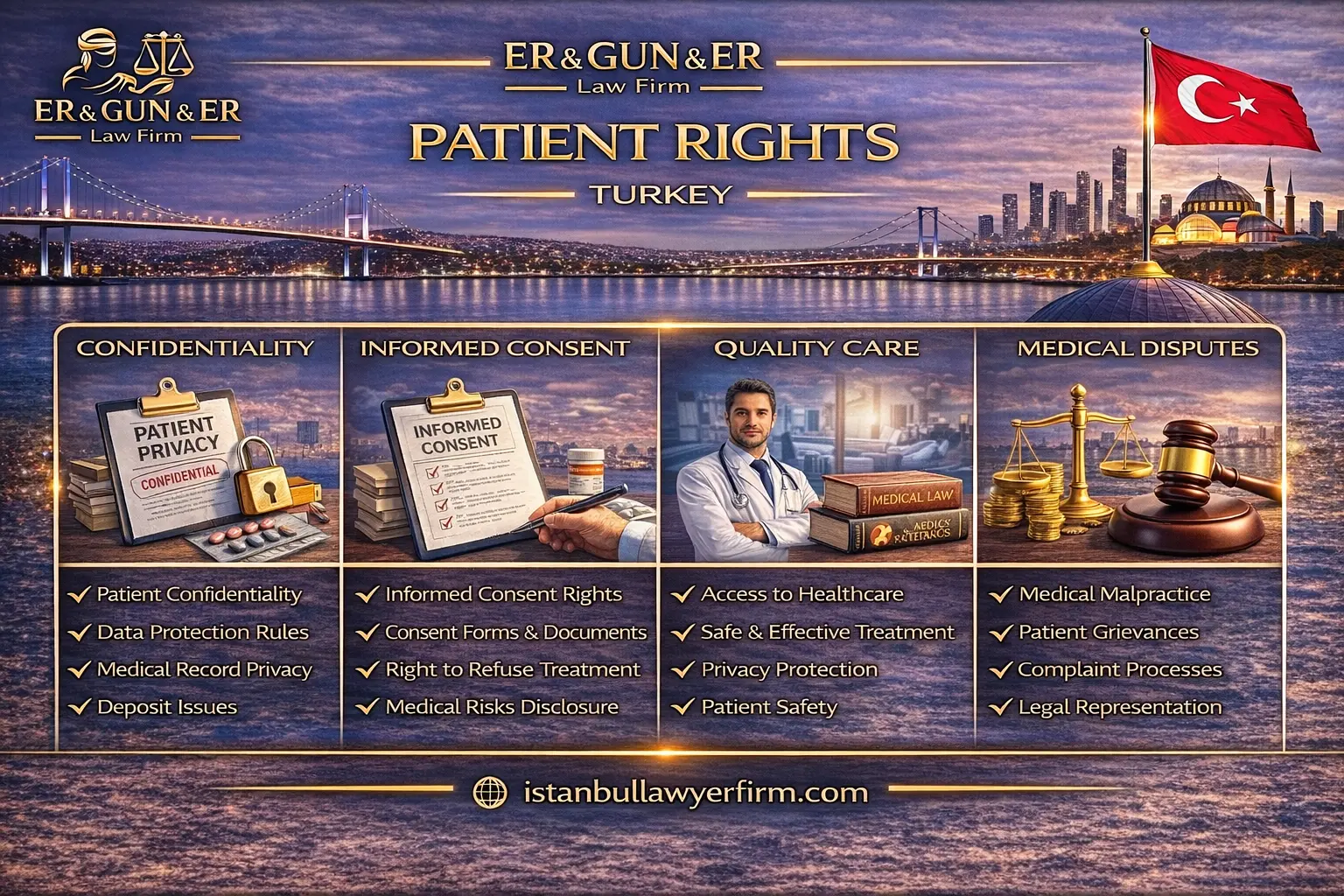
Patient rights in Türkiye define how care must be explained, documented, and delivered to protect dignity and autonomy. When people search patient rights Turkey, they usually want practical clarity about consent, records, and confidentiality in real hospital conditions. The legal framework matters because disputes are decided on what was written and what can be proven, not on what was intended. Informed consent and record access are central because they show whether the patient understood and whether the provider acted transparently. Complaints can move through hospital units, administrative channels, and litigation tracks depending on facts and documentation. Evidence discipline is decisive because missing records and unclear timelines often decide outcomes before merits are fully assessed. This is why a Turkish Law Firm approach starts with preserving the file, mapping the chronology, and avoiding speculation.
Patient rights overview Turkey
Patient rights in Türkiye cover dignity, autonomy, information, and safe care. The framework combines general health law principles and specific secondary regulations. Patients often discover the framework only when trust breaks down. The key is to treat the relationship as a documented service with clear boundaries. Patient rights law Turkey is not limited to private hospitals and applies across care settings. The baseline is that medical intervention requires lawful consent and transparent information. Records must be kept and can be requested under defined procedures. Confidentiality limits who can access and share health information. Complaint routes exist inside hospitals and through public authorities. Remedies can be administrative, civil, and sometimes criminal depending on facts. The content of rights can be checked through the Mevzuat portal. A patient should keep copies of every form and every discharge summary. A provider should document every explanation and every refusal in writing. Courts and boards rely on files more than on memories. For that reason, the first practical rule is to preserve evidence from day one.
Many disputes start because the patient does not receive a clear explanation in plain language. Another common trigger is a surprise bill or a disagreement about what was authorized. A patient should ask what the treatment goal is and what alternatives exist before signing. A patient should also ask who will perform the procedure and who will supervise. When a complication occurs, the patient should request a full record set promptly. A provider should not treat record requests as hostility because they are a normal right. In practice, hospitals use different forms, portals, and internal workflows. practice may vary by authority and year — check current guidance. The safest approach is to make the request in writing and keep proof of submission. A patient who plans a complaint should separate medical facts from personal feelings. A clear chronology improves credibility with committees and courts. If legal support is needed, a lawyer in Turkey should be given the full file, not selective screenshots. A patient can also review broader healthcare compliance context in the health law overview. Evidence discipline protects both patients and professionals because it prevents distortion. The goal is not escalation but clarity about what happened and why.
Patient rights are implemented through hospital policies, professional rules, and public oversight. Many institutions have a patient communication channel or a patient rights unit. The unit can record the complaint and request an internal review from the clinic. The Ministry also publishes public information at the Ministry of Health website. This does not mean every complaint leads to the same administrative step. practice may vary by authority and year — check current guidance. A patient should therefore focus on documenting what they asked and what they received. A provider should document who explained the risks and how comprehension was checked. Where the provider is a foreign professional, licensing and authorization questions may arise. Those questions can be contextualized through medical professional licensing guidance. Patient rights also interact with insurance and reimbursement rules that shape hospital behavior. A calm and complete dossier makes it easier to assess whether standards were met. If the matter becomes contentious, a law firm in Istanbul should frame the dispute around provable events. Overstated accusations usually harm credibility and can delay constructive resolution. A disciplined approach keeps the focus on consent, records, and causation.
Informed consent requirements
Informed consent is the patient’s legal authorization for a specific intervention. It is not a generic signature and it must match the planned procedure. Informed consent Turkey healthcare focuses on information, comprehension, and voluntariness. The patient should be told the purpose of the intervention and the expected benefits. The patient should be told the material risks that a reasonable person would consider. The patient should be told meaningful alternatives, including no treatment where applicable. The patient should be told who will perform the intervention and what supervision exists. Consent should be obtained before sedation or medication that affects judgment. If the patient is not competent, legal representation or family authorization may be needed. practice may vary by authority and year — check current guidance. Hospitals often use standard forms, but the explanation must still be individualized. A rushed signature without explanation can create a dispute about validity. Clinicians should document the discussion, not only the signature. Patients should keep a copy of the signed document and any explanatory leaflets. Clear documentation reduces later conflict about what was disclosed.
Consent documentation should be readable and should describe the actual intervention. A form that uses broad medical jargon can fail to show true understanding. Patient consent form Turkey is usually a standardized template, but it must be completed correctly. The date and time matter because they show whether consent was obtained before the act. The identity of the explaining clinician should be recorded to avoid ambiguity later. The patient’s questions should be noted when they show areas of concern. If a patient does not speak Turkish well, interpretation should be arranged and documented. The patient should be given enough time to consider alternatives without pressure. A patient should not be told that refusal will automatically harm future access to care. Clinicians should avoid presenting consent as a waiver of all rights. The form should not be used as a shield to justify inadequate explanation. Where a dispute arises, a best lawyer in Turkey will look for gaps between the form and the medical record. Patients should also keep messages and appointment notes that show what was discussed. Providers should keep a record of educational materials and any risk disclosure sheets. This evidence later helps determine whether consent was truly informed.
Consent requirements become more sensitive for minors and for persons under guardianship. The medical team must confirm who has legal authority to consent on behalf of the patient. If parents disagree, the hospital may request guidance from authorities or a court. practice may vary by authority and year — check current guidance. Consent should also be procedure-specific, so a prior signature may not cover a new intervention. For repeated treatments, consent should be refreshed when material facts change. If the risks change due to a new diagnosis, the patient should be informed again. Language barriers should be handled with formal interpretation rather than ad hoc translation. Documentation should show that the patient understood the core risks and alternatives. If a provider relies only on a signature, the record may look weak under scrutiny. If a dispute proceeds to litigation, courts often compare consent notes with nursing charts. Inconsistent notes can undermine credibility even when care was appropriate. A provider should avoid backdating or re-signing forms because it creates authenticity issues. An Istanbul Law Firm will usually advise building a clean record rather than arguing from assumptions. Clear consent practice is the first layer of patient safety and legal safety.
Refusal and withdrawal of consent
Patients have the right to refuse treatment after receiving adequate information. Refusal is meaningful only when it is informed and voluntary. The clinician should explain foreseeable consequences of refusal in plain language. The clinician should document the refusal and the explanation in the medical record. A patient can also withdraw consent after previously agreeing to a procedure. Withdrawal should be respected unless an emergency exception applies. practice may vary by authority and year — check current guidance. Hospitals often ask the patient to sign a refusal note to confirm understanding. A patient should request a copy of that refusal note for personal records. A provider should avoid framing refusal as disobedience or moral failure. The dispute risk increases when refusal is ignored or not properly documented. In litigation, courts often test whether the patient was offered alternatives. If a patient was pressured, the consent may be challenged as invalid. Turkish lawyers often advise keeping a clear timeline of requests and refusals. A clean refusal record protects both the patient and the clinician.
Capacity assessment is central when refusal involves high risk consequences. A clinician should assess whether the patient understands information and can decide. If capacity is doubtful, the hospital may seek input from a specialist team. The assessment should be recorded with reasons rather than with a label. A family member’s disagreement does not automatically remove the patient’s autonomy. If the patient is under guardianship, the legal guardian’s authority must be checked. practice may vary by authority and year — check current guidance. Where guardianship papers are outdated, the hospital may require updated documentation. If there is a conflict of interest, the hospital may avoid relying on a single relative. Refusal in long-term care can also involve social support and discharge planning. Discharge against medical advice should be documented with the reasons and warnings. The patient should be told which symptoms require urgent return to care. Providers should avoid coercion, including threats about future access to services. The patient’s dignity should be protected even during disagreement. Proper refusal management reduces later allegations of forced treatment.
Withdrawal of consent is easiest before an intervention begins. During an intervention, stopping may itself create risk, so the clinical response must be prudent. The record should show what was requested and what was clinically possible at that moment. If anesthesia has started, the patient may not be able to communicate withdrawal meaningfully. The pre-anesthesia consent discussion should therefore include the possibility of additional steps. For staged procedures, clinicians should clarify which stages are optional and which are necessary. If an unexpected finding appears, clinicians should consider whether to pause for renewed consent. practice may vary by authority and year — check current guidance. Where the patient is conscious, communication should be documented in the chart. Where the patient is not conscious, reliance on prior consent should be documented with reasons. If a patient refuses medication, the refusal should be recorded with risk explanation. Hospitals should also document any interpreter assistance used during the refusal conversation. A patient should avoid leaving the facility without collecting key records of the refusal event. A provider should avoid later rewriting notes because authenticity challenges are common. Clear refusal documentation is often decisive when disputes arise later.
Access to medical records
Access to records is a core right because it allows the patient to verify what happened. Medical records access Turkey includes both paper charts and digital hospital systems. The patient can request copies of reports, imaging results, discharge summaries, and consent forms. The patient can also request nursing charts and medication administration notes where relevant. Hospitals may have a designated unit or desk that receives record requests. practice may vary by authority and year — check current guidance. The safest practice is to submit the request in writing and keep proof of receipt. The request should specify the date range and the type of records needed. Overly broad requests can cause delay and confusion even in good faith systems. Patients should ask for records in a format that preserves legibility and completeness. If documents are in Turkish, a translated review may be needed for foreign patients. An English speaking lawyer in Turkey can coordinate record review and avoid misunderstandings about terminology. Providers should respond with complete copies rather than selective extracts. Selective extracts often create suspicion and escalate disputes unnecessarily. Record access is also essential for second opinions and continuity of care.
Record access is not only for litigation and it is also for clinical continuity. A patient may need past imaging to avoid repeated exposure and repeated costs. A patient may need lab histories to understand chronic conditions and treatment response. Hospitals should confirm identity before releasing records to protect confidentiality. If a representative requests records, the hospital will check authority documents. If a patient has died, record access questions can involve heirs and representatives. practice may vary by authority and year — check current guidance. Minors’ records may require parental authority verification and careful handling. Patients should keep a log of what was requested and what was provided. If records appear incomplete, the patient should ask for clarification in writing. Providers should document what they disclosed and on what legal basis. If a record contains errors, patients may ask for an explanation and a correction note. Corrections should be handled transparently without altering original entries. Altering original entries can create severe credibility issues in later disputes. A structured record request process is therefore in the interest of both sides.
Patients should request records early, especially when complications are still being treated. Early requests reduce the risk that staff changes and system changes create gaps. Patients should store records in an ordered folder with dates and facility names. Digital files should be kept in original format and backed up securely. If a patient prints screenshots, the patient should still keep original digital files. Courts and experts often want to see full context rather than isolated pages. When records include radiology images, the patient should request the full image files where possible. practice may vary by authority and year — check current guidance. A provider should avoid refusing access based on fear of complaint. Refusal can be interpreted as concealment and can damage trust. If the patient anticipates an insurance process, the record package should be kept consistent. If the patient anticipates a complaint, every submission and response should be preserved. If a patient communicates with the facility, the patient should keep full message threads. If the facility provides a portal download, the patient should download promptly and save copies. A complete record set is the foundation for any later expert assessment.
Confidentiality and data privacy
Confidentiality is a cornerstone of healthcare because patients disclose intimate facts to receive treatment. In disputes, confidentiality of health data Turkey is tested by what was shared, with whom, and under which justification. Hospitals usually treat medical files as restricted and give access only to staff involved in care and authorized administrative units. Third parties like laboratories, imaging centers, and insurers may process data, but the patient should know the role and the basis of that processing. A patient should ask whether the facility will share results with a referring doctor and how that sharing is documented. A patient should also ask whether the facility uses outsourced call centers or cloud systems and what safeguards exist. Even routine reminders and appointment messages can reveal health information if sent to the wrong number or email address. Patients should verify contact details at admission and keep a copy of the registration sheet when possible. Providers should limit access to the minimum needed and record access events to make later auditing possible. If a family member requests information, the facility should confirm authorization rather than relying on informal family dynamics. If the patient is an adult with capacity, the default expectation is that the patient controls who receives updates. If the patient is a minor or under guardianship, the facility should confirm who holds lawful authority before disclosure. When confidentiality is breached, patients should preserve proof such as emails, screenshots, and witness statements without escalating publicly. practice may vary by authority and year — check current guidance. A clean record of what was disclosed and what was not disclosed often determines whether a complaint becomes credible.
Confidentiality problems often arise from ordinary workflow failures rather than from deliberate misconduct. A patient should request the facility’s disclosure policy and ask whether disclosures are logged in the patient file. A patient should also request a complete copy of the consent forms that relate to data sharing and communication preferences. If the facility refuses to explain its disclosure basis, the patient should document the refusal and keep it for later review. If a breach occurred, the patient should write down the exact date, time, and channel of disclosure while memory is fresh. The patient should identify any third person who received the information and whether that person forwarded it onward. Providers should run internal incident reviews and preserve system logs before they are overwritten. Providers should also separate clinical staff from complaint handling staff to avoid retaliatory behavior. A structured file review by a Turkish Law Firm usually starts with mapping every disclosure event to a document or a system record. That mapping helps determine whether the issue is a policy breach, a technical breach, or a misunderstanding about consent. Patients should avoid editing screenshots because editing creates authenticity objections later. Patients should instead preserve original messages and export logs in the native format when possible. Providers should avoid asking patients to withdraw complaints as a condition for continuing care. A patient can seek a corrective note in the file if inaccurate information was circulated. Clear, professional communication often resolves confidentiality disputes faster than accusatory language.
Confidentiality disputes frequently overlap with record access disputes because patients want to see what was written and by whom. If a patient believes a staff member discussed the file in public spaces, the patient should note the location and any witnesses. If a patient believes a file was shared with an employer, the patient should preserve the employer communication and any resulting impact. Hospitals sometimes respond by providing general explanations that do not address the specific event, which can frustrate patients. Patients should insist on event-specific clarification rather than on generic statements about policy. Providers should respond with factual investigation outcomes and should not speculate about motives. If the dispute is escalated, patients should keep their statements factual to avoid unnecessary defamation risk. Providers should similarly avoid blaming the patient in writing because blaming language can escalate the conflict. Many Turkish lawyers advise clients to separate the privacy issue from the medical quality issue so the complaint remains coherent. This separation helps because the evidence types differ, with logs and disclosures on one side and clinical records on the other. If the patient is foreign, translation quality can also affect what appears to be a disclosure breach. A patient should confirm whether the hospital created an English summary and whether it was sent to third parties. If consent was provided for limited disclosure, the scope of that consent should be read carefully against the actual sharing event. practice may vary by authority and year — check current guidance. A disciplined approach focuses on proving the breach and its consequences rather than on personal hostility.
KVKK and health data
Health data is treated as sensitive personal data and is subject to stricter handling expectations. The phrase KVKK health data Turkey refers to how health information must be processed, stored, and shared under data protection rules. Patients can consult the KVKK Authority for official guidance and publications. Providers should identify a lawful basis for each processing activity, including registration, treatment, billing, and quality assurance. Providers should also define retention periods and deletion processes in internal policies without improvisation. Patients should ask whether their data will be used for research, marketing, or secondary analytics and how consent is obtained. If the facility uses third-party software, the facility should document vendor roles and security controls. Data processing agreements should be in place with vendors who access health information. If the patient receives communication by SMS or email, the patient should confirm whether this is optional and how to opt out. If a breach is suspected, the patient should preserve the message headers, screenshots, and any access notification logs available. Providers should preserve server logs and incident records because those records can become decisive in investigations. Providers should also provide a structured explanation of what happened, not only a general apology. Where the patient is a foreign national, passport details and residence information may be processed and should also be protected. practice may vary by authority and year — check current guidance. Clear documentation of data flows often prevents misunderstandings from becoming formal complaints.
Many disputes are not about whether care was correct but about whether data handling respected privacy and minimal access principles. Hospitals should keep written policies on access control, logging, encryption, and staff training. Patients should request a copy of the privacy notice and ask whether the hospital provided it at admission. If the privacy notice was not provided, the patient should record that fact and keep any admission paperwork as evidence. If the hospital denies responsibility and blames a contractor, the patient should ask for the contractor’s role and the scope of access. Providers should remember that delegating processing does not remove accountability for security governance. A structured assessment by an Istanbul Law Firm often begins by mapping the hospital’s data inventory to actual systems and user roles. That assessment tests whether access was limited to care teams and whether unusual access events occurred. If the hospital claims the disclosure was required by law, the legal basis should be identified clearly in writing. If the patient believes the hospital used data for marketing, the patient should preserve messages and any consent screen records. Administrative compliance disputes can be coordinated with broader privacy risk management work such as KVKK audit defense planning. Providers should also maintain a breach response plan and designate an internal contact for patient data questions. Patients should direct requests to that contact and keep copies of every submission and response. practice may vary by authority and year — check current guidance. When privacy issues are handled transparently, clinical disputes are less likely to escalate into multiparty litigation.
A patient who believes their health data was unlawfully shared can pursue clarification through the hospital and then consider formal complaint options. The first practical step is to request the full record set and a written explanation of the disclosure event. The second practical step is to request whether access logs exist and whether an internal incident report was opened. The third practical step is to preserve proof of harm, such as employment consequences or public exposure, without exaggeration. Complaints should be written factually and should attach only necessary documents to protect privacy. Over-disclosure can unintentionally spread the same sensitive data that the complaint seeks to protect. Providers should respond in writing and should avoid vague statements that do not address the disclosed data category. If the dispute becomes formal, the quality of the evidence package will matter more than the volume of narrative. A lawyer in Turkey will usually advise separating the privacy issue from the medical negligence issue to keep the file coherent. This separation also helps because data protection analysis focuses on access, consent, and security measures rather than on clinical judgment. If the patient is simultaneously pursuing a clinical claim, the patient should avoid conflicting statements about what was disclosed and when. If the provider claims that the patient consented, the consent record should be reviewed carefully for scope and clarity. If the provider relies on a form that the patient never received, the patient should document that gap in the chronology. practice may vary by authority and year — check current guidance. A disciplined privacy file can protect the patient while also prompting the provider to improve systems and reduce recurrence.
Right to information and translation
Patients have a right to receive understandable information about diagnosis, treatment options, and foreseeable risks. This right is practical because without understanding there cannot be meaningful consent or refusal. When language barriers exist, right to interpreter hospital Turkey becomes a risk control issue as well as a dignity issue. Hospitals should identify the patient’s language needs at admission and document what support was provided. If the hospital uses staff members as ad hoc interpreters, the accuracy risk increases and should be mitigated with documentation. Patients should request that key explanations, consent forms, and discharge instructions are provided in a language they can understand. If translations are partial, the patient should document which parts were not translated and how comprehension was checked. Providers should document the interpreter’s identity or the method of translation used in the file. If a misunderstanding later leads to harm, the dispute may turn on whether translation support was reasonably offered. A foreign patient should also ask whether follow-up instructions will be sent by email and in which language. Communication errors often occur at handoff points like discharge, referral, and medication reconciliation. A careful law firm in Istanbul will advise clients to preserve every written instruction and to keep a timeline of what was explained. This timeline helps determine whether information disclosure was adequate and whether later instructions were consistent. practice may vary by authority and year — check current guidance. Clear information and translation support often prevents complaints from escalating into legal conflict.
Translation issues also interact with identity documentation because foreign patients may present passports, residence cards, or tourist documents. Facilities may copy these documents for registration, so patients should confirm how copies will be stored and protected. If a patient is concerned about immigration exposure, the patient should seek advice before making assumptions about data sharing. The legal interface can be complex and patients may want context from immigration law guidance. Language barriers can also affect the patient’s ability to file a complaint because complaint forms are often in Turkish. Patients should request assistance to submit complaints without distorting the content of the complaint. Providers should avoid discouraging complaints by claiming that complaints are only for Turkish speakers. In high-stakes files, an English speaking lawyer in Turkey can help align translations, consent documentation, and the patient’s narrative. That alignment reduces the risk that the patient’s account is misread due to translation error. Providers should also keep copies of any translated documents provided to the patient to prove what was communicated. If a patient uses a family member as an interpreter, the hospital should document that choice and assess any conflict risk. Family interpretation can create pressure and can distort sensitive conversations about reproductive or mental health issues. Professional interpretation is usually safer because it creates neutrality and clearer accountability. practice may vary by authority and year — check current guidance. Clear translation support is also a patient safety measure because it reduces medication errors and follow-up failures.
Patients should verify the written materials they receive because verbal explanations can be forgotten under stress. Discharge summaries, prescriptions, imaging reports, and lab reports should be collected and stored in chronological order. If the patient receives contradictory instructions from different departments, the patient should ask for clarification in writing. Providers should correct contradictions promptly and record the clarification in the medical file. Patient rights frameworks can be updated through official publications and administrative guidance. Patients and providers can monitor updates through the Official Gazette and cross-check full texts through official portals. A patient should avoid relying on social media summaries because summaries often omit key limitations and exceptions. A provider should avoid relying on old templates that may not reflect current forms or current institutional practice. Documentation is particularly important for cross-border patients who may need to present records to a foreign insurer or physician. If the patient requests an English summary, the request and the delivered summary should be preserved as part of the record set. If the facility refuses translation, the refusal should be documented with date and reason. A patient should remain calm and factual in all written communications because tone affects credibility in review processes. practice may vary by authority and year — check current guidance. The most reliable way to protect the right to information is to keep a complete file and request confirmations in writing. When communication is documented, disagreements about what was said become easier to resolve.
Choice of physician and facility
Patients generally expect to choose where they receive care and who provides it, but the scope depends on the facility and the clinical context. In elective settings, patients can often select a physician and request information about the care team. In public settings, capacity and appointment systems may limit selection and scheduling options. Even when selection is limited, the patient still has rights to information and respectful treatment. Patients should ask whether the physician is directly employed by the facility or works under a separate contractual model. This matters because responsibility for billing and record keeping can differ. If the patient wants a second opinion, the patient should request the relevant records promptly and keep proof of the request. Second opinions often require imaging and lab results in original form rather than in summary form. If the patient is foreign, the patient should also check whether the facility can provide bilingual discharge documents. A patient who needs structured guidance may search health law lawyer Turkey patient rights to understand the interface between rights and practical steps. Providers should avoid presenting physician choice as a privilege that can be removed when a patient asks questions. Patients should also be cautious about informal referrals that are not documented in the medical record. If a dispute arises, undocumented referrals make it harder to reconstruct what advice was given and why. practice may vary by authority and year — check current guidance. A clear written record of the chosen provider and the planned intervention supports both continuity and accountability.
Facility choice also involves understanding the facility’s complaint handling culture and documentation discipline. Patients should ask how to contact the patient rights unit and how complaints are logged. Providers should disclose how to request corrections if administrative details are entered incorrectly at registration. Registration errors can later create confusion about identity, billing, and record access. If a facility uses an online portal, patients should ask how to download records and how to reset access securely. Patients should also ask whether the facility shares data with affiliated clinics or laboratories. If sharing exists, the patient should ask whether the sharing can be limited to treatment purposes. Providers should avoid bundling marketing consent into clinical consent because it creates confusion about voluntariness. Patients should read consent screens carefully and keep screenshots of options selected when possible. When the patient is covered by private insurance, the facility may have separate preauthorization workflows. The patient should request written confirmation of what will be billed and which approvals are pending. If approvals are unclear, disputes can later shift from medical issues to administrative conflicts. A patient should avoid signing blank forms or forms with missing procedure descriptions. practice may vary by authority and year — check current guidance. The safest path is to choose a facility that provides clear written information and responds to record requests consistently.
Choice of physician is limited in emergencies, where the immediate priority is stabilizing the patient. In non-emergency settings, patients can still face practical limits due to scheduling and facility capacity. Patients should treat these limits as logistical realities and focus on preserving their rights to information and records. If a patient wants to change provider after a disagreement, the patient should request a full record set before leaving. A record request made after a conflict should be calm and specific to reduce friction in processing. Providers should respond professionally even when a patient is dissatisfied because hostility creates new disputes. If the patient plans to escalate a complaint, the patient should avoid confronting staff in a way that triggers security reports. Security reports and incident logs can later be used to challenge credibility on both sides. The patient should keep a written log of appointments, names, and key statements to reconstruct the timeline later. If the facility refuses record access without explanation, that refusal should be documented and preserved. In complex matters, a consultation with the best lawyer in Turkey can help separate evidence issues from clinical issues. That separation allows the patient to decide whether to pursue internal resolution, administrative complaint, or litigation. practice may vary by authority and year — check current guidance. A patient who keeps a complete file usually has a stronger position because the narrative can be proven rather than asserted. A provider who keeps a complete file also has a stronger position because the standard of care discussion is anchored in records.
Emergency treatment rules
Emergency care changes the consent dynamic because the primary aim is to prevent imminent harm. Hospitals may proceed with life-saving steps when a patient cannot provide meaningful consent. This does not eliminate patient rights, and the provider should still document why immediate action was necessary. The record should state the patient’s condition, the clinical urgency, and the reason consent could not be obtained. If a relative is present, staff should record what information was given and whether any objection was raised. If the patient is conscious, the team should explain options briefly and record the patient’s response. Emergency interventions should be limited to what is clinically required for stabilization, not what is convenient. After the acute phase, the team should return to ordinary informed consent and renew explanations for ongoing care. Disputes often arise when a later elective step is treated as if it were emergency care. For that reason, timelines in the file should separate stabilization from planned interventions. A patient should request the emergency record set early, because those notes often define the later narrative. A provider should preserve triage notes, medication administration records, and imaging timestamps without alteration. Where the patient is foreign, the file should note how communication was managed and what language was used. practice may vary by authority and year — check current guidance. In most disputes, Turkish lawyers focus first on whether the emergency exception was correctly documented and proportionate.
Emergency departments also create record access challenges because multiple units contribute to the file. Patients may receive results verbally but later find that written discharge papers are minimal. A patient should therefore request the full emergency chart, including triage, nursing notes, and orders. Hospitals may provide summaries first, but summaries can omit key clinical reasoning. If a patient is transferred between facilities, the transfer note and handover communications should be preserved. If the patient signs any form during emergency admission, the form should be reviewed for completeness and timing. A signature obtained under stress can later be disputed, so clear documentation of explanation is protective. Families should avoid pressuring staff for promises about outcomes, because those conversations are rarely recorded accurately. Instead, families should ask for written clarification of diagnosis and next steps when the patient is stable. If the patient requires translation, the facility should record who interpreted and whether the patient asked questions. Where translation was not available, the file should still reflect what was communicated as accurately as possible. A foreign patient who later disputes consent often needs a structured bilingual review of the records. An English speaking lawyer in Turkey can help align medical terminology, translations, and the chronology in a way that is consistent with the record. practice may vary by authority and year — check current guidance. Clear post-emergency documentation reduces both misunderstanding and escalation into formal complaints.
Emergency treatment also interacts with facility and physician choice, because immediate availability may control who treats the patient. Patients can still ask who is responsible for the case and request a change once the patient is stabilized. Hospitals should document the responsible physician and the consult services involved to avoid later uncertainty. If the patient refuses a proposed intervention after stabilization, that refusal should be recorded with risk explanation. If the patient leaves against medical advice, the discharge note should state what warnings were given. A patient should keep copies of prescriptions and imaging reports received at discharge, because follow-up depends on them. If an adverse event is suspected, early preservation of medication charts and monitoring records is essential. Delays in collecting these records can make later expert review incomplete. A complaint should distinguish between the emergency stabilization decision and later elective decisions. This distinction helps reviewers assess whether ordinary consent standards were re-applied when urgency passed. When the file is inconsistent, the dispute often becomes about documentation rather than about clinical judgment. Patients should avoid posting sensitive details online because public disclosure can create privacy complications. Providers should avoid defensive rewriting of notes, because audits and logs may reveal later edits. practice may vary by authority and year — check current guidance. A best lawyer in Turkey will usually start by isolating the emergency window, verifying the record integrity, and then assessing whether the later care complied with ordinary consent rules.
Complaints to hospitals
Most facilities have an internal patient rights unit or complaint desk that records concerns and requests a response from the relevant department. An effective complaint starts with a clear chronology, the treatment dates, and the names of units involved. Patients should attach copies of consent forms, discharge summaries, and key test reports to avoid factual confusion. The first objective is often clarification and correction, not immediate litigation. Hospitals may offer meetings with the treating team or with administrative staff to review the file. Patients should request that any meeting outcome is confirmed in writing so that commitments are traceable. Where communication is tense, patients should keep interactions calm and focus on documented facts. If the patient is foreign, the complaint should state language needs and request a response that can be understood. The term hospital complaint procedure Turkey generally refers to this internal pathway before escalation to external authorities. practice may vary by authority and year — check current guidance. Patients should keep proof of submission, such as a stamped copy, email receipt, or portal confirmation. If the hospital refuses to register the complaint, that refusal should be documented as part of the file. A provider should treat complaints as an opportunity to correct documentation and explain reasoning rather than as a personal attack. If the complaint raises privacy concerns, the facility should identify the disclosure event and the corrective steps taken. Where the stakes are high, a lawyer in Turkey can structure the complaint so that it remains factual, consistent, and usable for later review if needed.
Internal complaints are strongest when they request specific records and specific explanations tied to those records. Vague complaints about disrespect are hard to investigate unless linked to identifiable events. Patients should specify what they want, such as a copy of the operative note, the nursing chart, or the incident report. Hospitals often respond with general policy language, but patients can request event-specific answers. A request for a correction note should identify the exact statement believed to be incorrect and the reason it is incorrect. Patients should avoid altering documents before submission because alteration creates authenticity arguments. Hospitals should preserve access logs, camera records where relevant, and staff statements while recollection is fresh. When the complaint involves billing or insurance, the facility should clarify whether the issue is clinical or administrative. If the patient is insured, the facility should identify which approvals were obtained and which were pending at the time of service. A structured review by a law firm in Istanbul typically checks whether the internal response matches the clinical record and whether any gaps in disclosure exist. If the hospital admits an error, patients should ask how the record will be corrected and how recurrence will be prevented. If the hospital denies the allegation, the patient should ask which documents support the denial. If the complaint is resolved internally, the resolution should be documented with clear language and clear dates. practice may vary by authority and year — check current guidance. A complete internal file can later support administrative complaints or litigation without requiring the patient to reconstruct events from memory.
Patients should also understand that internal complaints do not automatically pause other legal timelines or duties. For that reason, a patient who anticipates formal action should keep a parallel file of submissions and responses. The patient should keep the original medical records separate from personal notes to avoid confusion about what is official. The patient should avoid recording staff secretly, because privacy and criminal rules can affect admissibility. Instead, the patient should rely on written requests, written responses, and official record copies. If the facility offers a settlement or goodwill gesture, the patient should request that the terms are written and precise. Verbal settlement offers often lead to misunderstanding and later denial. If the issue is an adverse clinical outcome, the patient should request a second opinion based on the official record set. The patient should also document any ongoing symptoms and follow-up care, because causation analysis depends on chronology. Hospitals should respond in a way that addresses the alleged rights breach and not only the clinical outcome. A defensible response identifies the consent process, the records provided, and the confidentiality safeguards applied. If multiple departments were involved, the response should not shift responsibility without evidence. practice may vary by authority and year — check current guidance. A coherent complaint record often narrows disputes because it forces both sides to speak in documents rather than in assumptions. When the internal pathway fails, the same disciplined file can be used for external complaints and for later expert review.
Ministry complaint pathways
If the hospital’s internal process does not resolve the issue, patients can consider administrative escalation depending on the facts. One common route is to file a complaint through channels linked to the Ministry of Health. The phrase Ministry of Health complaint Turkey usually refers to submitting the chronology, supporting documents, and the requested remedy to the relevant administrative unit. Patients should keep the submission factual and attach only necessary medical pages to avoid over-disclosing sensitive data. A patient should keep proof of submission, such as a reference number, receipt, or registered mail record. The Ministry publishes public information and access points at the Ministry portal. practice may vary by authority and year — check current guidance. Administrative review often focuses on process compliance, documentation, and whether internal mechanisms were used. Patients should therefore include proof that the hospital received and responded to the initial complaint. If the complaint concerns a specific regulation text, patients should rely on official sources like the legislation portal rather than informal summaries. Patients should avoid quoting article numbers unless they can verify the exact wording and source. The administrative authority may request additional documents, so patients should keep originals ready for controlled submission. Where the patient is foreign, the complaint should explain language barriers and attach translations where necessary. A carefully prepared file by a Turkish Law Firm can keep the narrative consistent across hospital, ministry, and later legal steps. The purpose of the ministry route is usually oversight and correction, not immediate compensation, so expectations should remain realistic.
Administrative pathways can differ depending on whether the care was delivered in a public facility or a private facility. Patients should not assume that the same form, portal, or department handles every category of complaint. The authority may route the complaint for internal inspection or request a written response from the facility. Patients should focus on verifiable events, such as what was explained, what was signed, and what was refused. If the complaint involves record access, the patient should attach the record request and the facility’s response. If the complaint involves confidentiality, the patient should attach proof of the disclosure and the harm caused. Patients should avoid attaching unnecessary pages that reveal unrelated diagnoses or family members’ data. The authority’s review may depend on institutional workload and local practice, so fixed processing predictions are not reliable. practice may vary by authority and year — check current guidance. A disciplined approach by an Istanbul Law Firm often includes preparing a clean annex index so the authority can locate critical pages quickly. If the authority asks for additional documents, the patient should respond in writing and keep copies of everything submitted. If the authority closes the file with a generic explanation, the patient should request clarification of which facts were accepted and which were not. Administrative outcomes can also influence later civil analysis because they may clarify what the facility admits. However, administrative findings do not automatically decide civil liability, so the patient should avoid overreliance on a single letter. A coherent administrative file still helps because it documents the patient’s efforts to resolve the matter without immediate litigation.
Patients should also understand that administrative complaints may require careful handling of personal data. If the complaint includes sensitive attachments, the patient should label them clearly and avoid public dissemination. If the issue is purely clinical dissatisfaction without rights violations, the authority may treat it differently from a documentation breach. A patient should therefore articulate the rights dimension, such as lack of explanation or refusal to provide records. Where the dispute is about standards of care, the authority may still request an internal clinical review. That review may involve expert input or internal committees, depending on the case category. practice may vary by authority and year — check current guidance. Patients should monitor official publications for changes in complaint channels and forms through sources like the Official Gazette. If the patient receives a written response, the patient should store it with the medical records and the complaint submission proof. If the response identifies a corrective action, the patient should ask whether the action includes a correction note in the medical file. If the response denies any breach, the patient should consider whether the evidentiary record supports further steps. Administrative complaint routes can coexist with professional discipline complaints, but the content should be consistent. Consistency matters because contradictory statements can undermine credibility across all forums. The patient should avoid speculation about motives and focus on what happened and what documents show. When administrative pathways are used strategically and calmly, they can narrow disputes and create a clearer record for any later remedy.
Professional discipline process
Professional discipline refers to oversight of clinicians by professional bodies and institutional committees. Patients sometimes consider this route when they believe standards were breached even if compensation is not the immediate goal. A discipline complaint should be written with the same evidence discipline as a court file. The patient should state dates, departments, and the specific conduct alleged. The patient should attach the relevant consent forms, records, and correspondence that show what was disclosed. If the patient alleges poor clinical care, the complaint should focus on verifiable deviations rather than on outcome alone. The phrase doctor negligence claim Turkey often appears at this stage because patients want accountability and an objective review. Professional review may also examine communication failures, such as ignoring questions or failing to document consent. Hospitals may run internal quality reviews that are separate from formal disciplinary bodies. Patients should ask whether the review will produce a written conclusion and whether they can obtain a copy. practice may vary by authority and year — check current guidance. Discipline processes may rely on file review and written statements, so record completeness is critical. If records are missing, the patient should document which requests were made and what was refused. Clinicians responding to a complaint should provide factual explanations tied to the medical record and avoid personal attacks. A disciplined complaint can clarify facts and narrow disputes even when it does not produce direct compensation.
Professional discipline and criminal exposure can overlap when allegations involve falsified records, illegal procedures, or intentional harm. Patients should not accuse staff of crimes without evidence because accusations can escalate conflict and create defamation risk. Instead, the patient should describe observable facts, such as a missing record, a conflicting note, or a refusal to provide documents. If a patient believes a criminal complaint may be necessary, the patient should seek advice on evidence preservation before filing. A separate overview of criminal procedure context is available in criminal law guidance. Discipline bodies may request written statements from the clinician and from the institution. Patients should ask whether they can submit a reply if the clinician’s statement contains factual errors. If the process allows a hearing, the patient should prepare a clear chronology rather than a broad narrative. The patient should avoid introducing new allegations late because late allegations may be treated as unreliable. practice may vary by authority and year — check current guidance. Clinicians should respond with a professional tone and should anchor explanations in documented observations. If the clinician relies on a consent form, the clinician should explain how consent was obtained and where the discussion is recorded. If the clinician relies on an emergency exception, the clinician should point to the exact chart entries that show urgency. Discipline outcomes may include warnings or training recommendations, but the patient should not assume a fixed result. Even when discipline outcomes are limited, the process can generate a written record that helps clarify disputed facts.
Discipline findings do not automatically determine civil liability because civil courts apply their own legal tests. Patients should therefore keep discipline documents as part of a broader evidence file rather than treating them as a final judgment. If the discipline body identifies a documentation failure, that can support arguments about transparency and consent. If the discipline body finds no breach, the patient can still pursue other routes if the evidentiary record supports them. The key is consistency across submissions because contradictions reduce credibility in every forum. Patients should keep copies of every submission, every response, and every decision letter in chronological order. Providers should also keep copies because institutional memory changes and staff turnover is common. If the dispute concerns privacy, discipline bodies may coordinate with data protection governance inside the institution. If the dispute concerns billing or insurance, the institution may route parts of the file to administrative units. practice may vary by authority and year — check current guidance. Patients should avoid public campaigns during a discipline process because public claims can complicate confidentiality and fairness. Clinicians should avoid informal settlement conversations that are not documented because those conversations can be misreported. A written settlement attempt, if any, should be clear on what is admitted and what is not admitted. When discipline and administrative pathways are used calmly, they can narrow the factual dispute even before litigation begins. The practical value of discipline is often the creation of a structured record that an expert or court can later evaluate.
Malpractice and liability interface
Patient rights disputes often overlap with negligence debates. The legal question is whether the standard of care was breached. A separate question is whether consent and records were handled correctly. These questions can exist even when the outcome is unavoidable. Patients sometimes begin with a doctor negligence claim Turkey narrative. The file must still show what the clinician did and why. Clinical notes, orders, and imaging timestamps anchor the chronology. Consent forms and explanation notes show what was authorized. If consent was incomplete, liability analysis becomes more complex. If records are missing, credibility becomes a central dispute point. Hospitals may argue that complications are known medical risks. Patients may argue that warning and monitoring were inadequate. A careful lawyer in Turkey separates emotion from proof. That separation helps experts evaluate causation and prevent confusion. The safest approach is to build one coherent evidence file.
When allegations deepen, parties move from rights discussion to liability framing. Many claim files are described as a medical malpractice Turkey patient claim. In practice, the legal route depends on provider type and facts. Public facilities and private facilities can trigger different procedural tracks. The patient should avoid assuming a single forum fits every case. The provider should avoid assuming a consent form ends the debate. Causation must be shown through records and expert assessment. If multiple clinicians acted, responsibility allocation becomes evidence-driven. Insurance coverage can influence settlement behavior and communication style. A Turkish Law Firm will typically request the complete hospital file. The same review checks whether policy and documentation were consistent. If defense strategy is relevant, review the malpractice defense overview early. Patients should keep follow-up bills and pharmacy receipts as supporting proof. Providers should preserve internal audit logs and incident review notes. practice may vary by authority and year — check current guidance.
Liability discussions often expand to include insurance and indemnity issues. Hospitals may notify insurers and ask staff to route communications carefully. Patients may pursue parallel routes such as internal review and civil claims. A disciplined file reduces the risk of contradictory statements across routes. If an insurer is involved, coverage terms can affect negotiation leverage. Coverage disputes should be assessed from the written policy, not assumptions. A focused insurance policy review can clarify exclusions and notice duties. The patient should preserve every email and letter exchanged about coverage. The provider should preserve every notification sent to the insurer. If a settlement is discussed, written terms should be precise and limited. Vague apologies can be misread as admissions in later arguments. Clinical quality concerns should still be evaluated independently by experts. A best lawyer in Turkey will usually keep the narrative narrow and provable. That approach protects credibility even when emotions are high. It also supports earlier resolution when facts are clear.
Evidence and expert reports
Evidence planning determines whether a claim can be tested fairly. Clinical disputes usually require an expert assessment to interpret records. Parties often ask what a medical expert report Turkey lawsuit will examine. The answer begins with the completeness and integrity of the medical file. Consent forms, orders, and nursing charts must be collected as originals. Imaging files should be preserved in native format when available. Laboratory results should include reference ranges and timestamps. Device logs and monitoring records can matter in intensive care disputes. If records are missing, the expert may be forced to work on assumptions. Assumptions reduce reliability and increase conflict in litigation. Parties should therefore request records early and in writing. A law firm in Istanbul will usually build an annex index for every page. That index helps experts locate key entries without confusion. It also helps the court see that the file is complete. practice may vary by authority and year — check current guidance.
Expert work is strongest when the questions are drafted precisely. A vague question invites a vague answer and later objections. Parties should define the clinical act and the alleged deviation clearly. Parties should also define the claimed harm and the causal mechanism alleged. Experts then compare the documented course of care with professional standards. If the standard is not documented, the expert may rely on general practice. General practice arguments can be contested, so record quality still matters. Parties should avoid presenting selective extracts that distort chronology. If screenshots are used, the underlying source should be preserved. If witness statements exist, they should be tied to observable facts. Experts rarely treat emotional narratives as clinical proof. Many Turkish lawyers therefore focus on documents, timestamps, and internal consistency. Where multiple departments are involved, responsibilities must be mapped carefully. The map should identify who ordered, who performed, and who supervised. This mapping prevents the dispute from becoming personal and unfocused.
After an expert report is produced, parties should review it line by line. A review should test whether the report relies on complete records. A review should also test whether the report answers the questions asked. If the report misstates a fact, the correcting document should be cited precisely. If the report assumes a fact, the assumption should be challenged explicitly. Parties should avoid attacking the expert personally because it backfires. Instead, parties should challenge method, sources, and reasoning. If privacy concerns exist, sensitive annexes should be limited to necessity. Over-sharing personal data can create a secondary privacy dispute. A patient should keep copies of every submission to ensure consistency. A provider should keep copies of every response to avoid later gaps. An Istanbul Law Firm will often prepare a structured rebuttal with page references. That rebuttal is more persuasive than broad disagreement. It also helps the judge understand technical points quickly. practice may vary by authority and year — check current guidance.
Litigation and compensation
When internal channels fail, parties may consider healthcare litigation Turkey. The first step is to identify the legal basis of the claim. Some claims are framed in contract, others in tort principles. The underlying concepts can be reviewed through the tort law framework resource. Forum selection can depend on the provider’s status and the relief sought. Patients should not assume one court type fits every scenario. Evidence should be organized before filing, not after filing. Filing with incomplete records often leads to delays and expert confusion. Claims should focus on provable deviations rather than broad dissatisfaction. If a patient is foreign, translation and service steps must be planned. An English speaking lawyer in Turkey can help align bilingual records with the case chronology. This alignment reduces misunderstanding in expert and court review. Parties should avoid making public accusations while litigation is pending. Public statements can complicate privacy and credibility assessments. practice may vary by authority and year — check current guidance.
Compensation analysis is fact-specific and depends on proof and causation. The phrase compensation for malpractice Turkey is often used, but amounts are not predictable. Courts examine whether harm was caused by the alleged deviation. They also examine whether the harm would have occurred anyway. Documentation of baseline condition and follow-up course is therefore critical. Patients should keep pharmacy receipts, follow-up bills, and referral notes. Providers should keep incident reports and internal review notes where they exist. Insurance can affect recovery pathways when a policy responds to the event. Patients should understand whether the hospital expects an insurer process. A structured insurance claims process review can clarify documentation expectations. Even when insurance is involved, the claimant still needs a clean evidence file. Settlements should be written precisely and avoid ambiguous admissions. Parties should avoid relying on verbal promises about future payments. If future care costs are discussed, they should be supported by medical records. practice may vary by authority and year — check current guidance.
Some disputes expand into insurer versus insured disagreements about coverage. Coverage disputes are different from clinical disputes and require separate proof. The starting point is always the written policy and the notice history. If coverage is denied, the reasons should be requested in writing and preserved. Patients should avoid assuming that a denial means the underlying claim is weak. Providers should avoid assuming that a denial removes duty to cooperate with record disclosure. Where insurers become parties, the correspondence file can become as important as the medical file. This is why parties should keep emails and letters in chronological order. If the dispute turns to court, a focused insurance litigation overview can explain how courts evaluate coverage. Insurance disputes may also influence settlement timing and negotiation posture. Parties should keep settlement drafts separate from final signed documents. A document that is not signed should not be treated as agreement. If a settlement includes confidentiality, the clause should be compatible with lawful enforcement. If a settlement includes data handling terms, they should reflect privacy rules. practice may vary by authority and year — check current guidance.
Practical roadmap
Start by stabilizing health and securing follow-up care. Ask the facility for the complete record set in writing. Request operative notes, nursing charts, imaging, and consent forms. Keep proof of the request and the response. Create a simple chronology of dates, symptoms, and conversations. Write the chronology while memory is fresh and factual. Preserve originals of messages and portal notifications without editing. Save screenshots only as backups to originals. Keep receipts for medicines, tests, and later treatment visits. Avoid public posts that reveal sensitive details or accuse individuals. Public posts can complicate privacy and credibility later. If interpretation was used, note who interpreted and when. If interpretation was not offered, note that gap factually. Organize documents into a dated folder structure for review. practice may vary by authority and year — check current guidance.
Decide whether the objective is clarification, correction, or formal remedy. Begin with an internal complaint that identifies concrete events and documents. Ask for a written reply that addresses each point. If the issue is record access, keep a copy of the refusal. If the issue is confidentiality, preserve proof of the disclosure channel. Limit attachments to necessary pages to protect privacy. If there is no meaningful response, consider administrative escalation with the same file. Submit consistent facts across hospital and authority channels. Do not introduce new allegations late without supporting records. Keep translation consistent across submissions if you are not fluent in Turkish. If a representative submits documents, confirm authority in writing. Request that the authority confirms receipt and provides a reference number. Store every submission and reply in one master folder. If a meeting occurs, request written minutes or a written outcome. A calm tone improves credibility with reviewers.
If litigation becomes necessary, prepare the file before filing. Separate privacy issues from clinical issues to keep analysis clear. Identify the exact clinical act challenged and the harm alleged. List the documents that prove each step of the chronology. Ensure that the record set includes baseline condition and follow-up course. Avoid assuming that an adverse outcome proves wrongdoing. Also avoid assuming that a signature proves valid consent. Formulate expert questions that can be answered from documents. Test every claim against the written record for consistency. Preserve the chain of custody for digital files and imaging data. Keep sensitive data encrypted and share only with necessary parties. Coordinate with insurance and reimbursement correspondence when relevant. Do not promise results or timelines because courts and authorities differ. practice may vary by authority and year — check current guidance. A disciplined file improves both settlement prospects and court clarity.
Author: Mirkan Topcu is an attorney registered with the Istanbul Bar Association (Istanbul 1st Bar), Bar Registration No: 67874. His practice focuses on cross-border and high-stakes matters where evidence discipline, procedural accuracy, and risk control are decisive.
He advises individuals and companies across Sports Law, Criminal Law, Arbitration and Dispute Resolution, Health Law, Enforcement and Insolvency, Citizenship and Immigration (including Turkish Citizenship by Investment), Commercial and Corporate Law, Commercial Contracts, Real Estate (including acquisitions and rental disputes), and Foreigners Law. He regularly supports corporate clients on governance and contracting, shareholder and management disputes, receivables and enforcement strategy, and risk management in Turkey-facing transactions—often in matters involving foreign shareholders, investors, or cross-border documentation.
Education: Istanbul University Faculty of Law (2018); Galatasaray University, LL.M. (2022). LinkedIn: Profile. Istanbul Bar Association: Official website.